A 7.5 N.Y. Times opinion piece called “The Dominance of the White Male Critic” has been written by Elizabeth Mendez Berry and Chi-hui Yang. My first thought was that the article could have been co-authored by Sundance honcho Keri Putnam, who voiced a similar beef at the beginning of the 2019 Sundance Film Festival.
During a 1.24 Sundance presser Putnam said that organizers had noticed “a disturbing blind spot” in the press credential process. “Diversity isn’t about who is making the films,” Putnam said. “It’s about how they enter the world.” She said that the festival noticed that they were admitting “mostly white male critics,” adding that “this lack of inclusion has real-world implications.”
Excerpt from Berry-Yang piece: “For decades, those given the biggest platforms to interpret culture [have been] white men. This means that the spaces in media where national mythologies are articulated, debated and affirmed are still largely segregated. The conversation about our collective imagination has the same blind spots as our political discourse.
“Consider how this played out around the movie Green Book,” Berry and Yang observe, adding that “when it premiered at the Toronto Film Festival in September, most of the reviewers heralded it as a heartwarming triumph over racism.”
HE response: Yes, a number of reviewers who attended the Green Book premiere at the Elgin on the night of Tuesday, 9.11.18 (myself among them) passed along rave reactions, but mainly because the crowd had really flipped for it. Not because anyone saw it as any kind of “heartwarming triumph over racism” — that certainly wasn’t my impression — but as a well-mannered, nicely buffed capturing of the various shades and permutations of American racism coursing through the body politic back in the Kennedy era, and that’s all.
“Is Green Book anywhere close to daring or nervy?,” I wrote after the Elgin screening. “Nope — it’s a nice, safe, entertaining middle-class dramedy, tidy and affecting and right out of the big-studio handbook, but man, it really hits the spot. You can call me a square or a sap for succumbing to a film of this sort, a liberal-minded social-issue dramedy that could’ve easily been made 20 or 30 years ago, but you should’ve heard that audience go nuts when the closing credits began. I mean, it was like thunderbolt and lightning.”
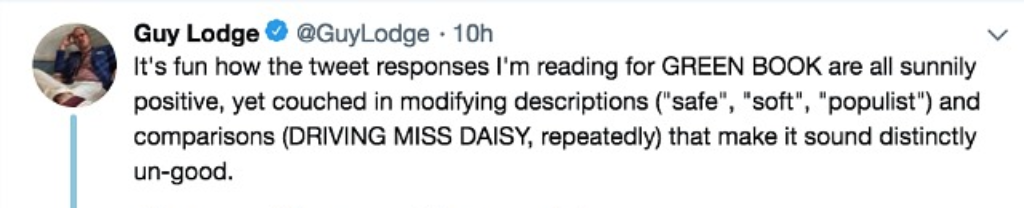
But the Toronto afterglow didn’t last long. One day after the Elgin screening — one day! — I posted a piece called “Fussies & Pissies Mulling Green Book Pushback.” How did I know that the film snobs would be coming for it? Because of a tweet posted by Variety snootmeister Guy Lodge, a living, breathing barometer of elitist critical disdain in our day and age. Sure enough the grenades were soon lobbing in.
Berry and Yang: “But two months later, when [Green Book] started screening in movie theaters across America, black writers saw it as another trite example of the country’s insatiable appetite for white-savior narratives.”
HE response: Over and over last fall I explained that there’s nothing the least bit white savior-ish about Green Book, and that it’s basically a parent-child road dramedy — Mahershala Ali‘s Don Shirley is the strict if constricted father, and Viggo Mortensen‘s “Tony Lip” is the casually brutish adolescent. It’s a spiritual growth and friendship flick. If anyone does any saving it’s Mahershala who saves Viggo from his crude Italian-meathead-from-Queens attitudes. Peter Farrelly‘s film is simply about listening, kindness and compassion. But that’s me.

Did the white-savior thing get thrown at Green Book regardless? Yeah, of course, but those who took potshots in this vein were hardly confined to critics on the urban fringes. It was mostly attacked during award season (and in some cases savagely) by under-40 white wokesters along with know-it-all palefaces who’d been around for decades. Trevor Noah‘s much-discussed Daily Show billboard slogan (“Don’t Green Book This One, Guys!”) wasn’t aimed at critics of color, trust me.
The Green Book haters included Indiewire‘s David Ehrlich, the N.Y. Times‘ A.O. Scott, Variety snootmeister Guy Lodge, London Times‘ Kevin Maher (who actually called it a “botch job”), Claudia Puig (“insensitive”), NPR’s Mark Jenkins, eFilm Critic’s Peter Sobczynski, The New Yorker‘s Richard Brody, Toronto Globe & Mail’s Barry Hertz (“not quite Racism for Dummies, but close”), The Wall Street Journal‘s Joe Morgenstern, Screen International‘s Tim Gierson, etc.
Berry and Yang” “The initial positive buzz [for Green Book] set such a strong tone that its best-picture win at the Academy Awards seemed a foregone conclusion. But that didn’t stop the white filmmakers from going after black reviewers like K. Austin Collins of Vanity Fair who found it problematic.
“’What the makers of this movie are missing is just that many black critics didn’t get to see this movie until it came out‘ during Oscar season, well after early screenings for critics, Mr. Collins said during a panel at the Sundance Film Festival. ‘When black critics do finally get to see this movie, it is seen as disrupting the Oscar campaign. I don’t think any of us really care about that. We care about representation.'”
Obviously critics of merit should be given a chance to see and review the big films at the same time as established hot-shot critics. No one’s arguing against this.
What has my attention are the last four words in the above quote, for they constitute the kind of admission that Tom Wolfe once wrote about in “The Painted Word” when he described the classic “obiter dicta” — words in passing the give the game away.
When people talk about Oscar-season distinctions they’re usually referring to qualities that have touched or impressed a wide swath of viewers by way of theme, metaphor, emotional poignancy or commanding applications of skill and craft — the kind of stuff that moviegoers and Academy members tend to associate with classic keepers.
Correct me if I’m wrong, but Collins seemed to be saying that he and like-minded fellows regard this kind of thing as less than vital or perhaps even peripheral when considered alongside the much important issue of representation, which basically means “rewriting codified racist narratives and in some cases evening the score by way of progressive approaches to casting and story-telling.”
Maybe, but if you ask me that sounds like a rather limited and politically-minded place from which to absorb and assess the wondrous and delicate art of filmmaking. Making great movies and using movies to alter social consciousness can be achieved in the same effort, sure, but can also be understood as separate challenges, no? At least in some instances.
There are more things in heaven and Earth, Horatio, than are dreamt of in your philosophy.
