

Will Fincher’s “Mank” Be Welles Hit Job?

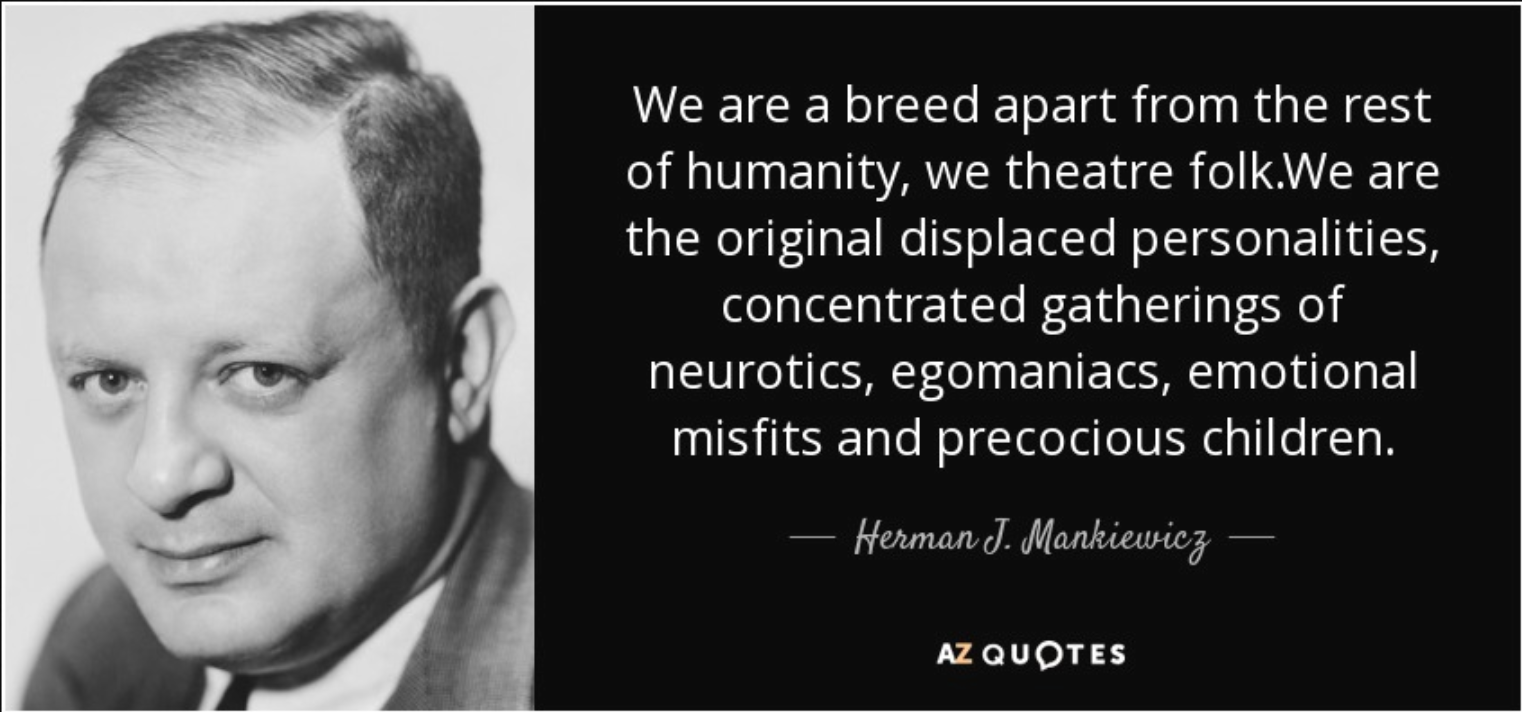
It seems logical, at least from a dramatic standpoint, that David Fincher‘s Mank, a forthcoming Netflix feature about the life and times of Citizen Kane co-screenwriter Herman Mankiewicz, would portray Kane director, producer and star Orson Welles in a less than flattering light.

The whole Welles-vs-Mankiewicz mishegoss has been the subject of fierce debate for nearly 50 years, or since the 1971 publication of Pauline Kael’s disputed essay that claimed Kane was almost entirely written by Mankiewicz. Where’s the drama if the third act isn’t about Welles trying to buy Mankiewicz off or otherwise elbow him aside?
Calling Joseph McBride and other Welles biographers and admirers! To arms! To arms! Pass out the muskets and gunpowder!

I have to be honest and say I’m not all that keen on watching Gary Oldman play Mankiewicz. Oldman is a little too old for one thing (61) — a little too weathered and blinkered. Born in 1897, Mankiewicz worked on Kane when he was a relatively spry 43 and 44, and who enjoyed his main Hollywood heyday during his 30s and 40s. Mank died of drink at age 55, in 1953.

You know who should play Herman Mankiewicz? Bill Hader or somebody in that vein. A clever 40something or nudging-40 type with a twinkle in his eye. Mankiewicz was chubby, yes, but not overly so. A thin guy could pull if off.

Wiki excerpt #1Mank and The Wizard of Oz: “In February 1938, he was assigned as the first of ten screenwriters to work on The Wizard of Oz. Three days after he started writing he handed in a seventeen-page treatment of what was later known as ‘the Kansas sequence’. While Baum devoted less than a thousand words in his book to Kansas, Mankiewicz almost balanced the attention on Kansas to the section about Oz. He felt it was necessary to have the audience relate to Dorothy in a real world before transporting her to a magic one. By the end of the week he had finished writing fifty-six pages of the script and included instructions to film the scenes in Kansas in black and white. His goal, according to film historian Aljean Harmetz, was to “capture in pictures what Baum had captured in words — the grey lifelessness of Kansas contrasted with the visual richness of Oz.” He was not credited for his work on the film.

Wiki excerpt #2: “Mankiewicz was an alcoholic. He once famously reassured his hostess at a formal dinner, after he had vomited on her white tablecloth, not to be concerned because ‘the white wine came up with the fish.’ He died March 5, 1953, of uremic poisoning, at Cedars of Lebanon Hospital in Los Angeles.”
Read more

“Ad Astra” Gut Call

The boilerplate synopsis says that James Gray‘s Ad Astra (Disney, 9.15) is about an astronaut (Brad Pitt‘s Roy McBride) who embarks on a space voyage in search of his long-lost father Clifford (Tommy Lee Jones) “whose experiment threatens the solar system.” Right away I’m thinking “huh?” What kind of an experiment could threaten even a single planet, much less the whole solar system?

Be honest: If Tommy Lee Jones’ “experiment” were to eradicate Jupiter in the same way Alderaan is destroyed by the Death Star, who would care? It’s just a pretentious ball of gas. **

My second thought is that Ad Astra (a Latin phrase meaning “to the stars”) may not sound dumb enough for your lowest-common-denominator filmgoer. Americans tend to regard askance any film with the slightest hint of erudition.

What would happen if Stanley Kubrick had never made 2001: A Space Odyssey 50 years ago, and if Gray had directed the exact same film with Ryan Gosling as Dave Bowman and it was coming out in the fall? What kind of money would it make? I’ll tell you what it would make. It wouldn’t make squat. The ending would piss people off, and the Cinemascore rating would probably be a B or more likely a B-minus. The Rotten Tomatoes and Metacritic scores would be mixed. The word of mouth that happened among stoners in ’68 would never materialize, and even if it did Gray’s 2001 would be kicked out of theatres and put into streaming so fast your head would spin.

All to say that the crowd that flocked to Spider Man: Far From Home is probably going to be a teeny bit suspicious of Ad Astra. This latest TV trailer suggests it might not be half bad (it seems like something I might like except for the Gravity shots and that moment when Tommy Lee Jones makes a scary face), but “if people don’t want to see something you can’t stop ’em.”

Read more

Strangeness of “King of Kings”

A riff about King of Kings from yesterday’s Rip Torn comment thread:

What a strange, compromised in-betweener King of Kings is. Composed according to the rules of a costly, conservative, big-studio Biblical epic (i.e., even the wandering poor wearing studio-finessed wardrobes with perfect hair stylings) but at the same time political-minded and eschewing the usual religious sentiment (except towards the end). It seems to be straining to become something less conventional but without the focus and nerve to really push into that.

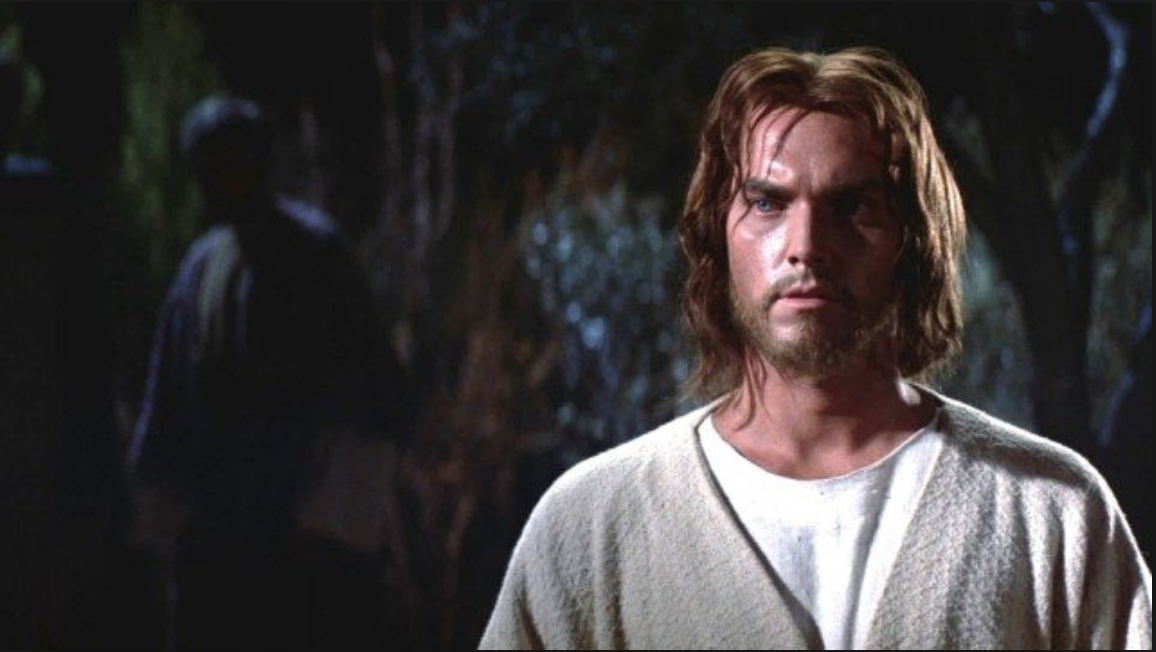
Director Nicholas Ray was quite the muscular auteur in the ‘40s and ‘50s, but he was a director-for-hire here. And yet a faint hint of personality emerged in one respect. Ray seemed to regard Jeffrey Hunter’s Jesus as a vague relation of James Dean’s Jim Stark in Rebel Without A Cause. How else to interpret Hunter’s red shepherd cloak + white undergarment matching Dean’s famous red jacket + white T-shirt outfit? But Ray’s bold power days were behind him. King of Kings was a job — he was pocketing a paycheck. You can almost sense a tone of resignation.

Ray fell apart two years later during the making of 55 Days at Peking (’63). Wiki excerpt: “Ray was a tortured individual at the time of the production of 55 Days at Peking. Paid a very high salary by producer Samuel Bronston to direct 55 Days, Ray had an inkling that taking on the project — a massive epic — would mean the end of him and that he would never direct another film again. Ray’s premonition proved correct when he collapsed on set halfway through shooting. Unable to resume working (the film was finished by Andrew Marton and Guy Green), he never received another directorial assignment.”

Young Rip Torn (29 during filming) gave a thoroughly uncharacteristic performance as Judas Iscariot, solemnly invested in playing a devoted disciple according to the accepted mode of earnest, second-banana acting in 1961. As Barabbas Harry Guardino was in his own spear-and-sandal movie, playing a Che Guevara-like mad man insurrectionist, turning on the Italian machismo spigot and using raw bleating lung power to rail against the Roman oppressors.

The only elements that hold King of Kings together are Miklos Rosza’s reach-for-the-heavens score, Ron Randell’s crisp, disciplined performance as a skeptical but compassionate Roman Centurion, and Hunter’s Nazarene — a performance that doesn’t attempt much in the film’s early stages (underwritten, going through the motions) but gradually takes hold during the second half.

Read more

Panic, Begging, Salvation

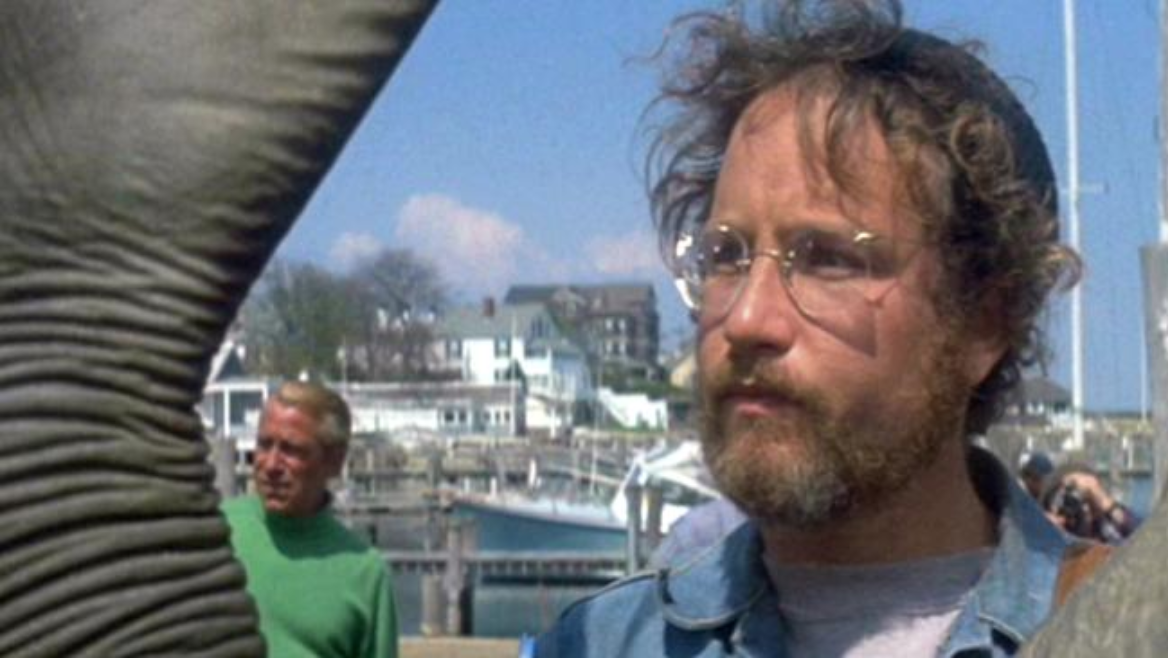
Starting at 5:08: “I can sincerely tell you that I tried to get out of [Jaws]. Because I had done a film in Canada called The Apprenticeship of Duddy Kravitz. And I turned Steven [Spielberg] down. And he said ‘why?’ I said ‘because this is going to be a bitch to shoot, and I’m really lazy.’ And then I saw Duddy Kravitz. For the first time. And I said to myself, ‘If somehow this film is sold in the United States, I will never work again.’ I had to get that [film] behind me.

“So I just did what every normal human would do. I begged for the [Jaws] part. On my knees, And then Steven gave it to me. [To do that Steven] had to deal-break another actor out of the film. I felt like shit. I got the role and did it as well as I could, and that made me ‘a something.’ I wasn’t a star, but I wasn’t not a star.”

Why doesn’t Dreyfuss talk about Stakeout? Or American Graffiti?

What’s Daughter of the Wolf?

Read more

Late to Epstein

In a just-posted Cut piece titled “Could Jeffrey Epstein Avoid Life in Prison?”, Irin Carmon writes the following:

“If all else fails, Epstein’s attorneys could try to get a deal by offering his cooperation or he could plead guilty to a lesser charge. But don’t count on it. ‘In my experience as a prosecutor involved in trafficking cases in the SDNY, that office is not in the practice of giving slap-on-the-wrist deals to sex offenders and will prosecute the case fairly but with appropriate zeal,’ wrote Mimi Rocah in the Daily Beast. In the view of says former SDNY prosecutor and CNN legal analyst Elie Honig, cooperating is [Epstein’s] “best chance to get a lower sentence. But even if he cooperates, he has to be willing to give up everybody and everything that he knows about.” Namely, his famous and powerful friends and possible clients.”

Also from Rocah: “What should we make of reporting that Epstein’s prosecution is being overseen by the Public Corruption Unit of the SDNY? Short answer: It’s too soon to say. It could mean that a public official is being investigated or will be charged with Epstein. That could be a minor public figure or a major one. It could mean that SDNY is investigating misconduct in the plea that Epstein was given in 2008. Or it could mean none of those things.”

One odd thing: In another Cut piece titled “The Décor in Jeffrey Epstein’s NYC Townhouse Is the Stuff of Nightmares,” Hannah Gold lists several curious or bizarre features of Epstein’s NYC mansion on East 71st Street. “The Prison-Guard Mural”. “The Wall of Fame”. “The Heated Sidewalk”. “The Human Chessboard”. “The Doll Chandelier”. But under a section titled “Dramatic Proportions,” Gold notes that the front door of Epstein’s mansion “is an unnecessary 15 feet high.” Huge wooden doorways (or medium-sized doors mounted inside a large wooden frame) are totally common in apartment buildings in Paris and Rome. They’re everywhere.