
Historical Aromas

West Hollywood has several classically designed apartment buildings (old Spanish, brick and stucco, shaded patios with fountains). I’m speaking of the area south of the Strip, north of Fountain and west of Fairfax, and principally on Laurel, Hayvenhurst, La Jolla and Harper Avenues. You can really feel the history and the ghosts, especially if you do a little research beforehand. The Strip was definitely cooler back in the ’20s, ’30s, ’40s and early ’50s. Preston SturgesThe Players, the Garden of Allah apartment complex, etc.

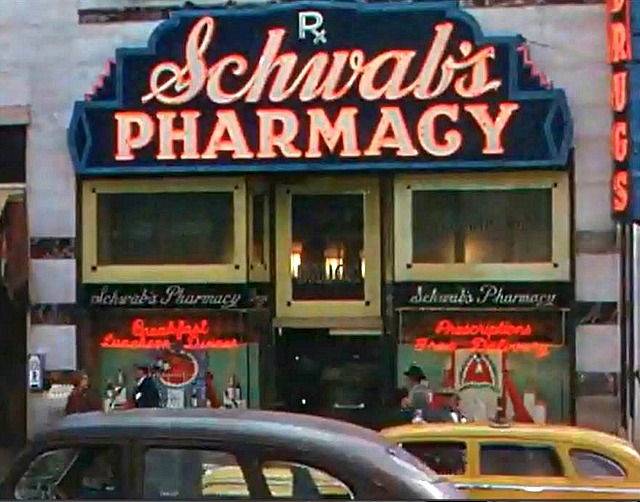
After eating last night at the decent but unremarkable Wokcano (Sunset and Crescent Heights, site of the old Schwab’s Pharmacy), Tatyana and I did a little strolling around. We didn’t do the whole classic-era tour but we hit three buildings.

First was the Villa d’Este, a beautiful Spanish-style apartment complex (arched entrance way, lots of palm trees, centrally located patio fountain) located at 1655 No. Laurel. Then we visited the 90-year-old Villa Primavera courtyard apartments (corner of Harper and Fountain), otherwise known as the In A Lonely Place residence where director Nicholas Ray actually lived. And then across the street to the Romanesque Villas (1301 No. Harper), where Marilyn Monroe lived around the time of The Asphalt Jungle.

The Villa d’Este was the setting of Under The Yum-Yum Tree (’63), a negligible Jack Lemmon horndog comedy. Never seen it, never will. The trailer is very convincing.

Lemmon was the hottest guy in Hollywood after starring in the one-two punch of Some Like It Hot (’59) and The Apartment (’60), both directed and co-written by Billy Wilder. Because the latter mixed ascerbic humor and frankly sexual situations, Lemmon was offered almost nothing but frothy sex comedies for five years following The Apartment. The only decent film he made during this period was Blake EdwardsDays of Wine and Roses(’62).

The sex comedies were The Wackiest Ship in the Army (’60), The Notorious Landlady (’62), Irma la Douce (’63, minor Wilder), Under the Yum Yum Tree (’63), Good Neighbor Sam (’64) and How To Murder Your Wife (’65). He also costarred that year in The Great Race, a period costume comedy about arch humor, empty artifice and scenic splendor.

Lemmon finally broke out of that shallow, synthetic cycle with Wilder’s The Fortune Cookie (’66). Not grade-A Wilder but certainly half-decent, and a great boost for Walter Matthau. And then Luv, The Odd Couple, The April Fools, The Out-of-Towners, Kotch, Avanti! and Save the Tiger. And then he hit another wall with Wilder’s The Front Page.
Read more

“Secrets” Now & Forever

I heartily approved of Gavin Hood‘s Official Secrets (IFC Films, 9.30) when I saw it at last January’s Sundance Film Festival. Four out of five critics had agreed with me (and vice versa) a few days prior to the opening. It’s mildly disappointing to report that after after 10 days in theatres Official Secrets has only earned about $350K. Then again audiences have been conditioned to watch this kind of fare at home for the most part.

Just before leaving for Telluride Hood spoke with me for a few minutes. Here’s the mp3.

Official Secrets is a fact-based whistleblower drama about exposing shifty, lying behavior on the part of the Bush-Cheney administration in the selling and prosecution of the Iraq War. It’s about real-life translator and British intelligence employee Katharine Gun (Keira Knightley) revealing a U.S. plan to intimidate United Nations “swing”countries into voting in favor of the 2003 invasion of Iraq, which of course was founded upon a fiction that Saddam Hussein‘s Iraqi government was in possession of WMDs and represented a terrorist threat.

Secrets is an ace-level piece about pressure, courage and hard political elbows — a grade-A, non-manipulative procedural that tells Gun’s story in brisk, straightforward fashion. It’s exactly the sort of fact-based government & politics drama that I adore.

The performances by Knightley, Matt Smith (as Observer reporter Martin Bright), Matthew Goode (as journalist Peter Beaumont), Rhys Ifans as Ed Vulliamy, Adam Bakri as Yasar Gun, and
Ralph Fiennes as British attorney Ben Emmerson are excellent fits — as good as any fan of this kind of thing could possibly hope for.

Two months ago Gun participated in a sit-down with Hood and the journalists who broke the story of the leaked memo, Martin Bright and Ed Vulliamy, on Democracy Now!:

Read more

“Knives Out” As Trumpian Allegory

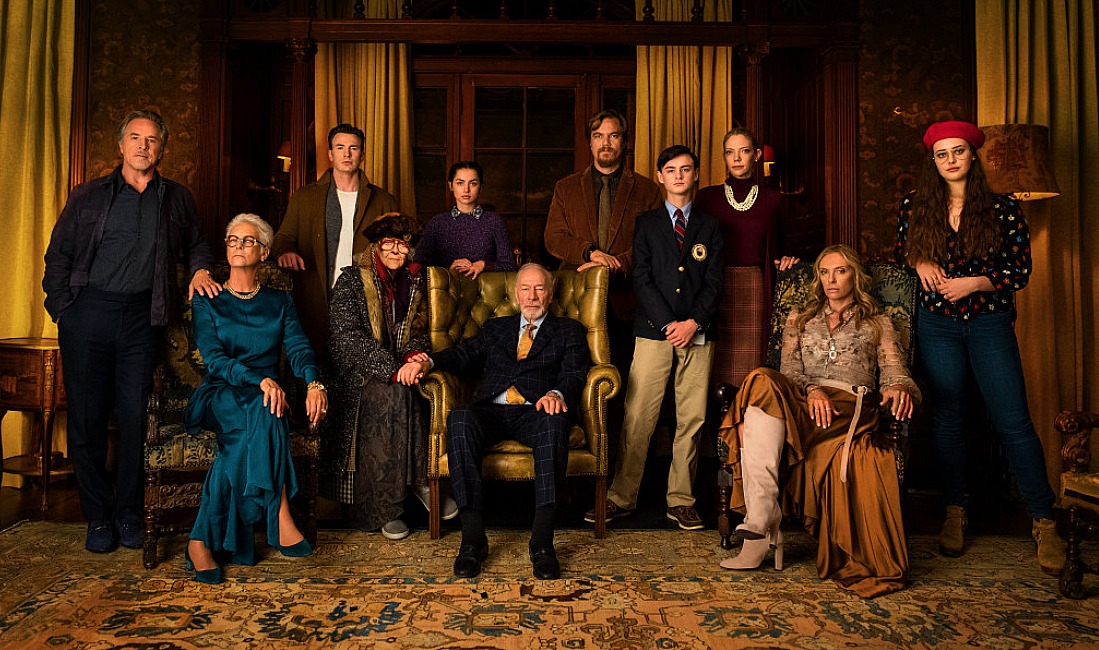
Rian Johnson‘s Knives Out (Lionsgate, 11.27) has been described by Toronto Film Festival critics as a good whodunit chuckle — a wokey reshuffling of an Agatha Christie deck of cards. Respective Rotten Tomatoes and Metacritic ratings of 100% and 85%.

The only slightly tepid review is from Screen Daily‘s Tim Grierson.

Without spilling any beans or speaking out of turn, I was told last summer that Knives Out is actually a Trump-era allegory by way of snooty one-percent entitlement attitudes and a matter of illegal immigration status.

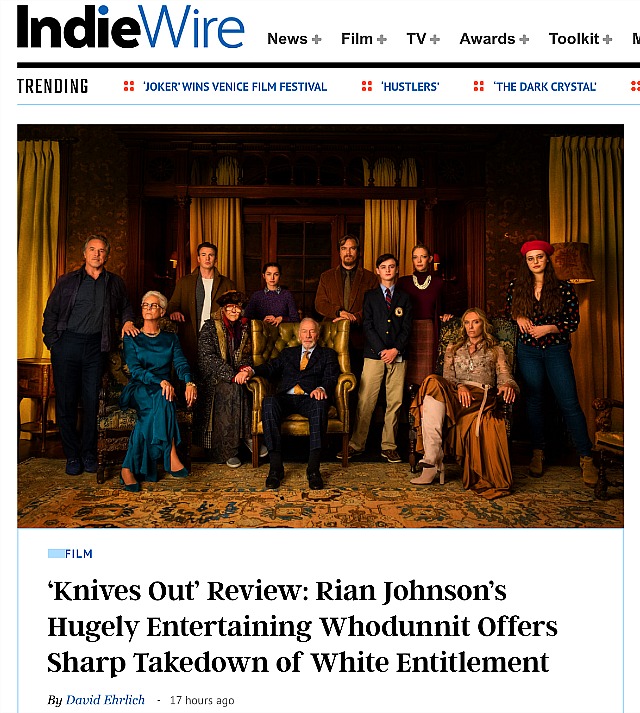
A colleague assures that Knives Out “is 100% a murder mystery, with the added layer of some Trump-era satire.” He found the latter “less effective although it seems to have delighted the folks at Indiewire.”

Many Indiewire Reviews Are Woke-Filtered

The common assessment is that Indiewire‘s Eric Kohn is absolutely top tier — one of the most sage and sophisticated critics out there. He has long been recognized as such. And David Ehrlich is also quite the steady and perceptive fellow, and generally an excellent writer — engaging copy just pours out of the guy. And Kate Erbland is…well, consistent.

But I have to be honest and admit to certain premonitions that kick in before I read almost any Indiewire review, and certainly reviews of films that lay claim to any degree of social realism.

My gut belief is that Indiewire assessments of films are first and foremost about “how woke is this?” and secondly about “how good is this?” I realize that to some HE regulars this may sound like one of the biggest “duhhh” observations I’ve ever posted, but it never hurts to reiterate. On top of which this is Sunday.

Kohn, Ehrlich and Erbland may vigorously dispute this view (I’d be hugely surprised if they didn’t) but I’ve been sensing over and over that Team Indiewire is always asking itself “are the attitudes and perceptions in this film sufficiently enlightened by SJW virtue-signalling standards?”

I believe this mindset is a big part of how they see things. Call me overly cautious or even timid for phrasing this viewpoint as carefully as I have here. To some Indiewire‘s “totally in the woke tank” approach is as obvious as the sky.

I fully admit that this impression could be proven erroneous if someone were to conduct an exhaustive inventory of all their reviews over the last two or three years (and certainly since the advent of the movement that was largely ignited by the historic 10.5.17 N.Y. Times story that brought about the fall of Harvey Weinstein.

I’m just saying that one way or the other I can always feel the presence of a woke measurement stick every time I read a Kohn, Ehrlich and Erbland review.

Should woke sticks be put aside when reviewing a film or anything else? Of course not. Every interesting or pertinent consideration under the sun should be included in any intelligent, fully considered review, column-inches warranting. I just happen to feel that a film’s wokeness (of lack thereof) isn’t the meat of the matter. But it sure seems to be a big deal at the woke-iest movie site on the planet.

If someone were to write a woke reassessment of all significant Hollywood-generated films of the 20th Century and the first 15 years of the 21st Century, would it sell? Maybe or maybe not, but reading such a book would almost certainly give me a headache.

Hanks Owns “Beautiful Day”

2:15 pm Update: Did I imagine that Indiewire‘s Anne Thompson is reported that as far as an awards campaign for A Beautiful Day in the Neighborhood is concerned, Sony intends to push Matthew Rhys in lead and Tom Hanks in supporting? Nope, I didn’t.

Thompson has written that campaigning Rhys as a lead is “fair,” considering that he plays an Esquire writer who profiles Hanks’ Fred Rogers. “The movie is really about him,” Thompson asserts.

Urging Academy and SAG voters to consider Rhys as a leading contender for the Best Actor Oscar might be “fair”, but this doesn’t sound like an especially savvy decision on Sony’s part. Running Hanks in supporting argues with the award-season strategizing that led to Anthony Hopkins‘ Hannibal Lecter performance in The Silence of the Lambs being nominated for and winning the Best Actor Oscar.

Hollywood Reporter critic Todd McCarthy is claiming that A Beautiful Day in the Neighborhood is “ultimately Hanks’ show, and Hanks’ show alone.”

Some weeks ago there was some discussion about whether or not Hanks’ Beautiful Day performance would qualify as a lead, as he has less screen time than Rhys’ “Lloyd Vogel” character, an Esquire journalist (based on Tom Junod) who interviews Hanks’ Fred Rogers.

Jordan Ruimy said this morning that Rhys “is in practically every scene and Hanks isn’t, but Rhys’ story is the weak part…the movie lags whenever Hanks isn’t on-screen.”

HE response: Based on these and other impressions, Hanks is apparently Anthony Hopkins in Silence of the Lambs — a performance that sinks in and dominates by sheer force of personality. Alongside this the measure of screen time is nothing.

If Sony is determined to pursue the strategy that Thompson has reported on, Hanks will stand a half-decent chance of losing to Once Upon A Time in Hollywood‘s Brad Pitt in Supporting. (OUATIH is, of course, also a Sony film.) And the allegedly mopey Rhys probably won’t be nominated for Best Actor at all.

If Sony reverses strategy and runs Hanks as Best Actor candidate as la Hopkins in Silence, he could win. Yes, he would be facing tough competition from Joaquin Pheonix‘s Joker performance, but he would almost certainly be supported by the Academy voters who gave the Best Picture Oscar to Green Book.

THR‘s McCarthy: There’s no question that Hanks is perfect in the part, as the actor’s amiability and unquestionable sincerity make for an ideal match with [Rogers]’ unique television personality. [But] Marielle Heller’s film is a more modest achievement, sympathetic and yet entirely predictable in its dramatic trajectory of making a believer of an angry, cynical journalist.”

Read more

On One Level It’s Laughable…”

Absurdism: (1) Intentionally ridiculous or bizarre behavior or character…”the absurdism of the Dada movement”; (2) “The belief that human beings exist in a purposeless, chaotic universe.”

“This is an embarassment for our country, and we see a new embarassment every day…literally pathetic, and that’s not how I want to feel about a President, whether from my party or from the other one. Putting up a wall is a 17th Century solution…it shows you how upside down and antique the President’s priorities really are.”

Read more