Best Bruhs

In yesterday’s Paths of Glory thread (“And Today’s Verdict Is…?“), LexG claimed that my recent assertion about Quentin Tarantino‘s Once Upon A Time in Hollywood being based on the 1969 situations of Burt Reynolds and redneck movie director Hal Needham is a “Wells loony tune” riff. LexG allegedly knows this town pretty well, and yet he says “where did this gem come from?”

I’ll tell him where it came from — (a) common knowledge and (b) Reynolds and Needham‘s Wiki pages.

Tarantino will probably tap-dance or shilly-shally when some junket journalist asks him this point blank, but it all fits together. It’s right there on the page. The 1969 career situations of DiCaprio’s “Rick Dalton” (struggling, pushing-40 TV actor) and Pitt’s “Cliff Booth” (Dalton’s same-aged stuntman-buddy who shares his home) mirror Reynolds-Needham. Fucking obvious. Okay, with a little Clint Eastwood thrown in.
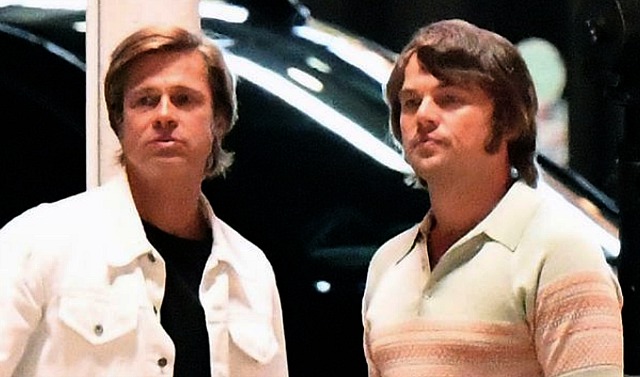

Cliff Booth, Rick Dalton in Once Upon A Time in Hollywood.
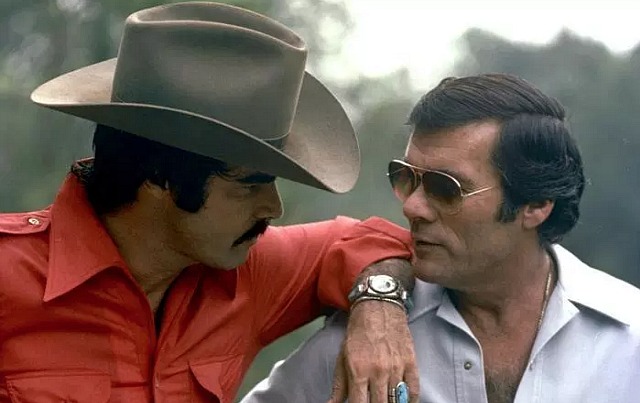
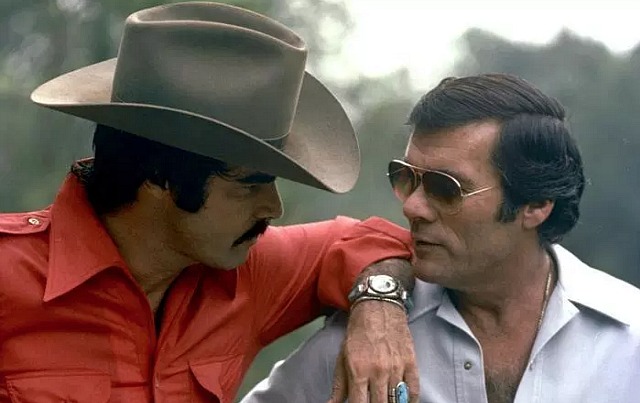
Burt Reynolds, Hal Needham during filming of Smokey and the Bandit.

In ’69 Reynolds, who had been acting on TV since the late ’50s (when he was in his early 20s), was a steadily working but diminished “known quantity” who was more or less poking along with B-level features like Sam Whiskey and 100 Rifles and short-lived TV series like Hawk and Dan August.

Reynolds had been trying and trying but was unable, during the first year of the Nixon administration when he was 33 years old, to break through into the bucks-up realm of A-level features.

And then, after 15 years in the business (when he was 20 or 21 he was told he couldn’t play a supporting role in Sayonara because he looked too much like Marlon Brando), Reynolds finally made it over the hump and became BURT REYNOLDS.

He accomplished this with the one-two-three punch of (a) his breakthrough lead role (studly survivalist Lewis with the bow-and-arrow) in John Boorman‘s Deliverance (’72), (b) that Cosmopolitan centerfold and (c) becoming a talk-show star with his amusing, self-deprecating patter in chats with Johnny Carson, Merv Griffin and David Frost.

In the space of a few months Reynolds was no longer Mr. Semi-Obscuro but suddenly the cool guy whom everyone liked and admired.

Reynolds Wiki excerpt: “Deliverance director John Boorman cast Reynolds on the basis of a talk-show appearance. ‘It’s the first time I haven’t had a script with Paul Newman‘s and Robert Redford‘s fingerprints all over it,’ Reynolds joked. ‘The producers actually came to me first.’

“‘I’ve waited 15 years to do a really good movie,’ Reynolds said in 1972. ‘I made so many bad pictures. I was never able to turn anyone down. The greatest curse in Hollywood is to be a well-known unknown.'”

Read more

Three Decades On

For me, Tim Burton‘s Batman gradually became a parent punisher. I used laser discs to distract the boys in their toddler years, and they wanted to watch this 1989 film over and over and over. I gradually became so sick of the dialogue; every line that Pat Hingle said drove me up the wall. I’ll probably never see it again. Favorite sequence: When Jack Nicholson‘s Joker tells his goons to leave a Francis Bacon painting unharmed. Least favorite sequence: The bat-costumed Michael Keaton swan-diving off a super-tall skyscraper and not dying because…I forget. Because his leather cape slowed him down or some kind of stupid micro-thin cable attached to his belt…I don’t want to remember.

And Today’s Verdict Is…?

For tough-minded critics, the pared-to-the-bone perfection of Stanley Kubrick‘s Paths of Glory falls apart during this final scene, which lasts just under four minutes. To them it’s a forced finale — an attempt to abruptly squeeze emotion out of a deeply cruel situation that Kubrick has portrayed in a cool, realistic, matter-of-fact manner from the start. And then, out of the blue, a roomful of coarse, rowdy soldiers, showing their own kind of cruelty to poor Christiane Kubrick, is gradually reduced to silence and then tears in the space of 100 seconds.

In short, critics have said, the first 84 minutes constitute one thing, and the final four are something else.

In my view the scene is saved by the unknown actors (who may have been extras for all I know but nonetheless hit the notes) and the expert editing, which allows the sadness to leak out just so.

How would Paths of Glory play today, if a fact-based World War I film was to somehow get made and distributed theatrically? One, making it would be awfully difficult — too much trouble and expense for too little return. Two, it would never open theatrically — a film of this sort would never have a chance with the downmarket megaplexers, but would probably find a berth with Netflix or Amazon. Three, the film festival circuit would appreciate it but the p.c. fraternity would probably give it a mixed response, partly for the ending and partly because it’s too white (no French solders of color) and too straight (no LGBTQ characters).

Lack of Moral Fibre

Billy Dee Williams at Episode IX panel: “I’m sick and tired of people saying I betrayed Han. Did anybody die? I was going up against Darth Vader. I had to figure something out.” HE reply #1: Lando could have whispered to Han and Leia as they arrived that Vader and his goons were already encamped and ready to pounce. HE reply #2: No, nobody “died” but Lando’s complicity resulted in Han being (a) severely tortured and (b) frozen in carbon.

Not So Fast on Omar Statement

Last night Donald Trump was fanning the usual anti-Islamic hate flames by attacking Rep. Ilhan Omar for referring to the 9/11 attacks last month as “some people did something.” Righties have glommed onto these four words as an indication of a blithe disregard about a truly horrific slaughter, but lefties haven’t helped the situation by focusing only on conservative Islamophobia while ignoring the import of Omar’s words.

Which was worse — Trump declaring on 9.11 that 40 Wall Street was “now the tallest” building in Manhattan after the collapse of the Twin Towers, or what Omar said?

But in all honesty, what would the reaction be if any official or politician was to refer to the 9/11 attacks as “something” that “some people did”? The Left is aggravating the situation by ignoring the fact that Omar did attempt to minimize the 9/11 tragedy. A Somali-American, Omar was obviously indicating an unwillingness to strongly condemn the perpetrators, whom (be honest) she probably feels a slight kinship with on some vague cultural level.

Imagine the reaction if Barack Obama or Hillary Clinton had described the 2012 Sandy Hook massacre as “a local disturbance.” What would the gay community have said if a Florida politician had described the 2016 Orlando massacre as “an unfortunate incident involving a nightclub crowd”? Imagine if Franklin D. Roosevelt had announced to a joint session of Congress that Japanese bombers had “stirred things up” with the 12.7.41 attack on Pearl Harbor.

Omar could have made this whole thing go away by apologizing for a poor choice of words, and expressing profound sorrow about the slaughter of nearly 3000 New Yorkers that day.

Read more

The Night Pasolini Died

Posted on 10.3.14: Abel Ferrara‘s Pasolini, screening this evening at the New York Film Festival, is about the last day or so in the life of the noted visionary Italian filmmaker — a brilliant writer and impassioned artist, upscale and refined, incredibly hard-working, the maker of one of the most rancid and perverse films of all time…and a guy with a thing for low-class, curly-haired boys. And an inclination on some level to flirt with danger.

Ferrara is obviously in awe of Pasolini’s artistic bravery (or obstinacy) and has captured some of his visions and dreams by depicting portions of Pasolini’s “Petrolio,” a meandering unfinished book he was writing, and has depicted his violent death with a certain raw power but…how to best say this?…I was faintly bored by some of it. Not dead bored — it’s an intelligent, earnestly presented film about an interesting man — but my fingers were tapping on the tabletop. Too many shots are murky or underlit…not Gordon Willis dark but “you can’t see shit” dark.

I actually loved Ferrara’s capturing of three scenes from Porno-Teo-Kolossal, a film Pasolini intended to make as a follow-up to Salo, The 120 Days of Sodom. And Willem Dafoe‘s performance as Pasolini is arresting — he obviously looks the part, and for whatever reason I didn’t mind that Dafoe and almost everyone else speaks English the entire time. And I love the way he pronounces “bourgeoisie” as “BOOJHwahzEE.”

But it’s finally a mercurial film aimed at Pasolini devotees. I agree with Variety‘s Peter Debruge that “it’s not fair to require audiences to know Pasolini’s ‘Petrolio'” — if you haven’t done your homework some portions of Ferrara’s film will throw you blind. But it’s lively and unfamiliar and anything but sedate. It’s not so bad to be faintly bored; it also means that you’re somewhat engaged. I’m glad that I saw it. It has portions that work. My vistas have been somewhat broadened.

Not A Rumor

Yesterday I found a yellow, dog-eared copy of the November 1979 issue of The Thousand Eyes Cinema Guide. Only three or four issues were published before the wily and colorful Sid Geffen, publisher of this TV Guide-like publication and operator of the then-thriving Bleecker Street and Carnegie Hall Cinemas, pulled the plug.

I served as the tireless managing editor and even, for a brief while, as the advertising guy. It was a great publishing experience while it lasted, but also grueling as hell because all 60 pages had to be written, edited, re-edited, copy-corrected, pasted and re-pasted by hand. With adhesive and Exacto knives. It took two or three days, two all-nighters and 85 cups of shitty coffee to finish the job at a composition-and-print house north of the city.

Yep, there really were 21 repertory cinemas (or venues) operating in Manhattan at the time. And yes, there was a certain musty romance to the analog, 27″ x 41″ display poster, reel-changing celluloid movie world of 1979. But for lovers of classic. indie, foreign or weird cinema, things are much better today in so many respects. Choices, image quality, ease of access…everything.

Read more

Career Hibernation Kings

Over the years many actors and performers have ducked out of sight for a year or two (Robert Downey, Jr., Dave Chappelle, Winona Ryder, Eminem, Britney Spears), but as far as I can recall only three big-time movie stars absented the screen for several yearsHenry Fonda, who vacated after 1949’s Jigsaw and didn’t re-appear until 1955’s Mister Roberts, Dustin Hoffman (Tootsie to Ishtar) and Al Pacino, who disappeared between Revolution (’85) and Sea of Love (’89).

Who am I forgetting? Contenders don’t measure up to Fonda, Hoffman and Pacino unless they were a big star when they dropped out, and they had to stay away from movies at least three or four years.

Warren Beatty doesn’t count. His post-Reds career has mostly been about not pulling the trigger.

Pacino was technically vapor for three and three-quarter years with Revolution opening in December ’85 and Sea of Love debuting in September ’89, but you might as well call it four. The legend is that the moody and whimsical New Yorker was lost and depressed, or maybe he was just charging his batteries. But however you slice it Pacino was a movie ghost all through ’86, ’87, ’88 and most of ’89.

But once he finally returned, Pacino made history with the best decade of his career and indeed his life. Nine grandslam performances in ten years — Dick Tracy (Big Boy Caprice), Glengarry Glen Ross (Ricky Roma), Scent of a Woman (Colonel Frank Slade), Carlito’s Way (Carlito Brigante), Heat (Lt. Vincent Hanna), Donnie Brasco (Lefty), The Devil’s Advocate (John Milton/Satan), The Insider (Lowell Bergman) and Any Given Sunday (Tony D’Amato).

[Thanks to RobertKid Notorious” for nudging me about Hoffman.]

It Happened in Bedford

A digital 4K restored version of Lawrence of Arabia played last weekend at the Bedford Playhouse. It was only the second time that this super-luscious, extra-detailed version (sourced from Grover Crisp‘s 8K scan) had been shown to an east coast audience — the first time was six years ago under the aegis of the Film Society of Lincoln Center. Original Lawrence restorer Robert Harris, who introduced the Bedford screening, told me this morning it’s the finest looking version he’s ever seen, including any and all 70mm presentations.

The Bedford Playhouse has a 37-foot wide screen. Sony delivered the film on two DCPs. If only I’d had the time and scratch to fly back and attend. I’m told that the 4K version has screened out here, but I’ve never heard of any such showings.

You can stream the 4K Lawrence via Amazon, of course, but as good as it looks you’re not really getting the full whack. 4K streaming delivers something like 2.6K, depending on the breaks — only physical media can deliver the full visual boatload. High-end connoisseurs have been pleading for a 4K Lawrence Bluray for years, but the market for 4K Blurays is flat, limited and possibly sinking, as we all know. Believe or not, 45% of physical media enthusiasts STILL watch films on DVD.

Last year a European audio-reference site, avcesar.com, reports that Sony will deliver a 4K Lawrence disc sometime this year**. Here’s hoping.

** The site also reports that Warner Home Entertainment will deliver 4k Blurays of Heat and Wyler’s Ben-Hur in 2019.

Read more

Live In Her Hell

With Alex Ross Perry‘s Her Smell opening this weekend, a repost of my 9.17.18 N.Y. Film festival review:

Her Smell is an audience-test movie — a kind of experiment to see how much in the way of undisciplined, pull-out-the-stops abuse viewers are willing to sit through.

“The tools of this abuse are wielded by Perry and star Elizabeth Moss, who gets to snarl and smile demonically and be all manic-crazy obnoxious as Becky Something, an edgy, drug-fueled grunge rocker (pic is set in the ’90s) who wears too much eye makeup and suggestively flicks her tongue and could stand to lose a few pounds. Five minutes with crazy Becky and you’re immediately plotting your escape. She’s Medusa-woman, lemme outta here, can’t do this…aagghh!

“Escaping wasn’t an actual option, of course, as I sitting in a New York Film Festival press screening at the Walter Reade theatre, surrounded by dozens of critics. If I’d bolted I would have never heard the end of it so I stuck it out like a man, but good God almighty.

“There’s one tolerable moment in the last third. I’m reluctant to use the term ‘third act’ as there’s no story in Her Smell, much less anything resembling story tension, although there are five chapters or sections, each announced by snippets of 1.37:1 footage. The moment I’m speaking of shows a sober Becky sitting down at the piano and gently singing Bryan Adam‘s ‘Heaven’ to her toddler daughter. Hollywood Elsewhere is very grateful to Perry for at least offering this small slice of comfort pie. Peons like myself (i.e., viewers who are unable to enjoy a film teeming with jabbering, wall-to-wall, motor-mouthed anxiety) need this kind of thing from time to time.

“85% to 90% of Her Smell is about enduring Becky’s rash, needling, abrasive behavior toward her bandmates (Agyness Deyn, Gayle Rankin), a trio of up-and-coming Seattle chick musicians (Cara Delevigne, Dylan Gelula, Ashley Benson), her ex-husband (dull-as-dishwater Dan Stevens), the record-label owner (Eric Stoltz, 56 during filming and eyeballing the big six-oh) and some kind of manager-agent character (Virginia Madsen, who was born only 20 days before Stoltz). They all regard Becky with the same expression, a non-verbal channelling of “oh, God…she’s gone over the edge…what can be done?” and so on.

“To sum up, Her Smell is Perry punishment. And an indulgent, highly undisciplined, 135-minute exercise in flamboyant behavior-acting for Moss. I will never, ever see it again.”

Remembrance of Things Past

Random thoughts: (a) What is that, Wadi Rum again?; (b) Here we go again…more money, more legend-spinning, more earnest expressions; (b) I don’t get the leaping backwards into an oncoming bad-guy star fighter; (c) How come Oscar Isaac has no close-up?; (d) Nobody hates C3PO more than myself; (e) when, if ever, will Hollywood Elsewhere embark on a Lawrence of Arabia camel trip that will include camping in Wadi Rum for a couple of days?

HE to J.J. Abrams and Rian Johnson: Luke Skywalker lives within the realm of The Force, but is otherwise dead. Rey is the inheritor but not his daughter or any immediate blood relation. (Or did I miss something?) There are no other Skywalker descendants, no Skywalker army, no Skywalker cult or tribe.

So what the hell does “The Rise of Skywalker” mean?

If it means Kylo Ren (grandson on Darth Vader) is going to turn from the Dark Side and became a last-minute hero…I really don’t care. I feel zero investment in the guy, and could never understand why he wore that Vader mask in the first place.

One implication is that Luke will return from the dead like Lazarus or Jesus but c’mon…is there any end to this? When Obi-wan died, he stayed a spirit and didn’t “rise.” Is there any such thing as any super-character in any CG-driven tentpole fantasy EVER ACTUALLY DYING? (Han Solo doesn’t count — he’s mortal.) Storytellers have to respect for what each and every living thing (human, animal, vegetable) has confronted and come to respect as natural and immutable, which is that when death comes calling and the curtain comes down, THAT’S IT. But the infantilizing of the fantasy realm by the Sons of Lucas (the original infantilizer along with Spielberg) constantly defaults to “NO, HE/SHE ISN’T DEAD…HE/SHE LIVES AGAIN!”

If Luke is indeed toast and staying that way, then I take the last paragraph back. But if it he’s toast, what does “The Rise of Skywalker” mean?

To go by the trailer, an alternate title could be “The Rise of Carrie Fisher.”

Never Seen Monochrome Nitrate Print Before

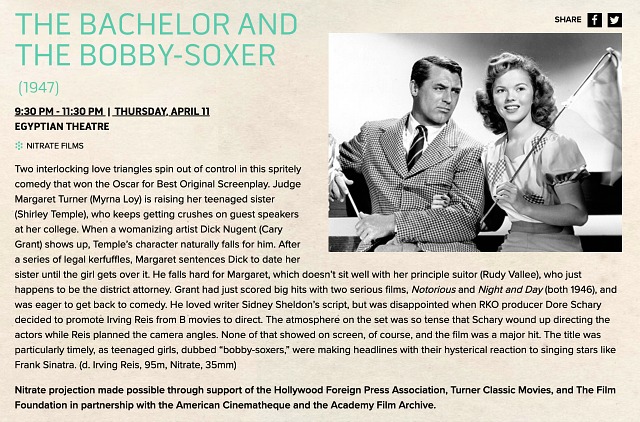
It’s not the movie but the nitrate thang. I just want to be able to say that once, just once, I watched a first-rate projection of a black-and-white nitrate print. TCM Classic Film Festival copy: “Nitrate projection made possible through support of the Hollywood Foreign Press Association, Turner Classic Movies and The Film Foundation in partnership with the American Cinematheque and the Academy Film Archive.”

After the show: Very handsome print with nice detail and texture, but the film looks better — sharper, a bit brighter, a bit more gleaming — when streamed at 1080p on 65” 4K monitor. Sorry but it does.