Sting and Walter Winchell

1. For years I thought that Ira Levin made up the line “nothing recedes like success.” I first heard it in the summer of ’78 when I went to see John Wood in Levin’s Deathtrap on Broadway. A N.Y. Times guy, Richard Eder, was also impressed. In a 2.27.78 article called “Stage: Opening Of Deathtrap; Five-Member Cast‎”, he wrote that “there are some amusing lines, particularly at the beginning. Lamenting his dead-end career after an initial hit, Mr. Wood reflects: ‘Nothing recedes like success.'”

But in an 11.24.12 posting, Barry Popik writes the following:

“’Nothing succeeds like success‘ is a French proverb from the 19th century. ‘Nothing recedes like success‘ — that is, nothing goes away faster than success — is a jocular variation that has been cited in print in 1904 and 1905 and was possibly coined by the New York City humor magazine Life.

“Newspaper columnist Walter Winchell (1897-1972) has been credited with the saying; he wrote it in 1931, but the saying existed before Winchell became a columnist.

The Post-Standard (Syracuse, NY), pg. 4, col. 4 (8 July 1905): ‘Nothing recedes like success.'”

2. For years I’ve been convinced that the worst lyric that Sting ever wrote was “Hey there, Mr. Brontosaurus / don’t you have a lesson for us?” Which is from “Walking In Your Footsteps” off the Synchronicity album. Then I double-checked and realized that the line is actually “Hey, mighty Brontosaurus / don’t you have a lesson for us?” Which isn’t quite as bad. No “there”, adding the “mighty.”

Thelma Schoonmaker, Doubt and Anxiety

In a 2.8 interview with Yahoo Movies UK contributor Sam Ashurst, Oscar-winning editor Thelma Schoonmaker, known primarily for her decades-long association with Martin Scorsese, offered two stand-out remarks about Scorsese’s The Irishman. One confused me; the other led to vague despair.

I’m not talking about Schoonmaker discussing the strategy of de-aging the actors (Robert DeNiro, Al Pacino, Joe Pesci), which has been known for some time.

“We’re youthifying the actors in the first half of the movie,” she said. “And then the second half of the movie they play their own age. We’ve only been able to screen for very few people, [but] nobody minds watching them play young, because they’re gripped. The characters are so strong, it doesn’t matter — it’s really funny. [But] I don’t know what it’s going to be like when we get it all — that’s the risk.”

What confused me was Schoonmaker saying that Scorsese’s The Irishman is “episodic” but not “narrative.”

Schoonmaker: “It’s a different kind of movie — it’s episodic, it’s not narrative. When you do a narrative film, you’re always saying, ‘Oh well, you know, we could slim that down, we could move the shot, maybe we should integrate that, maybe we should flashback with that.’ That’s not the way this movie is. It’s very different. You will see. It’s extremely different and it really works, which is very exciting.”

Could it be “episodic” in the vein of The Godfather, Part II? That 1974 film didn’t use anyone’s idea of a conventional narrative either as it kept hopping back and forth between the late ’50s and the late teens and early ’20s.

Thelma seems to be sidestepping an observation I’ve recently read, which is that The Irishman is an old man’s film….an “end of the road” movie about looking back with melancholy and reflecting on mistakes and lost opportunities.

The Schoonmaker quote that upset me: “The Irishman is not Goodfellas. And that’s what they think it’s going to be. It’s not. It is not Goodfellas. It’s completely different. It’s wonderful. They’re going to love it. But please don’t think it’s gonna be Goodfellas, because it isn’t.”

When Thelma says “not Goodfellas“, she presumably means an absence of the usual boppituh-beep. Nefarious wise guys committing crimes and wearing over-emphatic clothing and betraying their wives and each other and storing mink coats in the freezer and whacking each other in the back seats of cars…right?

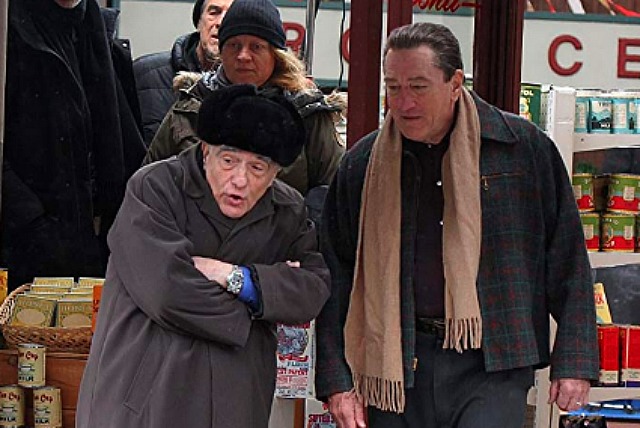
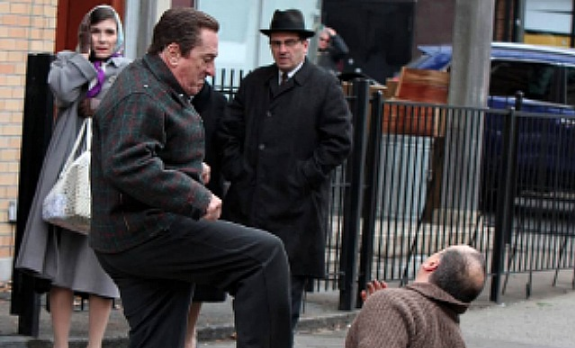
But how in the name of St. Christopher could Scorsese make a movie about the guy who killed Jimmy Hoffa (De Niro’s Frank “The Irishman” Sheeran) and which is wall-to-wall with Italian mob characters whose names end in vowels (Russell Bufalino, Felix “Skinny Razor” DiTullio, Joe “Crazy Joe” Gallo, Bill Bufalino, Angelo Bruno, Tony Provenzano, Anthony Salerno)…how could a movie like this not resemble Goodfellas? I’ve seen set photos of a dark-haired DeNiro pistol-whipping and kicking the shit out of guys so Thelma is obviously avoiding certain aspects.

So what does she mean, that it’s not going to have that familiar Scorsese goombah gangster flavor? No baked ziti, no sliced garlic, no Italian sausage, no girlfriends or wives with borough accents, quirky personalities and too much eye makeup?

Son of Chateau “White Pants” Incident

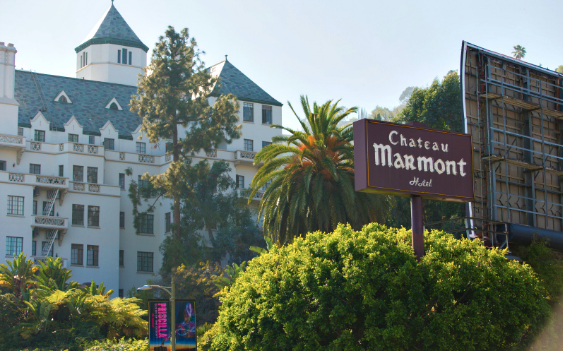
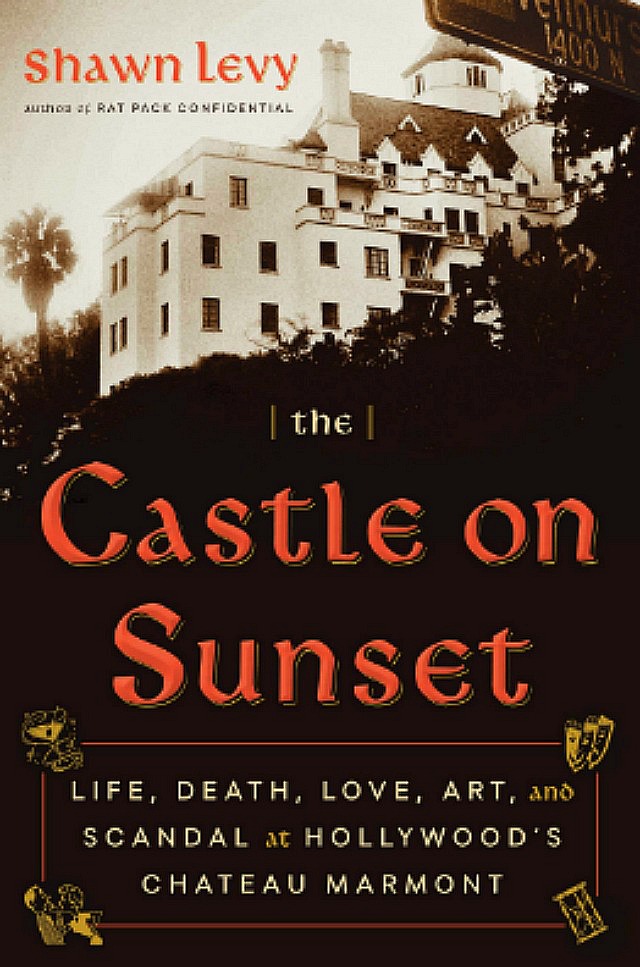
Shawn Levy‘s “The Castle on Sunset: Life, Death, Love, Art, and Scandal at Hollywood’s Chateau Marmont” won’t be out until early May. But it can’t hurt to remind everyone of the contrast between today’s Chateau and the the way things were during a low-rider period in the ’70s.

The storied hotel has 63 rooms and suites that run from from $575 to $3,000 per night. (It began as an apartment building in 1929, but became a hotel in ’31.) But as recently as the mid-’70s, it was possible to get a single room at the Chateau for $12 per night (about $55 today) and a suite for a little more than twice that.

And those were the published rates. Many of the longtime residents negotiated far better prices. After buying the place in ’75, Ray Sarlot was stunned to learn that he had a fully-booked hotel that was actually losing money.

Anecdote #2: During World War II, the hotel was bought by a German banker named Edwin Brettauer who had helped finance a number of classic films back home, including M and The Testament of Dr. Mabuse. In Hollywood, in addition to real estate deals, he funded several films by Douglas Sirk and Fritz Lang (including Hangmen Also Die!).

During Brettauer’s reign, which lasted until 1963, he built the hotel swimming pool and the modern bungalows on the northeast corner of the hotel grounds and, more impressively, he integrated the place. At his insistance, the Chateau Marmont became the first Hollywood / Beverly Hills showbiz hotel to host black guests.

The first time the hotel was ever mentioned in the N.Y. Times was when Sidney Poitier was forced to stay there while making A Raisin in the Sun because nobody in Beverly Hills would rent a home to a black family, even if the paterfamilias was a movie star.”

Those were the Chateau’s proud days. It was a pretty great place also in the ’90s and aughts. Then, of course, managing director Philip Pavel left to run the NoMad hotel in downtown Los Angeles. And then some people with snooty, dicky attitudes took over, and eventually this policy collided with Hollywood Elsewhere in late July of 2017.

Read more

Choices, Dick Pics

“The larger question is, have dick pics ever worked? I mean, Jeff…I know you’re rich but there’s something you should know. There is something in your pants that makes women want to fuck you. Your wallet.”

Read more

Festivals Switching Order

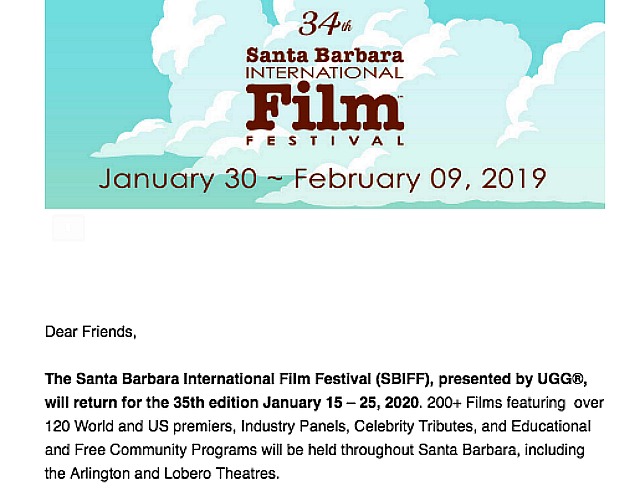
The Santa Barbara Int’l Film Festival has announced that next year’s event will run from 1.15.20 to 1.25.20. This is unusual as the SBIFF has almost always spanned from late January into early February, in part to avoid overlapping with the Sundance Film Festival. Generally speaking the SBIFF usually begins as Sundance is coming to a close, although once or twice it’s begun a few days or a week later.

Therefore the new 2020 SBIFF dates (1.15 thru 1.25) startled me. I did some checking and discovered that a Sundance Institute applications page contains the following sentence: “The dates for the 2020 Sundance Festival are January 23 – February 2, 2020.”

Therefore the 2020 Santa Barbara Film Festival will, for the first time ever, precede a Sundance Film Festival. The last portion of SBIFF ’20 will actually overlap the first days of Sundance ’20, which means that as far as go-getter journalistic coverage is concerned the celebrity tributes will want to wrap by Tuesday night, 1.21, to allow journos to leave for Park City on Wednesday, 1.22.20.

The earlier SBIFF is an adjustment to the fact that the 2020 Oscar telecast will happen on Sunday, 2.9. The 2019 Oscar show will happen on 2.24, or two weeks later than the 2020 show (and two weeks from this weekend).

For years and years the pattern has been to endure the hard-charging Sundance festival in 25-degree temperatures and snowstorms and whatnot, and then hit the gentle, warmer climes of Santa Barbara and coverage that is always less stressful. But in 2020, it’ll be Santa Barbara first and then Sundance.

Read more

Not The ’70s Racism But The Waning Enthusiasm

They call him Liam “Smaller Paycheck” Neeson, and here’s why: “Lionsgate’s Cold Pursuit isn’t running cold at the box office because of the headlines from Liam Neeson’s reported racist statements; it’s doing $10.3M because he’s made way too many man-with-the-gun movies. Even though this one is supposed to have a Fargo tone, it looks like another man-with-the-gun movie…in the snow…with a snowplow.

“Neeson is in Nicolas Cage land now — in fact, he’s been here for quite a while — where all of these pics have run their course stateside, and are financially structured for overseas audiences” — i.e., Asian, Indian and Middle-Eastern sophisticates.

Cold Pursuit‘s opening weekend is lower than last year’s The Commuter ($13.7M, which only did a 2.6x multiple stateside for $36.3M, but made close to $120M worldwide off a $40M production cost). Both pics come to Lionsgate via a StudioCanal release deal. Lionsgate didn’t shell out an MG, they just spent mid-teens for the P&A, and in regards to their books at the end of the day, they expect to break even, if not a bit better.” — 7:21 am box-office update from Deadline‘s Anthony D’Alessandro.

Well Done

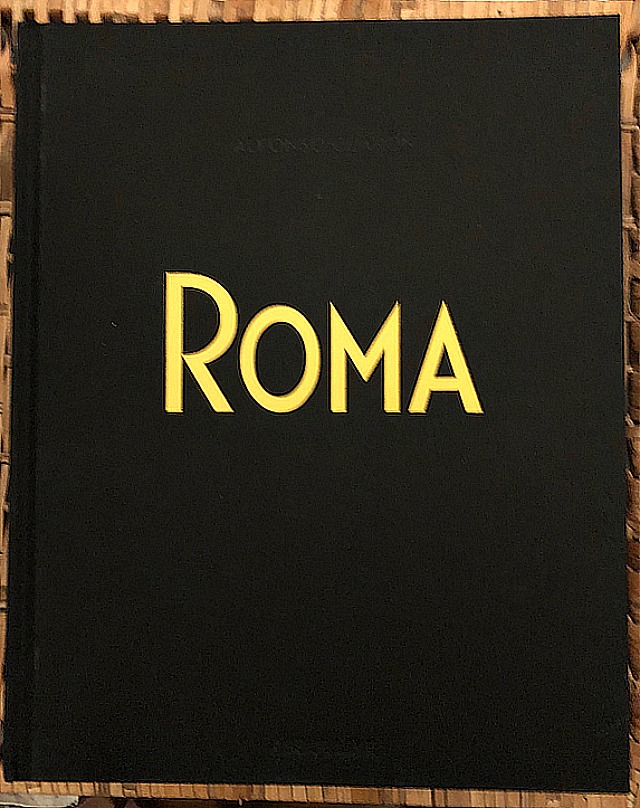
Earlier today I was flipping through an elegant, rather pricey ($175) coffee-table book on Alfonso Cuaron‘s Roma. Obviously an award-season deal but a class act. Published by Assouline, 172 pages, 165 illustrations, a Cuaron essay, etc. I gradually came upon an acknowledgment at the very end, which is that HE’s own Roger Durling (exec director of the just-concluded Santa Barbara Film Festival) co-handled the design and editorial duties with Claudia Lizale. Roger is quite modest, but I gather he was more or less in charge. Flew down to Mexico City to see Roma last July, etc. He and Lizale began the work not long after. An excellent job, one of the very best, Taschen-level.

Finney in New Orleans

Earlier today a New Orleans-based friend of a friend wrote a tribute to Albert Finney on his Facebook page.  About the time he worked alongside Finney on the set of Miller’s Crossing, which shot in the Nyawlins area:

“Finney’s role of Leo in Miller’s Crossing was originally written for Trey Wilson, who played Nathan Arizona in Raising Arizona. Trey died days before shooting. Finney stepped in on a few days notice and was incredible in the role.

“Finney went right to the production office when he got to town and announced loudly to all, ‘My name is Albert Finney but you can call me whatever the hell you want!’ He then kissed all the women and charmed all the men.

“Finney chose a teamster as his driver, a guy whose father worked at the racetrack. He had the driver take him to the track every day, spending lots of time [there].

“Albert had a table waiting at every Marva Wright show. More then once I saw Marva stop a show and tell folks to ‘make way for Mr. Albert.’

“There was a cigar store back then on Royal, just off Canal Street. The woman who worked the counter was older and British. Albert would stop in to buy cigars and the woman, noticing his British accent, became friendly with him.

“One day as he was leaving she said, ‘Has anyone ever told you you look a bit like Albert Finney?’ He replied, ‘Do you think so?’ She answered, “Yes, but I’m afraid he’s a bit more handsome than you.” Finney walked out laughing.

“Finney was everything I ever thought a movie star would be, and getting to observe him on stage and off remains one of the joys in my life.”

Funny Is Funny

“In my next life I want to live my life backwards. You start out dead and get that out of the way. Then you wake up in an old people’s home feeling better every day. You get kicked out for being too healthy, go collect your pension, and then when you start work. You get a gold watch and a party on your first day. You work for 40 years until you’re young enough to enjoy your retirement. You party, drink alcohol, and are generally promiscuous, then you are ready for high school.

“You then go to primary school, you become a kid, you play. You have no responsibilities, you become a baby until you are born. And then you spend your last 9 months floating in luxurious spa-like conditions with central heating and room service on tap, larger quarters every day and then Voila! You finish off as an orgasm!” — Woody Allen.

Certain parties complained about Allen’s joshing speech at a 2017 AFI tribute for Diane Keaton. But it’s a funny speech. Especially the Newport Beach joke; ditto bulimia + Pizza Hut. And: “Death is like a colonoscopy — the problem is that life is like the prep day.”

Remember Larry Olivier?

Roughly 40 years ago Sir Laurence Olivier was presented with an honorary Oscar. This YouTube capture lasts six minutes and 25 seconds — 130 seconds for Cary Grant to introduce Olivier, 80 seconds of standing ovation, and two minutes and 45 seconds for Olivier’s eloquent acceptance speech (i.e., “the prodigal, pure human kindness of [this tribute] must be seen as a beautiful star in that firmament”). And that’s not counting the film-clip reel, which probably lasted a good 90 seconds if not longer. So figure 7 minutes, 55 seconds — call it eight minutes.

This was one of the great emotional-surge moments in Oscar history. (Consider Jon Voight‘s reaction after Oliver concludes.) And this is what people watch the Oscars for — for some great articulation, some damburst of feeling, some out-of-the-blue surprise or upset or even a big mistake. The 2017 La La land / Moonlight screw-up was actually great TV…really!

As I understand it, the ABC commissars want this year’s host-free Oscar telecast to unfold as fast as possible, and that means eliminating or reducing Larry Oliver moments and cutting down on acceptance speeches and suppressing emotional outbursts and basically cutting all the impromptu stuff.

And — this is significant — handing out the Best Cinematography Oscar off-screen. Movies are an overwhelmingly visual medium, and they want to hand out the Best Cinematography Oscar during a commercial? The people who love movies and the joy and glory of legendary Oscar telecasts and the whole messy fun of it need to rise up and tell the ABC commissars to leave the room and let the Oscar show breathe and be itself, and basically let the love and humanity back in.

Hammond Has “Green Book” Winning

Deadline‘s Pete Hammond is picking Green Book to win the Best Picture Oscar for the same reason that everyone else is buying into this scenario — Green Book is a very strong preferential ballot contender whereas Roma is either a #1 pick or an end-of-the-lister.

Oh, and by the way: BlacKkKlansman‘s Spike Lee will be the recipient of a career-tribute “gimmee” by way of a Best Adapted Screenplay Oscar (which he’ll share with Charlie Wachtel, David Rabinowitz and Kevin Willmott). Sorry, but that’s the best he can hope for.

“I Don’t Think So!”

I’ve had this mint-condition, foam-mounted Sexy Beast poster for nearly 20 years now. I snagged a copy during the 1999 Toronto Film Festival. The “devil Ben Kingsley” ad concept was abandoned when Fox Searchlight acquired it for distribution, so it’s a relative rarity. But I’ve always found it too extreme to hang on my living room wall, and Tatyana has told me to throw it out. So it’s going to waste in a dark closet.

I’m figuring someone out there might want to own it and display it proudly. After 20 years I’m figuring it’s worth at least $250. No negotiations — take it or leave it.

Read more