Dennehy’s Last Hurrah

This evening I intend to watch Andrew Ahn‘s Driveways (RT 100%, Metacritic 80%), the late Brian Dennehy‘s final film and, to go by reviews, an occasion for one of his best performances.

Set in suburbia (and filmed in Poughkeepsie), Driveways appears to be a kinder, gentler Gran Torino — a relationship flick about a young Asian-American kid (Lucas Jaye‘s “Cody”) and a crusty but benign Korean War vet (Dennehy’s “Del”) who lives next door.

Driveways began streaming today (5.7) on Amazon and iTunes.

From 4.19 San Francisco Chronicle review by G. Allen Johnson: “On its own, Driveways would be a sweet, understated masterpiece, simply told, of human connection. But with the recent death of longtime distinguished stage and movie actor Brian Dennehy, director Andrew Ahn allows us to say a proper goodbye to the big fella, who gets the final six minutes of the movie all to himself.

“Dennehy plays Del, an octogenarian widower and veteran who forms a grandfatherly relationship with the fatherless Cody (Lucas Jaye), the 8-year-old son of Kathy (Hong Chau, Downsizing, Watchmen), a single mother who, one gets the sense, doesn’t really like being a mother.

“Kathy and Cody enter Del’s life when they arrive from out of town to handle the estate of Kathy’s sister, which is mainly the run-down house next door to Del’s.

“After Cody and Del first exchange pleasantries, the standoffish Kathy gruffly warns Del, ‘I told him not to talk to strangers.’ Replies Del: ‘Good idea.’

“But Cody, craving a male figure in his life, is undeterred. With Kathy constantly preoccupied, Del and Cody bond. They talk life, and he even teaches Cody to drive (well, a riding mower). Bingo at the veterans hall is a big ninth-birthday treat for Cody.

“Although it’s not explicitly spelled out, Del sets an example for Kathy, too. She can see the change in Cody, and as she becomes more comfortable around Del, she becomes a better mother. Parenting isn’t her natural thing, but she’s warming to the idea.
Read more

This Again?

Not being the least bit stupid or gullible, Megyn Kelly surely understands that Tara Reade is almost certainly a liar and that the facts don’t begin to support her allegation against Joe Biden. But she’s interviewed Reade anyway because it gets her back in the game, and because conservatives will admire her for this. And because she’ll acquire a whole new nationwide fan base of Berners.

Black Jogger Killing Echoes Trayvon Martin Incident

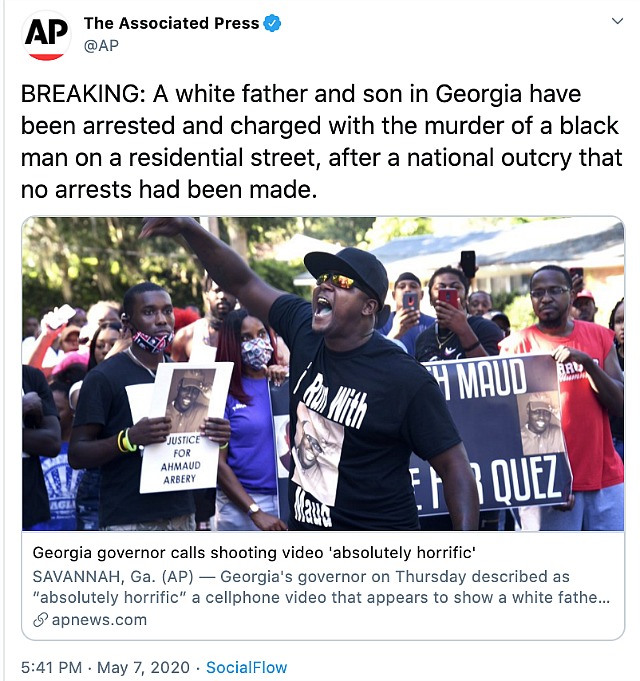
If and when The Beast says anything about the 2.23.20 murder of Ahmaud Arbery by suburban Georgia vigilantes, and especially the foot-dragging response by local authorities to an obviously unwarranted shooting by gut racists, it’ll be some kind of Charlottesville statement — i.e., respect due process, “there are many good people in Georgia”, killing is bad but black guys shouldn’t grab a white man’s shotgun, blah blah.

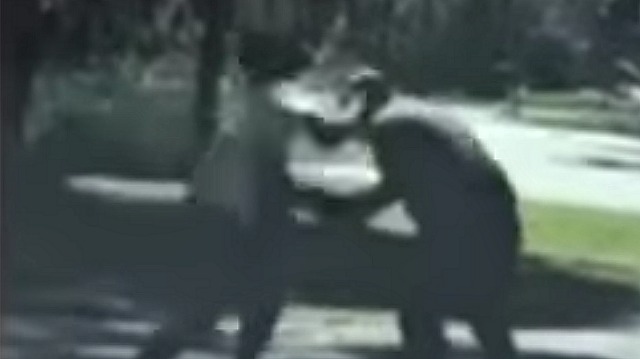
This is obviously Trayvon Martin II. The case blew open yesterday with the release of video of the shotgun slaying.

Boilerplate: “On 2.23.20 Ahmaud Arbery, a 25-year-old African American man, was shot dead while running near Brunswick, Georgia. Arbery was unarmed and running on a road, when he was chased and then confronted by three white bubbas with a pickup truck: Gregory McMichael, his son Travis McMichael and William “Roddie” Bryan. The confrontation involved Arbery trying to grab one of the men’s gun, and resulted in Travis fatally shooting Arbery.

Update: Two arrests (the shooter son and the father) happened today. Earlier: An anonymous YouTube video of the shooting was publicized on May 5th on a radio station website, before being reposted on Twitter by the attorney for Arbery’s family; it went viral. After the video’s release, the presiding prosecutor, Atlantic Judicial Circuit District Attorney Tom Durden, said a grand jury would decide whether charges would be brought.”

Read more

What Pandemic?

Late yesterday afternoon I rumblehogged out to the beachy areas of Venice and Santa Monica. Blue skies, warm air, T-shirt weather. I didn’t walk on the beach but I was close enough to smell the surf, and it was wonderful. But at the corner of Washington Blvd. and Ocean Ave I noticed all kinds of people congregating in groups large and small, lining up for takeout food and licking yogurt cones and without masks or gloves or any apparent interest in maintaining a proper distance.

I was wondering what was up, etc. These weren’t Huntington Beach bumblefucks but (presumably) liberal west-siders in shorts and flip-flops.

I made my way up Ocean and all was well. Maybe a half-block south of Santa Monica Pier I passed by some kind of mid-sized bar or cafe on the west side of the street, and the place was all but packed with rowdy 20somethings. They were happy and standing fairly close to each other and making a fair amount of noise. I should have pulled over and crossed the street and taken pictures of this motley crew, but I didn’t.

The general atmosphere seemed to be one of “fuck it, we’re tired of this COVID shit and we’re gonna see what we can get away with on a casual, fuck-all basis…let’s see if the bulls come over and bust us.”

I had my mask and gloves on and was taking no chances, but the natives were restless. Not everyone but a noteworthy percentage.

Lived Large, Died For Nothing

I had no problems with Laurent Bouzereau‘s Natalie Wood: What Remains Behind (HBO, now streaming). Never boring or irksome or in any way synthetic, it’s an intimate, considerate, mostly fair-minded portrait of a complex but understandable dynamo survivor who pushed hard during her 25-year peak period (mid ’40s to ’70 or thereabouts), and who had a lot of fire and brass and joy.

Produced by Wood’s actress daughter Natasha Gregson Wagner along with Wood biographer Manoah Bowman, the 100-minute doc is proably the smoothest and most highly polished study of the late actress ever assembled, certainly from my perspective. Bouzereau is a pro-level craftsman from way back, it has a lot of private footage that I’ve never seen before, and it struck me as “honest” and “forthcoming” as far as the terms allow. If you accept the fact, I mean, that it’s a friendly, family-controlled portrait, and that none of the icky or tawdry stuff is going to be used.

The long-rumored assault upon the teenaged Wood by a certain recently deceased superstar at the Beverly Hills hotel sometime in ’55 or thereabouts — this isn’t even alluded to. Wood’s 1964 suicide attempt is briefly mentioned, but her then-current entanglement with Warren Beatty isn’t explored with much depth. Her 11.29.81 drowning death isn’t explored in any way you haven’t heard about or considered before. It was just a tremendously sad tragedy that almost certainly wouldn’t have happened if Wood, husband Robert Wagner and Brainstorm costar Chris Walken hadn’t been drinking so heavily. Wagner’s confession about smashing a wine bottle while arguing with Walken certainly gets your attention, but this is the kind of thing that drunk people do when they’re really angry. Whatever really happened will never surface so let it go.

All in all, What Remains Behind is mesmerizing — poised, exacting, carefully honed and haunting as far as it goes. Definitely worth a looksee. Just don’t expect the moon.

Read more

“When A Guy Knows…”

When I was 12 or 13 my maternal grandfather delivered a speech about how I should always do my best regardless of the task. Even if the task is mopping a floor or cleaning a toilet, there’s honor and dignity in performing it to the utmost. I respected my grandfather and knew he was speaking from wisdom, but I’ve always hated mopping floors and cleaning toilets and so I never applied this ethos when it came to grunt work. But I gradually understood and embraced it when I got started to become a half-decent writer in the early ’80s.

YouTube commenter Alex Clark (two years ago): “One of the best scenes for a young person to watch. You’re going to spend a lifetime meeting people who have a shitload more than you have to offer on paper (money, titles, assets, things, friends, etc.) but everyone will respect, admire and envy the person who truly loves and excels at what they do.”

Henry II to Becket: “I made you a nobleman. Why do you play at being my bath servant?” Becket to Henry II: “Honor lies in the man, my prince. Not in the towel.

Val Kilmer as Will Sampson

Said before, saying again: I harbor no ill feelings about Val Kilmer. The opposite, in fact.

I helped report that “Psycho Kilmer” Entertainment Weekly article that ran in mid ’96, but I had a nice chat with him at a party he threw at his home back in ’04 or thereabouts. (He had just finished working on Oliver Stone‘s Alexander.) I ran into Kilmer again in the fall of ’11 while having lunch with Descendants costar Judy Greer. We waved and smiled as Kilmer sat at a nearby table. When I tried to pay the bill the waitress told me the check had been taken care of by “that man sitting over there,” except Kilmer had left by that point.

In Taffy Brodesser-Akner‘s “What Happened to Val Kilmer?” (N.Y. Times, 5.6.120), the 60 year-old Kilmer asks, “You don’t think we will be going to Cannes? How about the Olympics? The Olympics has never been canceled except in time of world war.” You can’t cancel the world, right? Bad things happen, but you still need art.


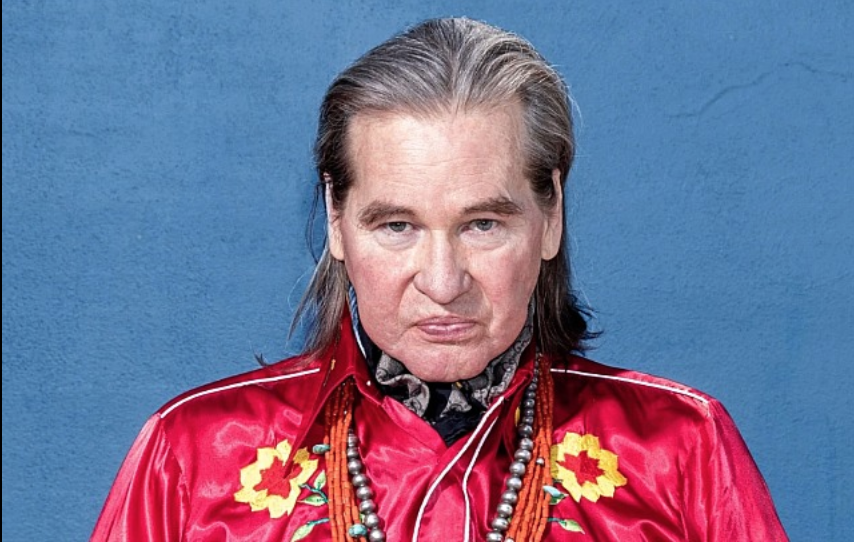
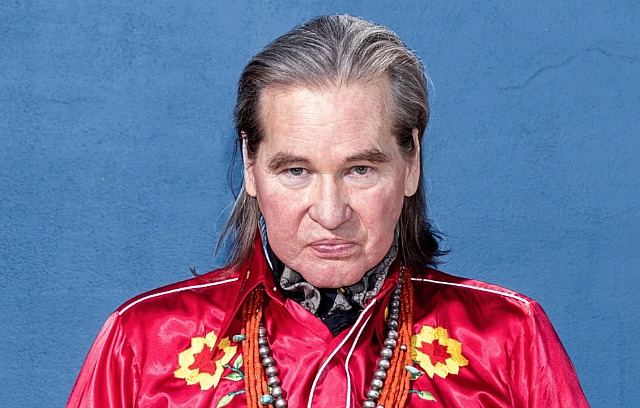
Val Kilmer as captured last month by N.Y. Times photograoher Jeff Minton.

TBA: “And I thought: Right? Right! You still need art. You still need forward momentum. You still need to believe that all your effort wasn’t for nothing, that we could — we will — survive a dark moment in history and that when that happens, we won’t be left without the things that made those moments decipherable and meaningful and therefore tolerable.

“The world outside had seemed to be getting so, so bad for so, so long, and this was the first whiff of overarching hope and positivity that I’d witnessed in I couldn’t remember how many months or years now — so much so that I almost couldn’t identify it when I saw it. The last glowing embers of hope coming from Val Kilmer? The movie hunk of my youth, who disappeared unceremoniously and now presented with an entirely different appearance and a bizarre accounting of where he’d been?

“But there was something familiar about it, like a faint knocking that came from inside me: It was the special kind of optimism that maybe only the faithful have, the enduring belief that some force will come along and save us from the centrifuge of despair we’ve found ourselves in. When is the last time you saw that up close?

Later in the piece: “Perhaps we had created the coronavirus out of our fear and wickedness — children in cages, the rich hoarding wealth; perhaps we had only the suggestion of a virus. I grew up with too many messianics in my household. I found this kind of thing too easy to believe, if only because it was more believable than the fact that in 2020, my young, healthy colleagues were in the hospital, the streets were bare, I was stuck inside my house and nobody knew how long that might go on for. It was so hard to parse all the fear that permeated society now — what was real and what had come as a result of our own hysteria. During the day I’d think that it was the fear that was hurting us most.

“But at night my husband would shake me to wake me up because I’d been crying in my sleep. More quickly than I could have imagined, the world took on the hallucinogenic quality of right before you fall asleep, when everything is outsize and nothing makes sense. The margins on my suspension of disbelief started to close in on themselves, and the borders of things began to diminish, and now the world seemed like a word you stare at so long that it becomes nonsense.”

Beg To Differ

Tatiana Siegel has posted a 5.6 Hollywood Reporter piece titled “Was Sundance a ‘First Petri Dish’ of Coronavirus in the States?” Without getting into the substance of the article, which is mostly an “okay, yeah, whatever” thing, HE takes exception to Siegel’s description of Park City as a “quaint mountain oasis.” The Sundance Film Festival host city is still a mountain oasis of sorts (in a kind of sprawling, over-developed, tropic of-corporate-cancer sort of way), and you could argue that downtown Park City felt “quaint” from late ’80s to mid ’90s, although the real quaint happened during the ’60s and ’70s, before the quarter-of-an-inch-deep elitists and expansionists began to move in and send real-estate values soaring. Trust me — this aggressively liberal upscale community, which has been condo’ed and McMansioned to death over the last couple of decades, stopped being quaint during the second term of William Jefferson Clinton. If that.