Why Is “Snyder Cut” Teaser in Boxy Format?

As a father and a human being, I feel great sadness about the tragedy that enveloped poor Zack Snyder and his family three years ago. But as a rule, Hollywood Elsewhere has hated Snyder’s films and especially his superhero bullshit for a long, long time. That’s just the way it is.

Snyder isn’t exactly Satan, but I’ve long regarded him as a high-style scourge of 21st Century cinema. I was half taken with Watchmen, okay, but otherwise you can shitcan and forget Dawn of the Dead, 300, Sucker Punch, Man of Steel, Batman v Superman: Dawn of Justice, Justice League, etc.

But I’m currently intrigued as to why a just-released teaser of the Snyder Cut, his unreleased version of Justice League, which Snyder abandoned following said personal tragedy, is presented in a 1.37:1 aspect ratio.

The 34-second teaser focuses on Gal Gadot’s Wonder Woman as she comes across some kinds of bullshit artifact in a torch-illuminated cave, blah blah. Before the clip cuts to the formidably evil Darkseid, Jesse Eisenberg’s Lex Luthor says something like “the bell’s already been rung, and they’ve heard it…out in the dark among the stars…ding dong, the god is dead.”

Or whatever. Who cares? The Snyderverse is a hellish place to contemplate, much less visit.
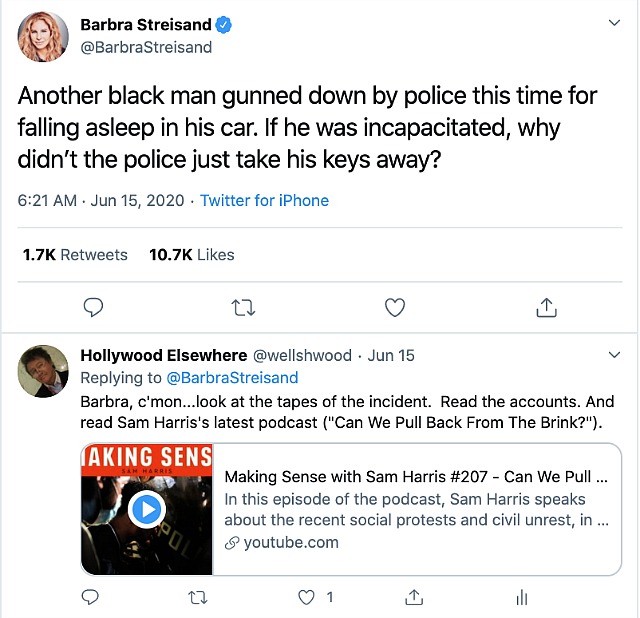
HE to Streisand: Watch The Video

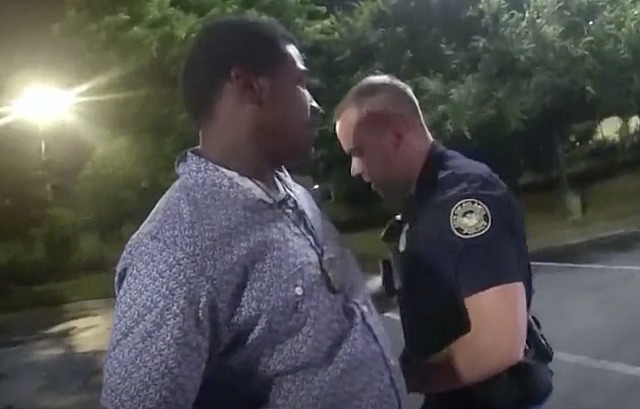
Video tells the tale: Rayshard Brooks was gently told to drive out of the Wendy’s take-out line and into a parking place. If he had done that it probably would’ve ended there. But Brooks was so bombed he couldn’t even manage that. And then he freaked when they decided to cuff him.

From “Look At The Facts in the Rayshard Brooks Case — The George Floyd Killing Was Different“, a 6.18.21 USA Today op-ed by Michael J. Stern, a member of USA Today‘s Board of Contributors and a federal prosecutor for 25 years in Detroit and Los Angeles.

Subhead: “There is no shortage of police misconduct due to racism. But claiming it where it may not exist weakens the righteous cause of stamping it out.

“That a man died [outside an Atlanta Wendy’s] is tragic. But the protests, celebrity outcry and general media capitulation that equates Brooks’ death with that of George Floyd, and countless other African Americans who were murdered at the hands of flagrant police misconduct, is wrong.

“In a headline reminiscent of the National Enquirer, the Los Angeles Times ran an editorial [on Tuesday, 6.16] that was titled ‘Atlanta police killed a Black man for being drunk at Wendy’s.’ No — Mr. Brooks was not killed for being drunk.

Rayshard Brooks was killed after resisting arrest, attacking two police officers, taking an officer’s Taser and shooting it at a police officer. The decision by the Times’ editorial board to intentionally omit this last fact is damning proof of its effort to create a narrative that serves a social agenda, despite evidence that supports a contrary conclusion.

“Atlanta’s district attorney, Paul Howard, announced felony murder charges Wednesday against the officer who shot Brooks.

“American Bar Association rules prohibit prosecutors from making pretrial statements that could influence public perception and prejudice an accused’s ability to get a fair trial. Howard violated this rule by making a lengthy presentation of evidence that supported his position and ignored key facts that did not. Judges, prosecutors and defense attorneys typically refer to Howard’s impropriety as trying the case in the press.

“A new and disturbing allegation presented by the district attorney is that the officer kicked Brooks after he was shot. Though acts after an event can be considered reflective of an earlier intent, the pivotal actions in this case will focus on what happened in the seconds before the shooting.

“In Georgia, an officer is entitled to use deadly force when he reasonably believes his life is in danger or he’s at risk of receiving a serious physical injury. When this case goes to trial, the jurors will be instructed that they must consider the context of Brooks attacking the officer, grabbing the Taser and shooting the Taser at the officer. This analysis includes the possibility that if Brooks hit the officer with the stolen Taser, he could grab the officer’s gun and shoot him.

Read more

Straight-Dopers Texting Each Other

HE to Hot-Shot Award-Season Player/Contributor/Handicapper: “As you know the Academy’s decision to add two months to 2020, with the awards-qualifying year ending on 2.28.21, is about (a) alleviating the logjam of year-end releases (including Oscar hopefuls) due to COVID and (b) allowing those Oscar-contending films that had planned to open by 12.31.20 an extra two months to complete post-production and be released by or before said Oscar deadline [2.28].  

“As things stand there will be a seven-week period of campaigning and whatnot (Academy nomination voting, Golden Globes, PGA/DGA/WGA awards, Santa Barbara Film Festival, final Oscar balloting) between March 1, 2020 andSunday, 4.25 (Oscar night).  But are you telling me that all the films that will open during the traditional fall-holiday Oscar season (and I don’t know how many films this will be)…are you telling me that that distributors won’t engage in Phase One-style promotions and celebrations during this late October to mid December period?  

For 90 years this has been the time for Oscar hullabaloo (10.15 to 12.20), and you can’t just suddenly shut that down and say ‘Oh, no, we’ll be waiting to talk about the Oscar hopefuls in February, March and April.’  You can’t throw in the towel like David Poland and say ‘no 2020 Oscar season action until the late winter and early spring of ’21.’  End-of-the-year Oscar wallah-wallah is in our blood, our genes, our instincts, our history, our traditions, our souls. You can’t just turn that 90-year-old spigot off like that. You can’t throw a nearly century-old tradition out the window.  

“It’s therefore my belief or theory that for the first time in award-season history (and hopefully the last time) we’ll have two (2) Phase Ones on the calendar — traditional Phase One A (mid October to late December) and an atypical, one-time-only Phase One B from late January to 2.28.21.  And then, after the nominations are announced, comes Phase Two.

“Please tell me, privately, in what way my thinking might be wrong.”

Hot-Shot Award-Season Player/Contributor/Handicapper to HE: “Things” –i.e., the award season that we all know and love except for crabby-heads like Bob Strauss — “will resume in October-November when we start to have a better understanding of how [the pandemic’s grip on our lives is ebbing or levelling off or whatever].  And once the presidential election has been decided.”

HE to Hot-Shot Award-Season Player/Contributor/Handicapper: “Hah!”

“Palm Springs” Time-Looping

Palm Springs is insane. Screenwriter Andy Siara knows we’ve seen our share of time-loop movies. He knows the problems we have with their plot holes and logic gaps. And he knows that the rules in this genre never, ever make sense, which is why he goes a completely different direction here — well, not completely different.

“Taking a page from Russian Doll Nyles (Andy Samberg) realizes that he’s not the only one caught in a loop. The CG in this movie looks terrible (so bad that it almost becomes funny), but that earthquake we saw at the beginning opened some glowing rift in the space-time continuum, situated in a remote desert cave, and when he enters, anyone who follows him in winds up cursed to relive Nov. 9 forever.” — from Peter Debruge‘s Variety review, posted from Park City on 1.28.20

Directed by Max Barbakow and costarring J.K. Simmons, Meredith Hagner, Camila Mendes, Tyler Hoechlin and Peter Gallagher, Palm Springs will pop on Hulu on Friday, 7.10. (No theatrical? Not even drive-ins?) Produced by Andy Samberg, Akiva Schaffer and Jorma Taccone.

The Only Ones I’m Interested In

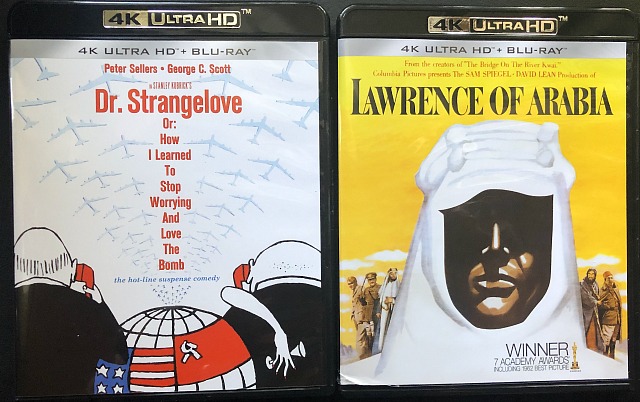
For now, I mean. I haven’t seen A League of Their Own (“There’s no crying in baseball!) since the early days of the Clinton administration. I love Jerry Maguire but how much better can it look? I was underwhelmed by Gandhi back in ’82, and feel no special urge to revisit. I’m mildly interested to see how good the black-and-white might look in Mr. Smith Goes to Washington, but no big hurry.

Seyfried-Fincher Make Cinematic History

During the 1958 filming of Some Like It Hot, it took 59 attempts before Marilyn Monroe was able to say “where’s that bourbon?” in just the right way, or at least to director Billy Wilder‘s satisfaction.

For years this was a fascinating, oft-repeated anecdote — an example of how much effort and sweat it could take to get a scene right. But many such stories have cropped up in the 60-plus years since the Monroe-Wilder incident. Stanley Kubrick was alleged to have asked Harvey Keitel to perform a certain scene in Eyes Wide Shut more than 59 times. (I forget the exact number.) And of course, David Fincher is legendary for asking his actors to do dozens upon dozens of takes.

But now comes Mank costar Amanda Seyfried with a story about Fincher having her perform a single line — “You think I can just relax?” — roughly 200 times. The story was passed along yesterday by Collider‘s Tom Reimann.

Seyfried quote: “I was part of scenes with tons of people in it and we would do it for an entire week. I can’t tell you how many takes we did, but I would guess 200, maybe I could be wrong and could be way off. Uhm, I could be underestimating by five days of one scene when I didn’t have one line…‘You think I can just relax?’ No, because there are probably about nine or 10 different camera angles that had been on me at one point.”

Bruh Uniform On The Links

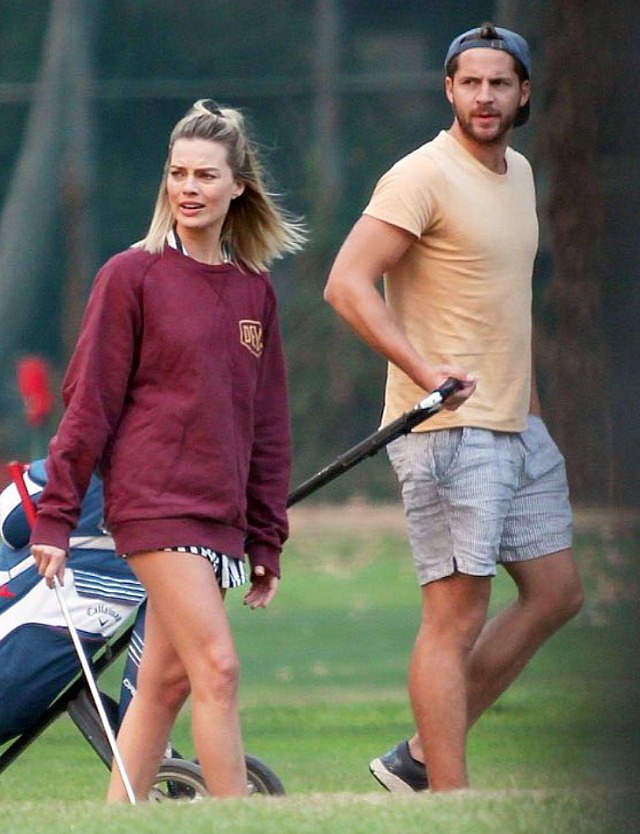
Last weekend Margot Robbie‘s producer husband Tom Ackerley offered further proof that the low-rent bruh uniform (about which I reposted three days ago) is scrupulously followed worldwide, regardless of wealth or status. Shorts, low-thread-count T-shirt, backwards baseball cap, closely-trimmed whisker beard, whitesides without socks. From Timbuktu to Tunbridge Wells to Tallahassee, they all look like the exact same bruh.

Regimentation, sartorial fascism, the primal urge to belong, etc.

The couple and friends played at the Loz Feliz 3-Par Golf Course (3207 Los Feliz Blvd, Los Angeles, CA 90039), a nine-hole operation located near Atwater Village and located alongside the L.A. river.


Margot Robbie, Tom Ackerley at Loz Feliz 3-Par Golf Course.

Pablo Larrain Short-Actress Theory

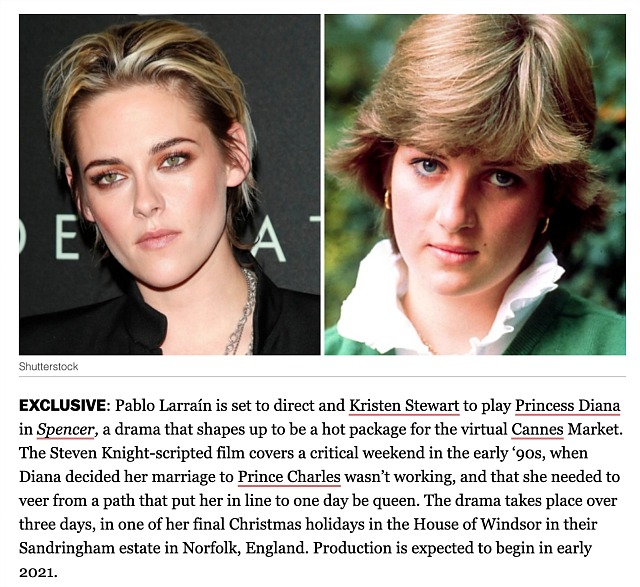
Deadline‘s Michael Fleming announced this morning that Kristen Stewart will play the late Diana, Princess of Wales (aka Diana Spencer) in Pablo Larrain‘s Spencer.

Due to roll in early ’21, the Steven Knight-scripted drama will “cover a three-day period in the early ‘90s, when Diana decided her marriage to Prince Charles wasn’t working, and that she needed to veer from a path that would put her in line to one day be queen,” Fleming reported.

Diana’s chosen path, as we all know, turned out to be sporadic and wayward, and was chiefly defined by a series of extra-marital and post-marital affairs (Barry Mannakee, James Hewitt, James Gilbey, Oliver Hoare, Theodore Forstmann, JFK Jr., Bryan Adams, Hasnat Khan). It ended tragically when she and the totally worthless Dodi Fayed died after a high-speed car crash in Paris on 8.31.97.

Right off the top, the Larrain-Knight project is flawed for two reasons.

One, nobody cares about Diana’s decision to bail on her marriage to Prince Charles in ’91 or thereabouts. What they want to see, of course, is a Harold Pinter-esque drama about her tragic, idiotic affair with Fayed with a special focus on (a) the particulars of her last few hours of life, and (b) the worldwide reaction to her death including the funeral and the Elton John performance of “Goodbye, English Rose.”

And two, the 5’5″ Stewart is way too short to inhabit the physical realm of the 5’10” Diana. Diana was seriously statuesque (5’10” in heels = six feet) and nudging the giraffe realm while Stewart — be honest — is smallish. It would be one thing if she stood 5’7″ or 5’8″ but she’s five full inches shorter than the Real McCoy — you might as well call it half a foot.

Plus Stewart doesn’t look anything like Diana in terms of eye shape or facial bone structure. She was a passable Jean Seberg as they shared certain similarities, but even the makeup guy who transformed Charlize Theron into Megan Kelly would be at a loss.

By the way: The 5’10”, 44 year-old Theron would be too old to play the 31 year-old Diana in Larrain’s film, but she could play the 36 year-old Diana in the Dodi Fayed version.

Larrain has twice cast too-short actresses as famous women — the 5’3″ Natalie Portman as the 5′ 7″ Jackie Kennedy (which didn’t work — Portman was simply too runty), and now Stewart as Spencer.

My pet theory is that Larrain, who himself only stands 5’7 1/2″, prefers to cast women who are shorter than himself.