Lore of Manhattan Streetwalkers

Posted on 9.15.13: Manhattan life is plagued by many irritations. I hate the fact that subway car doors frequently don’t open for several seconds after the train stops at a station. (In Paris you can manually open the doors yourself with that silver latch handle thing.) But the biggest drag these days (for me anyway) are the slowpokes on the street and especially in the subways.

I’m not saying they have to race around like crazy rats, but what’s wrong with walking with a purposeful stride? Very few do this, it seems, and the ones that are really slow are always blocking the sidewalks in groups of five or six or more. I was going to say it’s the tourists but I’m starting to think it’s almost everyone these days except for X-factor types. For me walking around Manhattan is exhilarating exercise, especially if you walk with a little bounce in your step; for the vast majority it’s apparently something to be endured by reducing energy expenditure as much as possible and shuffling around like 80somethings.

So basically when you’re walking around Manhattan half the game is spotting the “blockers” before you’re stuck behind them and have to sidestep their ass. The ones to watch out for in this respect are couples of any age, older women, heavy middle-aged men and especially urban females of girth.

I first mentioned this eight years ago: “Out-of-towners always seem to walk the streets without the slightest hint of spunk or urgency in their step, like they’re making their way from the bedroom to the refrigerator at 2 ayem in their pajamas and nightgowns. And they’re always wearing those dead-to-the-world expressions. (Writer Fran Leibowitz has described the shuffling gait of tourists as the ‘mall meander.’)

“Every day I’m walking along at my usual spirited pace and these Jabbas and sea lions are always walking ahead of me in self-protecting groups or, worse, three abreast. The idea that they might be blocking people, much less defying the basic transportation law of going with the flow, doesn’t seen to occur to them. Then again, the flow in Jabba tourist areas (Times Square, Rockefeller Center) is very zombie-paced so it probably feels right from their perspective.”
Full Ferrara

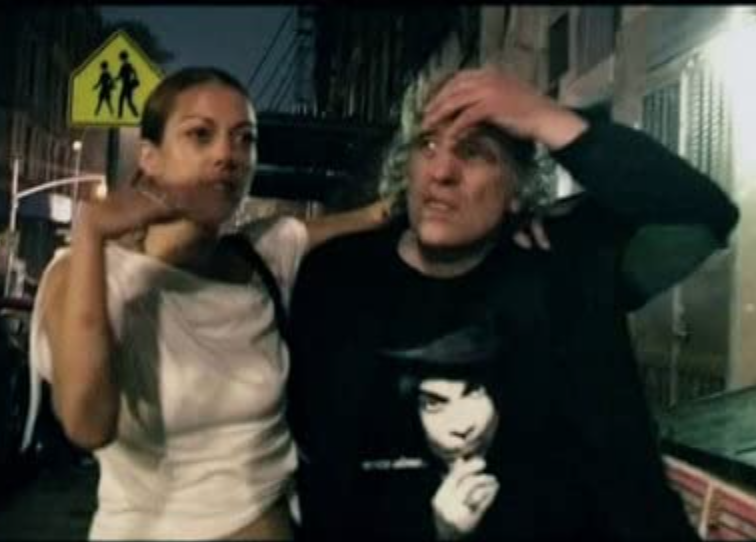
It’s been 17 years since I last saw Rafi PittsAbel Ferrara: Not Guilty. The kids and I caught it at the 2003 Locarno Film Festival. Six years ago a trailer popped up. The film also appeared on YouTube that year, but I somehow missed that fact. Anyway, here it is — shot in ’03, 117 minutes, worth a looksee.

Not Guilty doesn’t attempt an in-depth probing of Ferrara’s career and aesthetics by the usual means — searching questions put to the director, a comprehensive array of clips, talking heads offering insightful assessments, etc. Pitts just follows Ferrara around New York — shooting the shit, filming some kind of music video, visiting and hosting friends, talking to women on the street, tossing off anecdotes about Harvey Keitel, Christopher Walken and Willem Dafoe (the stars of Ferrara’s Bad Lieutenant, King of New York and New Rose Hotel) — and lets him be himself.

“‘I knew that an interview situation wasn’t going to give us any new information about Abel,’ Pitts told the Pardo News, the local festival rag. ‘The best thing was to show him how he is. The film is always from his point of view. He’s always in the shot.’ And it’s a cool ride. A wonderfully messy, slipshod, organically alive New York runaround.

“The festival program notes on this film describe Ferrara as ‘deranged,’ which I think is a little harsh. He comes off as a nutter, all right, but one deserving of respect. What comes through is a portrait of an anarchic creative teenager with the soul and finesse of a 51 year-old.

“A gnomish, stooped-over figure with longish graying hair in a leather jacket and a pink New York Yankees baseball cap, Ferrara is full of hyper, rambunctious energy. He plays guitar and piano (not too badly) and he loves to tell stories in one of those fuck-this, fuck-that Manhattan voices we’re all familiar with.

“An actor friend observes at one point Ferrara tends to do four or five things at the same time, and each one with distinction. It’s clear he likes to solve creative problems by immersing himself in chaos and sorting things out as he goes along.

“It’s also clear he knows from movies, and precisely what’s good and what’s not. He’s goes into a kind of frenzy when he’s working, and you can see why certain films of his (Bad Lieutenant and King of New York, certainly) work as well as they do and why, at the same time, constipated producer types might feel a little intimidated by him.

“But he’s great with actors and catching excitement on the fly. Bronx-born and quick with a quip, Ferrara loves taking cabs all over town and talking shit with people he runs into. There’s a great moment when he spots a long-legged brunette walking nearby and starts walking after her, making cracks like ‘tall…and that’s not all!’ and ‘those boots were made for walkin’!’

Read more

Easy Earbug

I’m aware that Twitter has recently condemned Eric Clapton to a life term on Devil’s Island for his (and Van Morrison‘s) support for live superspreader concerts. I’ve nonetheless let “Lonely Stranger” into my head over the last couple of days, and now I can’t get rid of it.

Read more

Tiffin Ascends

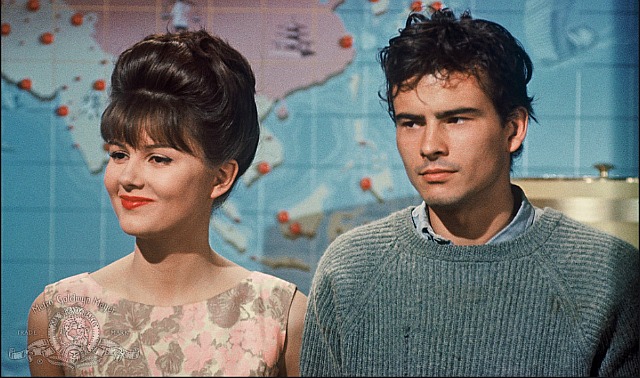
Condolences to family, friends, fans and colleagues of Pamela Tiffin, whose death at age 78 was revealed last night. She actually passed on 12.2, and in a New York City hospital…coronavirus?

Only boomers and Baby Busters (i.e., those born in the ’30s) remember Tiffin because her U.S. acting career was only hot between ’61 and ’66, and she only made two good films at that — Billy Wilder‘s One Two Three (’61, in which she played the hot-blooded Scarlett Hazeltine, a strong supporting role) and Jack Smight‘s Harper (’66), in which Tiffin played a pouty sex kitten opposite Paul Newman.

She acted in three other films of note. The earliest was an underwhelming Tennessee Williams drama called Summer and Smoke. Tiffin had a nothing role. Directed by Peter Glenville, the underwhelming 1961 film featured Laurence Harvey, Geraldine Page, Rita Moreno, Una Merkel and John McIntire. She also costarred in The Hallelujah Trail (’65) with Burt Lancaster, and opposite Peter Ustinov in Viva Max (’69).

I’ll always feel a special affection for Tiffin’s spirited performance in the Wilder film, because that fast-paced, rat-a-tat farce was the only first-class, triple-A rated film she ever made.

She made a few surface-fizzle teen flicks between ’62 and ’66, and then moved to Italy where she made almost nothing but crap-level giallo films.

Tiffin was married to legendary journalist-editor Clay Felker (!) from ’62 to ’69, and then an Italian guy, Edmondo Danon, with whom they had two daughters, Echo and Aurora.

Bob Seger’s “Still The Same”

From Owen Gleiberman‘s recently posted Variety review of Mario Puzo’s The Godfather, Coda: The Death of Michael Corleone: “Here’s the news and the ever-so-slight scandal: It’s the same damn movie. I’m not exaggerating; it really is.

“The one impactful change is the new opening scene. The film now begins with the let’s-make-a-deal negotiation between Michael and Archbishop Gilday (Donal Donnelly), the weasel who heads the Vatican Bank, in which Michael agrees to pay the Vatican $600 million in exchange for the right to become the controlling shareholder of Immobiliare, an international real-estate consortium. Taking that scene, which previously came about half an hour in, and moving it to the front gives the film a kick-start, and it clarifies the underworld-meets-Catholic-Church corporate-business plot that didn’t actually need clarifying.

“Once that happens, the movie proceeds along in exactly the same way it did before, except that Coppola has made about five minutes’ worth of trims. [Plus there’s] a new ending, in which Michael is seated in that same chair in the sun [by his Italian villa], only now he doesn’t die.”

Read more

Sheehan vs. Delson Over Stallone

Two days ago legendary Los Angeles movie-beat TV guy David Sheehan passed from cancer at age 82. Regrets and condolences for this one-time critic, interviewer, producer, man about town. Not the hippest cineaste I’ve ever spoken to but sharp and personable enough. Sheehan was hot stuff from the early ’70s to early aughts on KCBS, KNBC and then back to CBS.

In the spring of ’85 I was working for partnered publicists Bobby Zarem and Dick Delson, and their star client at the time was Sylvester Stallone. Delson and I were with Stallone out at KNBC studios in Burbank for a Tonight Show with Johnny Carson appearance. Delson and I were waiting in a large adjacent hallway while Stallone was attending to business.

All of a sudden Sheehan showed up with a camera and sound guy, wanting to speak with Stallone. Delson hadn’t approved this — it was a totally unscheduled, total guerilla ambush on Sheehan’s part.

Did Delson go up to Sheehan and say, “Look, if you want to do an interview let me talk to Sly, and if he’s agreeable we’ll figure something out.” No, and the reason was unclear. Either Delson didn’t personally like Sheehan or was extremely angry about the ambush and determined to rebuff all advances, or had he figured Stallone might not be amenable and didn’t want to risk angering him?

So Delson stood in the hallway and glared at Sheehan and sulked, and Sheehan and his camera guy just waited patiently for Stallone to appear.

Stallone emerged 10 or 15 minutes later, Sheehan pounced, they did a five-minute quickie…over and out.

Sheehan was obviously playing a kind of hardball game with Delson. He was basically saying “look, Stallone will be here in a few minutes and I work in this building so why can’t I just talk to him right now? Why do I have to play by your chickenshit rules when I don’t have to?”

He was clearly showing more balls in this situation than Delson was. Delson was giving him a deathray look, but Sheehan just chilled and kept his cool and did his job.

Ankler Observation: “Rare Moxie”

From Richard Rushfield‘s Ankler newsletter — “Special Dispatch: Mad Max,” posted earlier today:

“Pump and Dump, I believe, is the term of art. AT&T would not be the first corporation to come to Hollywood and once the excitement of Oscar floor seats fades and the checks start coming due, their first thought is ‘Somebody get me the hell out of here!

“With all that as the backdrop, let’s first stipulate that I’ve frequently criticized the leaders of our little industry as too timid, conservative, reactive, and lacking guts and vision. Whatever else you can say about [Warner Bros.’ decision to offer all 2021 films simultaneously in theatres and HBO Max], timid and piecemeal it ain’t.

“A giant entertainment conglomerate is risking everything it’s got, betting the entire store on a new division — a floundering new division, no less. So whatever else we say about it, let’s bow to a rare show of moxie.

“This may turn out to be brilliant, or the greatest disaster in entertainment history, but at least it’s not ‘Are there any other Spider-Man supporting characters we can make a movie about?’

“Whatever else happens, you can’t say they didn’t try.”

Read more

21st Century Deletions

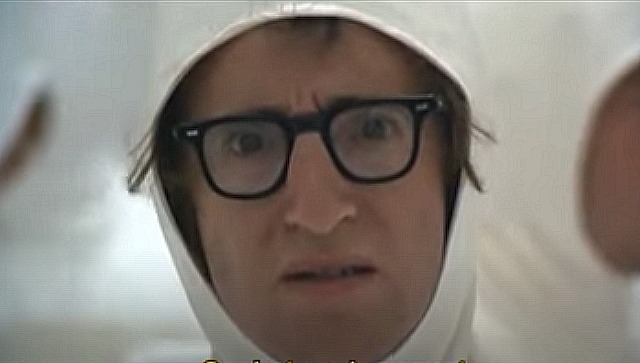
For the good of enlightened 21st Century culture and the emotional safety of a certain subsection of Millennials and Zoomers, it is proposed that two lines of dialogue in Woody Allen‘s Everything You’ve Always Wanted To Know About Sex (specifically the “What Happens During Ejaculation?” sequence) be removed.

Both can be found in the top video. At 2:48 a sperm cell played by Allen asks “what if this is a homosexual experience?” This has to go along with the look on Allen’s face. At 3:59 an African-American sperm cell asks, “What am I doing here?” — obviously toxic racism and completely unacceptable.

Read more

Culture of Scolds

“[A week after] I was asked to leave New York Magazine, they ran an 8,000-word piece I’d written, about plagues through history, so it wasn’t about the quality of my work. It was about their desire — not the editors, again, but other people — their desire to simply say, ‘I don’t want to be associated with this person, that he’s morally awful.’

“And you know, America is weird like this. There is a part of American history — Americans have tended to enforce orthodoxy through civil society, not through government. So this is the country that gave us the Salem witch trials, the country that gave us the Hollywood Blacklist, the country that gave us the Scarlett Letter, the country that gave us McCarthyism, and [now] the country that’s given us wokeness.

“These are attempts to enforce morality upon people in every part of their life…the language they use, the mannerisms they have, the places they work. This is the puritanical strain within American history, which is not equivalent in many other countries…this moralizing attempt to persuade and coerce to save your fellow citizens.

“If America were as bad as bad as the establishment left now believes, why would all these people want to come here? 86% of our immigration is non-white. What [form of] white supremacy invites 86% of its immigrants to be non-white? It’s completely bonkers.” — Andrew Sullivan speaking this morning to Megyn Kelly on her podcast.

The good stuff starts around 8:15.

Atticus Bad

#DisruptTexts is basically a movement by African American educators to challenge white narratives in standard-cirriculum literature for pre-college students. The idea is to introduce anti-racist perceptions and understandings.

If you wanted to be judgmental you could call #DisruptTexts a form of progressive revisionism or even a racially enlightened form of book burning. The other side of the coin is that we need to step outside of our white attitudes and take steps to redress our culture’s racist history. Or something like that.

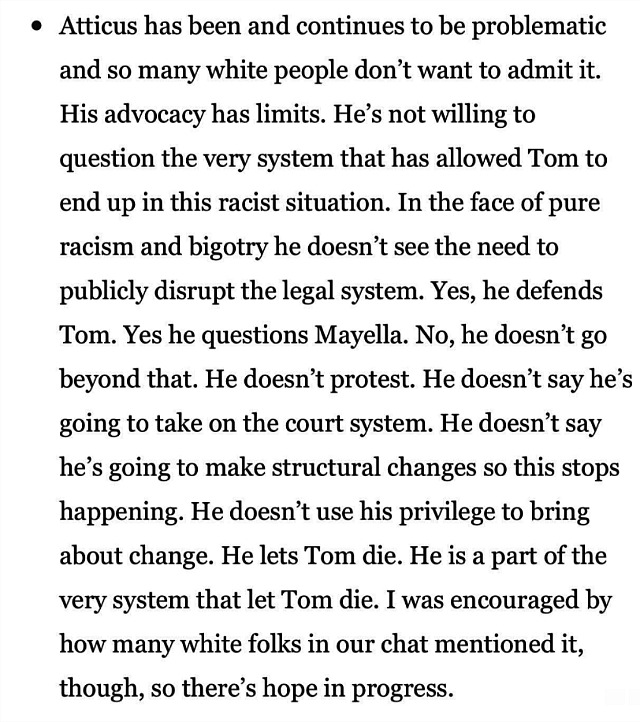
I was struck this morning by the dismissive #DisruptTexts assessment of the beloved Atticus Finch, the small town widowed attorney, father of two children and moral hero of Harper Lee‘s “To Kill A Mockingbird,” which has been taught in schools for decades.

Last June a reader suggested to #DisruptTexts co-founder Lorena German that “we must show compassion to teachers and writers of the past [and not] judge them so harshly.”

Excerpt from German’s reply: “How about we spend some time finally showing compassion for the victims of racism and systemic oppression instead of the folks who perpetuated it? I don’t need to know someone’s heart, to know they were doing something wrong and inhumane. There were plenty of people at the time of Harper Lee writing books, essays, articles, and making speeches who were antiracist and already operating in a humane manner toward People of Color. Teachers and writers of that time could have shown empathy, the one you’re asking us to show, then toward those writers and thinkers. So, they’re not simply ‘teachers and writers of the past’ — they were participating in racism.”

Thoughts? And what would Gregory Peck say if he was around?

Read more