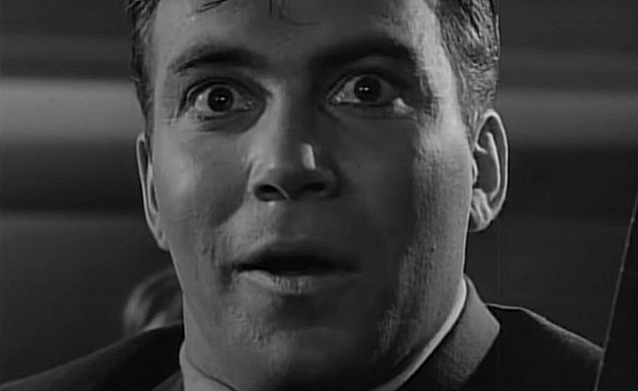
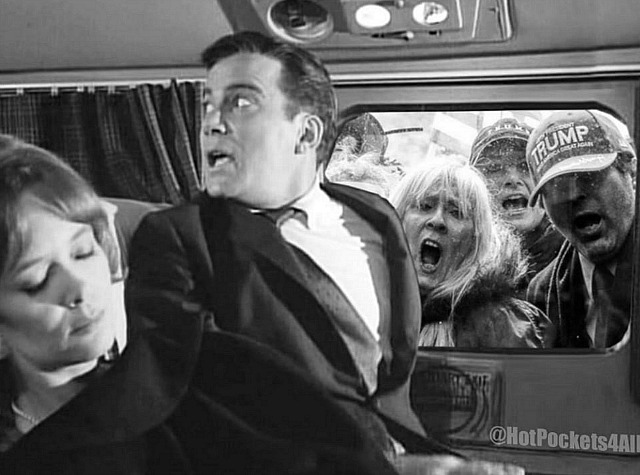
Hats off to “HotPockets4All” for the primary image — I added the Shatner CU.
The theoretical essence of the Open Up tea-bag movement (please correct me if I have it wrong) is something along the lines of “better to risk death or even die (while helping others to do same) than submit to a severely shuttered, economically smothered way of life that amounts to a kind of living death.”
Is that more or less it? Because it feels like a plot element from TheOmegaMan.
For decades the consensus has been that The Thing With Two Heads (’72) is a mild hoot and worth seeing at least once. I’ve never had the slightest urge (my favorite Ray Milland-Roger Corman collaborations are The Man With The X-Ray Eyes and The Premature Burial) but now I’m thinking about it. The current winter of our discontent allows all sorts of bats into the belfry.
The problem if that it’s apparently not streamable and paying 20-plus for a DVD (not even a Bluray?) is a bridge too far.
More or less based on Stanley Kramer‘s The Defiant Ones (’58), the majority view is that TTWTH wasn’t funny or creepy enough. The director was Lee Frost. The screenwriters were Frost, Wes Bishop and James Gordon White.
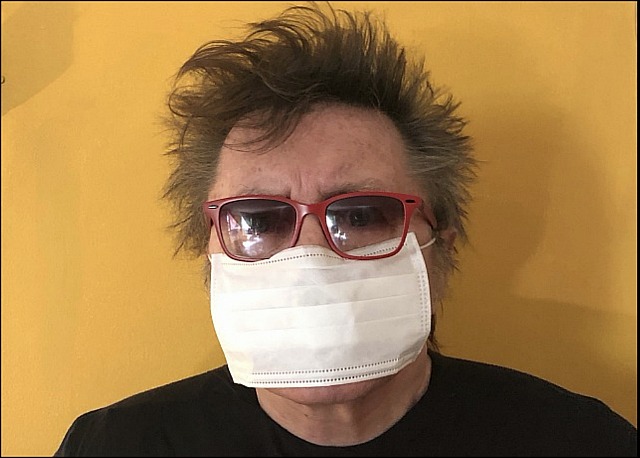
…the below photo (posted as part of a 2.25 story called “Don’t Stand So Close To Me”) was an attempt at humor. A publicist friend tweeted or messaged me on Facebook to say, “Okay, you need to calm down” or words to that effect. And I replied, “Just having a little fun” or words to that effect. Seven weeks.
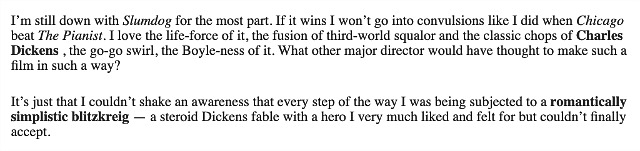
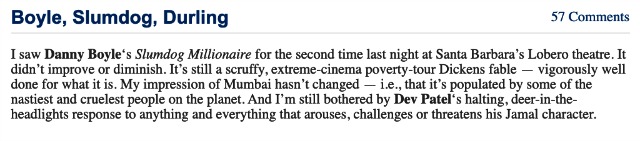
At best I was mixed on Slumdog Millionaire during the 2009/’10 Oscar season. I was 40% admiring and 60% annoyed, but I knew it wouldn’t do to make a fuss. So I had to sit there and take it for six damn months. In that sense it was a long Oscar season. Haven’t watched it since, will never watch it again.
Posted on 11.30.08: “How can anyone watch Slumdog and not be down with Jamal’s enormous dignity, strength of spirit and intelligence? And I understand (or think that I do) that Jamal’s life story is primarily a device that allows Boyle to dramatize the evolution of Mumbai chaos-culture over the past 15 or 20 years.
“But I just can’t believe that a kid who’s been subjected to such relentless cruelty and brutality his entire life — slapped, beaten, exploited, betrayed, booted, whipped, shat upon and made to suffer like a homeless dog day after day, year after year — would end up with this much patience and resolve and focus. Treat an actual dog like this and he’ll be incapable of showing anything but his teeth.
<
“Nor did I believe that the beautiful Freida Pinto‘s Latika wouldn’t be soiled and corrupted by her upbringing also, or that she’d stay emotionally loyal to and in love with Jamal through thick and thin. Things change, people grow up and move on, life is hard, get what you can, and nobody will save you but yourself. I know, I know…surrender to it, believe in love.
“But the cruelty in this film is relentless. Ugly behavior reigns during the first two acts. Except for the cop (Irfan Khan) who interrogates Jamal throughout the film, nearly every male character in Slumdog Millionaire is a cutthroat Fagin or Artful Dodger.
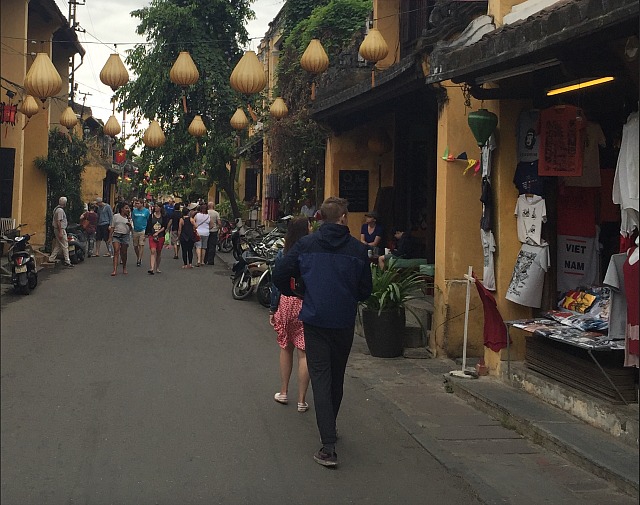
“And all through Slumdog I was muttering to myself how much I hate the Mumbai overload — the poverty, the crowding, the noise, the garbage landscapes, the public outhouses, the ugly high rises…the whole squalid cornucopia. I’ve never been especially interested in visiting urban India, but Slumdog settled things once and for all. If someone slips me a first-class Air India ticket from JFK to Mumbai, I’m trading it in for passage to Vietnam or China or Kampuchea or Katmandu.”
Johnny McQueen is a wounded, bleeding, half-delirious figure throughout Carol Reed’s classic 1947 film — after the robbery he’s never fully “there” and thereafter lies near the door of death, which constantly sings and beckons to him…”come to me, release your burdens, let me comfort you with my shroud”. And so Mason’s whole performance isn’t a tour de force but a fever-dream thing, and pretty much one-note — be honest. Poor rumpled Johnny is never strong or even conscious enough to say “I should do this” or “but I can’t do that.” He’s limp tissue, an invalid, a half-cognizant lamb waiting for the slaughter. His loyal girlfriend does him a favor at the end. Not a problematic performance as the sadness and resignation are constant and seeping, but certainly a limited one.
“Somehow, in their own way, the Rolling Stones split the difference, by performing ‘You Can’t Always Get What You Want.’ (They could have said, a la Bono, ‘Donald Trump stole this song, and we’re stealing it back,’ but did not.) It was easy to focus on the practical aspects of what they were doing: Were they playing together, or recorded sequentially? Why did Ronnie Wood’s licks appear to be live but Charlie Watts’ air-drumming not so much so? Certain elements of that conjoined performance may remain a mystery, until they’re explained to us. But it was kind of delightful, regardless — even as it imparted the slightly unnerving message that what we want — the old normal — probably isn’t what we’re going to get.” — from Chris Willman’s Variety review, filed just before midnight.
Donald Trump left our country unprepared and unprotected for the worst public health and economic crisis in our lifetime — and now we're paying the price. pic.twitter.com/aCxcqQqUqw
Never saw this before today. Good quality, excellent color, nicely mixed. Madison Square Garden, New York — 8.1.71. I saw Dylan play live exactly once, at Chicago’s Auditorium Theatre in 2005. The Never Ending Tour.
The other day I was saying to a friend that in 1960 industry attitudes about films like Psycho (shock and scare, psychologically twisted protagonist, knife murders and perversion) were regarded as basement-dwelling genre films, and that the most that could happen, even with Psycho‘s phenomenal financial success, were Oscar nominations and not wins.
The friend reminded that Bernard Herrmann‘s Psycho score, easily one of the most distinctive and influential ever composed, wasn’t even nominated. Obviously a major snub — Herrmann’s score should have won.
All I can figure or theorize is that Herrmann might have been personally disliked or otherwise regarded askance by colleagues. (Or something in that realm.) I’ve never read a biography of the man. Has anyone?
Alfred Hitchcock was handed a Best Director nomination that year, but Billy Wilder won for The Apartment. Janet Leigh was nominated for Best Supporting Actress (an odd call as she didn’t deliver in any kind of striking way), but Elmer Gantry‘s Shirley Jones won. Psycho was also nominated for best black & white cinematography (John Russell), but Freddie Francis won for Sons and Lovers. Psycho‘s black & white art direction and set decoration was nominated (Joseph Hurley, Robert Clatworthy, George Milo), but the Oscar was won by The Apartment‘s Alexandre Trauner and Edward G. Boyle.
Incidentally: Whatever happened to the idea of Universal releasing a Bluray of the slightly more risque German version? I’d buy it without blinking.
I’d like to agree. Okay, I do agree. To some extent. I’d like to think that things aren’t as bad as certain headlines have indicated. Okay, maybe they’re not. Editors know that fear sells, and we know that they know this. So while the actual reporting is reliable and commendable, headline suspicion is an okay thing. (Right?) Otherwise all I know is that self-imposed imprisonment is no way to live. Well, it is but at such a cost.
From sea to shining sea Americans are undoubtedly drinking more, getting stoned, dropping Percocets, etc. It’s all part of the general atmosphere of depression and stasis. Time is standing still. Writing for writing’s sake is the only thing that keeps me going. That and phone surfing, watching films, taking strolls and safe (if technically illegal) hiking.
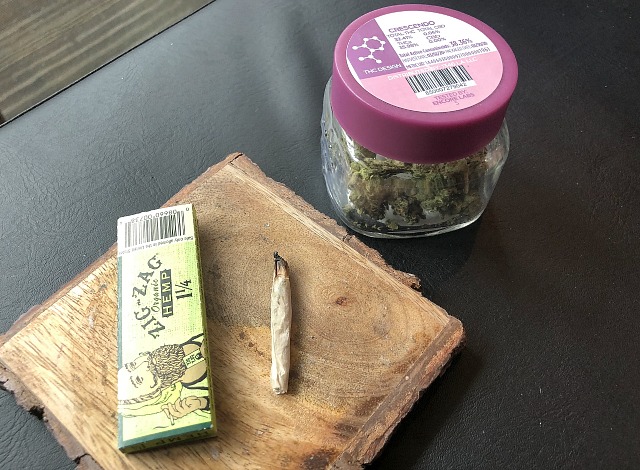
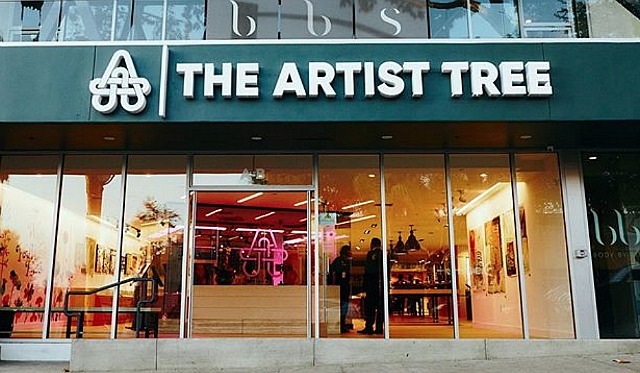
Last night Tatiana wanted to get high, so we walked up to The Artist Tree and bought a $51 container of Crescendo plus some rolling papers. For roughly the same cost they sell four pre-rolled joints, but where’s the fun in that?
Tatiana tried to talk me into joining her, but I can’t even flirt with the idea. Getting ripped has been out of the question since my mid 20s, which was when I realized that cannabis potentially re-ignites “the fear,” a state of acute anxiety and terror that I don’t even want to think about as we speak. I accidentally re-experienced this in the late ’90s when I stupidly ate a pot brownie. I don’t know what I was thinking.