
“Little Things” Can’t Match “Se7en”

There are three principal characters in John Lee Hancock‘s The Little Things (theatrical + HBO Max, 1.29), a cops-chase-killer drama set in 1990 Los Angeles.

Denzel Washington plays the wise old cop, seasoned but spooked by some past tragedy that Hancock’s script (written in ’91 or ’92) doesn’t tell us about until right before the end. Rami Malek plays the young cop, a tense hot-dog who wears perfectly tailored skinny suits. And Jared Leto plays the wacko weirdo baddy-waddy with sunken eyes, a pot belly and dirty Jesus hippie hair.

The first hour of The Little Things is all cliched, formulaic character shadings about Denzel’s past (borrowed from a hundred other cop films about a detective who withdrew from active frontline duty but now has has to return and face his demons while dealing with some bad buried business and blah-dee-blah-blah-blah-blah-dee-blah) + the building of trust between himself and hot-dog Malek.

They wind up working hand in hand to try and capture a nocturnal murderer of young women. And I’m telling you straight and true that the movie doesn’t kick in until Leto shows up, or roughly around the 60-minute mark.

I’m not saying if Leto is actually playing a killer or not (he might be), but he’s obviously offering a variation of Kevin Spacey‘s John Doe in Se7en. And he owns the film when he turns that weird shit on.

And then Hancock has the absolute friggin’ nerve to completely duplicate the finale of Se7en except for one or two things — (a) killer and cop drive out to a desert area so killer can reveal something big, (b) killer taunts cop by telling him to dig in three or four different spots but it just stalling, (c) killer taunts cop with knowledge about his own family and his own shortcomings as a dad, (d) cop seethes and seethes some more…

The difference is that unlike Morgan Freeman and Brad Pitt in Se7en, Rami and Denzel don’t call in choppers or backup and decide to fix things up. So the bad stuff is handled but destined to linger.

The problem is that we all expect a good cop drama to deliver some form of rough justice. We want things to balance out on some level, What happens at the end of The Little Things is not justice — it’s evasion. Stuff being buried or brushed aside.

Leto gives the movie its only real energy. Denzel is one of our greats, but he really needs to drop 20 pounds. With a little dieting and treadmill action he could get back to where he was in Man on Fire. Malek is okay.

So The Little Things is basically a poor man’s Se7en mixed in with sprinklings from The Onion Field and Manhunter and you-tell-me-how-many-other haunted cop films.

Question: What kind of stupid-ass detective reacts like a nervous rookie because it’s dark out and some woman has rustled some bushes before coming into view?

The period cars and whatnot look good. But there were no hookers on the streets of Los Angeles in 1990. I was here and driving around so don’t tell me.
Read more

Salesmanship + Momentum

You have to hand it to Netflix for pulling off a surprisingly effective award-season campaign on behalf of Spike Lee‘s Da 5 Bloods. First came Delroy Lindo and the late Chadwick Boseman snagging Best Actor and Best Supporting Actor trophies from the NYFCC. And then on 1.14.21 Lee became the 34th recipient Of American Cinematheque Award. And now the National Board of Review has handed three major awards to Lee’s film — Best Film, Best Director and Best Ensemble.

Seriously, I’m impressed.

I’ve placed a boldfaced HE next to the NBR Award that I fully support or can at least live with:

Best Film: Da 5 Bloods (Netflix)
Best Director: Spike Lee, Da 5 Bloods (Netflix)
Best Actor: Riz Ahmed, Sound of Metal (Amazon Studios) / HE
Best Actress: Carey Mulligan, Promising Young Woman (Focus Features) / HE
Best Supporting Actor: Paul Raci, Sound of Metal (Amazon Studios) / HE
Best Supporting Actress: YuhJung, Minari (A24) / HE
Best Adapted Screenplay
: Paul Greengrass, Luke Davies, News of the World (Universal Pictures)
Best Original Screenplay: Lee Isaac Chung, Minari (A24) / HE
Best Animated Feature: Soul (Pixar)
Best Foreign Language Film: La Llorona (Guatemala) / haven’t seen it
Best Documentary: Time (Amazon Studios)
NBR Icon Award: Chadwick Boseman / HE

Variety-Mulligan-Harvey Again

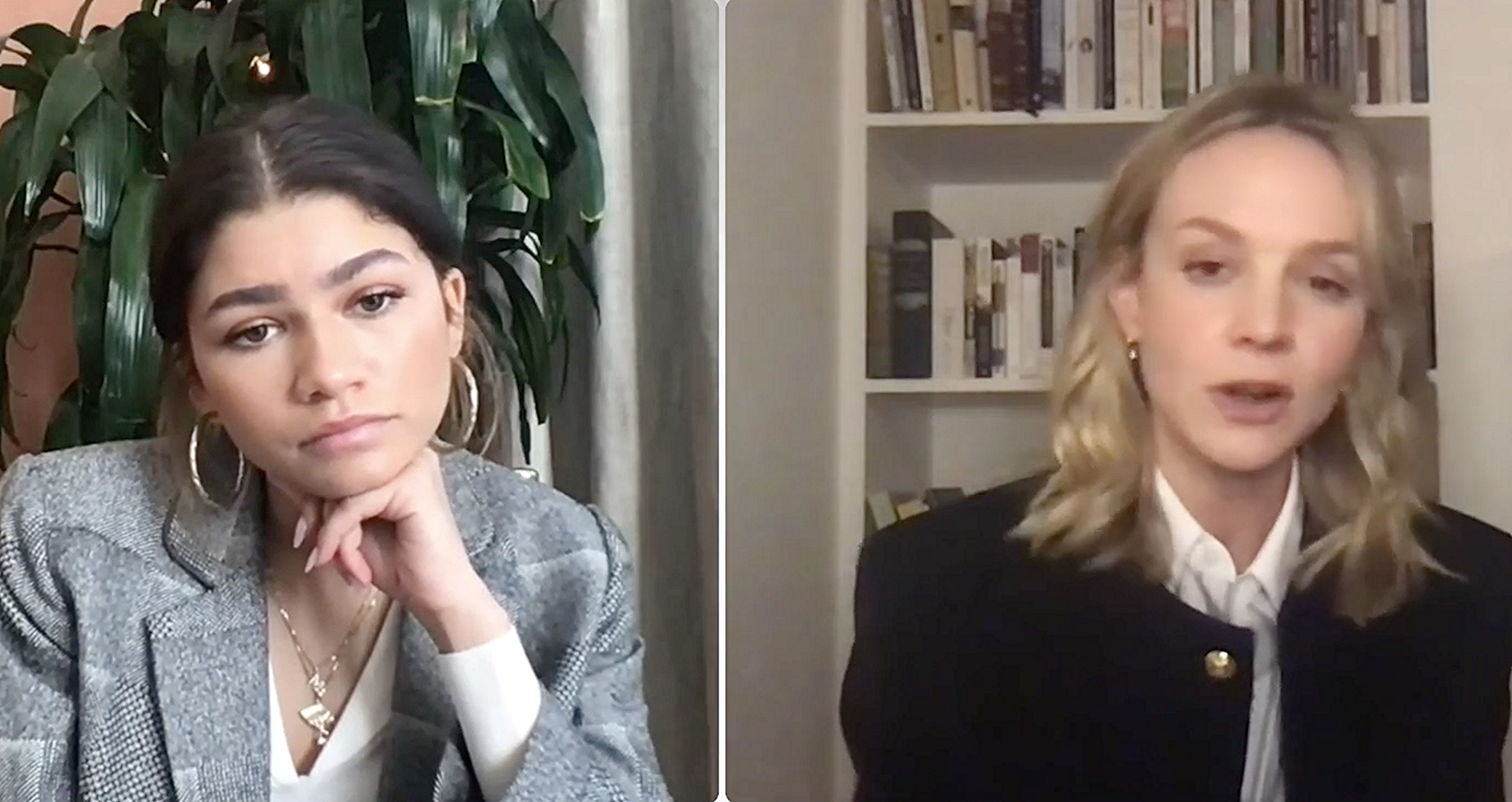
In a just-posted Variety video chat between Promising Young Woman‘s Carey Mulligan and Malcom & Marie‘s Zendaya, Mulligan offers her reaction to Variety management having apologized for a portion of Dennis Harvey’s 1.26.20 review of Mulligan’s film.

Mulligan’s assessment is astute and wise, but the timing of Variety‘s apology is crucial to understanding what actually happened here.

Harvey filed the review during last January’s Sundance Film Festival, but the apology didn’t appear until Mulligan complained to the N.Y. Times‘ Kyle Buchanan in a 12.23.20 profile.

Variety‘s mea culpa: “Variety sincerely apologizes to Carey Mulligan and regrets the insensitive language and insinuation in our review of Promising Young Woman that minimized her daring performance.”

Three important caveats: One, Harvey’s review passed muster with Variety‘s editors 12 months ago and nobody said boo — not until political pressure was brought to bear did they say a word. Two, a trade paper apologizing for a review is bad form and a bad precedentVariety should have instead posted a counter-review that argued with Harvey. (I personally disagreed with what Harvey said about Mulligan vs. Robbie — his remarks missed the point of the film.) And three, out of respect for Harvey’s years of excellent reviews Variety should have given him an opportunity to explain his viewpoint more fully. Instead they threw him under the bus, and in so doing bruised his reputation.

Variety has devoted a special page to Mulligan’s just-posted remarks about the Harvey brouhaha. Kate Aurthur‘s intro to Mulligan’s reaction states the following: “Though the review…was mostly positive, the Variety newsroom agreed with Mulligan.” 11 months after the fact, she meant to say. After Mulligan complained to Kyle Buchanan and not before. Variety didn’t apologize for jack diddly squat when the review ran a year ago. Let’s make that crystal clear.

Read more

Fashion Curve

If I were voting for the Film Independent Spirt Awards’ Best Feature prize, I wouldn’t think about it twice. It would have to be Nomadland. But the total number of Spirit Award nominations is often a tip-off, and the fact that Nomadland has only five suggests that it may not win the top prize. Eliza Hittman‘s Never Rarely Sometimes Always has tallied seven nominations, including for Best Feature…what does that tell you? I’ll tell you what it tells you. It tells you that Hittman’s film, a respected effort that doesn’t hold a candle to Cristian Mungiu‘s 4 Months, 3 Weeks and 2 Days (’07), is the likely champ.

Significant paragraph in THR announcement story, written by Hilary Lewis and Mia Galuppo: