Favorite Cannes Film Festival By Far

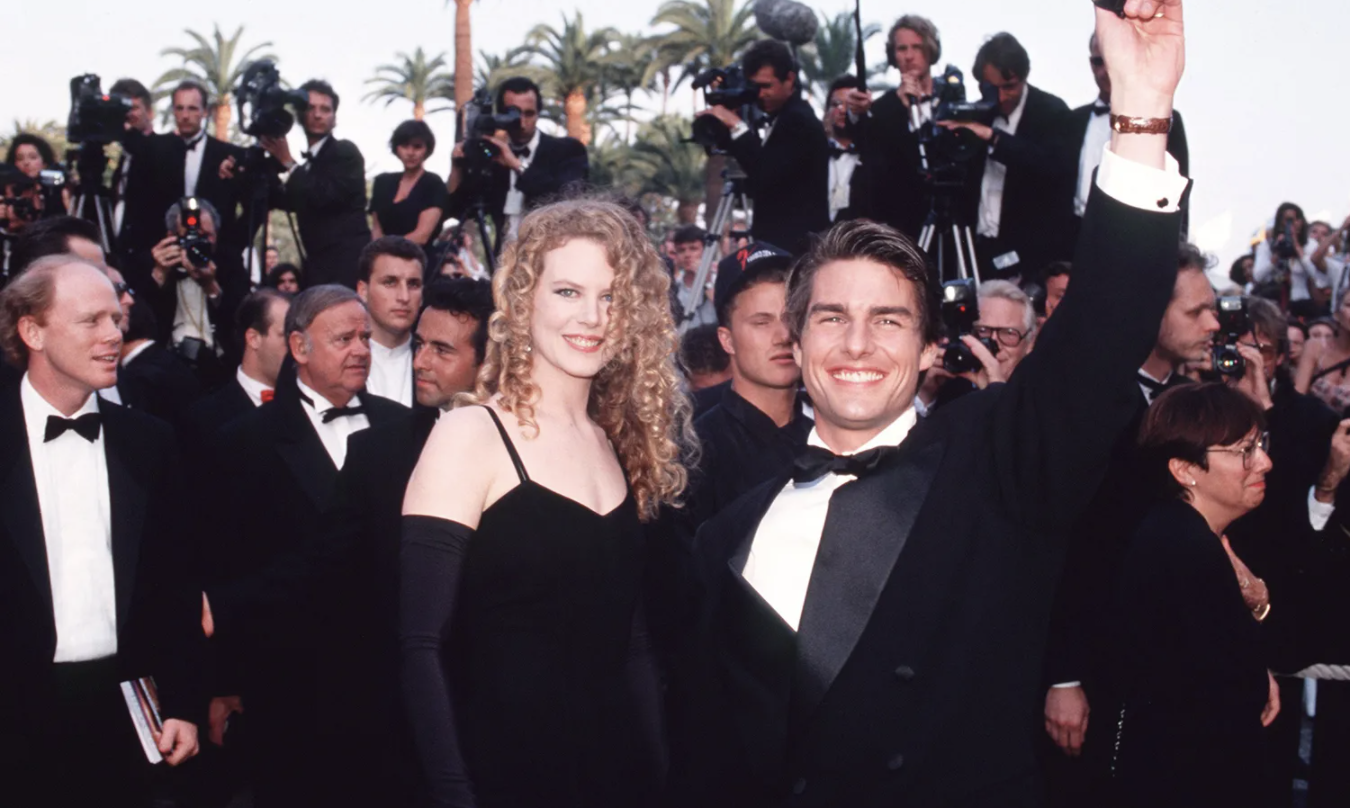
For mostly sentimental reasons, I can’t stop telling myself that the 1992 Cannes Film Festival (5.7 to 5.18) was my absolute personal best. Because it was my first time there and therefore it felt fresh and exotic and intimidating as fuck. I had to think on my feet and figure it out as I went along, and despite being told that I would never figure out all the angles, somehow I did. ‘

It also felt great to be there on behalf of Entertainment Weekly and do pretty well in that capacity. Plus it was the first and only Cannes that I brought a tuxedo to. I’d been told it was an absolute social necessity.

Here are some of the reasons why I’ve always thought ’92 was the shit.

The first time you visit any major city or participate in any big-time event things always seem special and extra-dimensional…bracing, fascinating, open your eyes…everything you see, taste, smell and hear is stamped onto your brain matter…aromas, sights, protocols, expectations, surprises.

Nearly every night I enjoyed some late-night drinking and fraternizing at Le Petit Carlton, a popular street bar. (Or was it Le Petit Majestic?) If you can do the job and get moderately tipsy and schmoozy every night, so much the better. (Or so I thought at the time.) A year earlier I read a quote from P.J. O’Rourke — “Life would be unbearable without alcohol”. I remember chuckling and saying to myself, “Yeah, that’s how I feel also.” Jack Daniels and ginger ale mood-elevators were fun! Loved it!

But not altogether. Four years later I stopped drinking hard stuff; 20 years later (3.20.12) I embraced total sobriety.
I stayed in a gloriously small room (big enough for a queen-sized bed and a dresser) inside the storied, exquisitely comforting, whistle-clean Hotel Moliere (5 rue Moliere 06400 Cannes), and for only $90 or $100 per night. (Something like that.)

I attended the int’l world premieres of the following films: Quentin Tarantino‘s Reservoir Dogs, James Ivory‘s Howard’s End, Robert Altman‘s The Player (I;d already seen it twice in Los Angeles but still), Abel Ferrara‘s Bad Lieutenant, Tim RobbinsBob Roberts, Paul Verhoeven‘s Basic Instinct, Hal Hartley‘s Simple Men, Abbas Kiarostami‘s Life, and Nothing More…, Baz Luhrman‘s Strictly Ballroom, Vincent Ward‘s Map of the Human Heart…perhaps not the greatest all-time lineup but each viewing felt like a big deal.

I ignored Far and Away — I’d seen Ron Howard‘s period film in Los Angeles a bit earlier, and that was enough.

I met and briefly schmoozed with Tarantino, Verhoeven, Altman, et. al. And attended six or seven cool black-tie parties.

Read more

Unfortunate Emphasis?

Honestly? I’d much rather see a smart, sexy, well-layered, in-depth documentary about the late Lou Reed than a doc about the Velvet Underground. Because all my life I’ve had to deal with John Cale‘s jagged, screechy-ass electric violin, and while I know (and respect the fact) that Cale’s tonally abrasive playing was an essential component in the Velvet Underground sound, it always bothered me regardless.

Telepathic HE to Cale while listening to “Venus in Furs”: “Yeah, I get it, man…you’re a brilliant string-saw, an avant garde musician who’s moved past the tired milquetoast game of trying to comfort or ear-massage your listeners…but every now and then I wish I could shut you up, no offense.”

I loved the Velvets because of Reed and Nico and most of the songs, but I liked Reed a lot more when he was free of Calescreech and began cutting his own albums with David Bowie, Mick Ronson and his own musicians — Transformer, Berlin, Sally Can’t Dance, Rock ‘n’ Roll Animal, Coney Island Baby, Street Hassle, Magic and Loss.

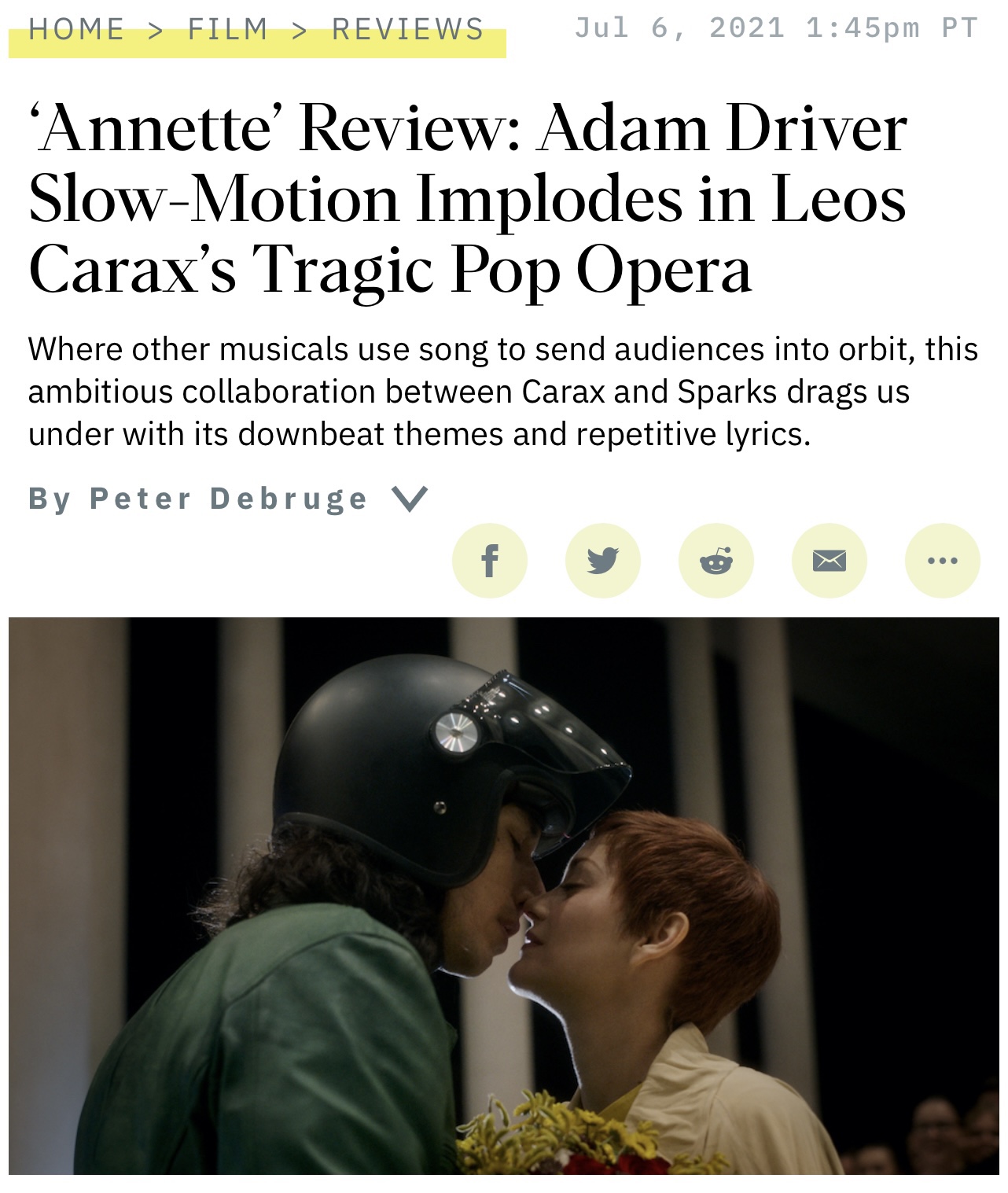
I’m therefore a little bit sorry that Todd HaynesThe Velvet Underground doc, which premiered Wednesday night in Cannes, allegedly focuses a bit more on Cale than on Reed. Or at least, it does according to Variety‘s Owen Gleiberman. That’s unfortunate, if true.

Gleiberman: “Lou the subversive guitar bad boy and Cale the debonair experimentalist came together like an acid and a base. The drone that Cale would listen to became part of the DNA of the Velvets — you can hear it in the ominous sawing viola of ‘Venus in Furs,’ the majestic cacophony of ‘All Tomorrow’s Parties.’

“Yet as great and defining as those songs are, it’s hard to shake the feeling that The Velvet Underground overstates the John Cale side of the equation. The film spends close to an hour reveling in the New York bohemian soil out of which the Velvets sprung. If this were a four-hour, long-form doc (which the subject deserves), I could see that, but Haynes, I think, also views John Cale as a metaphor for the band’s ‘purity.’ Their transcendent first album, The Velvet Underground & Nico, is unthinkable without him, yet he’s the one whose story the documentary feels organized around.

“And that’s not just because Cale (now 79, with floppy silver hair) is interviewed at length while Reed, who died in 2013, couldn’t be. No, it’s as if Haynes wanted the Velvets to be an art band even more than he wanted them to be a rock ‘n’ roll band.”

Instant Hate

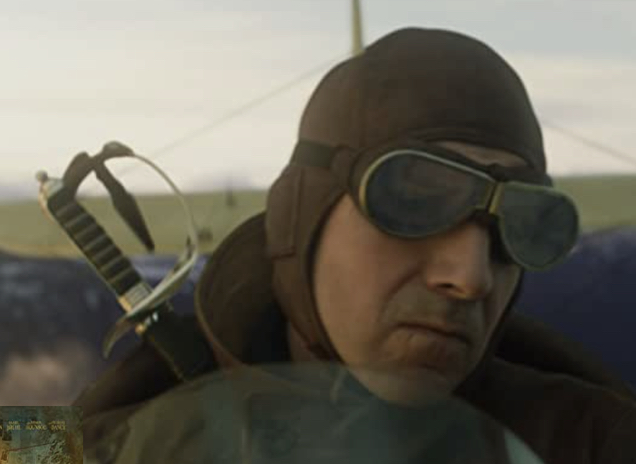
A prequel to the deeply loathed Kingsman: The Secret Service (’14) and Kingsman: The Golden Circle (’17), The King’s Man is a fresh serving of bored derring do, bland British attitude and bullshit CG swill from director-cowriter Matthew Vaughan and screenwriter Karl Gajdusek. The costars are Harris Dickinson (the new guy), Ralph Fiennes, Gemma Arterton, Rhys Ifans, Matthew Goode, Tom Hollander, Daniel Brühl, Djimon Hounsou and Charles Dance — each one bending over for the money and nothing else.

Originally slated to open on 11.15.19, or roughly a year before the 2020 election, The King’s Man (20th Century Studios) will open on 12.22.21. HE suggestion: What about December ’22?

Read more

Cannes Stasis…For Now

It’s now just after 10:30 pm Cannes time, and World of Reel‘s Jordan Ruimy, whose Montreal-to-Nice flight landed earlier today, reports that “nothing substantial has screened” in his orbit.

One seasoned know-it-all was impressed with Sophie Marceau‘s lead performance in Francois Ozon‘s Everything Went Fine but otherwise found it “a little too emotionally manipulative.”

Ruimy adds that Nadav Lapid‘s Ahed’s Knee “is a big whatever.”

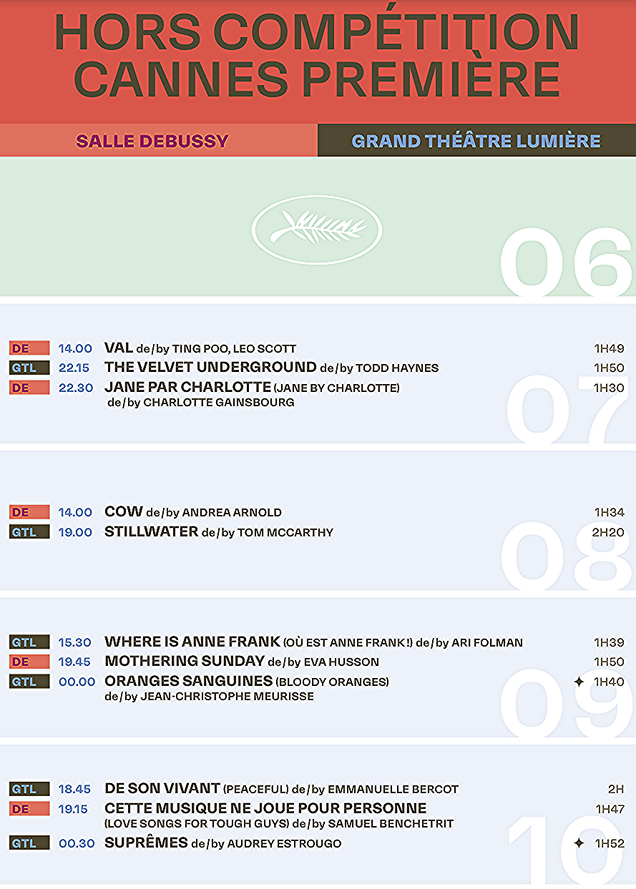
A black-tie screening of Todd HaynesThe Velvet Underground (doc) is currently playing for a sea of swells.

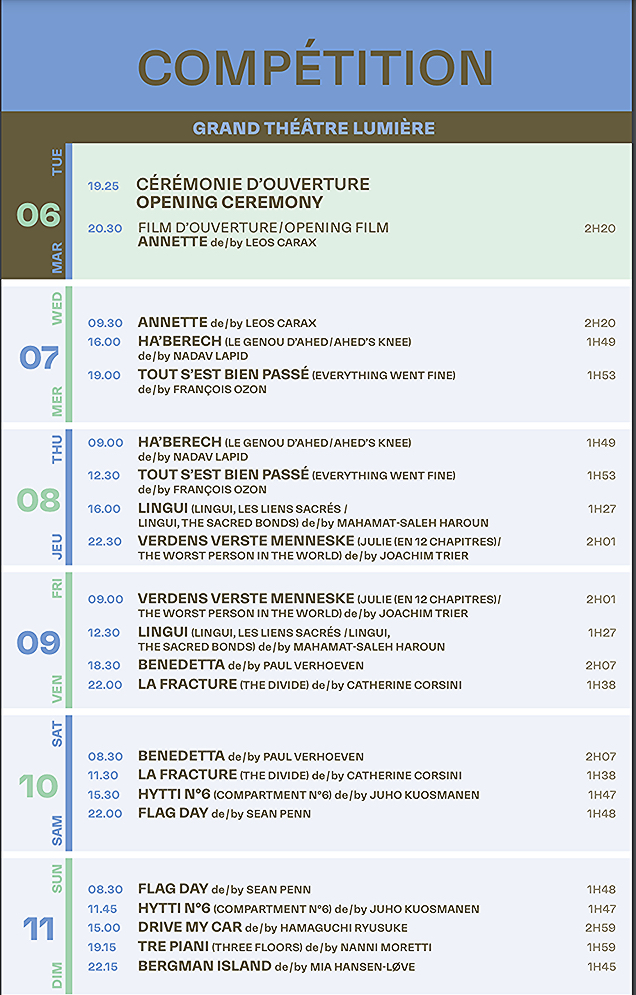
Playing out-of-competition tomorrow (Thursday, 7.8) are Andrea Arnold‘s Cow (Debussy — a doc) and Tom McCarthy‘s Stillwater (Grand Lumiere). Paul Verhoeven‘s Benedetta screens Friday and Saturday.

Read more

Respect for Robert Downey’s Genius Dad

Hollywood Elsewhere salutes Robert Downey Sr., the once-legendary director of iconoclastic, guerilla-style, counter-culture stoner classics like Putney Swope (’69) — the deadpan Madison Ave. comedy that put Downey on the map — and Greaser’s Palace (’72), an absurdist western comedy about the second coming of Christ. [The entire film is embedded after the jump.]

Not to mention lesser Downey efforts like Chafed Elbows, Pound, an adaptation of David Rabe‘s Sticks and Bones, Up The Academy, Too Much Sun and Hugo Pool.

Downey died in his sleep earlier today (7.7) at his Manhattan home. He was 85.

I interviewed Downey 24 and 1/2 years ago during the ’97 Sundance Film Festival, where Hugo Pool had its big debut. Nobody thought it was very good (including Downey Sr. himself), but the man was such a legend that all the journalists wanted to chat with him. My sit-down happened at a Hugo Pool party at a handsome chalet-type home in Park City, sometime in the mid to late evening. Downey Sr. was 61 at the time and brimming with personality — fleet, funny and wise. (And totally white-haired.) I liked him immediately, and felt honored to have been given my 20 minutes.

It can’t be over-emphasized what a huge counter-cultural deal Putney Swope was when it first broke; ditto Greaser’s Palace three years later. I’m not saying these films don’t “work” according to classic or present-day sensibilities, but they were much funnier and significantly enhanced if you were ripped.

Here’s a pretty good q & a (“Six Decades of Robert Downey Sr.“) from Interview‘s Kaleem Aftab, posted on 12.8.14.

Read more

Another “Teenage Pain” Story

Being a mid-realm teenager (14, 15, 16 and sometimes 17) can feel like a cross between a Eugene O’Neil or Edward Albee melodrama and a kind of low-simmering horror film. Or at least, it felt that way to me. Okay, most of the time I was dead bored or lost in television or a movie I’d recently seen or seething about some suffocating parental restriction, but during those periods when I actually faced my situation I was engulfed in something that felt like a form of suffocation.

I can’t speak about the horrors that teenage girls go through, God help them, but almost all male teenagers go through unpleasant trials and gauntlets and humiliations, sometimes involving sex (or the desperate longing for same or at least a brief taste of the nookie realm) and more often involving battling-buck behavior…parking-lot taunting, braggadocio, forced machismo, “I won’t back down but on the other hand it might make sense if I do, even if the other guy gets to preen and strut around,” etc.

Who contributed more significantly to making my teenaged life feel more tortured, more conflicted, more arduous, more upsetting in this or that way — my alleged junior high and high-school chums (i.e., confrontational peers) who gave me shit for being different and odd-angled in my thinking, or my well-meaning but nonetheless bruising parents, which is to say my mostly indifferent, occasionally seething alcoholic dad who was augmented for the most part by my mom, who was just trying to hold things together?

The answer, of course, is that my parents and high-school frenemies were a team — they worked hand in hand to make my teenaged life a creative, optimistic, positive-minded paradise.

Seriously, teenaged life is always difficult. I don’t want to say “it’s intended to be” — that would be too horrific a diagnosis — but the experience has never been a walk in the park for anyone except for high achievers, brown-nosers, goodie-goodie and Student Council types, and in some instances even these people, these apparent lightweights are dealing with all kinds of buried convulsions.

True story: There was a straight-arrow guy in my New Jersey junior high school, a bespectacled, conservative-mannered guy who had either run for or been elected Student Council president, and one night he tried to commit suicide. No, not by hanging himself in the bathroom — that would be too decisive — but by drinking some kind of poison. And he was the kind of guy who sprinkled talcum power in his shiny shoes when he was getting dressed for a prom.

I never even fantasized about doing myself in — the thought has never been in me until recently — but I did undergo a kind of long-accumulated rage explosion in my high-school cafeteria once, and it was a doozy.

A “friend” had gotten hold of something I valued — I can’t remember if it was a drawing or a letter to some girl or a movie program from Times Square or a cherished 33 and 1/3 record album — all I remember is that it was something that mattered a lot to me, and this guy (a casual hang buddy whom I regarded from time to time as a half-assed friend of sorts) had thrown it into a garbage receptacle of some kind, and I distinctly recall pulling the article out of the bin, walking over to a cafeteria table where the “friend” and some others were sitting, picking up a wooden chair and throwing it at him and shouting what an asshole he was. I threw the chair so hard that it bounced off my “friend’s” head or shoulder and hit a young girl who happened to be walking just behind him.

I was disciplined for this, of course. People who can’t hold their tempers will always be called on that by social forces, especially if physical harm (however slight) is part of the lashing-out process, as well they should.

But the girl who was hit by the chair didn’t make anything out of it (thank God). My “friend” was scowling in the aftermath and telling me what a jerk I was, etc. My comeback line was something along the lines of “yeah? well, there’s more where that came from, ya fuck…a lot more.”

Not bad under the circumstances.

Best Scene Gibson and Donner Ever Shot

100% Martin Riggs: “Whaddaya wanna hear, man? Do ya wanna hear that sometimes I think about eatin’ a bullet? Hah? Well, I do. I even got a special one for the occasion with a hollow point…look. Make sure it blows the back of my goddam head off, do the job right.”

The following passage is 50% Riggs and 50% me (i.e., Jeffrey Wells) right now: “Every single day I wake up and I think of a reason not to do it, every single day. And you know why I don’t do it? It’s gonna make you laugh. You know why I don’t do it? The job. Doin’ the job. And that’s the reason.”

Franchises & Sequels Are A Prison Camp

Every now and then Chris Gore seems to be on the verge of saying “yes, they’re a prison camp…of course they are!” But he always wusses out or, you know, holds back. Because he’s still invested in the things that moved him as a kid and a teenager. Which, I suppose, also describes me to some extent.

Splinter of the Mind’s Eye” is available on Kindle for $4.99.

Only Can Only Hope…

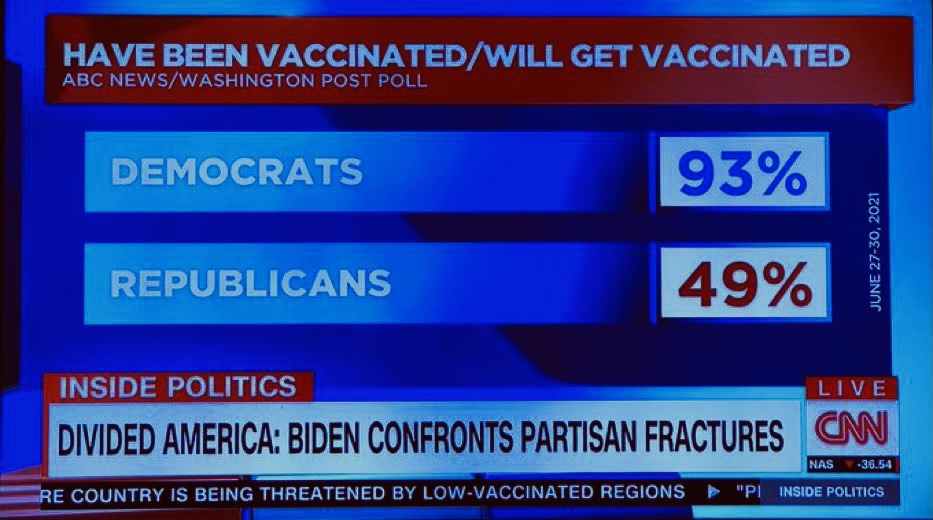
…that a fair-sized percentage of the Republicans refusing the vaccine will succumb to the Delta variant and perhaps…move on the next realm? C’mon, what’s so bad about that? They’re monsters, they’re lunatics, they’re prolonging the pandemic…fuck ’em if they can’t take a joke.

Excellent Richard Donner Story!

True story from a critic friend, edited by the author so as to obscure his/her identity:

I know it’s wrong to speak ill of the dead. But I so enjoy telling this story.

Let me start like this: Any job description in a help-wanted ad seeking to hire a critic should include these words: “Must be a bit of a dick.”

The ads never say that. But they should. Because, no matter how nicely you do it, some people don’t take criticism well. Inevitably, you will have to say something negative in a public forum about the creative expression of another human being. Whether you mean to be or not, they’ll think you’re a dick.

Here’s the thing: Sometimes, it’s really enjoyable to be as witty and as nasty as you can when you’re writing a review. Because you’re being a dick, which is, by definition, fun.

I knew early on that I had the ability to provoke and the willingness to do so (along with a shocking inability to foresee possible consequences of my
actions). I take a certain pride in a well-turned phrase and an irreverent sense of humor.

But while I’d experienced the immediate reactions of local artists — actors, directors, musicians — to my reviews in the early years of my career, I’d
rarely had the sense that, when I wrote a movie review or a review of a rock concert, the people I was writing about ever actually saw what I wrote.

Which brings me to my point about being a dick, and my Richard Donner story.

In 1994, during a moment when there was a microburst of interest in westerns because of the success of Unforgiven and Dances With Wolves, I’d been assigned one of those trend stories that editors love: the return of the Western. So I started making calls.

One of those went to a publicist at Warner Bros., which was a few months away from releasing Richard Donner’s remake of the 1950s TV hit, Maverick, starring Mel Gibson, Jodie Foster ands James Garner. Could I get a few minutes on the phone with Donner, I asked, to talk about westerns?

Donner was a director and producer of commercially successful middlebrow (or worse) films starting in the 1960s, including Superman with Christopher Reeve, The Goonies (most overrated kids film of all time), The Omen and the Lethal Weapon films, which, to my mind, had ruined action movies.

In those days before cell phones and e-mail, the reply came with surprising swiftness. I got a call back the same day from the Warners’ publicist, telling
me, no, Richard Donner would not speak to me about westerns — or anything else, apparently.

“Why not?” I asked.

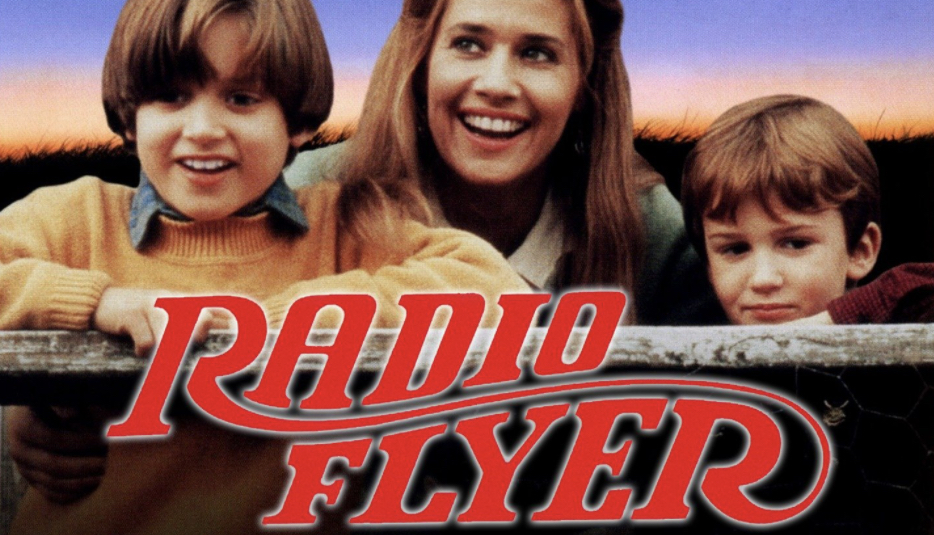
“Did you write a review of his film Radio Flyer“, the publicist asked.

It had been two years, but I knew exactly what he was talking about: I believe I called it “a feel-good film about child abuse.”

“Yeah, well, that was apparently a very personal film for him, so he’s not going to talk to you,” the publicist said.

Until that point — 1994, in a career that started officially when I turned pro in 1973 — I had no sense of anyone reading my reviews other than the
people within the immediate circulation area of my newspaper. I forwarded them to the film publicists in New York, and knew they were syndicated.
But I simply didn’t imagine filmmakers themselves actually taking the time.

Now, however, I knew I had Richard Donner’s attention.

So when Maverick came out in 1994 and I reviewed it, I referred to him on first reference as “Richard Donner, who directed Radio Flyer, a feel-good film about child abuse.”

Read more