First, as one who was friendly with Matt Drudge in the mid to late ’90s, I’m seriously impressed with Billy Eichner‘s impersonation of the guy (voice, physical resemblance, the hat) in the below clip from episode #2 of Impeachment. Listen to Eichner’s voice between :21 and :27 — “I hear you’re working on a new story about another woman our dear leader harassed.” Sounds a lot like the Real McCoy — just saying.
It’s odd how Impeachment producers have obviously gone to a great deal of trouble to make various cast members closely resemble the characters they’re playing, and yet they chose Beanie Feldstein to play Monica Lewinsky.
Second, there’s a scene in which Hillary is enraged at Bill for having lied to her about the Lewinsky thing. Hillary is far from stupid, and everyone knew Bill was an incorrigible hound when he was Governor of Arkansas in the ’80s and early ’90s. Plus everyone understands that leopards almost never change their spots. So what’s the possible basis for Hillary feeling betrayed and enraged over yet another infidelity during their White House years?
Hillary had a right to feel angry, of course, but about looking foolish by telling reporters that her husband was innocent. Bill broke their agreement by getting caught, and that made Hillary look like a liar or a fool. Generally speaking she obviously knew who he was in terms of randy behavior (watch Primary Colors) and couldn’t have been shocked to learn that he and Lewinsky had been intimate.
** We saw Titanic together on the Paramount lot in late November ’97, and a few weeks earlier he dropped by the People offices in West L.A. at my request to help me with a technical problem.
[WARNING: HE regulars who routinely complain about political-minded or inside-the-Hollywood-beltway posts should just ignore this. It’s just an angry reply to an ex-friend that I wrote last weekend. Don’t worry about it.]
A journalist I’ve known for a long, long time recently repeated an accusation that he’s hit me with before — that my blunt prose and occasional stridency isn’t a social fit these days, and that I’m not sufficiently emphasizing my passion for films and generally not being enough of a love machine in my jottings, and that my failure to do this since woke terrorism began to manifest in mid ’18 has been self-destructive.
My troubles are my own, he basically meant. He was also subliminally hinting that if there ever was a time to drop to my knees and start aggressively smooching ass, it’s right now.
Something snapped when I read his email, and so I sent him a sternly-worded reply. After being in this racket for 30 years (a little over 40 years if you go back to my NYC freelance days), he was basically saying “you need to recreate yourself…you need to eat a little humble pie and audition for your tormentors as a way of saying ‘hey, guys, I’m not that bad because I love movies!’ I thought about my reply this morning, and decided to share it with the world:
“I have written the best HE column I can, each and every day, for 17 years now (i.e., HE launched in August 2004). I was part of the serious film journo crowd starting in the early ’90s, and I stayed there for nearly 30 years — on all the screening and festival lists, occasionally quoted or written about, good to excellent ad income, liked by many, tolerated by others and, except in the minds of a few cancerous and malevolent personalities, certainly respected.
“And then (hello?) Trump was elected and THE CULTURE WENT INTO CONVULSIONS, the hinterland uglies came out of their gopher holes, the hate currents intensified, wokester advocates began to spread terror in liberal circles, and the crime of being an older white male (even a liberal, thoughtful one) suddenly became a ‘thing’ to avoid or identify as, and before you knew it older white dudes were presumed to be suspiciously toxic on all fronts (especially if your views on CRT and the 1619 Project were similar to Andrew Sullivan’s), and when questioned the only thing a white dude could do was drop to his knees and plead for forgiveness and insist (as was the case in my corner) that he’s a moderate left-centrist and that he despises the nutbag right.
“And somewhere in the midst of this process (i.e., starting around mid ’18 and certainly by ’19 and ’20) persons like yourself and the sickening fiends you schmooze and smile with decided it was time to murder my life and livelihood because…I don’t know, because people can be vile when given half a chance? Because Hollywood’s progressive, diverse, anti-racist, #MeToo agendas had to be furthered and mandated top to bottom, and that meant cancelling certain belligerents (i.e., people who thought Moonlight was good but not great, or who despised the Soderbergh Oscarcast or who loathe most of the Marvel/D.C. films or thought that Parasite fell apart after they let the maid in during that evening rainstorm, or who find ‘presentism’ in historical films to be a bizarre form of fantasy-projection or who regard the normalizing of morbid obesity to be grotesque).
Award-seeking fall movies often spark bitter disputes. God knows Green Book did, and I was an ardent fan of that film all through the ’18 and early ’19 season. I didn’t “believe” that Green Book had a certain humanity and emotional poignancy that would connect with Average Joes in the Academy and the guilds — I knew it did and would.
Green Book wasn’t the deepest or most complex film in the world, but for a character-driven period flick about a pair of flawed but recognizably human fellows and the way things unfortunately were back in 1962, it rang true. And I knew people would respond to that fact. I was 90% sure that the wokester take-down efforts would come to naught because Green Book had the heart, the cards and the horses.
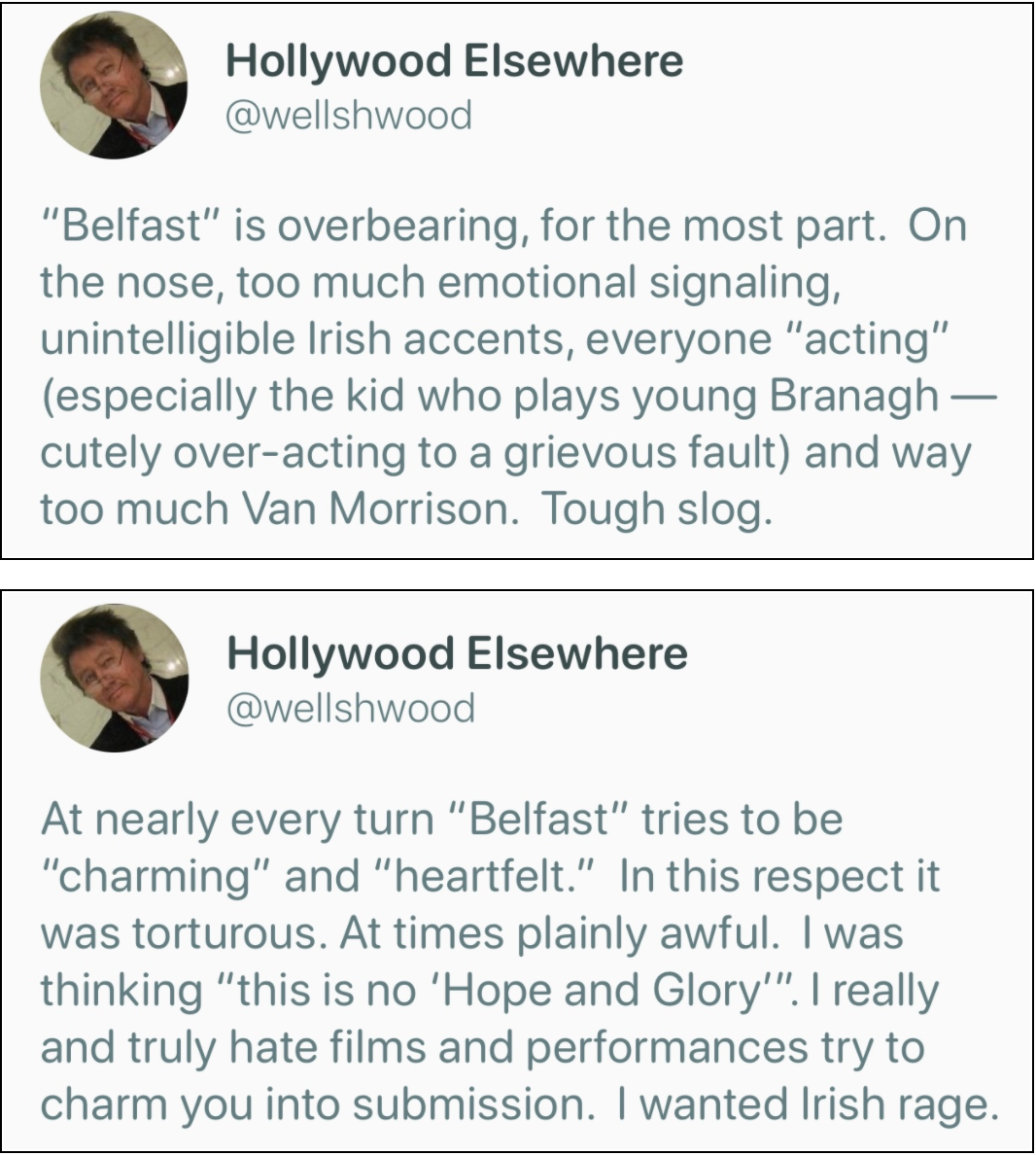
But now, God help us, it’s starting to appear that Kenneth Branagh‘s mawkish and treacly Belfast might be able to Green Book its way into the Best Picture category, and perhaps even into a win. As God is my witness and on the soul of my soon-to-be-born grandchild, Belfast isn’t worth the candle. I wouldn’t call it a calamity — it’s watchable and even interesting from time to time, and it delivers a certain bounce when Cieran Hinds is around — but it doesn’t have anything magical going on.
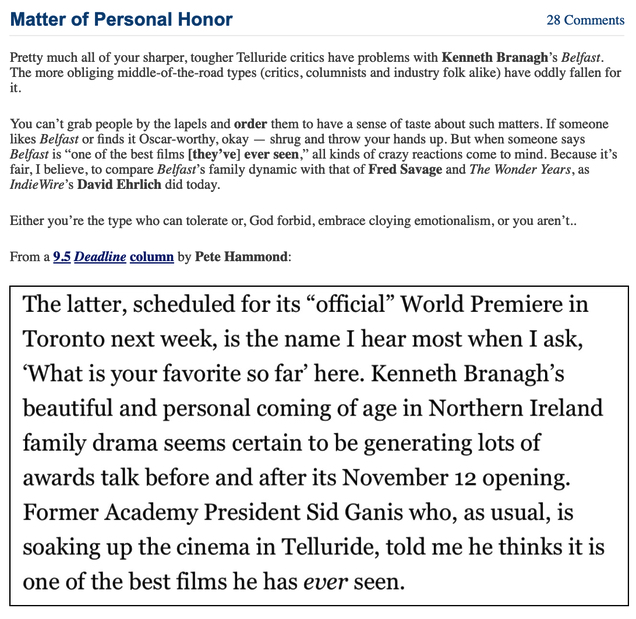
I knew after catching Belfast in Telluride that certain industry softies (i.e. the Sid Ganis brigade) would call it magnificent and heart-touching, etc. But I didn’t take them seriously. Competently made lump-in-the-throat movies, however treacly they may seem to some of us, will always win a certain portion of the crowd.
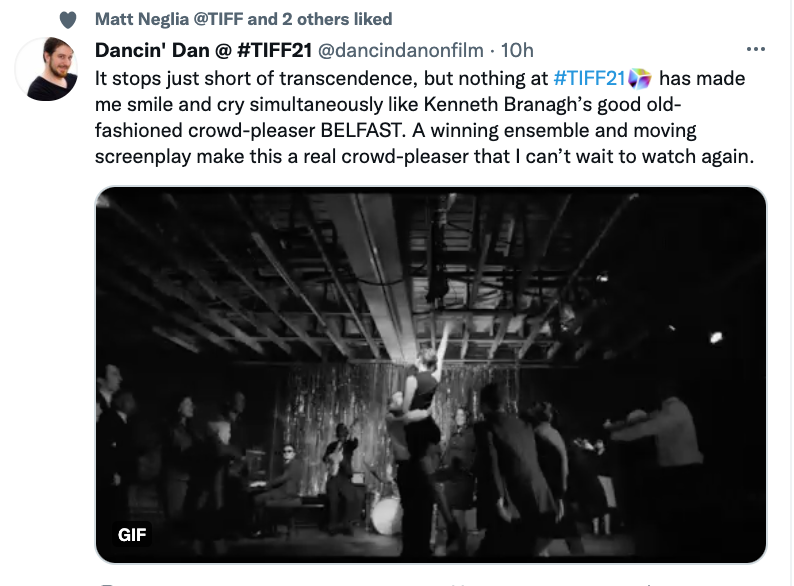
But this morning it hit me that the Belfast forces may be more numerous than I realized, and that they may be gaining strength. Awards Radar‘s Joey Magidsontweeted a few hours after seeing Belfast in Toronto that it may`go all the way and become “our” Best Picture winner, and that it’s “absolutely beautiful.” TheWrap‘s Steve Pond, a sensible and attuned pulse-taker who knows the difference between wheat and chaff, apparently attended the same TIFF screening and wrote directly after that it’s “visually stunning, emotionally wrenching and gloriously human.”
I feel drained and absolutely dumbfounded that we’re hearing such keen praise are for such a pandering and sentimental effort, a drama that partly incorporates the spirit of The Wonder Years (a thought posted by IndieWire‘s David Ehrlich) or even Leave It to Beaver (a view shared this morning by World of Reel‘s Jordan Ruimy), than to John Boorman‘s Hope and Glory or Alfonso Cuaron‘s Roma.
Pond: “Visually stunning, emotionally wrenching and gloriously human, Belfast takes one short period from Branagh’s life and finds in it a coming-of-age story, a portrait of a city fracturing in an instant and a profoundly moving lament for what’s been lost during decades of strife in his homeland of Northern Ireland. Plus it’s funny as hell — because if anybody knows how to laugh in the face of tragedy, it’s the Irish.”
Not only is Belfast not funny as hell — it tries for a tone of heartfelt amusement, but I didn’t so much as crack a smile.
Ruimy: “Belfast is rendered in rather ineffective and obvious ways — the first crush, going to the cinema, an absent father, Catholic school. Young Jude Hill, as a Branagh stand-in named Buddy, brings an insufferable amount of wide-eyed twee. [And] the whole thing sorely lacks a point-of-view, and so we never really get to know the boy well enough to become emotionally invested in the story. The end result is a mix of scattershot moments that want to feel personal and lovable, but end up isolating us. Too on-the-nose and lacking grit, Belfast plays like an odd mix of Roma and Jojo Rabbit.”
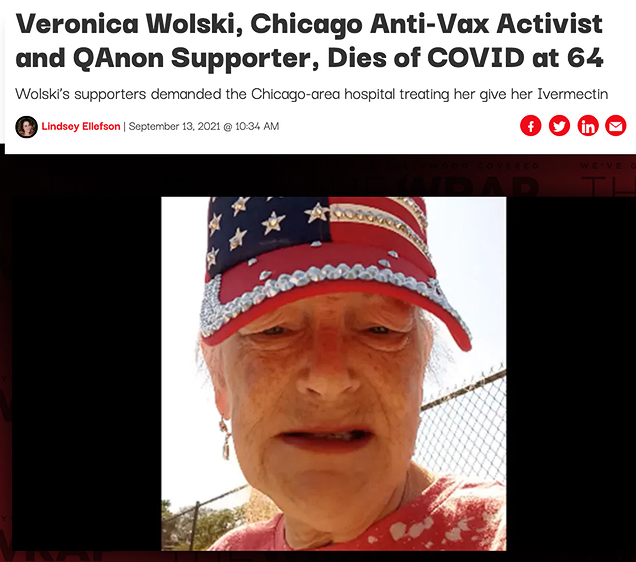
…if this or that anti-vaxxer passes on. Veronica Wolski could’ve taken the stab and saved herself. She didn’t because she was an idiot. Now there’s one less rightwing nutbag spreading toxic gas…works for me.
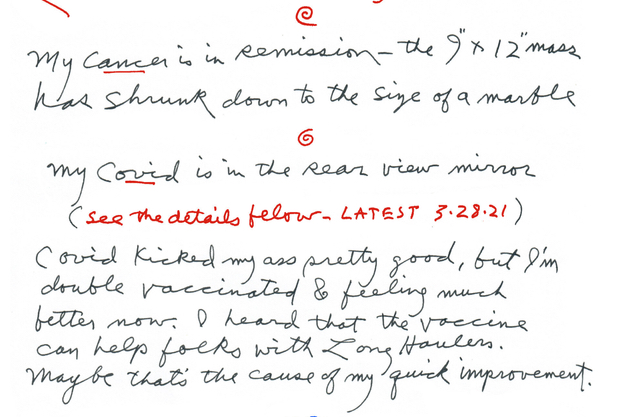
Posted today (9.13.21) by Jeff Bridges: “My cancer is in remission — the 9″ x 12” mass has shrunk down to the size of a marble. Covid kicked my ass pretty good, but I’m double vaccinated and feeling pretty good. I heard that the vaccine can help folks with Long Haulers. Maybe that’s the cause of my quick improvement.”