Surprise — Best Spider-Man Movie Ever

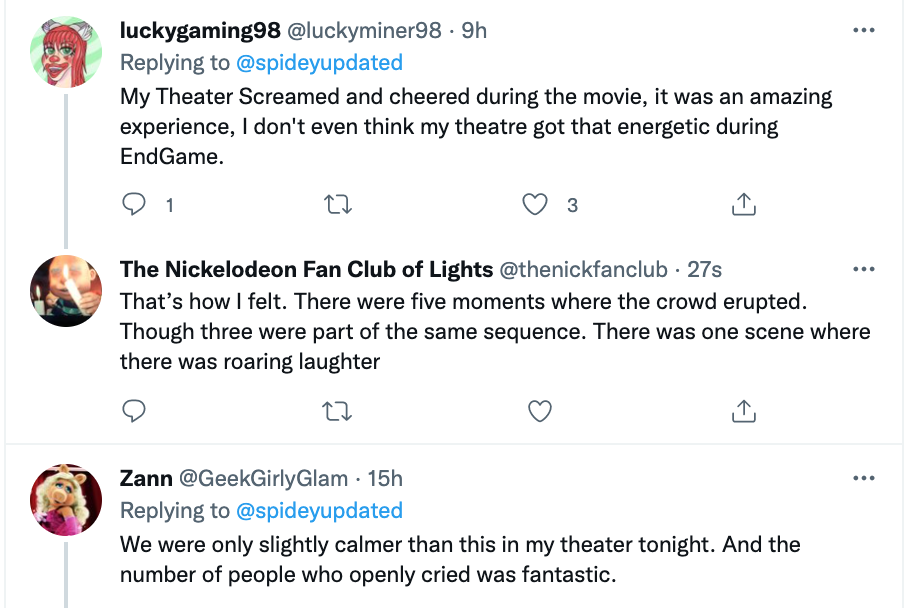
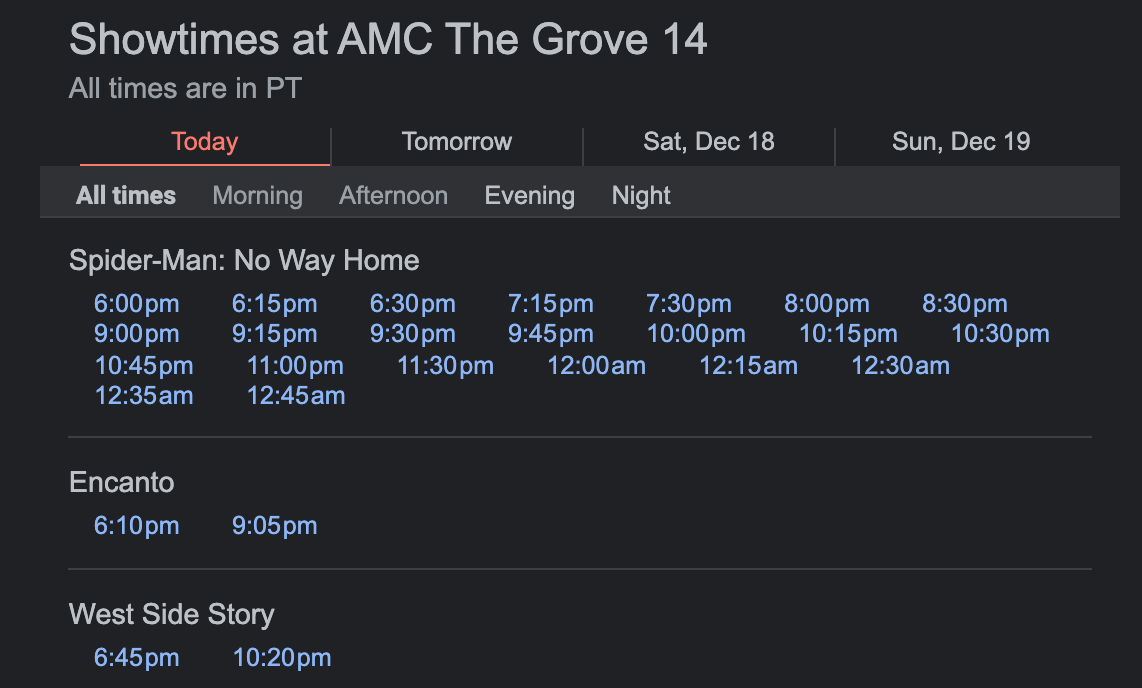
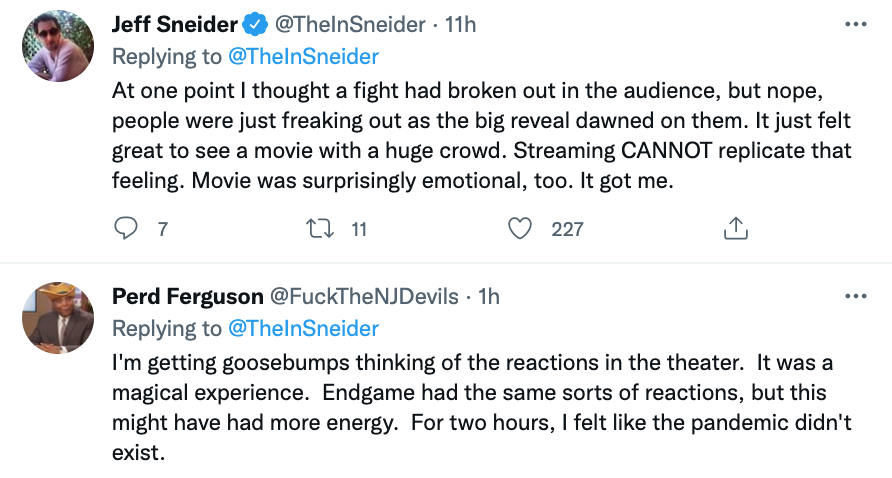
10:45 pm: My fears and premonitions about Jon Watts, Chris McKenna and Erik SommersSpider-Man: No Way Home were unfounded.. I’m not saying that a big chunk of it, particularly during the first 60 to 65 minutes, didn’t numb me out and at times bore me to death. I looked at my watch at 9:15 pm and went “oh, God, another whole hour to go!” But a tiny bit later everything started to change and advance and coagulate, and the trippier, hall-of-mirrors aspects of the “multiverse” plot started to kick in, and the movie got quieter and more reflective and then joyful…the crowd broke out in cheers three times…and I was suddenly going “holy shit, this is really working!”

Ridiculous as this may sound, it is HE’s conviction that McKenna and Sommers’ SM:NWH script has resulted in one of the most cosmically out-there meta-Marvel experiences ever, not to mention one of the most emotional Marvel sink-ins (and that includes Avengers: Endgame).

As much as I hate to admit this, Spider-Man: No Way Home — despite all the flash-bang-jizz-whizz-whomp-thromp crap that occupies much of the first 60 to 65 minutes, which I hated — is easily one of 2021’s best films. It actually should be nominated for Best Picture because it turns the proverbial magic key — it turns audiences on. I was there and I felt it, dammit. This is what people go to the movies for. It even ends a little bit like Warren Beatty‘s Heaven Can Wait…almost. At the finish everyone applauded.

Yes, the early sections are an unfortunate lesson in FX chaos action editing, and at times the film felt like a fan-service mechanism, a machine, a greatest hits service tray. But the last 45 to 50 minutes are really good. I was totally sold. Call me flabbergasted.
First Reaction

..to the teaser for Ben Stiller and Dan Erickson‘s Severance (Apple TV+, 2.18.22) is something along the lines of “this is obviously a dry and intelligent limited series, and I’m there.” Getting a bit of a Downsizing meets 1984 meets THX-1138 vibe…who wouldn’t? About a mass man (Adam Scott) willfully submitting to corporate-think — “a group of office employees who have agreed to have their memories severed through an experimental medical brain procedure that will permanently separate their work and personal lives.,” etc.

Costarring John Turturro, Britt Lower, Patricia Arquette, Christopher Walken. Exec producer Stiller directed some episodes.

Haven’t Revisited “Pennies From Heaven” in Decades

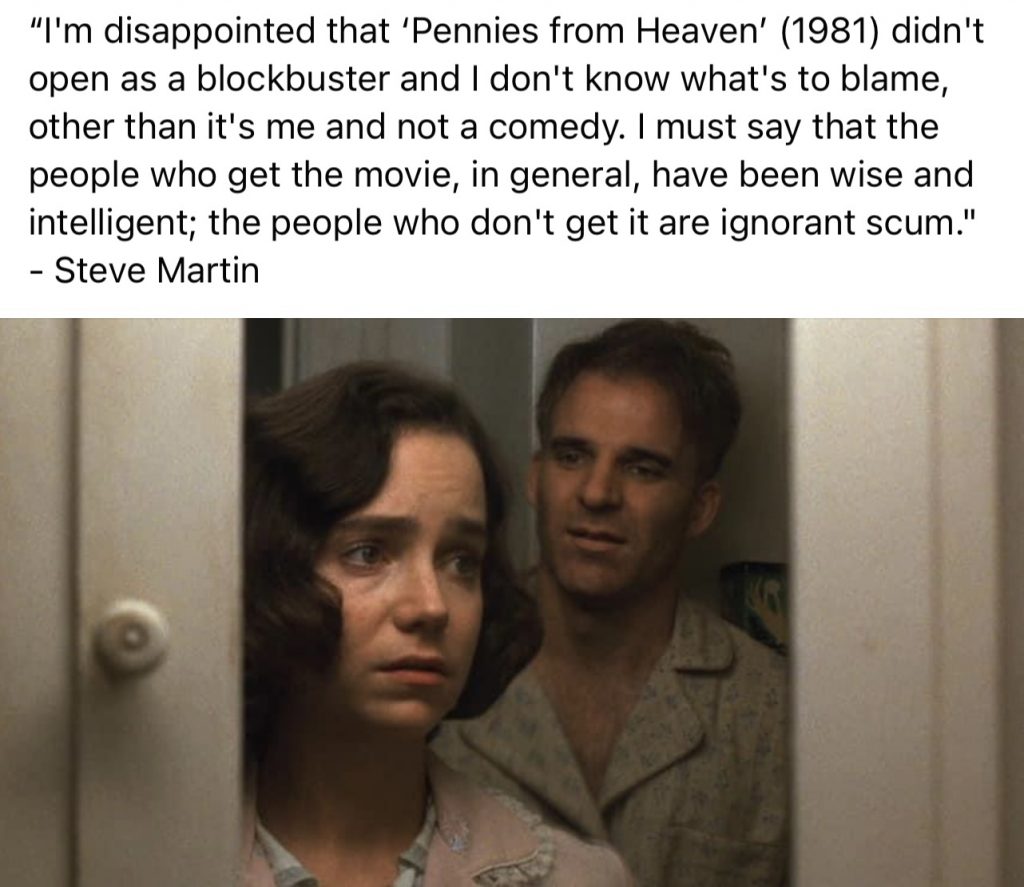
Herbert Ross‘s Pennies From Heaven, a big-studio adaptation of Dennis Potter’s original BBC musical drama, opened almost exactly 40 years ago — Friday, December 11, 1981.

I was a huge admirer of Potter’s 1978 original presentation (critics adored it), and my reaction to the Ross (which I reviewed for The Film Journal) was something along the lines of “as remakes go this is truly a brave and striking effort, and almost as good as the BBC version. I adore many of the musical sequences, but something feels wrong…it’s a film about how grim and draining and merciless life was for so many during the Depression, yes, but it’s also a kind of heavy-sauce mood trip, almost a horror film…a feeling of walls closing in.”

Ross and Potter’s versions were pretty much identical. A struggling Depression-era loser named Arthur Parker (played by Steve Martin in ’81, Bob Hoskins earlier) lives in a fantasy retreat of popular songs in order to keep his spirit going and endure life’s constant misery. The contrast between the harsh reality of Arthur’s actual life vs. the the dreamworld songs that fill his head (and those of costars Bernadette Peters, Christopher Walken, Jessica Harper and Vernel Bagneris) either moved you or sank you, but how could anyone fail to admire the audacious concept?

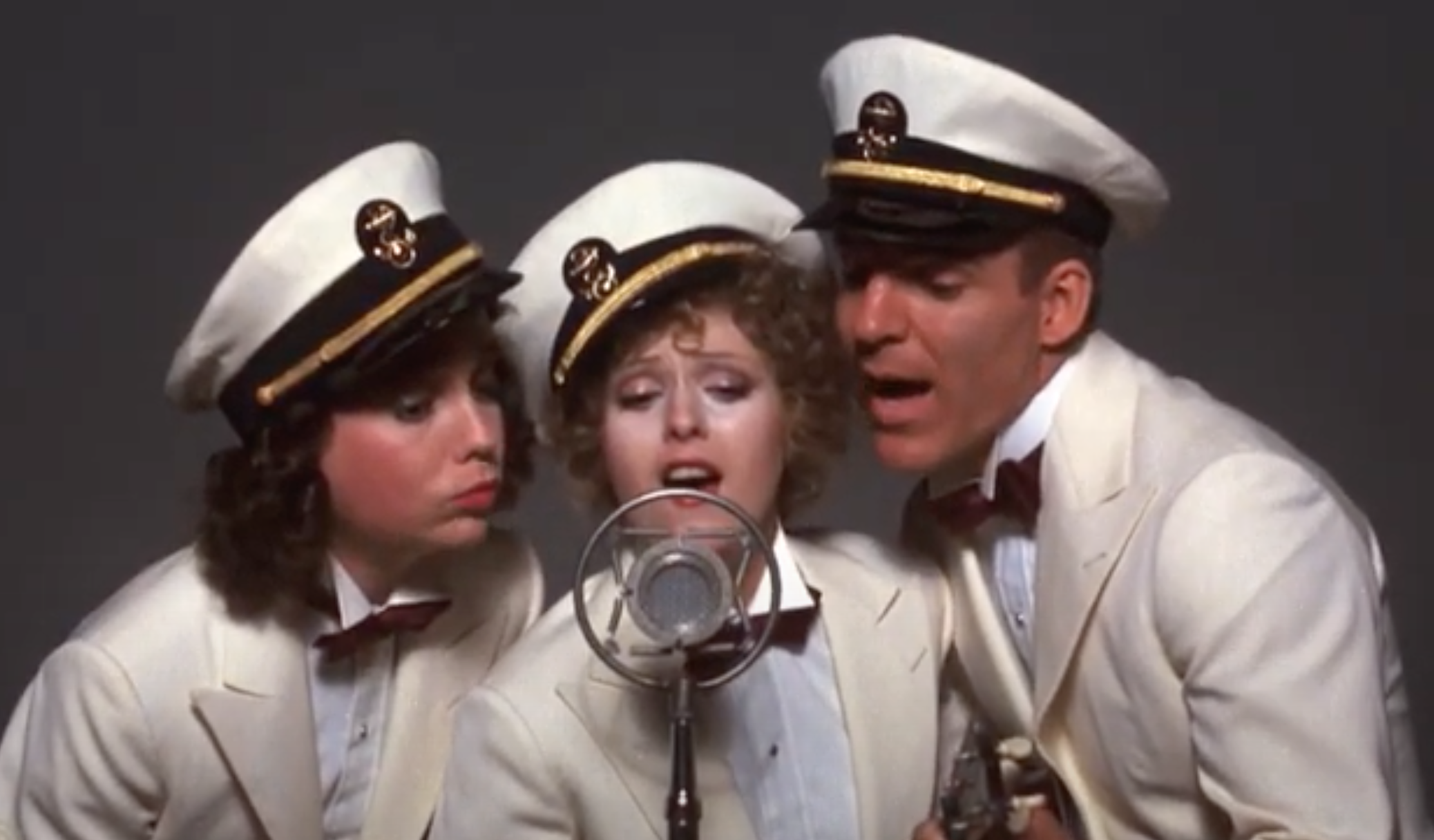
I’ve always been a fan of what Pennies From Heaven was about and how it got there. Brave and highly inventive, honoring the Potter while advancing its own signature, etc. Martin and Bernadette Peters were excellent. The black-and-white homage to a Fred Astaire + Ginger Rogers dance number in Follow The Fleet was pretty great, as I recall. I remember being extra impressed by Walken’s big dance number. But I haven’t once re-watched it over the last four decades. Not once.

Because somewhere around the halfway or two-thirds mark Pennies From Heaven drops a pill into your system that feels more dispiriting than anything else. It keeps leaning in the direction of despondency, death and doom. It’s a movie that says “most of us are rats on the treadmill, and the game is totally rigged against us so you may as well resign yourself to the endurance of it all…in all likelihood the only respite you will experience with any regularity will be in the realm of fantasy.”

Lars von Trier‘s Dancer in the Dark (’00), which I’ve seen three or four times, used pretty much the exact same premise. This time Bjork was the tragic and incorrigible daydreamer who, like Martin and Hoskins before her, ended up on the gallows.

Pennies From Heaven was a bust — $22 million to produce, $9.1 million in theatrical revenues. My pet peeve was the way Bagneris’s accordion player was initially portrayed as another sad but sympathetic loser, and then he turns out to be a rapist and a murderer of a young blind girl. Bagneris seemed like a weirdo to begin with, and for some primal reason I was repelled by the idea his character turning into a secret maniac, and of Martin being convicted for Bagneris’s crime…this was my big drop-out moment a la William Goldman.

Could Netflix or Amazon or Hulu be persuaded to fund a remake today? Or a similar musical tragedy with the same basic premise?

82 year-old Fred Astaire on Ross’s film: “I have never spent two more miserable hours in my life. Every scene was cheap and vulgar. They don’t realize that the ’30s were a very innocent age, and that [the film] should have been set in the ’80s. As is it’s just froth. It makes you cry it’s so distasteful.”

Read more

Has Brad Pitt Lost His Mind?

Why would Brad Pitt degrade his brand by costarring in a obviously ham-fisted, aimed-at-blithering-idiots, piece-of-shit adventure comedy like The Lost City (Paramount, 3.25)? It’s been 37 years since Romancing The Stone and nobody will give a shit anyway, but that’s more or less the template. (Or, if you will, Romancing The Stone meets a slightly less bullshit-stuffed Jungle Cruise.) Kathleen Turner played a reclusive romance novelist back then and Sandra Bullock is playing a romance novelist now. Channing Tatum is the new Michael Douglas, a brawny hero with feet of clay. Beware of directors Adam and Aaron Nee.

I will not watch this film. If I do, I will hate it.

HE to Barack Obama

Mr. President — Ever since you began posting your best-movies-of-the-year lists (when was that, late ’16 or early ’17?), Hollywood wags have doubted that they represented your own personal tastes. The assumption was that younger folks on your staff chose the right “tasteful” films and you signed off on them. I, for one, have always (naively?) trusted that your lists represented your own actual preferences, so I’m going to address my comments directly to you, the 44th president of the United States. Here they are…

(1) I’m going to assume you haven’t seen Pedro Almodovar‘s Parallel Mothers. Because if you had, there’s no way you would have omitted it in favor of Old Henry (who’s even seen that film?) or Passing (c’mon…a 1920s Manhattan-Harlem drama, one that barely had a pulse, about a completely unbelievable interracial marriage…the film’s admirers pretended that Ruth Negga‘s facial features could have passed as European-descended, even to a toxic racist husband who was hyper-attuned to such matters) or Pig (a movie about great organic cooking for the ages vs. blandly catering to to the know-nothings). These are all passable or pretty good films, but Almodovar’s is masterful. Did you not see it or something?

(2) Why did you choose 14 films? Why not 15? Why not 10? Nobody chooses their top 14 films of the year.

(3) Did you honestly feel that Drive My Car needed three hours to make the points that it made? Did you think that the director’s wife had betrayed him just that one time (which is what N.Y. Times critic A.O. Scott thought) or did you come to realize that she had numerous other sexual partners as a way of coping with the death of their child?

(4) Hat tip to your including The Worst Person in the World and Quo Vadis, Aida — both triple-grade-A, European-made films.

(5) In The Power of the Dog, did you honestly understand what had happened to Benedict Cumberbatch‘s Phil Burbank during the final reel? Because I didn’t. I had to ask friends and research it before I realized what had happened. Director Jane Campion certainly didn’t make it plain to the dumb people in the audience. This, to me, is not the mark of a triple-A film.

(6) Did you honestly think that the Robert Bresson-like prison ending of The Card Counter worked? Did you honestly think there was a compelling romantic current between Oscar Isaac and Tiffany Haddish? Did you really believe Haddish “was” who she was playing, a sharp casino talent scout?

(7) I thought you would have included the excellent King Richard on your list of 14, but it didn’t make the cut. Why not? It’s the only 2021 film that said “this is what it takes to make it in a difficult realm….only the devoted and highly disciplined succeed.” Plus it has a fascinating lead character, which is arguably Will Smith‘s best performance. You can’t tell me you saw King Richard and didn’t greatly admire it.

(8) In sum, no King Richard and no Parallel Mothers constitute, no offense, a pair of glaring WTFs.

Not A Good Look But…

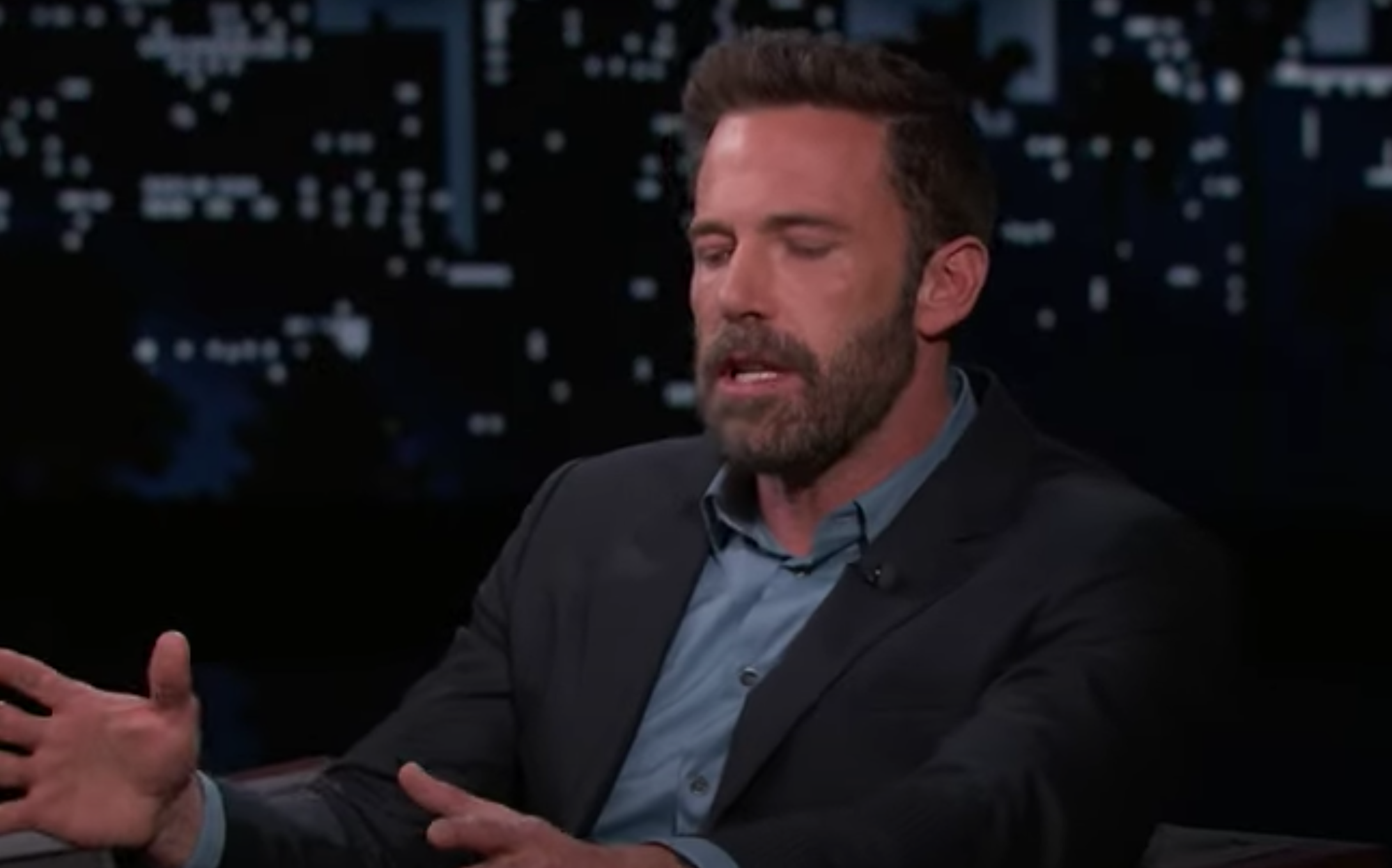
Last night Ben Affleck told Jimmy Kimmel that his reported remarks to Howard Stern about supposed links between his alcoholism and his waning marriage to Jennifer Garner, which sounded to a lot of people like “Jennifer made me an alcoholic,” were taken out of context and turned into toxic click-bait by voracious online rewriters.

Affleck did reportedly say that he and Garner “probably would’ve ended up at each other’s throats,” and if they hadn’t divorced “I probably still would’ve been drinking…part of why I started drinking was because I [felt] trapped…I was like, ‘I can’t leave because of my kids, but I’m not happy, what do I do?’ And what I did was [I] drank a bottle of scotch and fell asleep on the couch, which turned out not to be the solution.”

There was certainly more to their marriage than just this awkward summary.

Two thoughts:

(a) A “bad” or unfulfilling relationship (sexual boredom? constant conflicts over values and lifestyle issues? feelings of being intellectually stifled or constantly misunderstood or challenged?) can result in a repeating, no-way-out negative dynamic, and that can make a husband or a wife feel trapped. A couple can sometimes gradually work through this stuff; other times it’s hopeless. Anyone who’s been married knows what I’m talking about.

(b) Imagine if Garner had been the one who succumbed to alcoholism and sought a divorce while agreeing to joint custody, and who later said to Howard Stern the same things that Affleck said. Imagine if she’d said “I really wasn’t happy and every day was an ordeal, and yet there I was, stuck in a bad marriage, and I had to figure some way out of it…if I’d stayed with Ben I probably would’ve remained an alcoholic.” No one in the twitterverse or on The View or anywhere else would’ve trashed Garner like Affleck got trashed yesterday. Because the media always turns a blind eye when a woman admits to some kind of selfish behavior or failing, because if they don’t cut her a break or rush to her defense they’re probably sexist pigs under the skin. But if an older guy (white or BIPOC) admits to some selfish failing the media always chimes in with “look, a suspected asshole just admitted he’s an asshole!”