Son of Great Unsung Score

Forgive my never-ending Invaders From Mars enthusiasm, but I just happened to re-read a paywalled post from last July and thought I’d re-post.

I’ll bet that among connoisseurs of classic film scores, a fair-sized portion of the current membership has never heard of Raoul Kraushaar. Even during his peak period Kraushaar was regarded as a journeyman. If you scan his Hollywood scores from the 1940s and ’50s, you’ll notice that he composed almost exclusively for low-budget westerns with an occasional comedy or fright flick — In Old Monterey, Shed No Tears, Timber Fury, Stagecoach Driver, Bride of the Gorilla, Kansas Territory, The Flaming Urge, Mohawk, etc.

And yet Kraushaar’s score for William Cameron MenziesInvaders From Mars (’53) is easily one of the spookiest and most haunting of that era, and indeed one of the most distinctive regardless of genre or budget or any other qualifier. Anyone who’s seen Invaders knows what I’m talking about. That eerie choir (mostly female sopranos) puts the chill in…the stuff of childhood nightmares and creep-outs.

How odd that Kraushaar — steadily employed in genre pictures, a respected composer as far as it went, born in Paris in ’08, died in Florida 93 years later — how odd that a fellow whom no one had ever pegged as equal in talent to Franz Waxman or Max Steiner or Bernard Herrmann — how odd that Kraushaar, no doubt hired by Menzies out of a certain respect but mostly, I’m guessing, because his quote was low enough to be accommodated by the meager Invaders From Mars budget…how odd that Kraushaar managed to crank out one of the greatest (or certainly among the most fascinating) scores for a scary popcorn movie ever written…and under rushed conditions, no doubt.

Byron Haskin and George Pal‘s The War of the Worlds, another 1953 space invader flick, was made for $2 million and used a much higher grade of talent all around. George Barnes‘ cinematography, for one example, was clearly a classier, more high-grade effort (more sharply focused, more richly colored) than John Seitz‘s unexceptional and rather “soft” capturings for Invaders From Mars.

It could also be argued that Kraushaar’s strangely unsettling score is more emotionally affecting than Leith StevensWar of the Worlds score. There’s nothing miscalculated or insufficient about Stevens’ music — it’s fine as far as it goes — but it’s not in the same spiritual league as the Krasuhaar. Just saying.

The best passage from Kraushaar’s Invaders music begins just after the 3:00 mark:
Animal Dislike Conflicts Are Like….So?

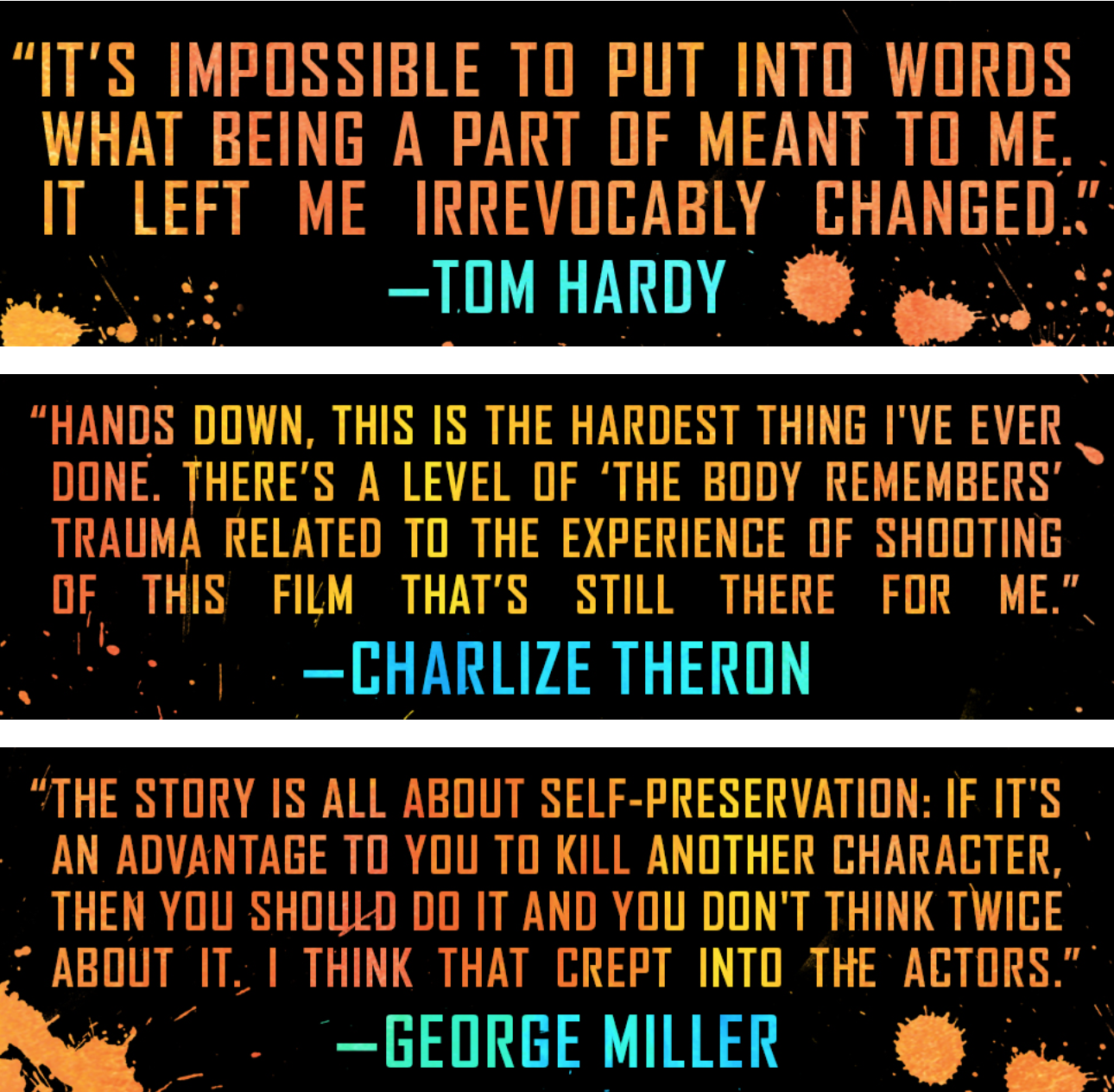
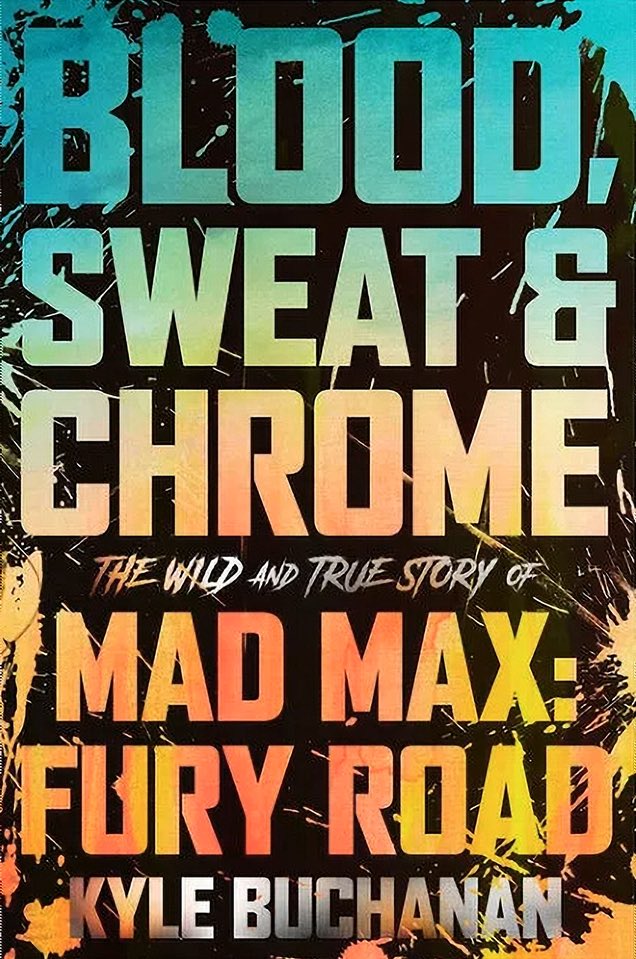
From Kyle Buchanan‘s “Blood, Sweat and Chrome: The Wild and True Story of Mad Max: Fury Road“, which is basically strung-together quotes from everyone who was there during the making of arguably the greatest action film of all time.

What the Vanity Fair excerpt boils down to is that Tom Hardy and Charlize Theron were (a) oil and water and (b) hated each other. But mainly because Hardy was a dick.

Nicholas Hoult: “It was a tense atmosphere at times. It was kind of like you’re on your summer holidays and the adults in the front of the car are arguing.

Charlize Theron: “He’s right — it was like two parents in the front of the car. We were either fighting or we were icing each other — I don’t know which one is worse –and they had to deal with it in the back. It was horrible! We should not have done that; we should have been better. I can own up to that.”

The fact that two headstrong actors didn’t like each other and had no hesitations about conveying that fact…who cares?

I’ll say this: Icing is always worse than fighting.

Admirable Coppola

We’re always adapting — all of us, but especially Type-A creative types. Maturing, cranking up, calming down, adjusting, shape-shifting — always in response to a changing world. It follows that no 40 year-old director is exactly the same in terms of craft, choices and sensibility as he/she was at age 30.

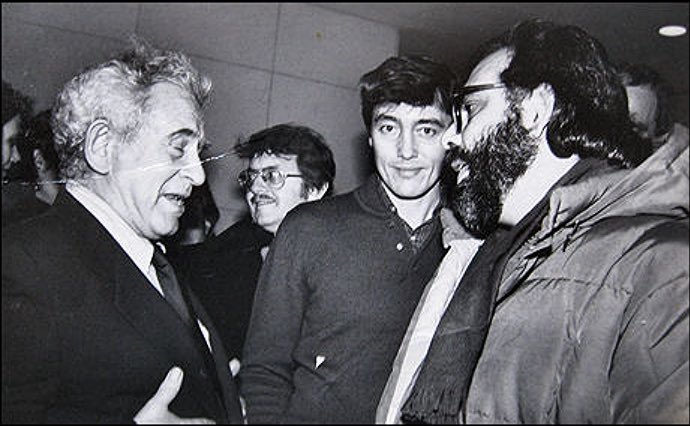
I think Francis Coppola (whom I had the pleasure of doing a two-hour phone interview with 41 years ago) was one guy when he made The Godfather, The Conversation and The Godfather, Part II. He was a slightly different guy when he made Apocalypse Now, and a faintly altered version of the Apocalypse Now guy when he made One From The Heart. He was a whole different dude when he made Jack — that’s for damn sure. And a much different guy when he made Tetro and Twixt.

Coppola has said he’s planing to invest over $100 million of his own dough in Megalopolis, which he’s called “a love story that’s also a philosophical investigation of the nature of man.”

It is my prediction that however good or bad it turns out to be, Megalopolis won’t connect with Joe Popcorn. Some will see it (I certainly will) but most won’t, and it’ll just end up as a streaming selection. That said, Coppola is living righteously for an artist who’s nearly 83 — still striving, still dreaming. Here’s hoping he makes Megalopolis and that it satisfies those who are willing to take the journey.

During His Heyday, Jerry Lewis Was A Dog

The late Jerry Lewis has been cancelled for gross sexual misbehavior that happened between 57 and 60 years ago.

In a 2.23 Vanity Fair report that includes a nine-minute video essay by documentarians Amy Ziering and Kirby Dick (Allen v. Farrow), actors Hope Holiday and Karen Kramer (formerly Karen Sharpe) recall Lewis having made crude overtures during the making of The Ladies Man (61) and The Disorderly Orderly (’64), respectively.

Lewis didn’t assault Holiday and Kramer but certainly made things unpleasant, they’re saying. Plus he punished them socially and whatnot for having refused his advances.

For decades we’d all understood that Lewis was a very tough interview and that he had a dark streak, and now we’ve been told that he acted like a dog with lower-tier actresses whom he thought he could manipulate, etc. Old-time Hollywood hotshots were taught by their culture that they could get away with crass sexual behavior, and for decades nobody said boo. But since the 2017 Harvey Weinstein revelations Hollywood culture has been encouraging victims to come forward and point fingers at the bad guys. The Lewis saga is what it is — obviously distasteful but not especially surprising, given the rules of the game in the bad old days.

If I’d been in Holiday or Kramer’s offended shoes, perturbed if not seething for decades about Lewis’s on-set behavior during the Kennedy and LBJ administrations, I probably would have gone public while he was still with us. I would have demanded a response and at least had the satisfaction of having done so while he was still walking around. Lewis passed on 8.20.17.

The Day The Good Guys Lost

The last time I seriously contemplated the idea of Russian tanks invading a neighboring country and imposing autocratic rule was on 1.25.11, or a little more than 11 years ago. On that day the 2010 Oscar nominations were announced, the most ominous among them being the 12 nominations gathered by Tom Hooper‘s The King’s Speech — an all-but-certain indicator that this British period drama, a favorite among the old Academy farts, would win the Best Picture Oscar.

I was thinking, you see, about Vaclavske Namesti (Wenceslas Square) in August 1968. The image in my head was of Entertainment Weekly‘s Dave Karger and other supporters of The King’s Speech, standing atop Soviet tanks as they rumbled into Prague (“Wait, wait…what happened?”).

In one fell swoop the hopes of all Social Network supporters were dashed. Many were shocked; some were tear-struck.

The Social Network‘s eight nominations (including Best Picture, Best Director and Best Actor) vs. 12 nominations for The King’s Speech — forget it, game over, the bad guys had won. Because Academy and guild schmoes didn’t relate to the Fincher film but felt an emotional rapport with late 1930s England and Colin Firth‘s performance as King George.

David Fincher‘s brilliant, razor-sharp drama — a story about ruthless conflict in the building of Mark Zuckerberg‘s Facebook empire — had enjoyed a kind of “Prague spring” reception since debuting at the 2010 New York Film Festival. It was seriously admired by critics and the cool kidz. and by anyone who was invested in the emerging cyber world and where things were going — but the Oscar nominations strongly suggested it was going to lose the Big Prize. And that, to me, was shattering.

The day before the announcement Nate Silver, the FiveThirtyEight creator who had been way in front of most political statisticians during the 2008 presidential election, analyzed the Best Picture Oscar race for Melena Ryzik‘s Carpetbagger column, and his view was that The Social Network would most likely prevail.

The other 2010 “good guy” movie that David O. Russell‘s The Fighter, which received seven Oscar noms and wound up winning two — Best Supporting Actor (Christian Bale) and Best Supporting Actress (Melissa Leo).

Read more

Too Heartfelt, Not Even Trying To Be “Hip”

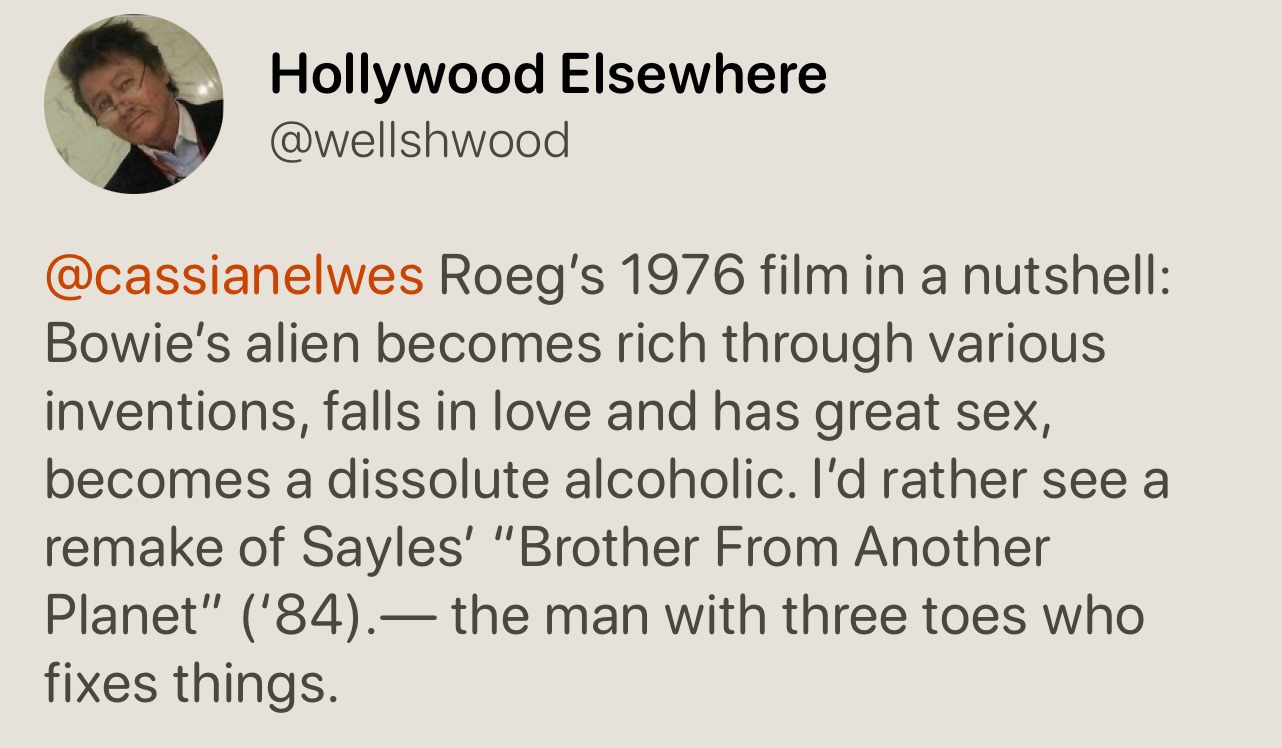
Although based on the original 1963 Walter Tevis novel, Showtime’s The Man Who Fell To Earth series feels more like John Carpenter‘s Starman than a revisiting of Nicolas Roeg’s same titled 1976 film. The newbie is too emotional — I can sense that much. I’m intrigued by the idea of Bill Nighy playing the original David Bowie character, Thomas Jerome Newton, but where can they go with this? I don’t trust this. I can feel trouble.

Read more

A Con-Man Flick For All Seasons?

Imagine that 1973’s The Sting, which earned the 2022 equivalent of over a billion dollars and won seven Academy Awards (including Best Picture), had never been made, and that David Ward‘s genius-level screenplay has been crafted by some young present-day hotshot.

Would it be produced by one of the studios, or by Netflix or Amazon or some other deep-pocket streamer?

A 2022 version of The Sting might get made, sure, but what are the odds that Ward’s original screenplay — a perfect Swiss watch, flawless of its kind, an Oscar-awarded jewel — would be filmed without significant changes?

My gut tells me that the rough-and-tumble social realism would be jettisoned. And that the casting would be subject to the usual presentism standards, meaning that one of the two male leads, Paul Newman‘s Henry Gondorff and Robert Redford‘s Johnny Hooker in the original film, would probably have to be played by an actor of color.

Yes, even though it’s set in 1934 Chicago, when racism was as common as dirt and factory soot and Robert Shaw‘s Doyle Lonnegan, a tough, old-school Irish mobster, would’ve never trusted a non-white hustler with any amount of his betting money. As Luther Coleman (Robert Earl Jones) confesses to Hooker in Act One of the film, “Ain’t no rich boy gonna trust a hungry [racial epithet] enough to be conned.”

Am I wrong? Would any producer or distributor have the stones to produce The Sting as is, or would they be obliged to make certain changes so as not to be frowned upon by progressives? It’s a fair question, surely.

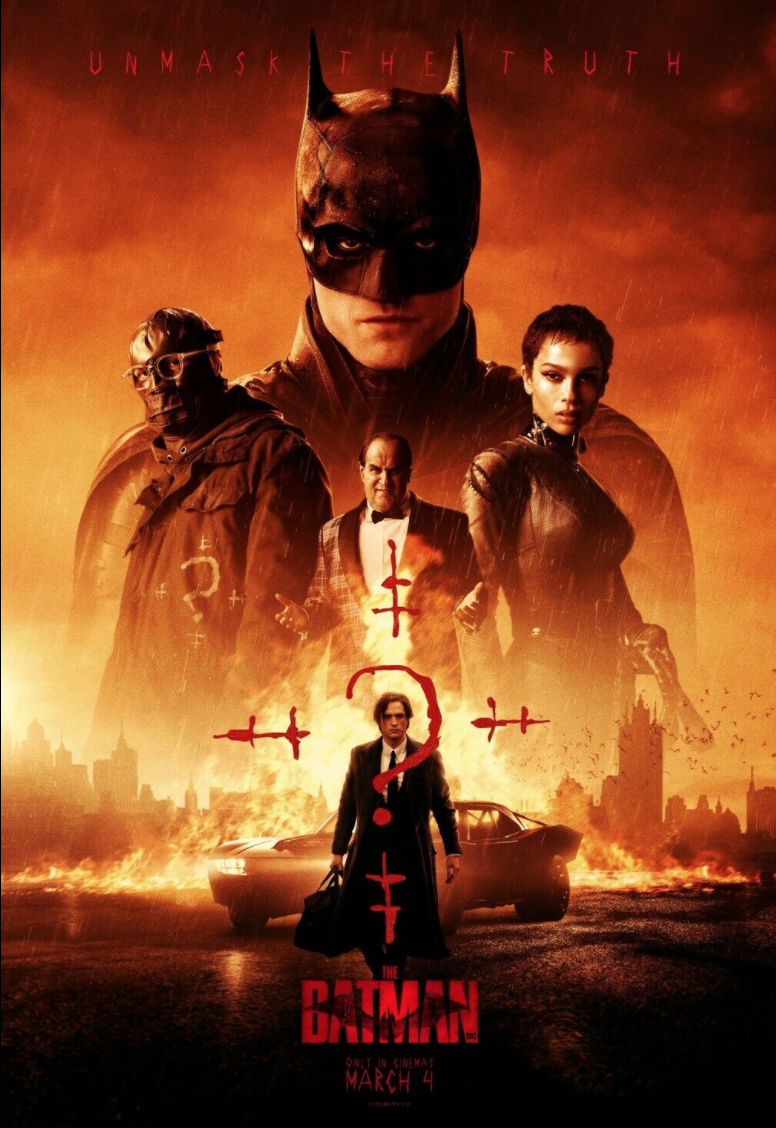
Whassup With Reeves’ “Batman”?

People are asking each other “what’s the word on The Batman?” (Warner Bros., 3.4). My response has been “other than looking like a close relation of Guillermo del Toro‘s Nightmare Alley except darker and grimmer, nothing…no word at all.”

The 176-minute action drama has been sneak-peeked to a select few, but the first significant nationwide screenings will happen two days hence — Thursday, 2.24 — with the review embargo lifting on Monday, 2.28 at 12 noon eastern. Hollywood Elsewhere gets to see it on the evening of Wednesday, 3.2, or one day before select theatres will begin showing it commercially.

Melancholy Brass

I cant find any YouTube excerpts from Johnny Mandel‘s mournful, low-key score for The Last Detail (’73), so I shot the outdoor picnic scene from Act Three. The tone of sadness and resignation…God! This isn’t music that instructs you what to feel but is sitting right beside the viewer, experiencing the same journey in exact synchronicity.

I’m Not Doing This

…but if I wanted to follow in the footsteps of Caitlin Jenner, this is how I might look. If I were to pull the trigger, I’d probably rename myself Jessica Wells. Honestly? I don’t think I look too bad.

“Dog’ Is Anti-Woke?

I was going to ignore Channing Tatum and Reid Carolin‘s Dog (UA releasing, 2.18). I love dogs but movies looking to “get” me with emotionally simplistic strategies…later. Then I was told that Dog has an anti-woke streak, and I said “really?” Because you’d never know this from reading the reviews — not the slightest mention of any left-skewing political-cultural attitude. Then I stumbled upon Kyle Smith‘s National Review assessment (2.18), and lo and behold…

“The politically asymmetrical nature of which Americans dismiss veterans is not lost on Carolin and Tatum, and much of the movie amounts to walking a gauntlet through the craziness of Progressive America.

“When Briggs (Tatum) leaves Lulu the dog in a cool, safe car at night, an animal-rights twerp seeks to break a window with a rock to let in some air, until Briggs advises him why this would be a bad idea. ‘Of course you threaten violence, you redneck!’ says the self-appointed animal savior. ‘You’re the one with a rock!’ replies Briggs, and the scene is a wonderful distillation of 2020s progressive mania.

“Briggs (Tatum) goes to a bar to try to pick up a date, but instead he gets an earful from every young wokette: ‘So at what point did you realize you were just a pawn of Big Oil?’ asks one.

“In San Francisco Briggs gets arrested for a hate crime because the dog attacks a Muslim. The cop who processes him, played with impeccably unearned arrogance by the excellent Bill Burr, brags that he, too, served, but it turns out that he was…an M.P. Briggs clearly thinks of these guys as the hall monitors of the military, practically the Hillary Clinton Brigades. “Oh, you were an M.P.?” he says nonchalantly.

Tatum, who in 2017 starred in a hilarious Amazon Prime series, Comrade Detective, that did to Communism what Lulu does to Taliban fighters, gives off a strong sense that he’s turning right these days, at least culturally speaking.

“In a recent interview, he chafed at the suggestion that he was making a movie for middle America. ‘I would not call myself a liberal. I would not call myself a Republican or a Democrat. I’m not political,”’ Tatum told the Associated Press. ‘I do believe that the stereotypes and the generalizations can get us in trouble.

Read more