I still haven’t seen J.T. Rogers and Michael Mann‘s Tokyo Vice (HBO Max, 4.7), but I know two things.
One, it’s based on Jake Adelstein‘s “Tokyo Vice: An American Reporter on the Police Beat in Japan” (’09), and is about Adelstein’s working as the first non-Japanese reporter for one of Japan’s largest newspapers.
And two, it is therefore necessary and appropriate to cast a young American actor as Adelstein. Which is partly why Rogers and Mann hired Ansel Elgort for the role.
So far the Rotten Tomatoes score, based on six reviews, is 83% — a better-than-decent rating.
But the score would be higher if it weren’t for certain toxic critics complaining about the casting of Elgort, who continues to be idiotically tarnished by the woke community over non-factual, mob-rule accusations of “sexual assault” — a completely unsupported charge about Elgort having assaulted a 17 year-old named “Gabby” when he was 20, despite every piece of testimony (Twittered and otherwise) indicating that nothing resembling an assault ever happened and that the worst Elgort could be accused of was ghosting Gabby after being intimate with her.
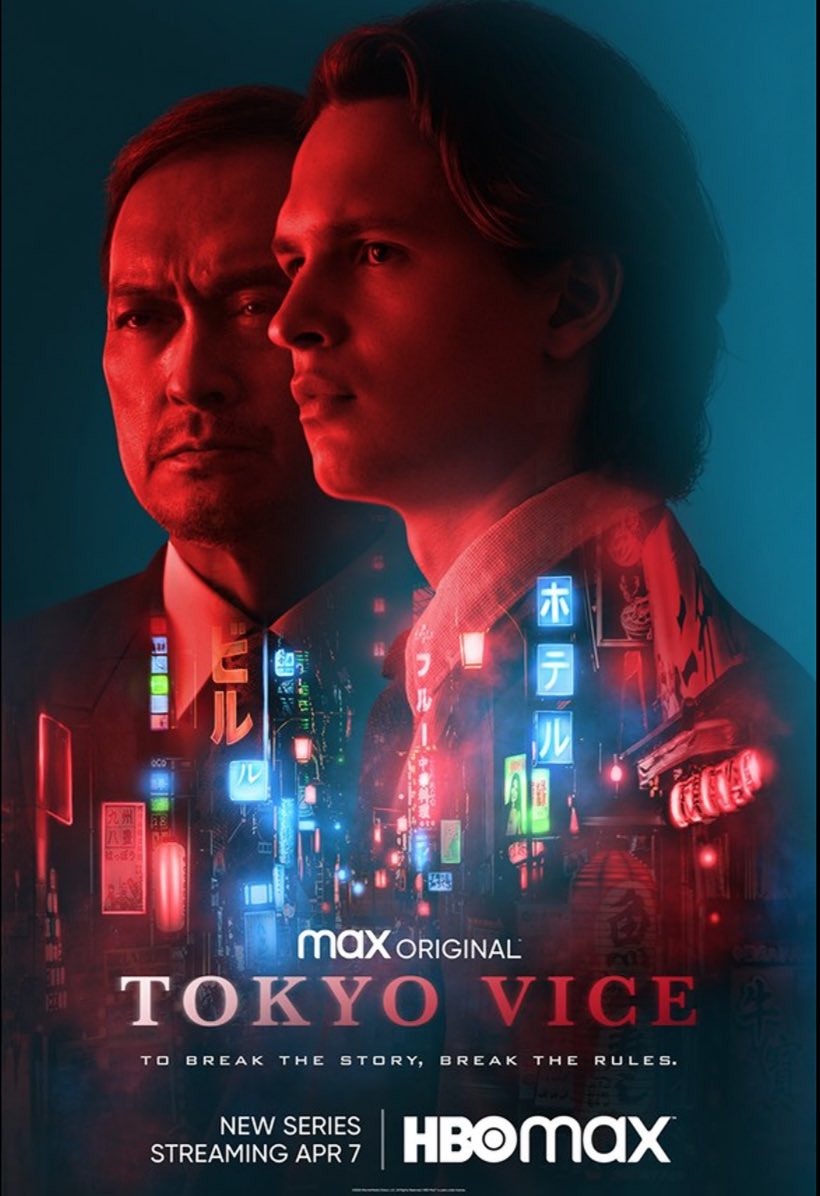
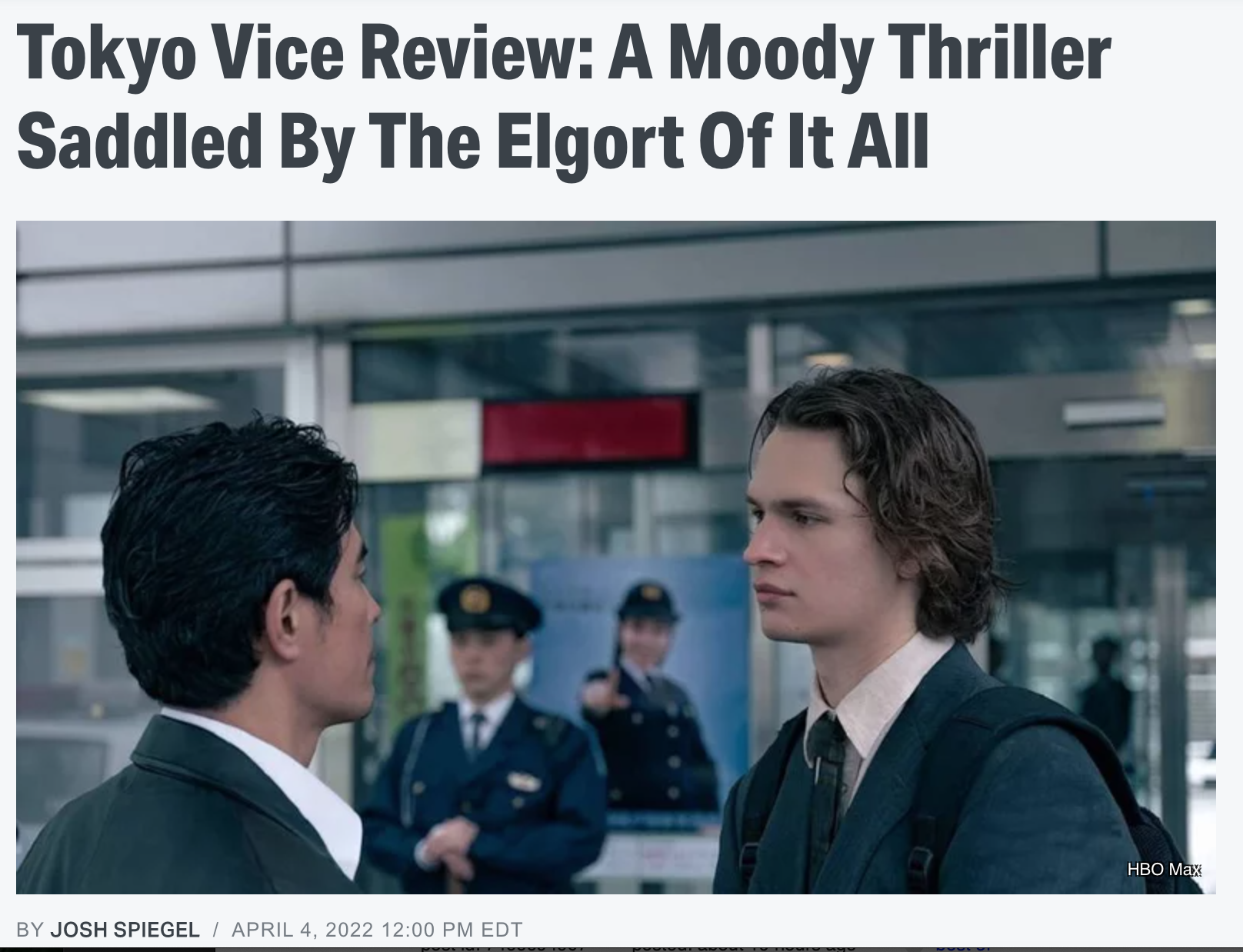
The lowest score of the six is from Slashfilm‘s Josh Spiegel, who merges an anti-Elgort attitude along with some anti-white racism sauce.
In a review titled “A Moody Thriller Saddled By The Elgort Of It All,” Spiegel claims that
Elgort “makes for a very dull and uninvolving lead actor here…when the show begins in 1999, Jake is already well ensconced in Tokyo, having moved from his home state of Missouri…while he has quickly fallen in love with Tokyo’s culture, he has a very specific goal: becoming a journalist, despite the general hurdle of…well, being a white American.”
In other words Spiegel, besides disliking the idea of Elgort starring, doesn’t care for the idea of a white guy playing the lead in a Tokyo-based journalism drama. Imagine if Mann had produced an HBO Max miniseries about an English-speaking Japanese reporter having been hired by the Los Angeles Times to cover the crime beat here. Would Spiegel have written that this fellow does his best “despite the general hurdle of…well, being Japanese”?
Rolling Stone‘s Alan Sepinwall follows a similar train of thought. In a review titled “What If Miami Vice Had a White-Savior Complex?“, Sepinwall states that “this is a decent show, but one that feels like it would be much better if it were willing to be more Japanese.”
Again, reverse the set-up (Japanese reporter covering the L.A. crime beat) and ask yourself if Sepinwall could or would have declared that L.A. Vice “would be much better if it were willing to be more American, and more specifically more Anglo Saxon.”
In short, Sepinwall and Spiegel are singing the same woke tune. Translation: “We don’t want to know from Jake Adelstein or his book, and we don’t like the idea of a white guy reporting about the Yakuza because white guys are basically bad news. And Elgort, in our humble and misinformed opinion, is double bad because he…uhm, well, he legally had it off with a 17 year-old in 2014 (when he was 20) and then hurt her feelings by ghosting her, and in our judgment Elgort should pay the Polanski price for this. And so we’re doing our part as morally-attuned critics to destroy the toxic bad guys out there…to not only lock arms with the #MeToo community but bring about the ruin of the heartless Elgort.”
Variety‘s Daniel D’Addario echoes the Sepinwall-Siegel mindset, but he’s a little more fair about it.
“Say this much for Elgort, a controversial figure off-screen after allegations of sexual assault surfaced in 2020: On screen, he’s able to avoid many of the pitfalls into which an actor who looks like him on a Japan-set series might have fallen,” he writes. “The show is aware of what’s potentially uncomfortable about Jake as savior figure, and undercuts the narrative, and its protagonist, accordingly, starting with the performance.”
It is unlikely but entirely possible that I will agree with Spiegel and Sepinwall when I see Tokyo Vice, but for now I think it’s fair to post the above-mentioned judgments and suspicions about their viewpoints.