Month: May 2022
“Don’t Be A Grain Perv, Man”
Earlier today HE commenter Patrick Juvet wrote the following: “Robert Harris knows the difference between genuine film grain and video noise, which you don’t. All of your rants against ‘digital mosquitos’ were often aimed at Sony transfers done by Grover Crisp‘s people — transfers that allowed all of the natural film grain to shine through (more than it would have in a film print ) and were praised to the skies by Mr. Harris in his reviews.”
HE reply: “Did you just say the Sony transfers ‘allowed all of the natural film grain to shine through’ and even ‘more than it would have in a film print’? Did you just say that?
“FILM GRAIN HAS NEVER SHINED THROUGH…EVER. Film grain is a visual affliction that classic-era dps were forced to finesse as best they could. It was a pestilence. If Gregg Toland could have made grain disappear by clapping his hands three times, he would have clapped his hands three times…TRUST ME!
“There has never been anything the least bit glorious or edifying or transcendent about film grain. It’s cinematic fog. (Not that there’s anything wrong with fog if you’re Fritz Lang and you’re shooting Manhunt with Walter Pidgeon. The London scenes, I mean.)
“Film grain is built into the image so it’s wrong to try and erase the stuff, but anyone who advocates for more film grain to show up on a Bluray of a classic film than the amount that was naturally visible to theatrical audiences is a grain perv…they have something psychologically wrong with them, I mean.
“And theatrical audiences of the ’30s, 40s and ’50s, by the way, weren’t clobbered with the stuff. The idea of film grain ‘shining through’ on home video more than it did in theatres is repugnant. It’s sick. You and people like you are like FOOT FETISHISTS, only it’s grain that turns you on, not the shape of women’s toes and the shade of their nail polish.”
Rainy Day in West Orange
It’s way too wet and miserable outside — too damn miserable for me. Indoor huddling is the only viable option.

Is Carey Fukanaga Being Ansel Elgort-ed?
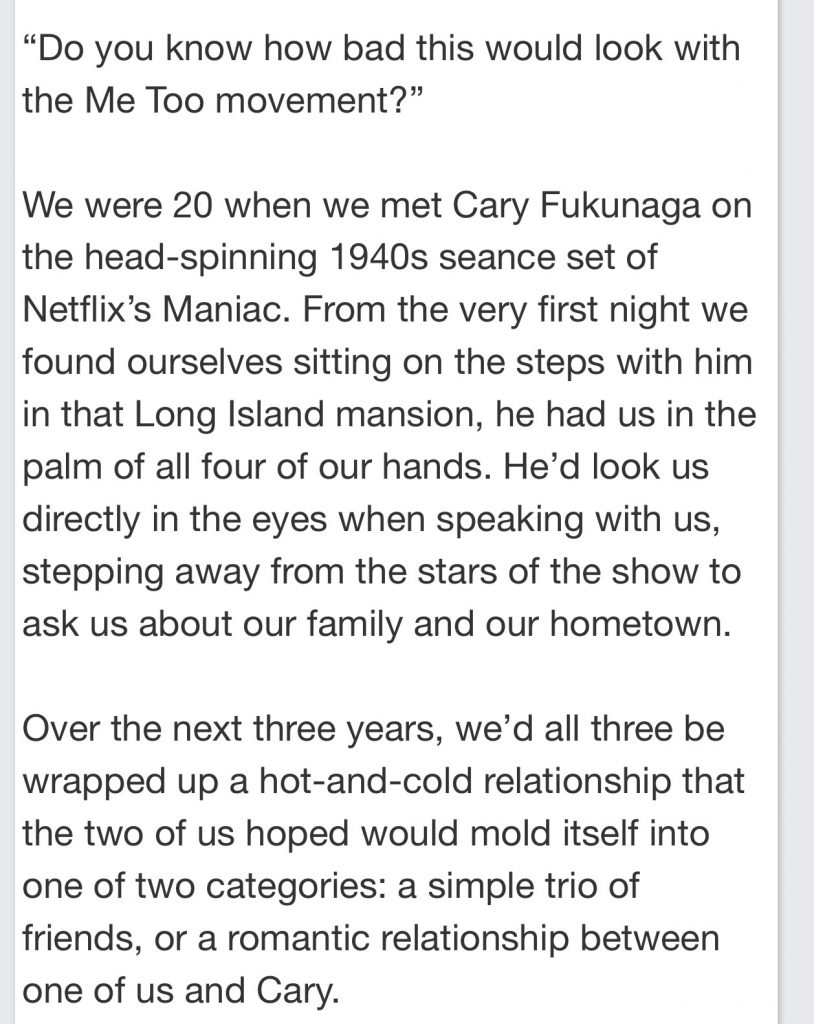
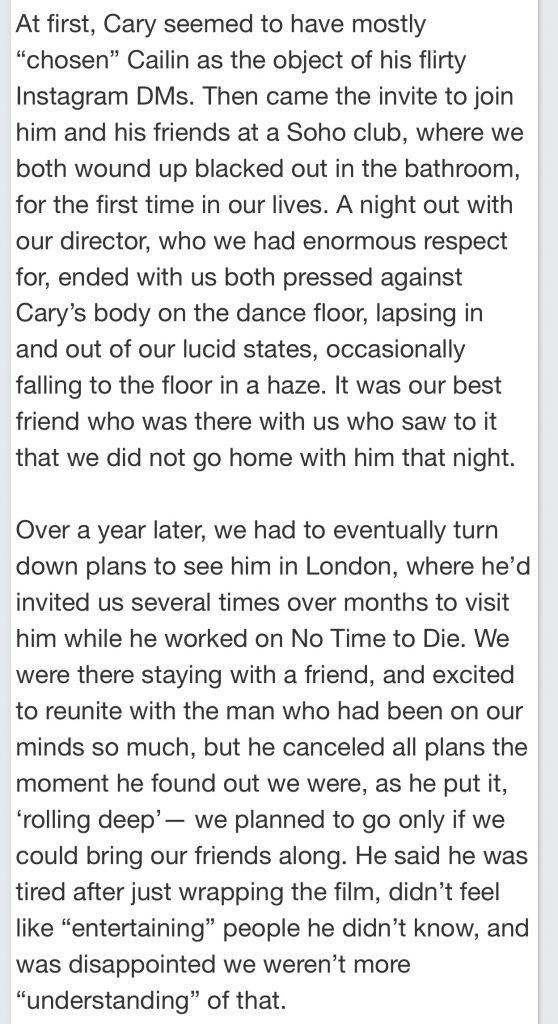
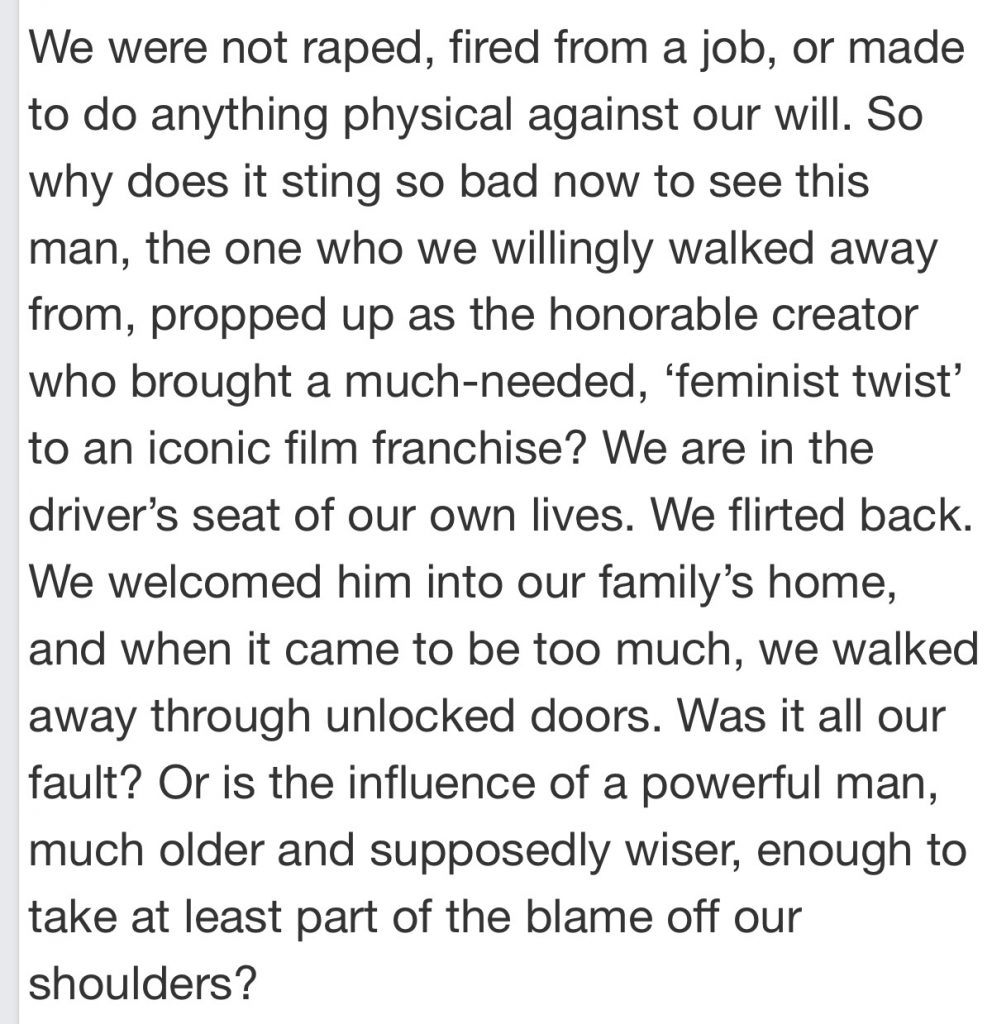
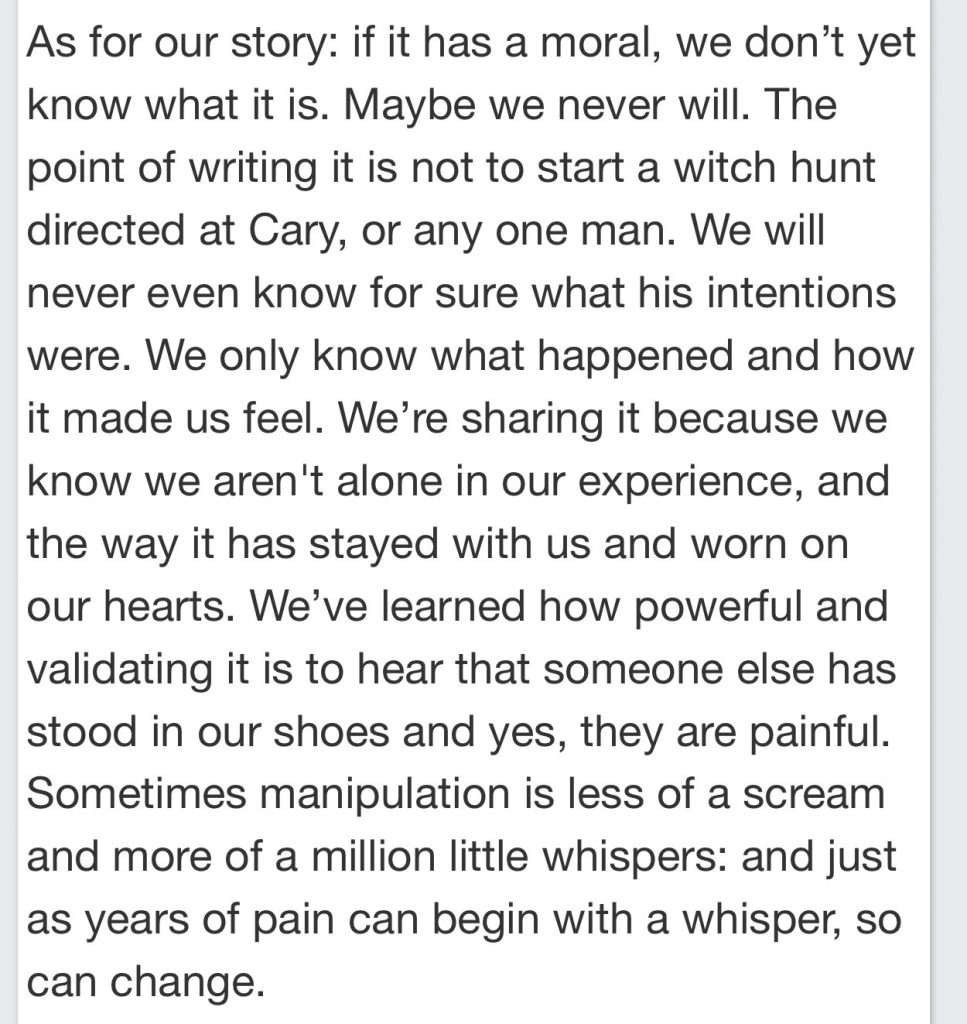
Read this story (dated May 5th) about a somewhat “close”, flirtatious but mostly hands-off relationship between director Cary Fukunaga (No Time To Die) and Hannah and Cailin Loesch, hosts of #Double Talk (aka @loeschtwins).
Over the last day or two there have been twitter conversations about whether or not Fukunaga should be punished for…well, it’s a little vague. For possibly attempting to groom the Loesch sisters into something or other…maybe a casual ménage a trois relationship….you tell me. Except nothing actually happened.
What does it mean to be Ansel Elgort-ed? It means being targeted by Twitter assassins as a sexual bad guy of some sort without any sort of hard evidence to back up the half-assed allegations. All I can say is that there seem to be some real monsters out there.



Marvin’s Room
Posted seven years ago (4.20.15) by “Kano’s Razor”: “Not to belabor the point, but it’s not really a big-name actor’s responsibility to ‘make good films’ (cue the old William Goldman line), but to (a) consistently project a unique vibe or aura, and to (b) select interesting scripts that will blend with or benefit from this aura.
“You could argue that Lee Marvin was better at the former than the latter, although one could easily counter that performers will always be at the mercy of the material that’s offered them. Marvin was in pretty good company in terms of possessing a certain brand of cool — a brand that the films he starred in rarely lived up to or sagely exploited to maximum mutual benefit.”
“Love This Guy,” posted same date: “Lee Marvin finally graduated out of playing bad guys with his double role in Cat Ballou, and after that he had three years in which he appeared in really good films — Ship of Fools (’65), The Professionals (’66), The Dirty Dozen (’67) and Point Blank (’67). And that was nearly it. Three years.
“From ’68 on Marvin started turning good stuff down (William Holden‘s role in The Wild Bunch, Robert Shaw‘s role in Jaws) or starred in not-so-hot films like Pocket Money or Hell in the Pacific or Paint Your Wagon. He appeared in one final decent film, The Big Red One, in ’80. He died in ’87 at age 63.
“You spend the first forty years of your life trying to get into this business,” Marvin once said, “and the next forty years trying to get out. And then when you’re making the bread, who needs it?”
His bad-guy period was arguably more interesting — The Big Heat (’53), The Wild One (’54), Bad Day at Black Rock (’55), The Comancheros (’61), The Man Who Shot Liberty Valance , (’62), Donovan’s Reef (’63) and The Killers (’64).
Kick The “Emancipation” Ball
Apple TV + has chickened out as far as releasing Antoine Fuqua and Will Smith‘s Emancipation, a 19th Century runaway slave drama, in a timely fashion.
Everyone was expecting to see this historical, fact-based saga during the fall ’22 award season, but Apple is afraid of releasing it during the same year as the 3.27 Oscar slapping incident.
The plan is now to release Emancipation sometime in ’23, although it would be idiotic to open it at any time other than award season.
Apple knows that a year’s delay isn’t going to change a damn thing, and that the slap will influence much of the press coverage whenever it comes out.
If the Apple team had any courage they would stick to the ’22 plan…damn the torpedoes. If it’s a powerful, well-made film it’ll gather Oscar noms and do decent business. The public won’t give much of a damn either way. Only the Apple pussies are flinching.
In the film Smith will play a slave named Peter (the actual slave’s name was Gordon) who escapes from a Louisiana plantation after being whipped severely. A photo of his horrid back wounds became a galvanizing factor in turning fence-sitters against slavery.
Harris Deplores Fake Grain on 4K “Liberty Valance”Disc
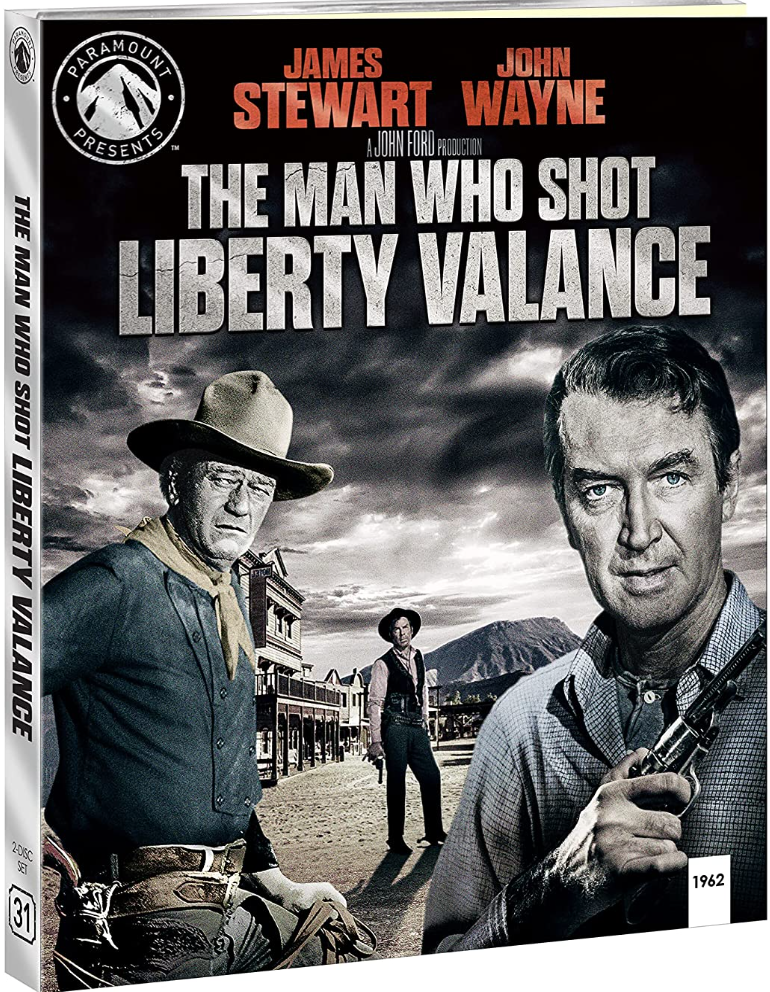
Two days ago (5.4) on Home Theatre Forum, restoration guru Robert Harris gave a failing grade to Paramount Home Video’s 4K UHD Bluray of John Ford‘s The Man Who Shot Liberty Valance (’62).
“While much of the home theater crowd is probably going to love what Paramount has done here, I’m hating everything that I’m seeing. The image is very clean and stable. Beautiful black & white, and [in some ways] reminiscent of the way that it looked on film.
“And yet this isn’t film, and looks nothing like it, even though with 4k UHD we’re able to get closer to and not further away from the real thing.
William H. Clothier‘s cinematography “has been totally de-grained, making it look like some sort of low-end data, and then smeared with video noise in an apparent nod toward those who desire that ‘film’ look.
“But here’s the rub. It’s not just that the image has been de-grained, but either somewhere in the de-graining or digital clean-up, swirling patterns of amoebae have been rendered in skies and neutral areas, and they swim about, presumably having fun.”
HE comment: I’m presuming that these “swirling patterns of amoeba” are roughly similar to the digital grainstorm effect (i.e., swarms of digital Egyptian mosquitoes) that I’ve been complaining about for years.
Back to Harris: “Sometimes the noise appears almost normal. Almost believable. Sometimes it goes away entirely, and is fully grainless. Sometimes it turns into them swirling creatures.
“The legend is that Paramount is capable of doing beautiful restoration work. I’m thinking back to the work from the likes of Ron Smith. I no longer believe it, but what the heck…’Print the legend.’ Upgrade from Blu-ray? Absolutely not. An unfortunate rendering, except for those who don’t like the look of cinema.”
Most Eloquent Reaction to Impending Roe Tragedy
Amanda Gorman‘s “Eight Reasons To Stand Up.” Most of us recall the 24 year-old Gorman delivering a poem, “The Hill We Climb”, at Joe Biden‘s inauguration on 1.20.21 — 14 days after the Capitol insurrection.
“Carrey” Misspelled
But otherwise splendid — the first impressionist medley of running styles I’ve ever seen online.
Hatched In ’38, Filmed in ’55
From “What Happens After That,” a New Yorker article about Alfred Hitchcock, written by Russell Maloney and dated 9.2.38:
“Whether he works in Hollywood or England, Hitchcock will go on making his own kind of picture. His mind is full of plans; nothing else can get in. When he was last in New York he wasn’t half so concerned about his financial negotiations as about a story idea he had.
“‘The picture would open near the London docks, at dawn,’ he explained. ‘The police are chasing a lascar sailor down a grain elevator. He gets away from them, runs through the gates into the road, and finally hides in a sailors’ boarding house. The police catch up with him, and he escapes from them again. The chase goes through the Sunday morning market in Middlesex Street.
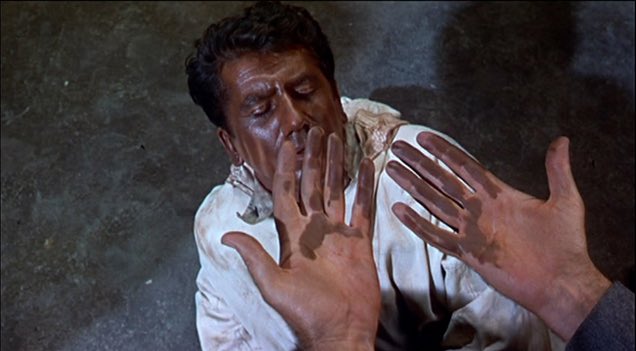
“At last the lascar comes to St. Paul’s Cathedral and runs in, with the police after him. There’s a service going on, so he runs upstairs to the balcony that goes around the dome. Just as he reaches the top step he falls over the railing down into the nave, dead, with a knife in his back. Some of the congregation rush up and turn him over. One of them touches his face and a smudge of blacking comes off. The man isn’t a lascar at all — he’s just made up as one.”
“At this point in his recitation Hitchcock became subdued. Then he said, ‘It’s good so far. But what happens after that? I wish I knew.'”