You won’t laugh or snicker or say a damn word. Just stick your head under the desk. As I did all day.

You won’t laugh or snicker or say a damn word. Just stick your head under the desk. As I did all day.
If you count Monday, 5.16 (flight arrival, moving into the pad, picking up my pass, buying groceries), this is HE’s ninth day of the 2022 Cannes Film Festival. Three full days to go plus a wakeup…home stretch. At this point I always take a breather and kick back a bit. And now it’s raining with a little lightning and thunder, and some nice cool air filling the kitchen.
Just two films today — Jean Pierre and Luc Dardennes‘ Tori and Lokita, a tragic immigration drama set near Liege, Belgium, about a pair of young, unrelated African kids (Pablo Schils as the younger Tori, Mbundu Joely as the teenaged Lokita) who get exploited and kicked around and treated cruelly by drug-dealing wolves. It ends sadly and shockingly. I didn’t melt down but I felt it.
The Dardennes have always had this plain, unaffected directing style — just point, shoot and watch. Believable characters, realistic dialogue, no musical score. Straight-up realism, a dependable brand. I’ve always emerged from their films saying “yup, that was a good, honest film” but I’ve never really been knocked flat. Because their plain-and-straight signature only penetrates so much. In my case at least.
At 10:30 this evening I’m catching Mario Martine‘s Nostalgia, about an older guy returning to his home town of Naples after a 40-year absence. My insect antennae are telling me not to expect too much, but it feels wrong to waste the opportunity.

Apparently I’m not going to be infected with monkeypox any time soon. Or down the road for that matter. Like everyone else I was mildly freaked at first by those horrific photos of boils and blisters, but fear itself is a virus.
“Monkeypox is not considered a sexually transmitted infection, but experts are suggesting that some of the cases that are happening outside of Africa…may be transmitted through sexual contact.” — Jameisha Presecod, BBC Africa reporter.
NBC report: “The Centers for Disease Control and Prevention is investigating four suspected cases of monkeypox in the United States. All of the cases are in men and related to travel. The individuals in the U.S. reported they had traveled in April, with symptoms appearing in early May, according to the CDC.
“The majority of current cases have been reported in men who have had sex with other men.
“Monkeypox has not been historically considered a sexually transmitted disease. However, it’s transmitted through close physical contact, and can be spread during sex. Two raves held in Spain and Belgium among gay and bisexual men have been connected to the current cases.”
Originally posted on 12.31.15: Two recycled stories about male behavior and character. As perceived by women on dates. They may sound disparate but they share a theme, which is that women respect guys who are frank and don’t shilly-shally around.
When Elaine Stritch died 18 months ago I posted a story she recounts about John F. Kennedy in Chiemi Karasawa‘s Elaine Stritch: Shoot Me.
It happened in Manhattan in the late 1940s. She was about 23 or 24 at the time, and wouldn’t be losing her virginity, believe or not, until she was 30. Stritch and the Massachusetts Congressman had a nice first date and then went out a second time.
When they got back to her place she said, “Do you want to come up for a nightcap?” Kennedy said, “Does that mean what I think it might mean, or does it mean listening to records and looking at photo albums and eating butterscotch pudding?”
“It means butterscotch pudding,” Stritch said.
“Well, no offense but I’m not interested in that,” JFK replied, “so I’ll just kiss you good night and wish you well and see you the next time.”
And Stritch said to herself when she got upstairs, “That guy is going places. He wants what he wants, lays it on the line, doesn’t mince words and is courteous but frank.”
The second story was passed along in the late ’70s by Sarah, at the time a 20something girlfriend. She’d been travelling around Europe with a girlfriend, but the friend went home early and somehow Sarah wound up on a train to Vienna with this nice guy she was starting to like. They had decided to split a hotel room (two American lambs alone in a large European city), but Sarah was certain she didn’t want to seal the deal that night and was feeling a bit anxious about whether the guy might make a move. They found a room with a pair of twin beds. Things were going nicely enough but Sarah wasn’t 100% comfortable. Then the guy went into the bathroom, and what Sarah heard through the door relaxed her for the first time. The guy was attending to #1, she deduced, but he ran both sink faucets to camoflauge the sound.
Sarah was only 22 or so, but when she heard those faucets she knew. “This guy is no threat,” she said. “He’s malleable, he can be handled.”
Honestly? Sarah’s story hit home because I’m a faucet-runner myself. When there’s a woman within earshot. That or I sit down.

Last night I attended a midnight screening of Brett Morgen‘s Moonage Daydream, a splashy, busy-bee, all-over-the-place, paint-splatter documentary about the great David Bowie, who passed a little more than six years ago.
I was filled with excitement as I walked up the red-carpet staircase, and less than a half-hour into it I was feeling…well, partially impressed but increasingly deflated. It starts off like a house on fire, but it wore me down with all the frenetic energy.
It’s strictly for Bowie fans who know the whole story, but I wanted clarity and focus — stuff that would broaden my Bowie vistas, and certainly deliver more than just an audio-visual assault with clips of this and that. Early on I was going “okay, enough with the Ziggy Stardust concert footage…move on to something else, Jesus.”
I know how this sounds, but because it was late I wanted a little meditation and reflection, and I began to feel annoyed by the absence of the usual-usual — no calm-down portions, no talking-head perspectives (which are stylistically old-hat, of course, but comforting), not enough focus on Bowie’s films or stories about the making of them. And I really wanted to see footage and anecdotes and whatnot from the pre-Ziggy period (late ’60s to Hunky Dory).
There’s a brief section in which Bowie is heard talking about his half-brother Terry, who turned young David onto the cooler subterranean side of things, culturally and musically. Poor Terry eventually succumbed to schizophrenia and spent the rest of his life in med wards. I related to this as my late sister Laura also went schizy (in her mid teens) and suffered a similar fate.
Within 15 minutes I noticed three or four Zoomers getting up and leaving. And then a couple more. After 35 or 40 minutes a friend I attended with did the same. I quit just past the one-hour mark. No way was I sitting through all 134 minutes. It was fucking 1 am, I’d been up since 7, I’d written all day and then seen the Park Chan-wook and the Cronenberg…later.
It’s not that I don’t respect Morgan avoiding conventional doc schemes, but Moonage Daydream doesn’t let you breathe and is scattered all over the map, or at least as far as the first hour is concerned.
David Cronenberg‘s Crimes of the Future, which I caught last night, is basically a play — a dialogue-driven, restricted-locale chamber piece. I felt respect and fascination — the scheme is nothing if not disciplined — and there’s never any doubt that you’re watching a thoughtful, rigorously sculpted effort by a grade-A auteur.
But (and I liked this aspect) it’s quite removed from the kind of gross-out horror film aesthetic that your midnight-movie crowd might enjoy. It’s not elevated horror but a kind of perversely erotic body-probe mood piece, and if you’re the kind of viewer who’s into mad energy and geysers of cinematic pizazz and gooey gore for its own sake, the likely reaction is going to be less along the lines of “holy shit!” and more in the vein of “uhm…what?”
Remove the physical-effects stuff — bizarre surgical slicings, erotic body penetration, superfluous internal organ removal — and the seaside, small-hamlet, sound-stage setting (it was shot in Athens), and you’re left with a presentation that could have been staged at Manhattan’s Cherry Lane theatre or…whatever, on Philco Playhouse back in the early to mid ’50s.
Set in a bizarre future in which pain has been eliminated (hence the various surgeries and excavations without anesthetics) and people are growing strange organs in their chest and stomach cavities, Crimes focuses on a performance-artist couple (Viggo Mortensen‘s “Saul Tenser”‘s and Léa Seydoux‘s “Caprice”) whose show involves the removal of said organs before paying audiences.
Did I mention that Caprice is into tattoo-ing Saul’s organs? (She is, but I’ll be damned if I can figure out why or to what end.) And the hanging, tentacled, oyster-like bed devices that Saul sleeps or meditates in, and a scene in which he and Caprice (naked as jaybirds) share some kind of sexual communion? And that you need to chew on the concept of “Accelerated Evolution Syndrome”?
The main thing is that these flesh slicings and subsequent icky probes are a turn-on for all concerned. You’ve read this before, but the film’s most quoted line is “surgery is the new sex.”
A secondary couple (Don McKellar‘s “Wippet” and Kristen Stewart‘s “Timlin”) are investigators at the National Organ Registry. Admirers of Saul and Caprice, they’re both tingling with anticipation about watching their act.
The key plot element is about Saul deciding whether to include in the show an autopsy of a recently murdered young boy — a kid who had become some kind of plastic-eating mutant. I’ll leave out mentioning his killer, but the boy’s father (Yorgos Karamihos), a guy who eats purple chocolate bars with curious chemical components, is the one pimping the autopsy to Saul.
Cronenberg wrote Crimes of the Future almost a quarter-century ago — in 1998 — and in a 5.23 interview with IndieWire’s Eric Kohn insisted “that he hadn’t changed a word of his original draft when production resources finally came together last year,” Kohn writes.
Cronenberg: “The human condition is the subject of my filmmaking and all art. Right now, these are things that are intriguing in terms of where people are and how they’re living.”
The subhead of Kohn’s article states that Cronenberg “elaborate[s] on the [film’s] complex themes,” and yet at no point in the piece do Kohn or Cronenberg even mention, much less discuss, a somewhat related present-day parallel — the fact that over the last few years gender ideology has brought about surgical alterations in young bodies — puberty blockers, breast removals, genital surgery, other transitional procedures.
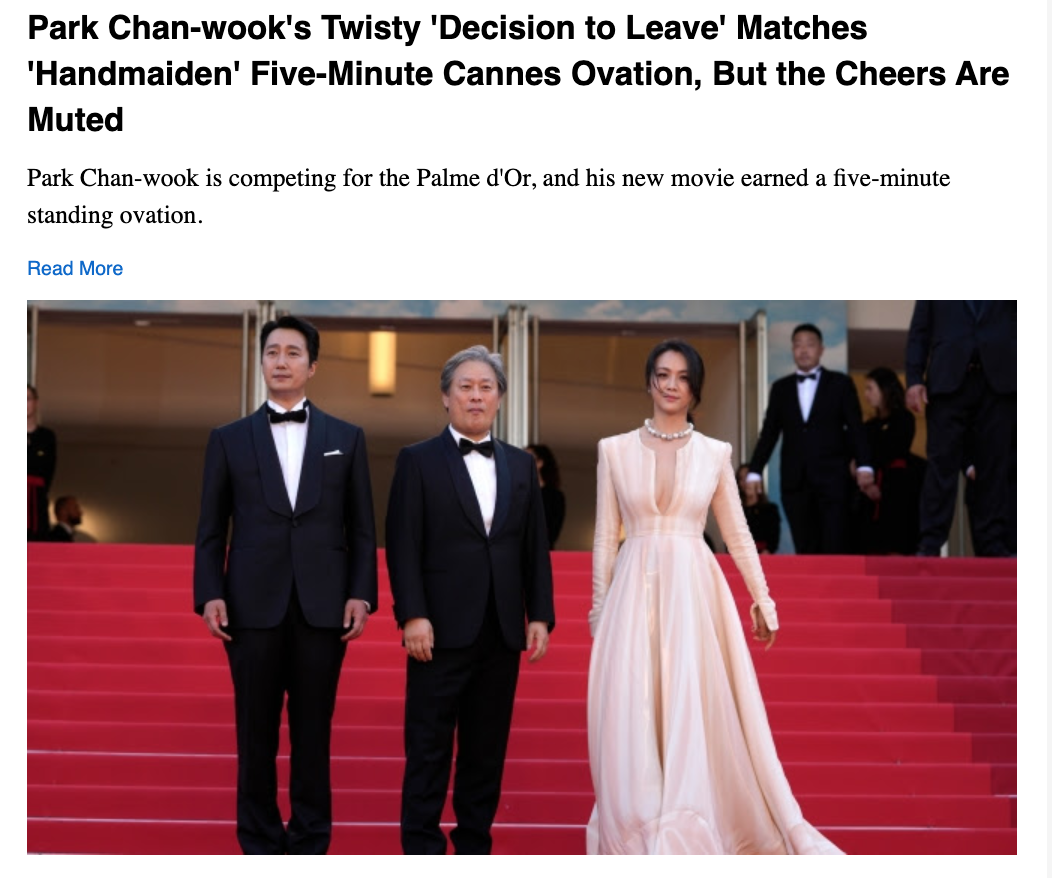
With all due respect for Park Chan-wook’s smoothly masterful filmmaking chops (no one has ever disputed this) and the unbridled passion that his cultish film critic fans have expressed time and again…
And with respect, also, for the time-worn film noir convention of the smart but doomed male protagonist (a big city homicide detective in this instance) falling head over heels for a Jane Greer-like femme fatale and a psychopathic wrong one from the get-go…
The labrynthian (read: convoluted) plotting of Park’s Decision To Leave, though intriguing for the first hour or so, gradually swirls around the average-guy viewer (read: me) and instills a feeling of soporific resignation and “will Park just wrap this thing up and end it already?”
Jesus God in heaven, but what doth it profit an audience to endure this slow-drip, Gordian knot-like love story-slash-investigative puzzler (emphasis on the p word) if all that’s left at the end is “gee, what an expert directing display by an acknowledged grade-A filmmaker!”
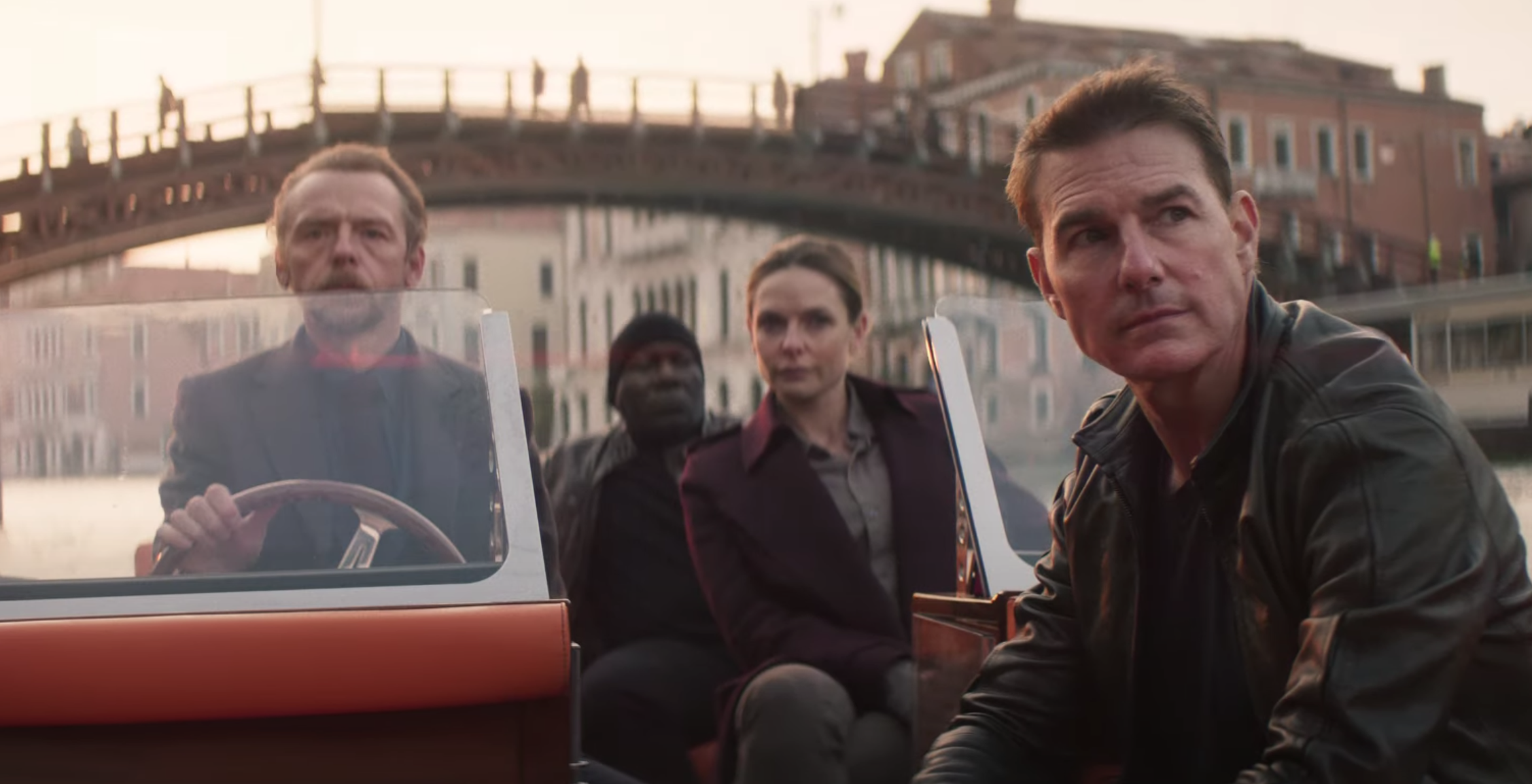
How could there be negative reactions to this trailer for Mission: Impossible – Dead Reckoning Part One? It looks great, especially the footage of Tom Cruise riding on horseback through sand dunes, dressed in Middle-Eastern commando garb?
The only negative I can think of is the fact that this Paramount release doesn’t open until 7.14.23 — 14 months hence.

In a 5.22 chat with Deadline‘s Anthony D’Alessandro, Armageddon Time director-writer James Gray delivered a neat assessment of the stink factor in mainstream gladiator cinema.
He basically said that CG comic-book spectacle films are systematically draining the poetry, music and gravitas out of the moviegoing experience.
Once in a blue moon a big franchise film will hit the magic button and deliver something transcendent. One example was last December’s SpiderMan: No Way Home, which I said over and over should be Best Picture-nominated. But mostly they don’t do this. Mostly they just make money.
Gray argues that the big studios “should be willing to lose money for a couple of years on art film divisions, and in the end they will be happier.”
In less extremist terms, Gray is suggesting that the big boys should consider reverting to the ’90s and early aughts system in which specialty divisions made smaller films — films that weren’t expected to bring in huge profits but didn’t necessarily lose money. Which means, of course, that above-the-title talent would have to accept lower fees for making these films. (And there’s the rub.)
HE version: The studios should at least be willing to make smarthouse flicks with a reasonable shot at breaking even or becoming modestly profitable.
Francois Truffaut once said that when one of the films produced by his company, Les Films du Carrosse, reached break even he and his colleagues would pop open a bottle of champagne.
#Cannes2022 ‘Armageddon Time’ Director James Gray On Why Studios Should Be Able To Lose Money On Art Specialty Divisions https://t.co/SgodYB80uM pic.twitter.com/Zno5g6uVQz
— Deadline Hollywood (@DEADLINE) May 22, 2022
Brett Morgan‘s David Bowie doc seems innately exciting (and how could it not be?); Park Chan-Wook‘s Decision to Leave looks and sounds exactly like a PCW film. Those actors generating those oppressive actorish expressions…God!

So far the 2022 Cannes Film Festival has felt weak. Okay, pretty good but not good enough. A pair of triples (R.M.N., the first half of Triangle of Sadness) but in terms of terms of excellence or ambition or primal goading madness, no homers or grand slams.
You know what probably would have been regarded as an exercise in primal madness if it had been screened at this festival? Andrew Dominik‘s Blonde.
Cannes topper Thierry Fremaux saw it and wanted it, but the longstanding Cannes-Netflix contretemps was insurmountable.
Pedro Almodovar, quoted by Jordan Ruimy on 5.10:
“I must be one of the few to have seen Blonde, Andrew Dominik’s great film, where Ana de Armas plays Marilyn Monroe in a chillingly real way.
“There is a sequence (if it does not disappear from the final cut) of the harassment she suffered in the hands of President Kennedy. The sequence is explicit enough to make you feel Marilyn’s revulsion and pain.

“The film is a novel by great writer Joyce Carol Oates, it tackles Norma Jean Baker more so than [the]’Hollywood creation ‘Marilyn Monroe‘. Norma Jean fought all her life for men around the world to understand that Marilyn was the result of her extraordinary work as an actress.
“Shortly after, when Norma Jean, already a zombie, was invited to famously whisper-sing ‘Happy Birthday, Mr. President.’ I can only imagine how poor Norma must have felt, in the face of patriotic duty, to sing ‘happy birthday’ to the same man who abused her (as seen in the film) dressed in a skintight dress that became iconic.”
Wait a minute…JFK is shown “abusing” Monroe? What’s that supposed to mean? That he muscled or mauled or raped her or something? He was a thoughtless, rambunctious user as far as women were concerned, but the energy required to abuse a famous movie star wasn’t required of the President of the United States at that time. All he had to do was wink and raise an eyebrow. I don’t believe Almodovar.
A passage from the Oates novel, from a chapter titled “The President’s Pimp”:
“Sure, [Peter Lawford] was a pimp.
“But not just any pimp. Not him!
“He was a pimp par excellence. A pimp nonpareil. A pimp sui generis. A pimp with a wardrobe, and a pimp with style. A pimp with a classy Brit accent. Posterity would honor him as the President’s Pimp.
“A man of pride and stature: the President’s Pimp.
“At Rancho Mirage in Palm Springs in March 1962 there was the President poking him in the ribs with a low whistle. ‘That blonde. That’s Marilyn Monroe?”
“Lawford told the President yes, it was Monroe, a friend of his. Luscious, eh? But a little crazy.
“Thoughtfully, the President asked, ‘Have I dated her yet?'”
Come hell or high water, Hollywood Elsewhere intends to see the following films today (Monday, 5.23): (a) Park Chan- Wook‘s Decision to Leave (Salle Debussy, 4:30 pm); (b) David Cronenberg‘s Crimes of the Future (Salle Debussy, 9:45 pm), and (c) Brett Morgen‘s Moonage Daydream (David Bowie doc, 12 midnight, Grand Lumiere).
Don’t kid yourself — Park Chan-Wook has always been a high-style genre wallower. I was willing to play along with Oldboy and Lady Vengeance, but Stoker is where I drew the line and said “all right, that’s it!…no more!” By the time The Handmaiden came along I was too alienated to respond.
For years I’ve been hoping that PCW would stop playing to the gallery (i.e., sensation-mongers, fans of visual-for-visual’s-sake) and cut the shit and calm down and use his considerable skills to make a real, serious-minded adult film. But year in and year out, he’s refused. He’s now 58 years old — what’s he gonna do, change?