Little Movies That Could

Last Saturday (6.11) marked the 40th anniversary of Steven Spielberg‘s E.T., The Extra-Terrestrial. It opened exactly one week after Poltergeist (6.4), which was partly directed by the late Tobe Hooper but mostly directed (or certainly overseen) by Spielberg.

E.T. and Poltergeist each cost roughly $10.5 million to make. Both were hugely successful, but E.T. left a much bigger box-office footprint with a grand total to date of $792 million. Poltergeist wound up earning $121.7 million.

I was the managing editor of The Film Journal at the time, and I distinctly recall that the promotional build-up for Poltergeist (“the beast!”, ghosts seeping out from Native American burial grounds, little girl sucked into a television) was louder than the E.T. drumbeat.

When the first E.T. screening happened I sent a stringer (Mark Kane, who went on to become a hotshot L.A. attorney) to cover it rather than see it myself. When Kane returned to the office later that day he had this funny little grin on his face. He didn’t say “this movie is going to make box-office history” or “it brought tears to me eyes” or anything like that, but he was definitely charmed.

Bottom line: There wasn’t much advance hoopla for E.T. The pre-screening buzz was that it was a “little movie” — a film that was basically about kids and divorce and suburbia and so on. There were no mentions of a toy-sized, big-eyed alien living in the closet of a little boy’s bedroom, etc. E.T.‘s p.r. materials were very restrained and neutral-sounding.

And then it opened and within a week or two everyone was saying “holy shit…how many times have you seen it?…I have to take my kids.”

The E.T. vibe before it opened (i.e., when it was just screening for Manhattan journos) was very cool and contact-high. I was in love with it. I saw it three times before it opened. And then it opened and the unwashed masses poured into theatres and it was suddenly less of a cool thing.

Your mission, should you choose to accept it, is to name other big hits that nobody saw coming…movies that no one expected anything stupendous from in terms of emotional content or box-office revenue but wound up surprising the handicappers.

Okay, I’ll name one — Ted Kotcheff‘s First Blood. Early buzz was flat, just another Stallone flick, a difficult production history, a re-shot ending, mixed reviews, etc. But it wound up earning a gross of either $125 or $156 million (serious money back in ’82) and of course launched a franchise.

None of the Rambo sequels have been as good as the original.

Not Getting “Tulsa King” Thing

The basic premise of Taylor Sheridan‘s Tulsa, a Paramount+ series debuting on 11.13.22, is…what again?

The East Coast goombah mafia doesn’t have a strong enough presence (i.e., isn’t making enough money) in Tulsa, Oklahoma, and so mafia bigwigs send Dwight “The General” Manfredi (Sylvester Stallone), an ex-com mafia capo with a chip on his shoulder, to Tulsa to set up a criminal organization.

“Tulsa? Is this a joke?”

Question #1: Tulsa doesn’t have several criminal types (drug dealers, bookmakers, hot car chop shops, loan sharks) already working it? Question #2: The city is crying out for an assertive criminal authority? Why? Question #3: The fuzz wouldn’t be on to Manfredi’s arrival and all over him like a cheap suit from day one? Manfredi won’t stick out like a sore thumb? Question #4: Is Manfredi into Edgar Allen Poe? Is there any chance he’ll recite the opening lines of “The Raven”?

The central idea seems to be to create a culture-clash dramedy…I guess.

Woman in Bondage

So Andrew Dominik‘s Blonde (Netflix, 9.23) was primarily shot in black-and-white (which I love) and at times within a 1.37 aspect ratio. But not entirely. Occasional color sequences used for…what, replicating sequences from her color films?

HE theory: The black-and-white conveys the sad and vulnerable stuff, the widescreen black-and-white is used for public appearances, and color pops in every so often for snippets of Niagara, Gentlemen Prefer Blondes, River of No Return, The Seven-Year Itch, The Prince and the Showgirl, Let’s Make Love, etc.

Marilyn Monroe‘s best films were in black-and white, of course — The Asphalt Jungle, All About Eve, Clash By Night, Don’t Bother to Knock, Some Like It Hot, The Misfits.

From Ben Dalton’s Dominik interview in 2.12.22 Screen International: “In summer 2021, reports emerged that Netflix was unhappy with the more controversial aspects of the film, including a scene featuring bloody menstrual oral sex. ‘That’s not true!’ laughs Dominik, who describes the claim as ‘hilarious’.

“Dominik does confirm, though, that a rape scene in Joyce Carol Oates’ book appears in the film. There was a back-and-forth with the streamer — which has yet to comment on the situation — about what was acceptable to include.

“‘It’s controversial, there’s a bit for [Netflix] to swallow,’ says Dominik. ‘It’s a demanding movie — it is what it is, it says what it says. And if the audience doesn’t like it, that’s the fucking audience’s problem. It’s not running for public office.’”

Jordan Ruimy is reporting (and Netflix has confirmed) that Blonde‘s running time is 166 minutes.

I’m presuming that Blonde will screen at both the Venice and Telluride festivals, which will kick off, respectively, on 8.31 and 9.2.

Todd Field’s “In The Bedroom”

This absurd TikTok fantasy reminds me of an actual, real-life infidelity episode. Or so I was told by a friend of Gerry Seitz, a Connecticut guy I knew and palled around with way back when. Gerry didn’t pass it along first-hand, but I believed the story then and I believe it now. (Partly because I want to believe it, I suppose.). True or false, I’ve never forgotten it.

It happened in the early to mid ’70s, somewhere in Southern Florida (Ft. Lauderdale, Hollywood, Boca Raton). A college grad, Seitz was working part-time in construction, and he was having an affair with the extremely hot wife of a co-worker (or a friend of a co-worker, something like that).

No dates, no motel assignations — Gerry would occasionally visit the unemployed wife at home around lunch hour or the early afternoon, and then, just to be safe, skedaddle around 3 or 4 pm. Hubby was usually home by 6 or 6:30 pm.

You know how this goes. Gerry and the wife were in bed around 3 pm when they heard the sound of a car outside, the jingle of keys, the front door opening, etc. It happened too quickly for Gerry to manage an escape. He tossed his clothes and footwear under the bed and slipped buck naked into the bedroom closet.

The husband walks in, a bit surprised to find his wife under the covers with (what is that?) a certain aroma in the air. She says something about wanting to take a shower or a sudden urge to take a nap…whatever comes to mind. Turned-on hubby gets flirty and handsy and takes off his T-shirt. The guilt-stricken wife feels she has no choice but to respond.

Gerry, listening from the closet, is quietly freaking. He figures it would have been one thing if the husband had walked in on him and the wife — an alarming trauma that probably would have turned violent. But the husband’s reaction would be much more ferocious, Gerry was imagining, if he discovers Gerry in the closet after he and the wife have had sex. The guy might shoot him if that happens.

Gerry is weighing the odds, sweating it out and struggling to stay as silent as possible. Before the husband and wife start to actually do it, Gerry decides he can’t stand the tension and opens the closet door and announces himself, dangling schlong and all…”I’m really sorry and I’m leaving.” Husband freaks, strong words, slaps and fisticuffs. But at least Gerry didn’t get shot.

God, I Love This Film

Posted on 12.24.17: Remember those dim-bulb Academy members who harangued Martin Scorsese and Leonardo DiCaprio after that first Wolf of Wall Street Academy screening because they didn’t get the satirical thrust behind all the coarse vulgarity (which was delivered both literally and within “quotes”)? And how Scorsese and DiCaprio had to attend screening after screening and patiently explain that they were depicting the louche adventures of Jordan Belfort and his cronies to make a point about the character of the buccaneers who have fleeced this country and will definitely fleece again? Remember the brief shining moment of Hope Holiday

Read more

Out Of the Past

The object of justified feminist scorn on The Dick Cavett Show so many decades ago was George Gilder, a Republican speechwriter who had written a Ripon Societys piece that defended President Richard Nixon’s veto of a day-care bill that had been sponsored by Senators Walter Mondale and Jacob Javits. He was fired as editor as a result. To defend himself, he appeared on Firing Line and then the Cavett show. Robert Shaw delivered the fatal stab wound.

Friendo: “So prescient, a discussion you could have today…but Robert Shaw would be needed.”

No Sale

This is several weeks late, but there’s a reason I decided against watching One Perfect Shot, a six-episode HBO Max series hosted by Ava DuVernay.

The director-friendly doc focuses on ambitious, well-executed shots in six films, shots that the producers believe are worthy of special praise. They’re from Jon Chu‘s Crazy Rich Asians (’18), Michael Mann‘s Heat (’95), Patty JenkinsWonder Woman (’17), Malcolm Lee‘s Girls Trip (’17), Kasi LemmonsHarriet (’19) and Aaron Sorkin‘s The Trial of the Chicago 7 (’20).

The problem, obviously, is that only two of these warrant in-depth study — Heat and Chicago 7.

The other four were chosen for the usual inclusive woke-Hollywood reasons…tributing black artists who are pals with DuVernay, saluting #MeToo progressivism. Girls Trip was mildly enjoyable fun but forget any notions of it containing a perfect shot. Everyone regards Harriet as a negligible thing — second-rate, historically inauthentic, flat-out terrible in some respects. Wonder Woman is a decent enough superhero flick and Jenkins did a fine job for the most part (it’s way better than Wonder Woman 1984), but it’s not my idea of top-tier and certainly isn’t even close to Heat‘s level. And Crazy Rich Asians is appalling…a synthetic wealth-porn romcom.

It’s actually an insult to Mann and Sorkin that their films (especially Mann’s) have been lumped in with the riff-raff.

What Else Couldn’t Happen Today With “Philadelphia” Remake?

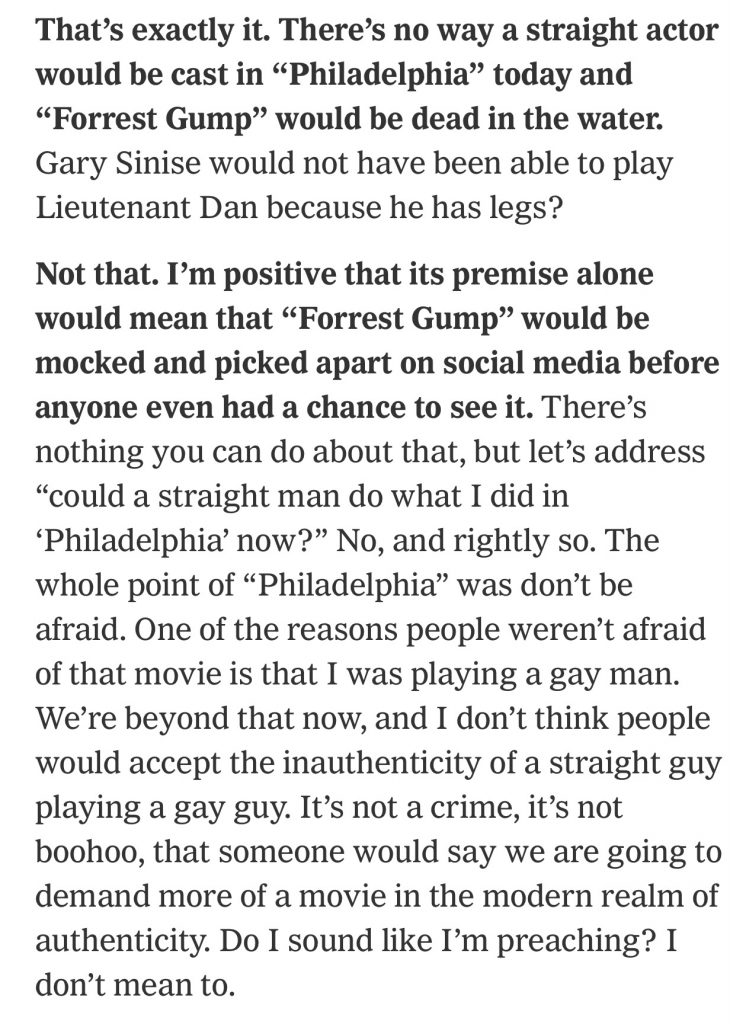
Tom Hanks to N.Y. Times interviewer David Marchese:

Another 2022 taboo: No major-league black actor (someone as big now as Denzel Washington was in ‘93) would agree to play a homophobe today. Too much negative signaling as everyone knows about real-life homophobia among blacks (just ask Pete Buttigieg) and therefore guaranteed antagonism from gay community. Am I wrong?