Great Sydney Pollack Quote

Alluding to Robert Redford in the early ’70s, director Sydney Pollack once said that “in acting, you have to sense that there’s a reserve somewhere, that you’re seeing the top of the iceberg.”

That, to me, is everything in screen acting — conveying that there’s a lot more underneath than what you’re seeing and hearing in a given scene. Forget technique — if you don’t have the under-the-water iceberg thing, you have nothing.

Proportional Inclusion

As far as Academy membership is concerned, one measure of fairness and equity would be to have Academy membership reflect general U.S.population tallies in terms of tribal ethnicities and whatnot. What are the actual hard Academy percentages as far as this goes? I’m asking.

We all understand that the Academy has become much more diverse since 2015. Two and a half years ago the Academy invited 819 new members into the fold. On 6.30.20 Variety‘s Marc Malkin reported that total Academy membership thereafter stood at 9,412 “with 45% of the new members will be women and 36% are from underrepresented ethnic/racial communities…the international make-up is 49% from 68 countries.”

But right now (January ’23), what percentage of the Academy is white, African American. Asian-descended, LatinX and so on? I’m searching around for hard stats and not finding any from ’22. Then again I’m in a rush and haven’t the time. I’ve asked some colleagues but they’re probably gun-shy…too much of a sticky wicket.

Should Academy percentages roughly equate with U.S. population percentages? That would be one yardstick. Right now the U.S. is roughly 60% white, 12.6% African American, 18.9% Latino, 9% Asian and so on.

Or should the Academy percentages be higher, based on the number of POCs or non-whites working in the film/TV industry? I honestly don’t know. But there has to be some statistical basis for fairness and inclusion.

Cut The Bullshit

Yesterday a “woe to black women filmmakers…Oscars-so-white is back” essay appeared in the Los Angeles Times, which of course was one of many articles lamenting the failure of Danielle Deadwyler and Viola Davis to land Best Actress noms for their respective performances in Till and The Woman King.

Written by Robert Daniels, the piece was a complaint about a seeming failure of Academy voters to follow the dictates of equity and quota voting, which basically means “to hell with merit…we’re in an age of social justice course correction and therefore it’s just not right for both Deadwyler and Davis to have come up empty-handed or, if you will, to have been elbowed aside.”

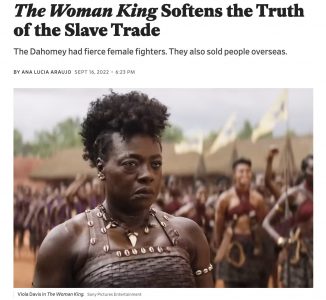
Do I have to remind that the chances of a Davis nomination were more or less out the window the minute those articles about Dahomey having profited from the slave trade appeared last September and October? They gave everyone an excuse to not vote for her.

And of course, Deadywler’s commanding lead performance aside, Till is just an okay or good enough film — it didn’t blow anyone’s socks off. So when Andrea Riseborough and her hardcore rummy performance in To Leslie busted into the conversation two or three weeks ago, it was inevitable (speaking from hindsight) that a weak sister contender would get pushed out. Fairly or unfairly, Deadwyler was the victim in this instance.

Riseborough to Deadwyler: “Excuse me, Danielle, but…wow, this is hard because I don’t know to put this. I absolutely adored your Till performance and all, but it’s not my fault that relatively few people saw it. The cold, cruel fact is that (a) I’m a latecomer and (b) I’m riding a surge, and I’m afraid somebody has to go. I know you’ve been working the circuit for several weeks plus you’re a presumed nominee for two reasons — how good you are in Till plus the equity thing. But I’m tapping you on the shoulder regardless. I’m in and you’re out…sorry.”

If You Must Know

Comment thread repulsion: “I was convulsing with misery and dying to escape but boiled down EEAAO isnt so much about generic verse-jumping (although it is) or the IRS audit or Ke Huy Quan’s nerd husband wanting a divorce or James Hong’s grandfather Gong Gong or the hot dog fingers, etc.

“Boiled down the central story tension is about the discomfort and denial that Michelle Yeoh’s Evelyn, a laundromat owner, is going through about her daughter Joy (Stephanie Hsu) and her lesbian relationship with Becky (Tallie Medel) and particularly Becky’s annoying hair style — a situation reflected in the multiverse by Joy’s Jobu Tupaki vs. Alpha-Evelyn and Jobu’s threatening, Darth Vader-ish behavior (“omnicidal” in the multiverse) blah blah.

“The big EEAAO catharsis manifests not so much with a resolution over the audit (although that’s welcome) as much as Evelyn’s ultimate acceptance and embrace of Joy’s queerness. Evelyn has travelled outside of and within herself to find peace with Joy not being straight.

“Kill me now with a steak knife.”

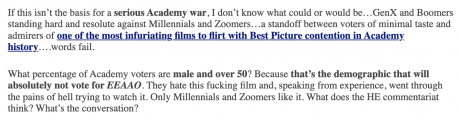
Friendo: “EEAAO has everything that Woke Twitter needs to feel safe. Bad white lady vs. good older Asian woman at the nominal center, augmented or flavored by a neutered dweeb-husband type plus gay daughter representing how people SHOULD think.

“The whole movie is the gay daughter chasing her mother around saying ‘why are you like this?’

“It’s basically everything we’ve all lived through from 2020 onward. CG purée made out of woke dogma. Or, alternately speaking, a 2013 Tumblr thread made into a movie.”

Read more

Hope For “EEAAO” Naysayers!

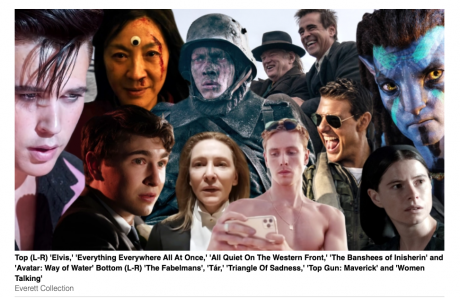
If you carefully read Pete Hammond‘s Deadline assessment of the possible Oscar fortunes of Everything Everywhere All At Once, there’s reason to believe that it might lose.

One, Hammond writes that “critics can take credit” for putting this infuriating A24 release “into front-runner status” — overly obliging, finger-to-the-wind critics, he means, and not your grounded, rank-and-file industry types.

And two, EEAAO is “relatively weak in the crafts area” (no noms in visual FX, cinematography, production design, sound, hair and makeup), which “could be telling in its overall Academy appeal.” You bet your sweet booty!

Friendo: “Right now I think EEAAO is the Best Picture frontrunner, principally challenged by Top Gun: Maverick and The Banshees of Inisherin.

Top Gun is a mood-lifter and one of the only ones. Banshees has no reason to win. EEAAO is a woke odyssey — essentially a movie that explains wokeness. Explore inner realms beyond traditional day-to-day life, and in so doing redefine reality. A female small-business owner with a queer daughter experiences a great awokening.”

Drebin In The Hills

I’ve never seen (and probably never will see) Tammy and the Bachelor (’57), but this musical overture passage, composed by Frank Skinner, is mildly impressive in a schmaltzy sentimental sort of way.

I’ll admit it takes some effort to imagine a blissful romantic pairing between young Frank Drebin (30 year-old Leslie Neilsen) and the 24 year-old Debbie Reynolds.

Speaking of Neilsen: In the fall of ’88 I was delivering Dukakis for President literature in the Hollywood hills (Maggie and I were living at 8682 Franklin) and after knocking on the front door of a fairly sizable hilltop bungalow who should answer but Drebin himself! White-haired, wearing only gym shorts, in no mood for banter. I played it dry and casual.

Sundance friendo: “I loved Passages, Infinity Pool (NC-17 cut), Fair Play, Scrapper, Theatre Camp. Minor woke servings but definitely better than recent years. Everybody loves the Willie Nelson, Michael J. Fox and Brooke Shields docs. I’m still trying to see Magazine Dreams, Eileen, Polite Society. So far I’ve seen 10 films. I should be able to see about 10 more by the time the fest comes to an end.”

Sundance friendo #2: “Honestly, from what I’ve seen, this has been a terrible Sundance. The festival is getting worse and worse. I haven’t seen Past Lives, which is supposed to be the best movie that played there.”

Formidable Fellows

Alejandro Gonzales Inarritu has reiterated his disdain for superhero movies. He recently told Variety‘s Marc Malkin that superheroes are “sad figures,” although inorganic or uninvested is probably closer to the mark. Overly confident, No pain or gain.

AGI seems to be alluding more to superhero fans and their attachment to repeatedly re-sampling those surges of adolescent euphoria…we’re all receptive to that stuff on a certain level, to the casual glory of it all…the basic selling point of every superhero flick.

“I see heroes every day,” AGI explained. “I see beautiful people really going through very difficult situations and doing incredible things. And [these are] the people that I kind of connect with. But superheroes…do we really need that?”

More to the point and aside from Chris Nolan, James Cameron and Sam Mendes, which world-class, major-league directors have truly embraced the basic superhero scheme from a fan perspective? They all pretty much hate them, don’t they?

Here’s an idea — imagine that five or ten genius-level directors (forget their ages) have been somehow forced to go superhero slumming as a one-off…forced to co-write and direct some kind of smartly imagined superhero flick. Who might perform well under these circumstances?

There’s a clear differences between superheroes and exceptional action stars, and most of us can roll with the latter. Seemingly invulnerable (or certainly difficult to kill) protagonists with extraordinary skills. No movie fan can truly enjoy the adventures of supermen because of the bullshit factor. But somewhat vulnerable figures with exceptional skills and determination…tactical intelligence wizards…action studs. That’s as far as I can go. Matt Damon‘s Jason Bourne…Denzel’s Creasy…that line of country.

Statistics & Precedent

It was asserted yesterday that for All Quiet on the Western Front to win the Best Picture Oscar, “It must win Best Adapted screenplay, but that will be tough because Sarah Polley could definitely win that.”

And I said “oh, yeah?”

It was then claimed that whichever film wins the Best Original Screenplay Oscar, Banshees or EEAAO, that is your Best Picture winner. What else can Banshees win?  If Kerry Condon wins, it’s over.  Banshees will take the Best Picture Oscar.

And I said “oh, yeah?”

It was pointed out that a film “usually can’t win Best Picture Oscar without a Best actor nom, a Best Screenplay nom/win, and a Best Editing nom.”

And I said “Oh, yeah?”

The same guy said “if Judd Hirsch wins the Don Ameche award, then The Fabelmans could win.”

He concluded by saying that Top Gun: Maverick, which will almost certainly win Oscars for sound and editing, can only win if it somehow wins Best Screenplay, but that ain’t happening.”

And I went “Ohhhhh, yeaaahhhh.”

Nikki Finke Returns

Friendo: “Any thoughts on Jacob Bernstein’s 1.21 NY Times piece about the last days of Nikki Finke?”

HE: “What’s there to say? Okay, to some extent Fink wept and lamented as she faced the Big Sleep, and to some extent she was accepting. Most of the article is a “Nikki’s greatest hits” rehash. The only new material (at the beginning and end) is from a friend of Nikki’s, Diane Haithman, who helped her during the waning days.

“For what it’s worth, Jay Penske comes off like a human being.

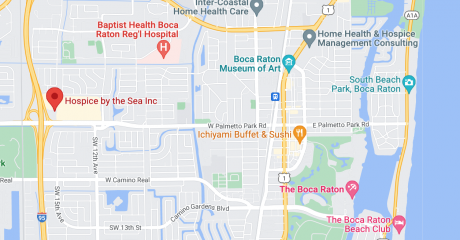
“The piece says, by the way, that Finke died last October at Hospice by the Sea in Boca Raton. In fact it’s located roughly 20 blocks from the sea. It should be called Hospice by Interstate 95.

“The important thing, no offense, is that she’s dead. Nobody wept when J.J. Hunsecker passed on either.”

Cave-Dwelling As Spiritual Calling

Last night “Correcting Jeff,” one of the more dickish and obnoxious HE comment hounds, stated that “cinema died years ago, yet Oscar bloggers fight on like Japanese soldiers hiding in caves.”

Not a bad metaphor for what people like myself do, but there’s more to it than just living on wild berries and stray lizards, bathing in mountain streams, sleeping on a bed of grass and leaves and occasionally sharpening the bayonet sword with a rock.

Wokesters deciding that “ars gratia artis” had to be diminished if not dismissed in favor of movies being used mostly if not exclusively as propaganda devices to promote social justice and implement across-the-board DEI — that’s certainly one big change that corroded the Oscar brand and the general aspirational vibe that fed the magic of Hollywood for so many decades.

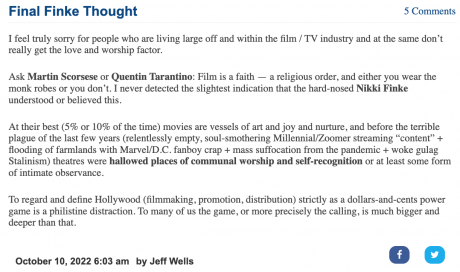
Over the last 90 or so years the best films have often reflected social-political tensions and concerns, but the balance tipped six or seven years ago when a stone sociopath and crime-family grifter won the Presidency and a reactive lurching decision was made by woke commissars to counterbalance the Trump toxicity…to emphasize progressive instruction and social equity over emotional revelation and (at least occasional) attempts at universal illumination — this is what killed the once-vital golden goose of cinema more than anything else…more than Marvel/DC, more than the pandemic and streaming, more than Bob Strauss incessantly beating the Get Out drum.

I for one am proud to be an online, 24/7 cave-dwelling Japanese soldier in this regard, fighting like Emiliano Zapata or William Wallace or Dorothy Parker or Mose Allison for the values of classic-brand cinema and the cause of reminding the industry that the artistic values of yore are eternal and need to be cherished …values that exist above and beyond the oppressively shallow SJW Jen Yamato progressive gulag aesthetic (“banal representation matters!”) and the terrible nerve-gas scourge of the Perri Nemiroff / Maria Menudos Noovies brand (“keep smiling!…keep hustling popcorn!”) and the soul-numbing narcotic of those utterly grotesque Nicole Kidman “big lie” AMC spots….I for one am proud to be a proverbial die-hard Japanese soldier in this regard.

“Everybody’s Daddy”

It goes without saying that Sea of Love (’89), a sexually charged Manhattan noir + Al Pacino‘s comeback film after the colossal misfortune of Hugh Hudson‘s Revolution, would never be made today.

Richard Price‘s screenplay is too male, too sexualized, too inauthentic as far as Ellen Barkin‘s character was concerned. But it had some really great scenes, and this was one of them.

Pacino was 48 at the time; Barkin was 34. The beefy John Goodman was perfect as Pacino’s temporary partner in a hunt for a serial killer. William Hickey, who had played Don Corrado in Prizzi’s Honor four years earlier, was perfect as Pacino’s widowed dad.