CODA Bros!!

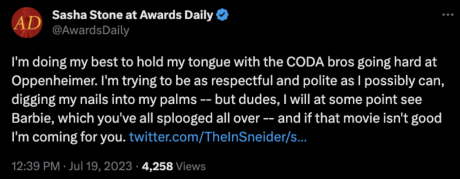
Every person reading this post needs to sit down, take a breath and ask themselves this question: Deep down, am I a CODA bro? Do I place a higher value upon movies that deliver strong emotional goods (i.e., that warm feeling of empathy that spreads throughout your system) than films that feel more intellectually-focused…more brainy-ish?

To put it differently, am I more of a cinematic Dylan fan or am I more into movies that give me a kind of pre-Rubber Soul Beatles high?

During yesterday’s Oscar Poker podcast Sasha Stone said that Oppenheimer was much more Dylan-ish than Lennon-McCartney.

What kind of music or what band is Barbie like? I won’t know until I catch it at 3 pm this afternoon, or roughly three hours hence. Oppenheimer follows at 7 pm. Both at the AMC Lincoln Square.

If I Sounded Like Marjorie Taylor Greene

…I would seek out a brilliant acting-and-vocal coach, part Evanna Lynch and part Henry Higgins, and beg him or her to please help me get rid of my white-trash, Deliverance hillbilly shitkicker accent. Because if I could sound more like Sigourney Weaver, I could become more acceptable as a national political figure.

Intimate “Salk” Perspective Is What Matters

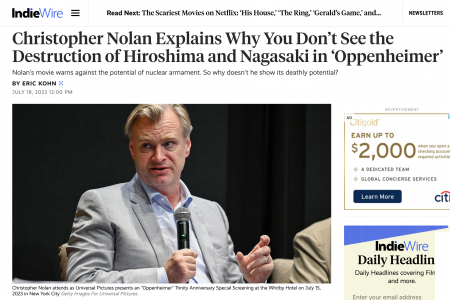
Following a special screening of Salk at Manhattan’s Whitby Hotel last weekend, director Christopher Nolan explained why he chose not to show the human-scale benefits of the Salk polio vaccine, which began to be distributed in 1955 and eventually eliminated polio in the United States.

In the recent documentary To Eliminate Polio: Jonas Salk and his Miracle Vaccine, the impact of the innoculations is shown in abundant, upbeat detail. Although the documentary was released in part to drum up hype for Nolan’s three-hour biopic about Jonas Salk‘s heroic achievement, no such footage appears in Nolan’s Salk.

Nolan’s film doesn’t show thousands of children running around and enjoying their lives unhindered by polio, he explained, for a good reason. Salk is strictly a POV film that is centered around Salk’s immediate perspective, and since Dr. Salk didn’t innoculate any kids personally (except for his own three children) and didn’t go on a national goodwill tour to personally observe the vaccine’s beneficial effect upon families with children, it felt like “a reach”, Nolan said, to dramatize the effects of the Salk vaccine.

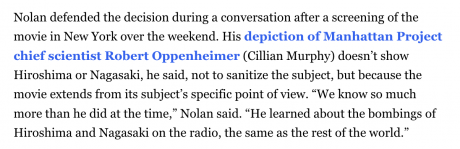
“We know so much more than Salk did at the time,” Nolan said. “He didn’t personally observe the mass innoculations and only saw them on TV, as he wasn’t exactly a ‘people person.’ He didn’t meet with any children or parents on a random basis, and he certainly didn’t administer the vaccine personally to children outside his own family, and so I decided to focus the film strictly on Salk’s research along with his dealings with scientific colleagues and a couple of government representatives.”

“Oppenheimer” & Oscar Poker Have Same Number of Syllables

It’s funny how these Oscar Poker chats go. Sometimes the discussion will feel relaxed and confident, and sound that way. At other times a relaxed chat (like this one) will bore your pants off. Still other times a discussion that feels awkward and inarticulate during recording will result in a good listen.

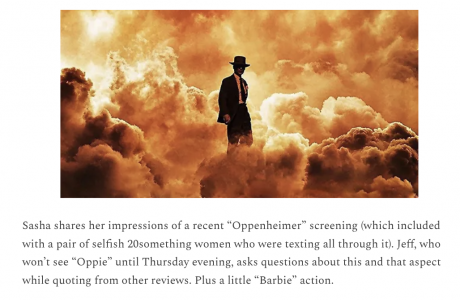
Having seen Oppenheimer in Burbank on Tuesday evening (7.18), Sasha shared her euphoric impressions, calling it a 10. She also described a grotesque encounter with a pair of selfish 20something women who were texting all through it. Jeff won’t see Oppie until this evening (Thursday, 7.20, 7:30 pm), and so he asked questions about this and that aspect while quoting from other reviewers. Plus a little Barbie action.

Again, the link

Truffaut or Bertolucci?

I happened upon these snaps (actually captures from a brief video) on Instagram…@alix_brown via keithmcnallynyc. Right away I was wondering if it’s from a ‘70s French film of some distinction. In and of itself the cigarette is unfortunate, but what the guy does with it is very Alain Delon in La Piscine or…I don’t know, Jean Pierre Leaud in Bed and Board. Back in the day I used to be that guy.

SAG/AFTRA, WGA Chill Option

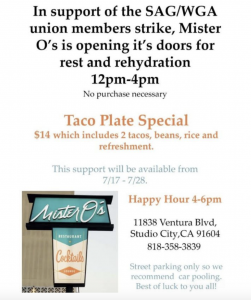
Director-screenwriter friendo to HE: ‘I know you appreciate old-school class, etc. Mister O’s is a retro-designed supper club a la Mad Men and ’60s Rat Pack style in the Valley. Since Universal and other neighboring studios are making it additionally difficult for picketing writers and actors by doing things like cutting down shade trees and blocking sidewalks, this upscale restaurant is offering itself as a cooling station…and it’s a very cool place to hang and cool down.”

Sweet Spot — 165 to 180 Minute Length

Many three-hours-or-longer films reside on my all-time greatest roster — The Godfather Part II, Apocalypse Now, Lawrence of Arabia, The Wolf of Wall Street, Scarface, The Irishman, Barry Lyndon, Ben-Hur, Titanic, The Seven Samurai, Gone With The Wind, Spartacus, etc.

Length, of course, has always been immaterial or irrelevant when it comes to quality — no bad film can be too short, no good film can be too long, etc. There’s nonetheless something a bit more transporting or inviting or impactful when it comes to films that are just a bit shorter — 165 minutes to 180 minutes, I mean.

If you’re talking “long but good movie,” 165 to 180 is HE’s sweet spot. Long but a little lighter, tighter and trimmer…slightly less indulged.

HE’s favorite 165 to 180s: The Godfather (175), Heat (170), Patton (172), The Best Years of Our Lives (170), Saving Private Ryan (169), The Thin Red Line (170), Long Day’s Journey Into Night (174), The Young Lions (167), The Longest Day (178), Beau Is Afraid (179), Dogville (’03), The Great Escape (172), The Unbearable Lightness of Being (171), Braveheart (178).

I even have a certain elveated regard for flawed films in this realm…King of Kings (168), In Harm’s Way (165), The Towering Inferno (165), The Good Shepherd (167), Alexander (175), etc.

All this said, we’ve all become sick of the relatively recent avalanche of needlessly long movies, otherwise known as the Peter Jackson King Kong syndrome….films running between 130 and 150 minutes or longer for no apparent reason other than a lack of basic narrative discipline.

Seasoned Critic Sez…

“Jeff — I totally agree with Paul Schrader on Oppenheimer — it’s the best film I’ve seen come out of a major Hollywood studio in eons. Really fantastic for the entire three hours. Tremendous.” — gmail message, arrived at 11:21 am eastern.

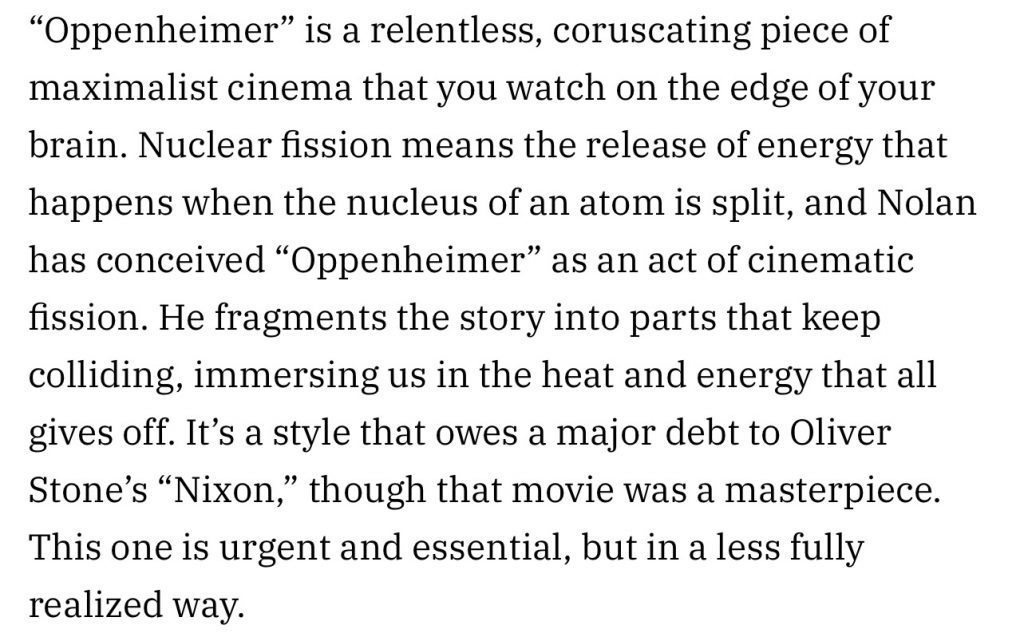
Gleiberman: “Oppie” Is “Urgent and Essential,” But Not As Good as Stone’s “Nixon”

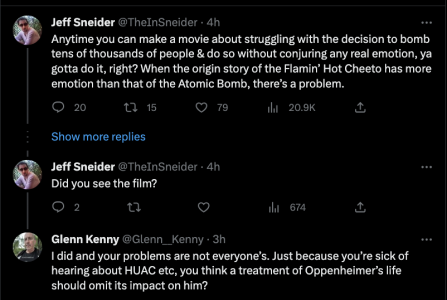
Okay, that’s it, Paul Schrader oversold it and now the game is more or less over — Chris Nolan’s Oppenheimer (Universal, 7.21) has been given a respectful-but-no-Cuban-cigar review by Variety’s Owen Gleiberman.

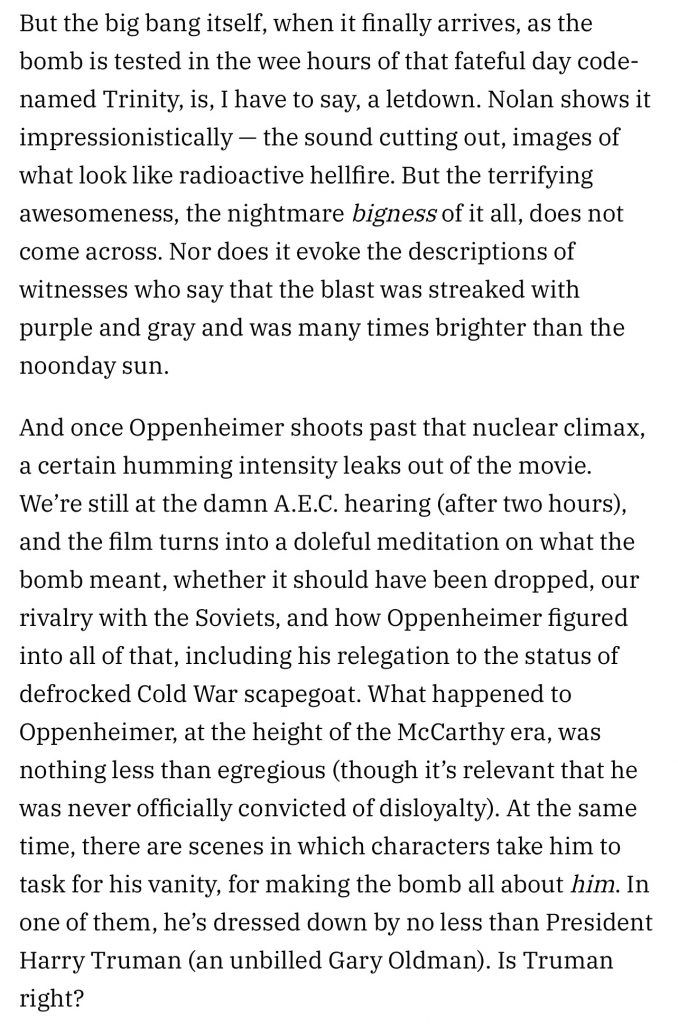
Even Nolan’s recreation of the Trinity explosion is a “letdown” Owen says…WHAT??

And then comes the funniest line in the whole review, a casual mention of “that damn Atomic Energy Commission hearing” which Nolan reportedly keeps cutting back to. As I chuckled I could see Gleiberman flinching in his seat: “God, man…enough with the damn AEC hearing already!”

And then Gleiberman really sticks the knife in by calling the second half “a doleful meditation” on atom-bomb morality and whatnot. Aaagghhh!! I’m melting…I’m melting!

Cillian Murphy’s titular performance will likely result in a lot of Best Actor talk, Gleiberman implies, but along with David Ehrlich’s backhand acrossthechops reaction (“Nolan’s first biopic feels like some sort of grandiose self-portrait”) you can probably forget any serious Best Picture Oscar headwind. Murphy and Robert Downey, Jr., fine, but that’s where it ends.

Honestly? It isn’t Nolan who’s taken the big hit here — it’s Schrader.

Fierce Bryant-Ruimy Contretemps

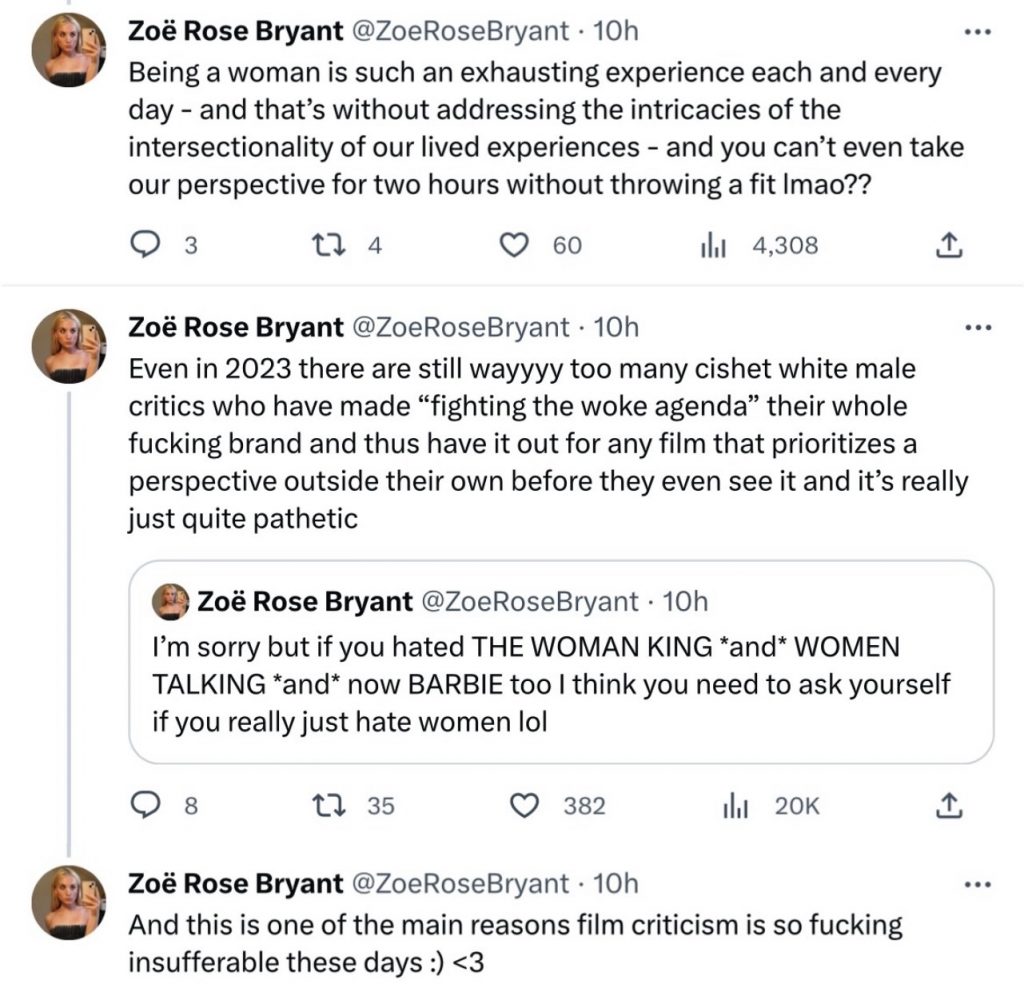
I for one would pay top dollar to see an Elon Muskvs.-Mark Zuckerberg cage match between World of Reel’s Jordan Ruimy and the highly assertive (i.e., trans-agenda-driven) Zoe Rose Bryant.

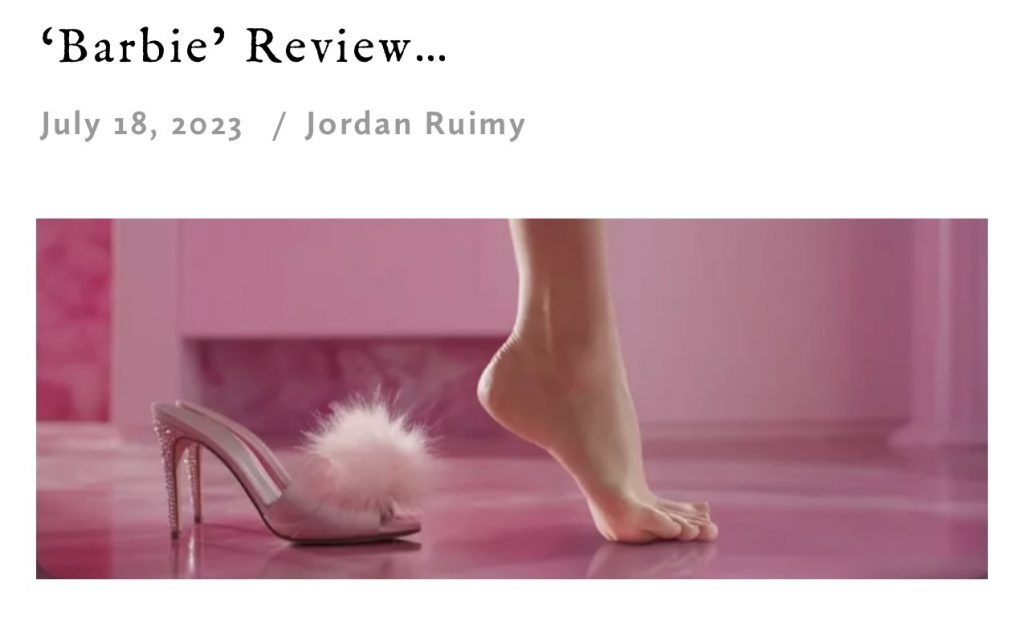
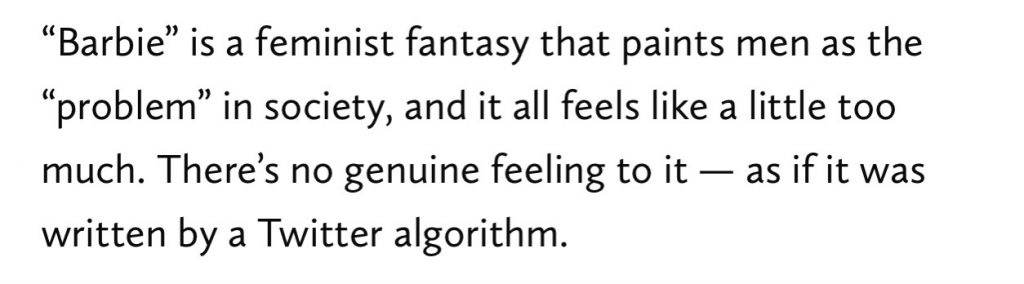
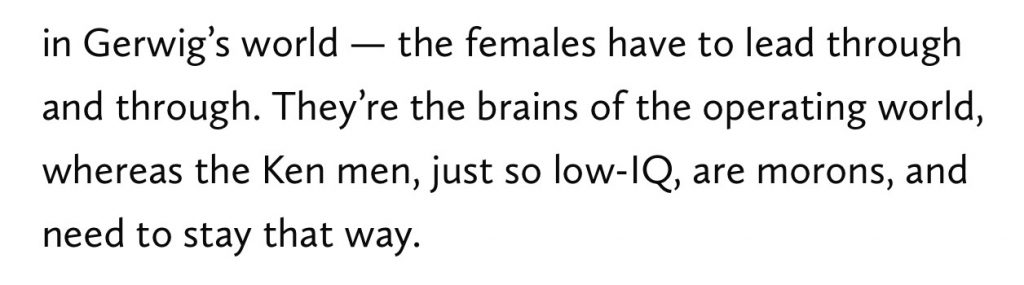
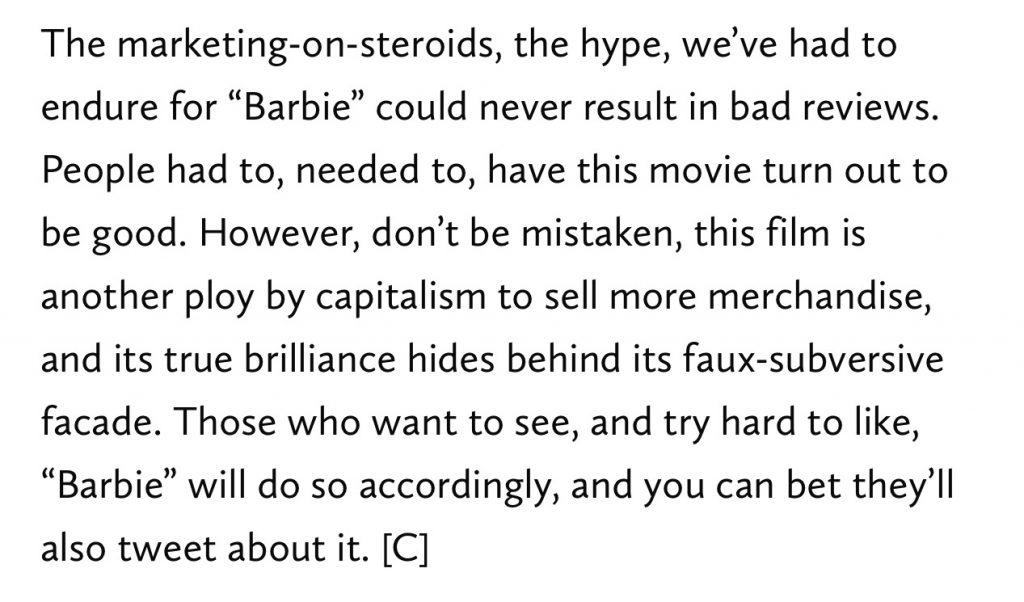
The dispute is over Barbie, of course. Ruimy first and then ZRB…

Bryant tweet-slammed Ruimy, but she seems to be aiming her slings and arrows at the general antiwoke community of sensible, fairminded, KoolAid-averse centrists, myself and Sasha Stone included.