Playing Ethnic Identity Card, Lily Gladstone Going For Best Actress Oscar

Variety‘s Clayton Davis is reporting that Killers of the Flower Moon costar Lily Gladstone won’t campaign for the Best Supporting Actress Oscar (a prize she would almost certainly win without breaking a sweat) but instead for Best Actress, which is not my idea of a smart move.

For one thing Gladstone will be going up against Maestro‘s Carey Mullligan and Poor ThingsEmma Stone — definitely the top two frontrunners as we speak. Not to mention Anatomy of a Fall‘s Sandra Huller, Priscilla‘s Cailee Spaeny (who won the Best Actress prize in Venice), Nyad‘s Annette Bening and The Color Purple‘s Fantasia Barrino.

Gladstone’s handlers know that her performance as Osage Nation victim Mollie Burkhart is good but unexceptional — the hard truth is that director Martin Scorsese and screenwriter Eric Roth didn’t give her all that much to perform. She mainly radiates suspicion and hostility at the white guys who are killing her fellow Osage tribespersons for their oil money.

Her performance is certainly less of a grabber than Stone’s, and the word on the street is that Mulligan, who’s been giving one knockout performance after another since breaking through 14 years ago with an acclaimed debut in An Education…the word is that Mulligan blows Maestro costar and director Bradley Cooper off the screen.

And let’s not belittle Huller, Spaeny, Barrino and Bening.

Gladstone’s attempt to land a Best Actress nomination is strictly an identity chessboard play.

The pitch: Gladstone’s performance may not be as powerhouse as Stone’s or Mulligan’s, but, as Davis explains in his article, this is a chance for the Academy to make history and set things right. “Don’t bother about quality of performance or the scope of her role,” Gladstone’s team is saying. “Identity is a much bigger deal.”

Davis: “Indigenous representation in the Academy has been virtually non-existent in the history of cinema. There have been three Indigenous women nominated for best actress — Merle Oberon for The Dark Angel (1935), Keisha Castle-Hughes in Whale Rider (’03) and Yalitza Aparicio for Roma (’18). Those women are British, Kiwi, and Mexican, respectively. Along with never winning an acting Oscar, an Indigenous actress from the U.S. has never won a SAG or Critics Choice prize, or even been nominated by those groups.”

Over the last six or seven years HE has noted repeatedly that woke flavors, sympathies and constitutions have been a ticket to Oscar glory by way of the New Academy Kidz. Movies about ethnic, non-white or outside-the-usual-mainstream characters and subject matter and/or films made by women or non-Anglos…good to go.

In the Best Picture category alone the winners have fit this paradigm…(1) the middle-class Asian family meets a Marvel-esque nerd sensibility in Everything Everywhere All at Once, (2) the hearing-challenged family in CODA, (3) the homeless woman saga, directed by a female Asian (Chloe Zhao), that was Nomadland, and (4) Parasite, the lacerating social drama directed by a South Korean genre nerd (Bong Joon ho). Green Book’s Best Picture triumph was an exception to this pattern (and was fiercely condemned by woke critics and columnists) but Moonlight (Black director-writer, focus on Black gay males) adhered to it.

Woke ideology has taken over, and everything (including Oscar campaigns in the acting categories) is measured by this.

Telluride flashback: On Thursday, 8.31, I was chatting with a couple of journo columnist acquaintances (i.e., not strictly critics) who, for political reasons or whatever, had seemingly bought into woke theology, or at least seem to have decided that siding with the wokesters is the safest way to go. The subject turned to Killers of the Flower Moon and my previously-stated view that Gladstone will not only be Oscar-nominated but may win, partly for the quiet intensity of her performance but largely, be honest, because of her Native American heritage. Because a Native American has never won an acting Oscar before.

I opined that in terms of her actual performance Gladstone delivers sufficiently but that’s all. Mostly she stares a hole into the camera lens…quietly enraged, guilt-trippy, “God will get you,” etc.

Immediately upon saying that Gladstone’s ethnicity will be a significant factor in landing a nomination, one of the journos said this was “insulting” and that “I won’t have it…I won’t tolerate this.” He was essentially saying that my opinion was racist, although he qualified this with the fact that we’ve known each other for decades and that he likes me personally but this kind of talk (harumph) will not be allowed in his presence.

Gladstone should go supporting. She would win in a walk.
Suppress All Melodies

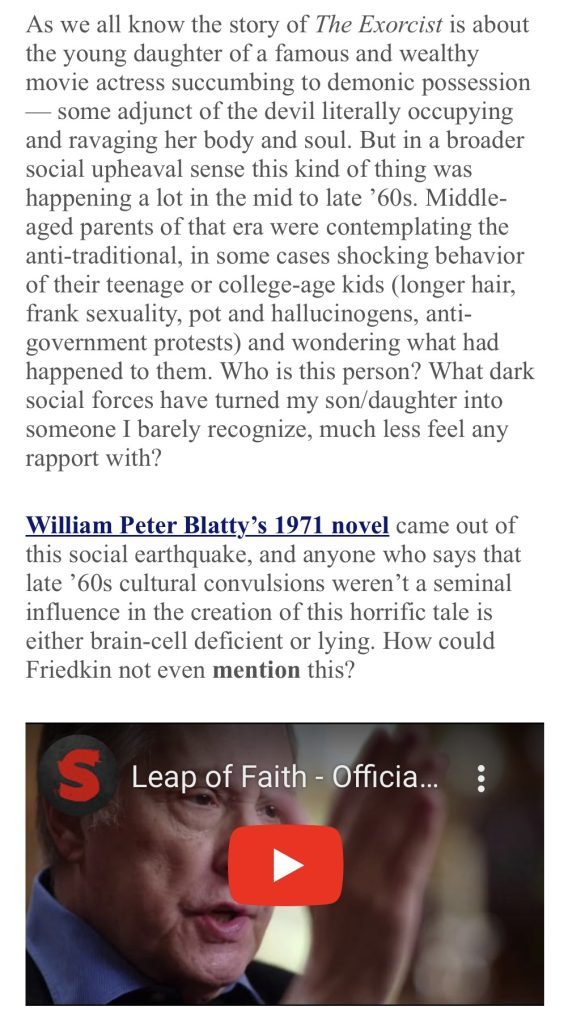
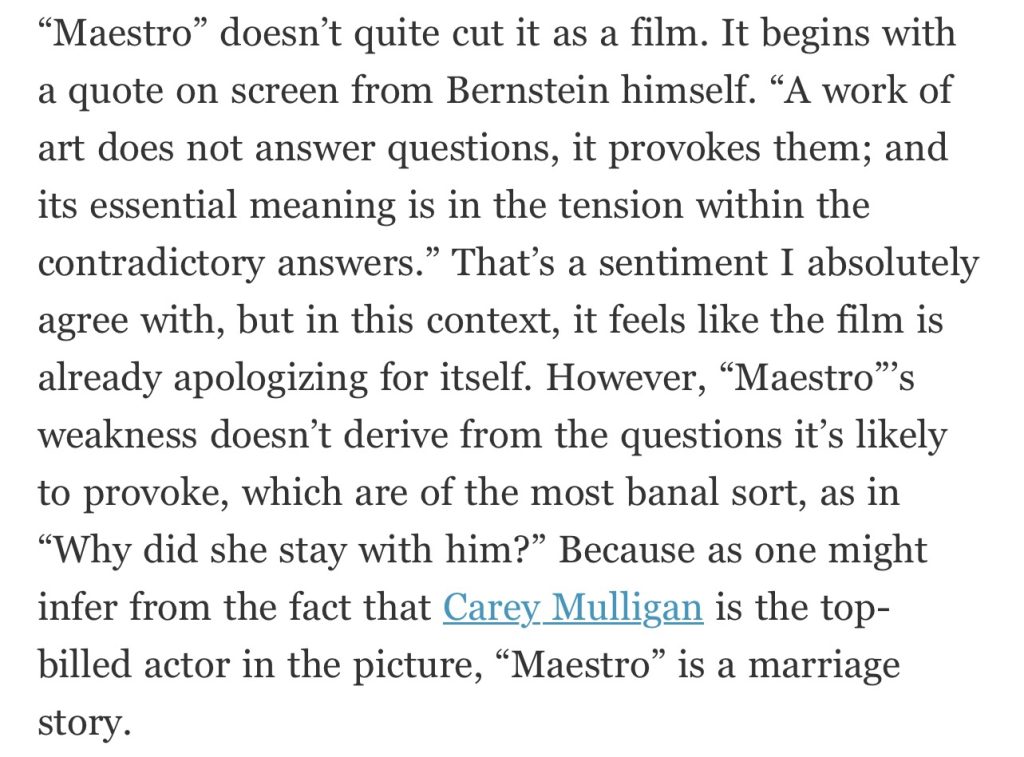
I knew Maestro ignores Leonard Bernstein‘s West Side Story score as well as the famous Tom Wolfe “Radical Chic” episode. Today I learned that it also ignores his On The Waterfront score…terrific!

Friendo: “Yes, it leaves out On The Waterfront and 100 other important things in Leonard Bernstein’s career. If you don’t accept the film on its own terms — as a highly idiosyncratic and selective but emotionally intimate portrait of him — then it will, almost by definition, not be fulfilling for you.

“Clearly Bradley Cooper wanted to go his own way, to subvert (or completely sidestep) the standard biopic diagram.”

“Outrageously Promiscuous Sex Addict”

“…who revelled in incessant womanizing.”

Over the last four days (including today), Russell Brand has gone from being the famously hyper comedian he’s been over the last 25 years or so to being…a dead man.

Is he, in fact, guilty of rape within the statute of limitations in Los Angeles or wherever? If so then he needs to face proper justice. But since last Saturday, he’s been tried and convicted and disembowled by social media, and that’s the bottom line.

Question #1: Why did none of his four accusers press charges with the authorities? Why did they wait 10 or 15 years to speak up? #MeToo made it a bit easier for victims to come forward five or six years ago. Some are persuaded that other accusers will come forward.

Question #2: What about that Tonia Buxton observation? — i.e., “Russell was horrid, but women were chucking themselves at him!”

Question #3: Brand has allegedly repented and, at age 48, is apparently no longer the ruthless sexual animal he apparently was in the ’90s, aughts and early 20teens. (Or so Tonia Buxton has said.) Should this be a consideration or should he be sent to the guillotine regardless?

Read more

Fading “Maestro” Enthusiasm

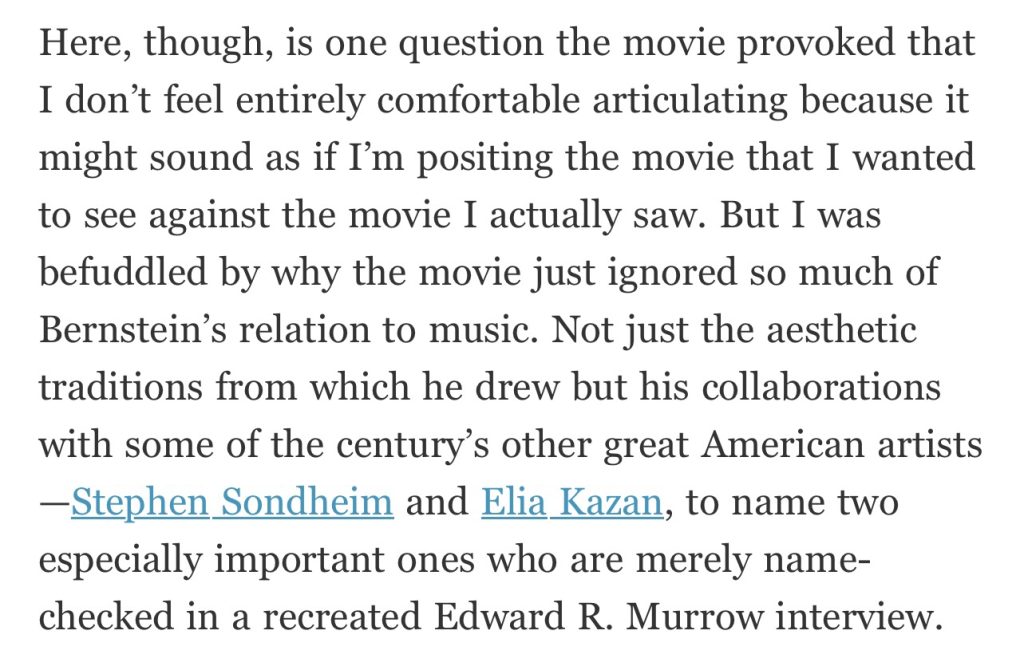
I’m about to buy some NYFF tickets at noon, and I really don’t like that they’re charging more for Maestro screenings, and shitty seats at that. Plus that HE comment thread remark of Glenn Kenny’s — “weak tea” — is sticking in my craw. I’m kinda pissed off and wondering how weak Bradley Cooper’s tea actually is and whether it’s even worth it.

I’m a bit more interested in Richard Linklater’s Hit Man.

Manhattan friendo: “I think it’s one of the very best movies of the year, but a number of people will not agree, and I suspect you’ll be one of them.”

Excerpt #1 from Kenny’s review:

Excerpt #2:

Excerpt #3:

Netflix’s “Sly” Doc (11.3)

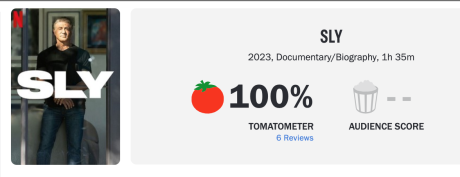
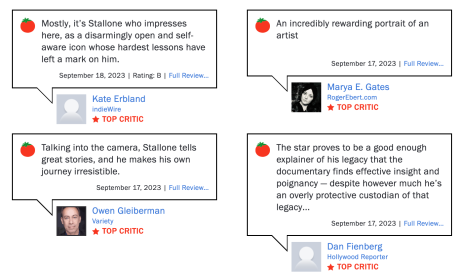
A generally shared view about Thom Zimny and Sean M. Stuart‘s Sly (Netflix, 11.3) is that Sylvester Stallone comes off as refreshingly candid and self-aware. Which is one of the nice things about being a wealthy, senior-grade celebrity with nothing to lose — you can let it all hang out and the reactions are cool and agreeable from every corner.

I got to know Sly a bit from the mid ’80s to early ’90s, and he was a lot less charming and forthcoming back then, lemme tell ya. Then again who isn’t careful (i.e., wary of predators and smart-asses) when their career is going great and the pressure is on?

Just under a half century ago Sly was a struggling actor near the end of his rope who gloriously broke through with Rocky, and after that he made exactly…what, six quality movies during his whole career?

Mostly he’s played taciturn, dead-eyed action heroes who glare and seethe. He tried like hell and did the best he could to stay in the game, but after Rocky the only films he can really and truly be proud of in a quality vein are First Blood (’82), Demolition Man (’93), Judge Dredd (’95), Cop Land (’97) and Creed (’15). (He also scored with some amusing voice work in 1998’s Antz.)

Mainly Sly stayed in his tried-and-true machismo realm and went for the box-office rather than reviews or awards. That’s not a felony of course, but it’s not exactly the sort of track record that would normally bring an industry audience to their feet.

I worked under Sly in ’85 and ’86 when I was employed as a writer/publicist for Bobby Zarem and Dick Delson, who had formed a p.r. partnership and had landed Stallone as their star client. I knew his vibe, hung in his orbit, watched him train and box, visited his home once or twice, did what I was told. But there wasn’t a lot of openness from the guy. He struck me as guarded and sullen and certainly not open to clear-light engagement, at least when it came to low-on-the-totem-pole guys like me.

When I was over at his place one evening I noticed an original Francis Bacon painting hanging in his foyer, and I said with some excitement, “Whoa, Francis Bacon!” I imagined this remark could result in…I don’t know, 20 or 30 seconds of shared appreciation for Bacon’s brilliance? Stallone’s total reply: “You got it.”

In ’92 I interviewed Stallone on the Italian Cliffhanger set (i.e., Cortina d’ampezzo) for the N.Y. Times. And a couple of years earlier I’d helped bring industry attention to a pair of screenplays that led to two of his better projects — Peter Lenkov‘s Demolition Man (’93) and Alexandra SerosThe Specialist (’94).

In ’88 and ’89 I was working for a going-nowhere production company, but I knew that The Specialist was a really top-notch script. (The ideal stars would have been Steve McQueen or Robert Duvall in their heydays). When it became clear that the guy I was working for wouldn’t move on it aggressively, I took The Specialist to the Intertalent guys (Bill Block, Tom Strickler) and they signed Seros and eventually helped set the film up as a Stallone vehicle at Warner Bros. Alas, the Luis Llosa-directed film, which costarred Sharon Stone, didn’t turn out as well as it could have.

I also semi-discovered (or was certainly among the early fans of) Demolition Man through a relationship with Lenkov, and when I again realized it wasn’t going to be made expeditiously by my employer I took it to Nina Jacobson, who was then working for Joel Silver. The film was eventually produced by Silver. Directed by Marco Brambilla, it turned out reasonably well.

Half-decent but less than fully satisfying Stallone films: The Lords of Flatbush (’74), Rocky II, Rocky III (’88), F.I.S.T. (’78), Cliffhanger, Assassins, Daylight, the new Rambo (’08).

Stallone shortfallers & stinkers: Staying Alive (’83 — director), Rhinestone (’84), Cobra, Over The Top, Lock Up, Tango & Cash, Oscar, Stop or My Mom Will Shoot.

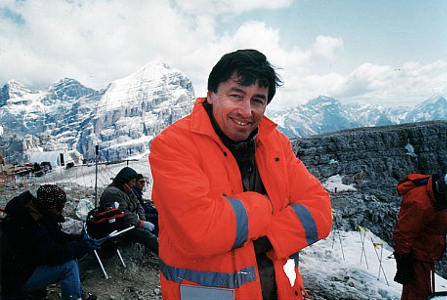
Visit to the Cliffhanger set, on or about 5.20.92 in the Italian Dolomites, about 90 minutes north of Venice — a little below 30 degrees, elevation of 11,000 feet, maybe a bit less.