Raging Hamas-Israel Hostilities

The brutality and slaughter of war has always been hateful and horrible. Plus Israelis and Palestinians have been at each other’s throats since the ’60s. So when I heard about the new hostilities a day ago, I went “okay, here we go again.”

But according to N.Y. Times columnist Thomas Friedman, “This is not your usual Hamas-Israel dust-up.”

Israel newspaper columnist Nahum Barnea has told Friedman that “this is the worst day that I can remember in military terms in the history of Israel, including the blunder of the Yom Kippur war, which was terrible.”

Friedman: “This time Israel was invaded in 22 locations outside the 37-mile-long Gaza Strip, including communities as far as 15 miles inside Israel, by a military force belonging to ‘the equivalent of Luxembourg.’ And yet this tiny force not only invaded Israel, overwhelming Israeli border troops; it took Israeli hostages back to Gaza across that same border — a border where Israel had spent roughly $1 billion erecting a barrier that was supposed to be virtually impenetrable. That is a shocking blow to Israel’s deterrent capabilities.”

I’m presuming Quentin Tarantino is back in Tel Aviv, where he lives with his wife Daniella, son Leo and a year-old daughter, and keeping a sharp eye out. Brett Ratner recently emigrated to Israel.

I Have To Deal With This Crap Every Day

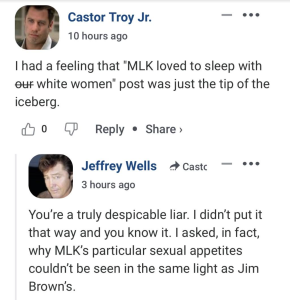
It has long been my conviction that HE commenter Castor Troy, Jr. is a liar and a flinger of mud pies. I find him detestable, and here’s one reason why.

Chris Rock‘s Martin Luther King film will be based upon Jonathan Eig’s “King: A Life. It’s been described by its publisher as an “intimate portrayal of King as a courageous but emotionally troubled individual who demanded peaceful protest while grappling with his own frailties and a government that hunted him.”

Initial HE reaction: Emotionally troubled?? Because he routinely cheated on his wife (Coretta Scott King) with white women in hotel rooms? Didn’t that just make him a standard-issue hound? Maybe he felt he needed perversity in his life to counter-balance everything else?

I wrote yesterday that football star and actor Jim Brown “was into white women also. Was this due to Brown being a somewhat frail, emotionally troubled guy, or was it because his tastes simply led him in this direction?

“Remember that Spartacus scene in which Laurence Olivier‘s Marcus Licinius Crassus says he enjoys both snails and oysters? Were Crassus’s appetites a result of his being an emotionally unstable fellow? As J.J. Hunsecker once said, ‘Are we kids or what?'”

What did Castor Troy, Jr. make of this? Like a good little scumbag, he slandered.

Whitewalls and a Moustache?

If I run into a guy with a closely trimmed moustache and fairly short hair, I say to myself “uhm, okay…a man’s man type, possibly a conservative, probably born and raised in the West or Midwest or the South or northern Maine…possibly a former athlete or an ex-military guy…probably steady and trustworthy but not that hip.”

But a Wyatt Earp handlebar moustache and super-short hair with Marine Corps whitewalls? No way, man…no way in hell.

If I was a real-deal artist like Taylor Swift, I definitely wouldn’t fuck this guy. Because if I did I would know what everyone would be saying…another quickie relationship, and then she’ll write a song when they break up.

Spike Lee Has Joined The Identity Mob

I was speaking to Spike Lee in early December ’18 in a Manhattan screening room. (Alan Elliott‘s Amazing Grace had just shown, and Lee, one of the producers, had just sat for a q & a.) Being a huge fan of Green Book, I asked Spike if he’d seen it. Spike said he hadn’t, but a little voice was telling me that he had and was fibbing because he didn’t want to get into it.

Sure enough, Spike turned out to be a Green Book hater. Which really surprised me. I figured a director as skilled and sophisticated as Lee would at least admire the craft that went into Peter Farrelly’s film, not to mention Mahershala Ali‘s sublime performance. But no — Spike had decided to join the haters because he wanted a film set in 1962 to look, talk and feel like it was set in 2018 — i.e., all woked up.

“Wow, that’s not very perceptive,” I muttered to myself. “Why would a feisty independent guy like Spike, a guy who was born in 1957…why would he  side with the wokesters?”

Now Lee has done it again, and I’m realizing that there are two Spike Lees — the smart and willful guy who knows all about sharp-edged filmmaking (Lee #1), and another who says what he feels he ought to say given the anti-white-guy woke climate and whatnot (Lee #2).

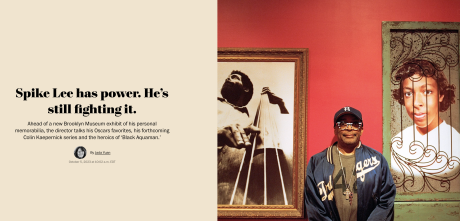
He’s told The Washington Post‘s Jada Yuan that Killers of the Flower Moon is “a great film” when he knows deep down it’s more of a sturdy, well-crafted one than a truly stellar achievement…one that exudes that Scorsese aliveness, that snap-crackle-and-pop. He’s calling it “great” because it says over and over that greedy white Oklahoma murderers were really bad news, and because Lee feels a natural kinship with anti-racist cinema.

He’s also told Yuan that Lily Gladstone — “that Native American woman,” he calls her — will be “winning an Oscar. And I don’t think that’s a supporting role. I think that’s a leading role. She’s got my vote.”

I’m sorry but Lee #2 is just full of shit. He knows what a leading actor has to do in order to qualify as such (i.e., stand up, carry the ball, confront the bad guys). He’s not saying what he really thinks deep down. He’s playing along with the identity fanatics.

Message from a critic friendo, received yesterday: “With Killers of the Flower Moon, Scorsese has become a dull moralist. This is not why we all loved his films over the decades.”

Hawks vs. Lean — The Final Throwdown

We’re all familiar with a certain Howard Hawks quote, the one that says a good movie (or a formidable Best Picture contender) always has “three great scenes and no bad ones.”

An hour ago i was reading a Vanity Fair excerpt from “My Name Is Barbra,” Barbra Streisand‘s forthcoming autobiography. It was a chapter about the arduous and complicated making of The Way We Were.

A few paragraphs in I read a slight stunner:

So Hawks has competition? I’d never read Lean’s version before and was immediately suspicious. Just to be sure I spent a half-hour Googling it….nothing.

If the quote is genuine, Lean seems to be saying that even if a film has three or four great scenes, it isn’t quite enough. It needs a full five, he’s saying, which I think is overly demanding.

I also like Hawks’ quote better because of “and no bad ones.”

“Keep Away…The Sow Is Mine!”

I would rather stick needles in my eyes than see David Gordon Green‘s The Exorcist: Bologna.

I have, however, read the Wiki synopsis. The fate that befalls Ellen Burstyn‘s Chris McNeil character is cruel and humiliating.

A half century ago Burstyn emerged from William Friedkin‘s The Exorcist with pride and dignity. That’s gone now.

Torturing of Ellen Burstyn“, posted on 7.6.21:

Leslie Odom: “Excuse me…are you Chris MacNeil? My God, it’s you! How are you? Are you good? I’m asking because my daughter’s been possessed by Pazuzu or some cousin of his and I’m wondering if you’re up for kicking that demon’s ass like you did back in the early ’70s.”

Burstyn: “I’m fine, thanks, but I didn’t do anything. I persuaded a Jesuit priest named Damien Karras to exorcise the demon, and he asked an older priest, Father Merrin, to help him. I didn’t do a thing. All I did was scream and weep and plead for help.”

Odom: “Yeah, but you know all about demons and shit, right? You know how to deal with the moving beds and green vomit and all that. You’re experienced.”

MacNeil: “I don’t know anything. I just went through a horrible ordeal a half-century ago, and now I’m almost 90. Find your own exorcist.”

Odom: “But I need your help.”

MacNeil: “What’s wrong with you? Look at me…what am I gonna do?”

HE commenter Jeff Jinx: “Anticipating another mind-numbing, CGI shit-fest. The power of green compels them.”

Guarded Guy

The conventional time to memorialize poor Chris Reeve would be 12 months hence — the 20th anniversary of his death. The Superman star and quadriplegic crusader passed almost exactly 19 years ago — 10.10.04. Three days later I wrote a piece called “Guarded Guy.” Hollywood Elsewhere was only two months old at the time. Here’s an excerpt:

I had an experience with Reeve in 1980, when I was a pup journalist living in New York. It began with an interview piece I wrote about him for a New Jersey weekly called The Aquarian, the main subject being Somewhere in Time, which I had a thing for at the time, or more particularly the beautifully shot finale. (I wrote about this in ’17 — reposted below.)

Reeve and I met for the interview at a restaurant on upper Columbus Avenue. I had done my homework and prepared a lot of deep-focus questions, and I think he enjoyed our talk. Sonia Moskowitz, a gifted photographer whom I was seeing at the time, sat in for the interview and then took some photos of Reeve (plus one of him and me) outside the restaurant. Then we went back inside to sort out the bill.

I was a bit green back then, but I’d done a few celebrity interviews and knew that the basic rule was that the studio always picked up the tab. I assumed this would be the case but there was no Universal publicist at the restaurant to cover the check, and I didn’t know what to do because my Aquarian editor had never talked to me about expenses, and I didn’t have the cash to cover it on my own.

I thought Reeve (wealthy actor, right?) might step up to the plate and get his money back from Universal. It was that or somebody would have to leave a personal check or wash dishes. Talk about embarrassing. When I told Reeve I was a bit light I could see he was irritated. We kind of hemmed and hawed about it on the sidewalk, I offered everything I had (about $15 bucks), and he finally dug out his wallet and said, “Well, all right” and paid the balance.

When I wrote my piece I threw in a couple of graphs at the end about this bill-paying snafu. I thought it was both amusing and humanizing on some level that a successful big-name actor who’d played Superman was capable of getting flustered about paying a check, just like anyone else.

A week or two later, just as the Aquarian piece came out, I went with a couple of friends to see Reeve in The Fifth of July. We visited his dressing room to say hello after the show, and as an ice-breaker I asked if he’d seen the article. Bad question. Reeve hadn’t liked my closer and said so. He was scowling at me. I felt like I was suddenly in the Twilight Zone. I thought I’d written about the restaurant-tab thing with humor and affection. I’d figured this plus the fact that the overall piece was highly flattering would have charmed him.

To soothe things over I wrote him a note the next day saying I was sorry he had that reaction, that I really thought the humor I got out of our check-paying episode made it a warmer, fuller piece, and that I hoped he wouldn’t hold a grudge.

A few weeks later I ran into Reeve at an invitational party at a Studio 54-like roller skating joint in Chelsea. As soon as he spotted me he came right over, smiling, and said, “Hey, Jeff. Got your note…everything’s cool…don’t worry about it.” We shook hands, he smiled again and said “peace,” and that was that.

What this told me about Reeve is that he was gracious, obviously, and able to handle embarassments and whatnot. It also told me that deep down he was into dignity and protocol and doing things a certain way. I think that attitude bled into his acting on a certain level, and that’s why he wasn’t quite Marlon Brando.

Read more

Son of “Somewhere In Time” Tragedy

HE-posted on 7.31.17: I’ve never called Somewhere In Time a great or even a top-tier film, but it did develop a cult following about a decade after it opened, and it has — or more accurately hadone of the most beautifully executed single-shot closing sequences in a romantic film that I’ve ever seen, and one that almost certainly influenced the dream-death finale in James Cameron‘s Titanic.

I’m speaking of a longish, ambitiously choreographed, deeply moving tracking shot that’s meant to show the viewer what Reeve’s character, Richard Collier, is experiencing on his passage from life into death. I saw it at a long-lead Manhattan screening of Somewhere in Time 37 years ago, but no one has seen it since.

That’s because some psychopathic Universal exec (or execs) had the sequence cut down and re-edited with dissolves. The version I saw allegedly no longer exists. All that remains today is the abridged version.

The sequence was a single-take extravaganza accomplished with a combination crane and dolly. It happened as Reeve’s character, Richard Collier, is dying on a bed in a Mackinac Island Grand Hotel room. His spirit (i.e., the camera) rises up and above his body, and then turns and floats out the hotel-room window and into a long, brightly-lighted hallway and gradually into the waiting embrace of Collier’s yesteryear lover, Elise McKenna (Jane Seymour).

I asked about this sequence when I happened to run into Somewhere in Time cinematographer Isadore Mankofsky at the 2004 Newport Beach Film Festival. I told him how much I admired it, etc. Mankofsky said that as the film was about to be released some executive at Universal decided that the shot went on too long and trimmed it with a couple of fade-edits.

This was vandalism, pure and simple. The people who caused this sequence to be destroyed should be identified and shamed and if possible pilloried in front of Universal Studios.

Mankofsky told me that as far as he knew the original cut of this closing sequence no longer exists, but he wasn’t entirely sure.