“Ferrari” Is Authentic, Bruising, Searing Stuff

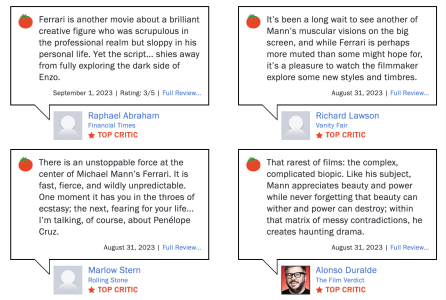
Michael Mann’s Ferrari (Neon, 12.25) has turned out to be much better than I expected.

A portrait of aging Italian car magnate Enzo Ferrari struggling to keep his business and family afloat at a highly critical juncture, Ferrari is “better” in terms of recreating the past and a very particular cultural milieu (mid to late ‘50s, northern Italy) and generally radiating a certain textural, visual and emotional verisimilitude that is rather wonderful in its own studious, deep-dish way.

I’ve been reading since last summer that Ferrari is a period racecar drama that doesn’t follow the expected plot contours and certainly not in the fashion of James Mangold’s 2019 Ford vs. Ferrari, another racecar saga which involved the same real-life character (played by Remo Girone) while set in the mid ‘60s, or roughly eight years after Mann’s story.

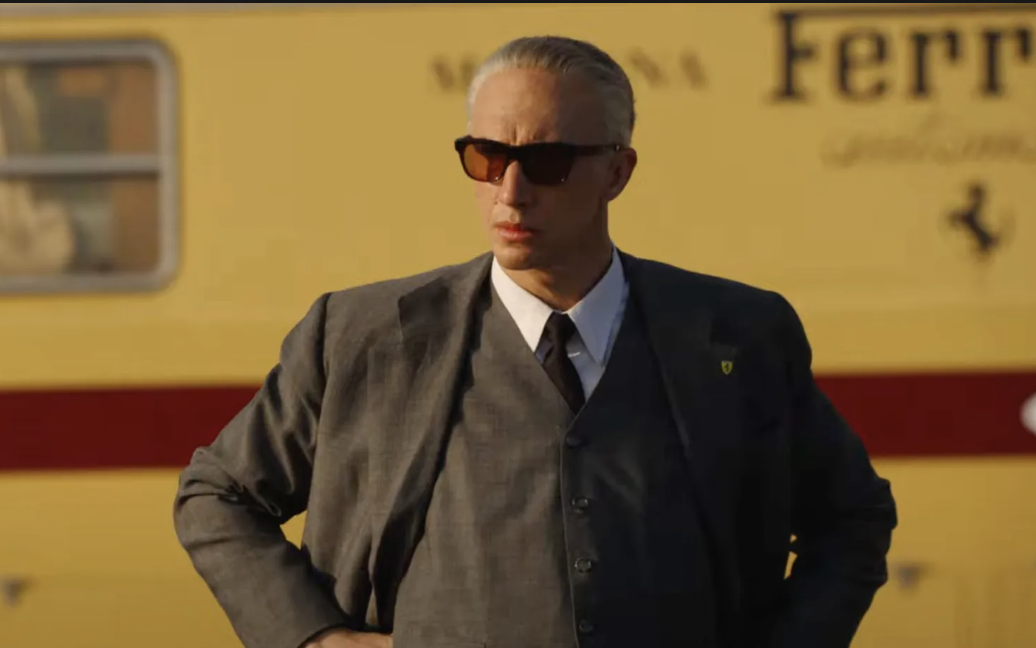
Ferrari is basically a torrid Italian family drama (Mann meets Luchino Visconti with a splash or two of Douglas Sirk salad dressing) about emotional and financial turmoil afflicting the embattled Ferrari, played by a nattily-dressed, white-haired, slightly paunchy Adam Driver.

Let’s not forget, of course, that two years ago a younger-looking Driver played another head of an elite, world-renowned, family-owned Italian company in Ridley Scott’s House of Gucci.

Let’s be honest — Joe and Jane Popcorn are going to say “this again?”

Given the Ferrari-Driver-Gucci overlap, I’m not sure how commercially vigorous Ferrari will turn out to be when it opens in late December. All I know is that despite the vaguely odd-duck, here-we-go-again factor, Ferrari works on its own compelling terms.

Ferrari is about an old man (Ferrari was born in 1898) entwined in a make-or-break struggle to keep his teetering car company afloat while preparing for a climactic, fate-defining cross-country race and while finessing a volatile family situation involving infidelity and conflicted loyalties.

It’s a great time-machine trip, intimate and low-key for the first three quarters but with a serious knockout finale. It’s culturally authentic (you really feel like you’re there) with a sturdy script and several nicely flavored performances…an ensemble piece that pretty much fires on all cylinders.

Ferrari really pays off over the last 35 to 40 minutes, which is almost all racing.

Penelope Cruz’s blistering, tough-as-nails, scorned-wife performance is a guaranteed Best Supporting Actress nomination lock.

Eric Messerschmidt’s cinematography is wonderful — it reminded me of Gordon Willis’s lensing of the first two Godfather films and Part Two in particular.

It’s basically 90 minutes of fractured family drama and a knockout crescendo showing the 1957 Mille Miglia, a decisive, hair-raising event in the fortunes of Ferrari’s precariously financed car company.

The domestic side is basically about Ferrari’s hands being full with Cruz’s angry wife Laura, Ferrari’s mistress Lina Lardi (Shailene Woodley), and loads of financial pressure and numerous wolves at the door.

Mario Andretti: “[Ferrari] just demanded results. But he was a guy who also understood when the cars had shortcomings. He was one that could always appreciate the effort that a driver made, when you were just busting your butt, flat out, flinging the car and all that. He knew and saw that. He was all-in. He had no other interest in life outside of motor racing and all of the intricacies of it. Somewhat misunderstood in many ways because he was so demanding, so tough on everyone, but at the end of the day he was correct. Always correct. And that’s why you had the respect that you had for him.”

I can’t think of a kicker ending so what I’ve written will have to do.
Read more

Bucks Up

Ferrari is generally in the high-middlebrow mode of The Insider or Ali more than the genre mode of Miami Vice or Blackhat. It’s largely a domestic drama with racing and auto manufacturing as the milieu. Yeah, it’s got racing scenes and an absolutely harrowing, mercilessly constructed racing accident climax. But if social media imbecile and Oppenheimer complainer Logan Paul sees the movie, he’ll likely bitch that it’s just Ferrari and his wife and mistress and drivers talking all the time.” — Glenn Kenny’s 8.31 Venice Film Festival review.

LGBTQ Women Are Automatically Innocent These Days

As I noted a month ago, Justine Triet’s Anatomy of a Fall is a did-she-do-it? film — a smartly written marital mystery-slash-courtroom procedural. It’s about about whether or not a German writer named Sandra (likely Oscar nominee Sandra Huller) may be guilty of murdering her husband Vincent (Swann Arlaud) by pushing him out of a third-floor window in their Grenoble A-frame.

This is the source of the film’s tension, and what makes Anatomy a fascinating bad-marriage film.

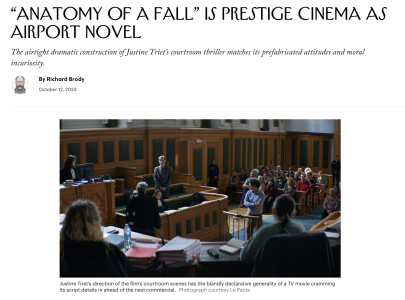
In a 10.12 piece called “Anatomy of a Fall Is Prestige Cinema as Airport Novel,” The New Yorker‘s Richard Brody has hit upon something that I completely missed when I was writing my review. And I should have because it’s a total HE thang.

Brody observes that once the film has revealed that Huller’s character is bisexual, it is all but guaranteed that she’s innocent. Because in today’s woke-subservient climate no progressive-minded filmmaker is allowed to make a bisexual woman into a villain of any kind. It’s simply not done.

In Brody’s words: “There’s the revelation that Sandra is bisexual, which, as I watched the movie, struck me as an instant exoneration, for the simple reason that a film governed by high-minded consensus would no longer dare to posit a bisexual woman as a wanton killer.”

Observations on “The Last Tycoon”

“I’ll tell you three things. All writers are children. 50% of them are drunks. And up until very recently writers in Hollywood were gag men…most of them still are gag men but we call them writers.”

Elia Kazan‘s The Last Tycoon is an adaptation of an unfinished F. Scott Fitzgerald novel about MGM production chief Irving Thalberg. Thalberg is called Monroe Stahr in the film, and is played by Robert DeNiro in an extremely irritating fashion.

It was DeNiro’s annoyingly boorish performance that persuaded me to never see Kazan’s film a second time. (I caught it once in late November of ’76.) I’d always read that Thalberg was quite the MGM wunderkind, the power behind the throne — a blend of class and willfulness and concentrated drillbit smarts that everyone admired.

The Last Tycoon runs 123 minutes, and there were very few scenes when I wasn’t muttering to myself, “God, what an asshole.” Not to mention that idiot grin of DeNiro’s. 15 minutes into the film I was wondering why Kazan, one of the greatest-ever directors and a guy who could really see into actors and calculate what they were capable of bringing to a role…why did Kazan cast the dorky DeNiro, unless the idea was to undermine the Thalberg legend? A very perverse film, and the two scenes below reminded me of that.

Napoleon Face-Off: Phoenix vs. Brando

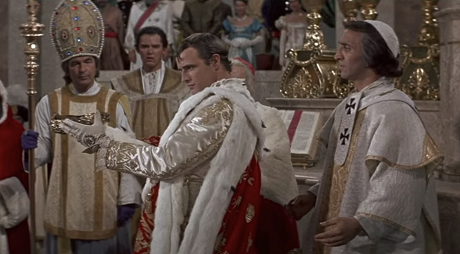
In Henry Koster‘s Desiree (29th Century Fox, 11.16.54), Marlon Brando‘s performance as Napoleon Bonaparte was actually pretty good. Plus the 30 year-old Brando was the right age to play Napoleon at the time of his crowning, which happened in 1804 when he was 35. Phoenix is a great actor but he was 48 during filming and looks it. He’ll turn 50 on 10.28.24.

Not so much the film itself. An “historical romance” aimed at impressionable women. The music score was created by Alex North; the CinemaScope cinematography by Milton R. Krasner. Jean Simmons played the titular role of Desiree Clary. Costarring Merle Oberon (44 at the time) as Josephine. Plus Michael Rennie, Cameron Mitchell, Elizabeth Sellars, Charlotte Austin, Cathleen Nesbitt, Carolyn Jones and Evelyn Varden.

Hundreds of Thousands of Decent Palestinians Are Facing Hell

Go to 4:55 — that’s when a nearby explosion rocks this Palestinian woman’s building, and yet she more or less shrugs it off and keeps talking. Courage.

No food, water, gas, electricity…nothin’.

If I was a resident of Gaza City you can bet I’d be locking up and humping it south with a backpack and sleeping bag, as long as it takes.

Read more

Knockout Vapid

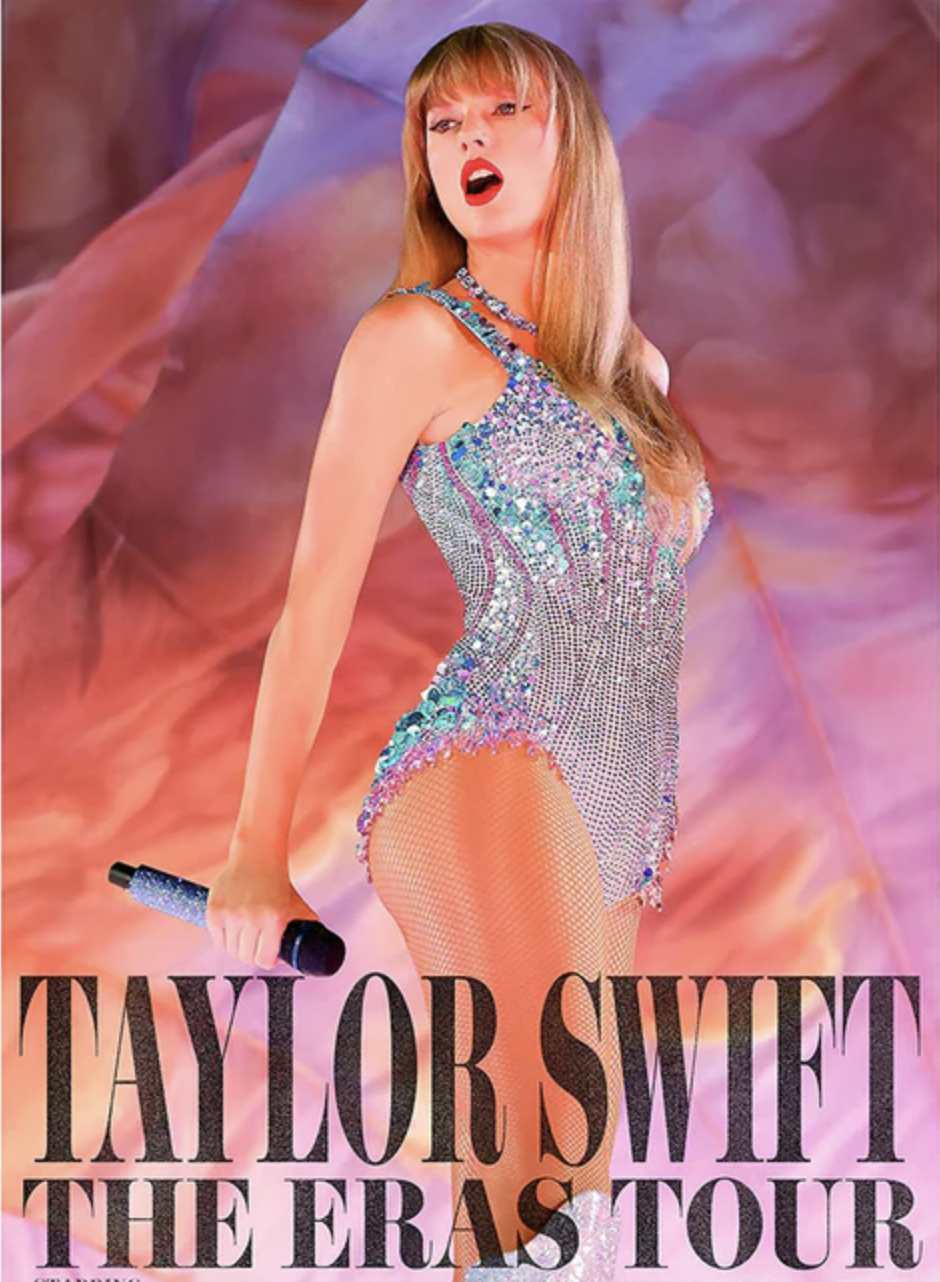
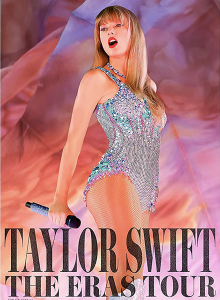
Last night I saw about 65 minutes’ worth of Taylor Swift’s The Eras Tour, which runs 169 minutes. You can’t say I didn’t man up, buy the popcorn and give it the old college try. I didn’t hate it but it didn’t hook my heart or elevate my soul, and the more Swift sang and waved and strummed and strutted around and gave it up for her adoring, beaming and even tearful fans, the flatter I felt within.

As concert films go The Eras Tour is quite the visual power-punch (first-rate photography, editing, choreography, lighting design plus considerable personal charm and audience rapport) but aside from the fan-rapture aspect (95% younger white women) Swift’s act just doesn’t levitate. Or at least it didn’t in my situation.

I swear to God I sat down with an attitude of “okay, I’m here…let’s do it!” But it just didn’t connect.

Swift doesn’t have the greatest singing voice (it’s okay) and her country music origins put a damper on things. Her songs are rather flat and popfizzy and lacking in catchy, inventive hooks…they all kinda sound the same…no rivers of soul (not even streams of it)…confessional lyrics (ruptured romances, shitty boyfriends) but rendered without much in the way of edge or unusual style or anything “extra”…imbued with an unmistakably bland, girlygirl current, and a general lack of sophistication or complexity.

Swift is no Joni Mitchell-in-her-prime. Her songs seem to lack depth and intrigue.

I was engaged and studying the spectacle (which is fascinating in some respects) for the first half-hour but starting around the 45-minute mark I began to feel narcotized and then drained.

I nonetheless respect Swift’s energy and verve and swagger, and the Beatles-like following that she’s acquired over the last 16 or 17 years.

I was collecting my reactions in the AMC Westport lobby when a Manhattan-based journalist who’d also escaped at the one-hour mark (he’d been sitting two seats to my left) came over and said howdy. He’d been unable to snag a ticket to any Thursday night Manhattan showing and decided that a show in Connecticut was his best option.

We chewed things over for a half-hour or so. He felt roughly as I did about the film. “What’s the essence of Swift’s appeal?,” he asked. “Power,” I said. “The Swifties relate to who she is and where she’s been, and are really getting off on the bold persona and image…she’s a heroic figure in their eyes. It ties in, I think, with the Barbie explosion on some level.”

He had taken a Metro North train and then Uber-ed to the theatre, but didn’t want to see any more of the film. So I gave him a lift to the East Norwalk train station. Nice guy.

A respectful hat tip lo Eras Tour director Sam Wrench, director of photography Brett Turnbull and editor Don Whitworth.

Shot last August at Inglewood’s SoFi Stadium over a period of three nights, The Eras Tour is indisputably a huge cultural and commercial phenomenon. Swift-produced, Swift-starring, Swift-distributed (straight to AMC and Cinemark) and sure to pull down God knows how many hundreds of millions.

Everyone did a great job. It just wasn’t for me.

Friendo: “You’ve offered a reality-based corrective. The media is offering her a rubber-stamp rave. I think she’s got a number of very good songs like ‘Mean’, ‘I Knew You Were Trouble’ and ‘Shake It Off’ and — possibly her greatest — ‘Lover’.

“But you have to watch what you say if you have young daughters. You can’t come down on Taylor too hard, but I think her war against men is deplorable. And fundamental to her appeal. But I can’t say that in mixed company.”

HE: “I give her football player boyfriend (Travis Kelce) another couple of months. Okay, five or six months total.”

Friendo: “These men are just momentary accessories to her. Her message is basically ‘fuck men — they suck and we don’t need them’. In that sense, she’s doing her own bit to bring Trump back. All woke behaviors help the other side. Because the majority of people don’t want to vote for psychosis.”