When Will I Be Loved?

Or at least, you know, treated more fairly and respectfully?

Unless you subscribe to the extreme view that Robert DeNiro is an unreliable or unhinged narrator (which I doubt), there seemed to be an element of doubt or suspicion in that month-old financial grievance lawsuit with former employee Graham Chase Robinson. On the plaintiff’s part, I mean.

I’m presuming that DeNiro treated Robinson with insufficient respect or a lack of sensitivity from time to time, but many bosses are guilty of this. Not all but many. But you take your lumps and move on.

The term “abuse” or “abusive behavior” is thrown about fairly liberally these days. By today’s Millennial or Zoomer snowflake standards, it’s a very rare exception to the rule when a wealthy boss (celebrated or otherwise) doesn’t treat his or her veteran assistant with a certain degree of disregard or callousness. It’s not a desirable state of affairs, but it does seem to go with the rough and tumble.

By typical wokester sensitivity standards I, Jeffrey Wells, have been abused my whole life in one way or another, starting with my ostensibly brutal parents (when I was young I used to carry on internal debates about which one, mom or dad, was worse) and brusque grade school teachers and moving on from there. I’m not being facetious. I have been. I have the emotional scars and bruises to prove it.

On the other hand once you adopt the Everly Bros. or Linda Ronstadt attitude of “I’ve been cheated, been mistreated…I’ve been put down, I’ve been turned ‘round,” there’s no end to it.

Life is often abusive or hurtful in one way or another, at least to some degree. Do I wish that “abuse” was never visited upon poor poor pitiful me? Yes, I do wish that, but what else is new?

What Can Eggers Possibly Do With This?

Another Nosferatu/Orlok/Dracula yarn? Again? How many have there been?

The original 1922 F.W. Murnau film with Max Schreck as Count Orlok. Tod Browning‘s Dracula (’31). Those Hammer Dracula films of the ’50s and ’60s with Christopher Lee and Peter Cushing. Followed by Werner Herzog‘s Nosferatu the Vampyre (’79), Francis Coppola‘s Dracula (’92) and E. Elias Merhige‘s Shadow of the Vampire (’00) with Willem Dafoe as Max Schreck himself. What am I forgetting?

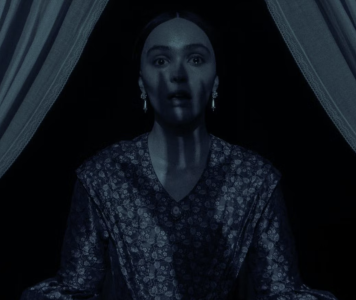
Robert EggersNosferatu will open theatrically on 12.25.24.

But technique aside, what could Eggers be expected to add to the lore? The saga has been beaten to death, and Eggers, it’s fair to say, suffered his first semi-failure when he released The Northman in April ’22. If Nosferatu works, it’ll almost be considered a comeback.

Eggers’ film costars Nicholas Hoult, Lily-Rose Depp, Aaron Taylor-Johnson, Emma Corrin, Willem Dafoe and Simon McBurney.

Read more

Another Flashback

My first reaction to this trailer for John Lennon: Murder Without A Trial (12.6) was “okay, the 40th anniversary of Lennon’s murder was three years ago so what’s the compelling reason for revisiting this?” Other than acknowledging the 43rd anniversary, I mean.

Posted on 12.5.20: Many rock stars had died of drugs and fast living in the ’70s (Hendrix, Morrison, Joplin), but Lennon’s murder was the first big twentysomething and thirtysomething boomer tragedy — an event that throttled the big media world, and which made everyone who’d ever learned Beatle harmonies feel suddenly slugged in the heart, not in a sharply painful romantic breakup way but in a slightly older person’s (certainly not a younger person’s) way…a terrible weight of the world thing…an awful sense of vulnerability and the jabbings of a harsh and cruel world.

In the obsessively warped mind of Mark David Chapman, Lennon was killed for having betrayed his destiny as a kind of spiritual leader and torch-bearer, which he arguably was from ’64 through ’70 (the end of the dream coming with the release of Plastic Ono Band).

He was therefore assassinated, in Chapman’s mind, for the crime of having withdrawn from the hubbub and become a retiring house husband in the Dakota…just another pampered rich guy whom Holden Caulfield would have strongly disapproved of.

Read more

“Poor Things” Feels More Dazzling With Second Viewing

I re-watched Poor Things a couple of nights ago (my second viewing), and reacted in a way I hadn’t expected. I felt a bit more dazzled or certainly more appreciative of the multitudinous elements that go into each shot. I was knocked out when I saw it in Telluride in early September, but I expected to have more or less the same reaction. Maybe a slight enthusiasm drop but that’s par for the course and nothing to sweat.

But to my surprise it gained. I was saying “wow” over and over, as much as I did three months ago. Over and over I was shaking my head in admiration for the visual energy…the exacting care and immaculate invention that went into every aspect — the exciting abnormality of it all, the skewed Victorian-era dialogue, Emma Stone‘s robotically out-there manner and behavior, the imaginative artificiality and bizarre production design, the weird performances from pretty much everyone, the perverse humor…all of it. It looks and feels like a weird dream, but one you can easily settle into.

I gradually realized that Poor Things is one of those films that you need to see twice because there’s so much going on that a single viewing won’t suffice.

I was wondering for a while what Poor Things would be like if I saw it on peyote or mescaline. I would never consider such a thing (in my youth I tripped my way through at least three or four films) but it’s a film that would really be enhanced by the right kind of hallucinogen. A gentle one, I mean.
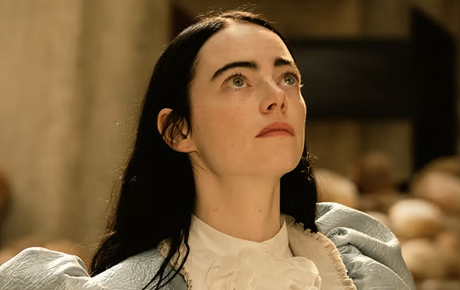
Make no mistake — Poor Things delivers a woke narrative. An attractive and spirited artificial young woman in her 20s encounters the big, bad, male-corrupted world for the very first time with naive, childlike eyes and somehow finds her way through the thicket, and emerges at the end of the tale with an emboldened, seen-it-all feminist attitude. But Bella Baxter’s tale is so inventively told I not only didn’t mind the preach but was taken by it. I didn’t feel the least bit dismayed or disengaged.

I noticed something else that I probably shouldn’t mention but will anyway. I’m talking about the simple biological fact that Emma Stone has large, slender, shovel-like feet. I’m sorry but she’s barefoot in at least half of her scenes, and I was saying “well, there it is…her feet don’t have that petite Japanese geisha thing going on.” No problems or judgments; her anatomy is her anatomy. But I did notice this.

But I was also thinking, “God, what a brave and striking performance…Bella is so eccentric, so stiff-necked (a little like Elsa Lanchester‘s Bride of Frankenstein) and yet so carefully and correctly phrased,m and so willful…such an original concept.

And before Poor Things I was never a huge Yorgos Lanthimos fan, mind. I respected and appreciated his brand and sensibility, but this was the first time I felt really enthused about what he was showing me.

HE: “When I think of Yorgos LanthimosPoor Things (Searchlight, 12.8), I think of a one-two effect. First I think of Frankenstein’s sexually vigorous daughter, and then a back-from-the-grave woman whose worldview evolves from wide-eyed wonderment into critical male-shirking wokeness. I also believe that Emma Stone has the Best Actress Oscar in the bag.”

Friendo: “When I think of Poor Things, I first think of a lurching, amusing and sometimes audacious [effort] that feels second-rate-ish at the end of the day. Then I think of the in-your-face woke design (Ms. Barbie Frankenstein in a world of angry, damaged, predatory men!), then I think of all that sex and how it’s really kind of gratuitous (unless this were 1972) but wow, it sure is going to help sell the movie!”

Some Apple Functionary Effed Up

From Brent Lang and Matt Donnelly’s Variety story (filed on 11.28 at 10:18 am) about the attempted censoring of Robert DeNiro‘s speech at last night’s Gotham Awards:

“A source close to the film denied that there was any censorship involved and said that the incident was a miscommunication. There had been multiple versions of De Niro’s speech and there was a desire to focus solely on the moviemakers and their artistry, according to the source. Apple and the filmmakers were unaware that De Niro hadn’t signed off on the final draft, the insider added.”

Translation: “We [Apple] tried to politically sanitize DeNiro’s speech. In hindsight we realize we shouldn’t have done this, But to protect ourselves now, we’re going to deny everything and call it a miscommunication.”

DeSantis Is Finished, Needs To Fold Tent

The Nikki Haley campaign is, at heart, a classic Republican pride campaign — a valiant attempt to keep alive notions of conservative Reagan-esque sanity. Which isn’t my deal, just to be clear — I’m a Gavin Newsom-Pete Buttigieg-Gretchen Whitmer guy by way of sensible, anti-woke centrism.

Alas, Haley is attempting to prevail within the confines of a once semi-normal political party that over the last seven or eight years has been infected with tearitalldown, mulelike authoritarianism and dumbfuckism.

Haley can’t defeat The Beast or hope to persuade those millions of rural, anti-Democracy nihilists to vote sensibly, but if Trump were to drop dead she would almost certainly become the Republican nominee for the presidency and, given her age and gender and mental vigor and non-extremist views for the most part, would undoubtedly defeat Joe Biden in the general.

Read more

Melton Confusion

May December‘s Charles Melton has won the Gotham Award for Best Supporting Performance. Good, fine and congrats, but may I ask where this Melton energy came from? Why did this happen? What voting bloc rammed this through? What is this?

It is Hollywood Elsewhere’s opinion, due respect, that no less than eight Gotham nominees in this category delivered far more arresting performances than Melton.

HE’s best-of-the-best is The HoldoversDa’Vine Joy Randolph, closely followed by BlackBerry‘s Glenn Howerton. HE’s #3, #4 and #5 picks are Ferrari‘s Penélope Cruz, The Taste of ThingsJuliette Binoche and All Of Us StrangersClaire Foy.

Then comes Jamie Foxx in The Burial (#6), Rachel McAdams in Are You There God? It’s Me, Margaret (#7) and Ryan Gosling in Barbie (#8).

Then and only then comes the ninthplace Melton.

The Outstanding Lead Performance award went to Lily Gladstone in The Unknown Country, a film that no one relatively few have seen or reviewed, to go by general impressions. The urge to socially and culturally celebrate Gladstone’s Killers of the Flower Moon Oscar campaign was the motivating factor here. Congrats to her handlers.

The Best Feature award went to Past Livesyeesh. The Gotham voters really and truly live on their own tight little island.

Posted on 10.24.23:

A “Get Out”-Resembling Comedy?

Daniel Richtman is reporting that Jharrel Jerome is “in talks” to play the lead role of Mike in an untitled, racially-themed comedy from director Trey Parker and screenwriter Vernon Chatman.

Jeff Sneider reported about this last March. He noted that Parker and Matt Stone would produce alongside Kendrick Lamar and Dave Free.

Sneider: “Chatman’s script finds the past and present coming to a head when a young Black man who is interning as a slave reenactor at a living history museum discovers that his white girlfriend’s ancestors once owned his.”

This is an interesting plot hook? That a young black dude is…what, alarmed that ancestors of his white-ass girlfriend owned Mike’s ancestors during slavery? What is this supposed to be, an echo of Get Out or something?

Or a parody of the wokester currents that lay beneath Get Out?

Don’t look now but ancestral guilt is a totally meaningless notion. People behave according to the morals and ethics of the time that they live in…no more or less.

Remember the 2015 Ben Affleck embarassment when Finding Your Roots producer Henry “Skip” Gates, Jr. revealed that an Affleck ancestor had been a slave owner?

Affleck apparently feared that the wrath of outrage culture. Would it make a lick of sense for the p.c. crowd to scream “Affleck is descended from racists so he must be a closet sympathizer”? That would be a bone-dumb assumption, to put it mildly. But you know that at least some lefty wackazoids would have suggested this all the same.

HE excerpt: “‘Outrage culture‘ is running wild these days and Affleck, no dummy, is fully aware of the potential. Time and again the p.c. mob has read things in a cretinously simple-minded fashion and made absurdly broad conclusions as a result.

“For all Affleck knew, this ‘scion of racists’ idea could become an urban legend like Richard Gere putting a gerbil up his ass, and it could affect his financial and creative future.

“It’s nuts out there, really nuts. But Affleck didn’t want to characterize Twitter culture as stupid or deranged, which in itself could land him in hot water, so he decided to use the ‘really embarassed’ line, which is true, I’m sure, as far as it goes. Who wouldn’t feel shamed by this knowledge, but then again who was walking around during the early to mid 1800s with the moral convictions of a decent 20th Century person, let alone a veteran of our own time? Relatively few, I would imagine.”

Jerome is probably best known for his performance in Barry JenkinsMoonlight (’16). He played “Kevin”, the teenaged guy who gave that beach handjob to Ashton Sanders‘ Chiron.

Read more

Projection Booth Action

Last night “Bob Hightower” posted an anecdote about director Mike Nichols. Residing in the comment thread for an HE article titled “Son of New York Theatre Stories,” it concerns the summer movie-house run of Who’s Afraid of Virginia Wolff? and particularly the behavior of a certain New York projectionist.

“When Nichols’s first film, Who’s Afraid of Virginia Woolf?, opened in late June of ’66, he went to a theater in New York one afternoon to watch it with a paying audience.

“The film was out of focus. It kept being out of focus. And of course, no one in the audience complained.

“Nichols frantically ran out and up the stairs to the projection booth. He banged on the door. No one answered. He banged again. Nothing. So he pushed open the door and found the projectionist on the floor banging an usherette. Nichols crept out and left the theater. As Gregg Toland once said, ‘The projectionist is the ultimate censor.'”

HE correction: Toland probably meant to say “the projectionist is the ultimate arbiter.” Showing a film out of focus obviously doesn’t constitute censorship, but vandalism.

Mark Harris informs that the anecdote isn’t from his 2022 Nichols biography, but says “it certainly sounds credible.”

Well, I don’t find the story credible.

HE to Hightower #1: With the urgent knocking why wouldn’t the randy projectionist have gotten up and seen who it was, especially if the door was unlocked? He surely understood that women hate it when strangers burst into a room with intimate activity going on. If the projectionist wanted to keep things going with the usherette he would taken proper privacy precautions. It would have been one thing if the projection booth door was locked, but it obviously wasn’t. You can’t tell me he didn’t hear Nichols knocking.

HE to Hightower #2: Projection booth floors are made of hard plastic tiles or plain cement. Who would attempt to make love to an usherette on one of those awful uncarpeted floors? What kind of usherette would submit to this? Women like their romantic encounters to be nice and soft and candle-lit. I would expect that most projectionists and usherettes would avoid the floor and attempt the deed standing up. Or perhaps with the usherette bent over the reel-spicing table, say.

One thing that’s always bothered me about Virginia Wolff is that George and Martha’s young guests — George Segal‘s Nick and Sandy Dennis‘s Honey — arrive around 2:30 am. The four of them have already been to a previous faculty party which presumably started at 8 or 9 pm, and now it’s five or six hours later and they’re about to start drinking and chit-chatting again? Even at the height of my most rambunctious youth I never showed up anywhere — a friend’s home or a bar or anything — at 2:30 am. During my drinking days I might’ve crashed at 2:30 or 3 am, but I never partied until dawn killed the moon…never. And I was a wild man, relatively speaking.

The Tom Hulce Factor

As much as I respect Milos Forman‘s Amadeus (’84), I haven’t had the slightest desire to rewatch it over the last 39 years. This is due to my profound, never-forgotten loathing for Tom Hulce‘s performance as Wolfgang Amadeus Mozart. Not to mention that awful white lion’s-mane wig that he wore. Perhaps others feel this way also.

But if I could somehow re-experience my viewing of the B’way stage version with Ian McKellen and Peter Firth, I would do so repeatedly.

From “Respect for Milos Forman,” posted on 4.4.18: “Sometime in ’81 I saw Peter Shaffer‘s Amadeus at the Broadhurst, and revelled in Ian McKellen and Peter Firth‘s performance as Salieri and Mozart. It was such a huge, radiant high that I had difficulty adjusting to Milos Forman’s film version, which opened in September ’84.

“It was a handsome, well-crafted thing and a Best Picture Oscar champ, of course, and like everyone else I…well, appreciated F. Murray Abraham‘s Salieri. But Forman’s film just didn’t have that same snap and pizazz, and I hated Thomas Hulce‘s giggly-geek performance as Mozart and flat-out despised Elizabeth Berridge‘s bridge-and-tunnel performance as Constanze Mozart (i.e., she called her husband “Wolfie”).

Amadeus is a good film but the play was much better.”