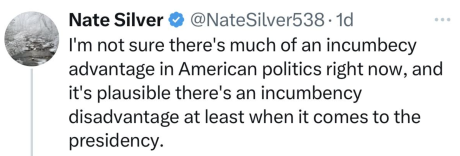
If and when The Beast persuades Tucker Carlson to become his 2024 vice-presidential running mate, two things will most likely happen. One (and it pains me to admit this**), Trump-Carlson would probably beat Biden-Harris. Especially with RFK, Jr., Jill Stein and Cornel West mucking things up. And two, Carlson would probably mop the floor with Kamala Harris in the vice-presidential debate. She wouldn’t stand a chance.
Maggie Haberman to The Dispatch‘s Jamie Weinstein (11.20.23): “It’s a real thing that I’m hearing as a possibility. The likelihood of it I don’t know. I think there will be a pretty professionalized vetting process. Honestly, I know that might sound unbelievable, based on what we’ve seen from Trump historically, but Trump’s current political team is the best at least as a non-incumbent. There’s just a different level of control.
“I don’t think the Tucker thing is not real. I think the risk with Tucker Carlson and Trump is that Tucker Carlson is a star in his own right, and I’m not sure how Trump would contend with that.”
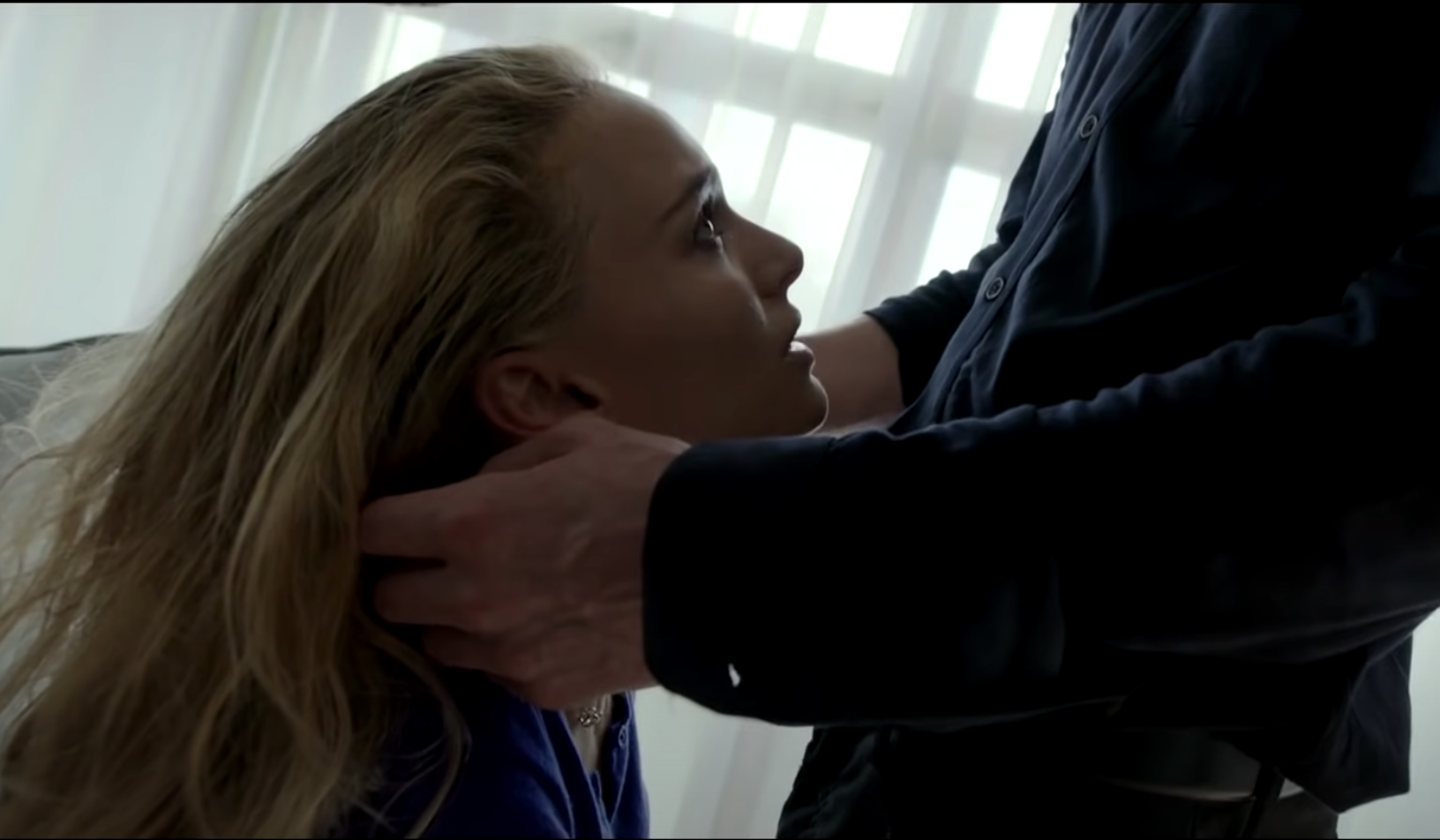
Terrence Malick‘s Song to Song (Broad Green, 3.17) is more or less the same movie as To The Wonder and Knight of Cups — another meandering, whispering voice-over, passively erotic Emmanuel Lubezskitour de bullshit. All directors make the same movie over and over, of course, and this, ladies and germs, is another return to Malickland…what he does, what he can’t help recreating and re-exploring. I just sat there in my seat at Broad Green headquarters, slumped and going with it and silently muttering to myself, “Yuhp, same arty twaddle.”
The older Malick gets (he’s 73), the foxier and more barefoot and twirling the girls in his movies get, and this one, a kind of Austin music industry La Ronde, has a fair amount of fucking going on. And that’s fine with me. No “sex scenes”, per se, but a lot of navel-worshipping, I can tell you. Rooney Mara‘s, I mean.
At first Song to Song is about a romantic-erotic triangle between Faye (Mara), a guitarist and band member who doesn’t seem to care about music as much as whom she’s erotically entwined with at the moment, and two attractive music industry guys — Ryan Gosling‘s BV, a songwriter-performer, and Michael Fassbender‘s Cook, a rich music mogul. I can tell you Mara is definitely the focus of the high-hard-one action or, as Quentin Tarantino put it in Reservoir Dogs, “Dick dick dick dick dick dick dick dick dick dick dick dick dick dick dick dick dick dick.”
Mara seems to start off with Cook and then move on to BV. Or was it Gosling first and then Fassbender and then a really hot French girl (Berenice Marlohe) and then back to Gosling at the very end with a Cook pit-stop or two? There’s never much sense of linear time progression in a Malick film so you never really know, but she definitely does them all.
There’s something vaguely L’Avventura-esque about Song to Song…pretty, wealthy people lost in impulsive erotica, embracing momentary pleasure, bopping from song to song, bod to bod, orgasm to orgasm, and all the while trying to make things happen within the Austin music scene. But falling away from the eternal, and hanging in too many cold-vibe high-rises and high-end homes and not enough folksy abodes with yards and dogs and oak trees. But with lots of rivers to gaze at.
I’m simplify as best I can recall: (a) Mara definitely becomes intimate with Gosling, Fassbender and Marlohe; (b) Gosling has affairs with Mara, Lykke Li and Cate Blanchett‘s Amanda, and (c) Fassbender — the most louche and perverse of the three — has it off with Mara, Natalie Portman‘s Rhonda (a waitress whose mother is played by Holly Hunter) and two prostitutes (or a prostitute plus Portman) during a menage a trois scene.
I was kinda hoping Fassbender would hook up with Blanchett and Marlohe, but it never happened. I was actually imagining a menage a trois between Fassbender, Gosling and Mara — that would have been something — or a menage a quatre between these three and Blanchett, even. Or a menage a cinque between these four and Val Kilmer, who is seen performing in a couple of brief outdoor-concert scenes but never gets to fuck anyone.
Cord Jefferson‘s American Fiction (Amazon MGM, 12.15) is a brilliant, perceptive, dryly amusing adult chuckler. Not a “comedy” but a heh-heh-funny kinda thing. I adored the low-keyness of it, and was delighted, of course, by the focus upon the general insanity of white wokeness — the off-the-charts fetishizing of black culture by guilty (wealthy, well-educated) white liberals. So I felt like a pig in shit.
And yet the source novel, Percival Everett‘s “Erasure,” was published 22 years ago, and therefore couldn’t have addressed the woke lunacy of the last five or six years. But Jefferson’s screenplay brings things right up to date. And having seen it this morning, I certainly understand the popularity of the film, starting with the Toronto Film festival debut (9.8.23); ditto those who voted to give it the People’s Choice Award.
Alas, I liked the first 45 or 50 minutes more than the remaining 60 or 65. (The total running time is 117 minutes.) I didn’t find the second section crushing or devasating or anything in that realm, but my hopes had been raised to such a degree…let me try again.
Here’s how I put it to a friend an hour ago: I was IN LOVE with American Fiction for the first 45 or 50 minutes. I adored the scathing criticism of idiotic white people falling all over themselves to praise black grit. I was definitely amused and charmed by it, and was positively swooning over Jeffrey Wright’s lead performance, and I really liked Sterling K. Brown‘s gay brother and pretty much the enire supporting cast (Tracee Ellis Ross, Issa Rae, John Ortiz, Erika Alexander, Adam Brody, Leslie Uggams).
And then a certain mock-literary hustle takes off and becomes a big success, and bit by bit and piece by piece the film starts to soften. The tension begins to dissipate. At times it even flails around. Less focused, less hardcore.
Please don’t think I disliked the second half because it does work here and there, but the back end doesn’t compare with that first 45 or 50. I thought the film might build into something angrier, more cynical, ballsier, franker.
It’s finally, to my mild disappointment, not much more than a smart social satire. Which is fine in itself but for a while I was yearning for so much more.
I thought Jefferson might go for broke and dive deeper, but he didn’t.
Friendo: “As finely crafted as the movie is, part of the reason I loved the first 45 minutes is the intense hope one has that American Fiction is going to be the scandalous, balls-out satire of white wokeness that we so desperately need (and by a black filmmaker!). And though it certainly nods in that direction, that’s not the film it turns out to be. I would call that a seriously blown opportunity.
“I agree that it’s a very solid and humane movie. But given the limitation we’re talking about, it’s being madly overhyped as an Oscar competitor. Clayton Davis and Scott Feinberg think it’s going to win Best Picture!”
Friendo #2 who’s read “Erasure”: “Everett’s book is harder than the film. [Jeffrey Wright]’s sister is murdered by an abortion protester, and the father may have sired another child with a white woman, etc.
“The movie stuff isn’t in the book but the book has a lot of meta, text-within-a-text stuff so I can understand why Jefferson wanted to transpose those effects into the adaptation.
“The book within the book parodies Richard WrIght and of course ‘Ellison’ is meant to evoke Ralph. There is some Ishmael Reed in the mix too. Everett himself teaches college so I’m sure he has had to endure the same sort of thing hat [Wright’s character] does in the opening scene.
“Wright’s romance with Erika Alexander isn’t in the book either. Everett is an executive producer so I presume he signed off on the changes. And I’m sure he knows no one is in a hurry to adapt ‘The Trees.'”
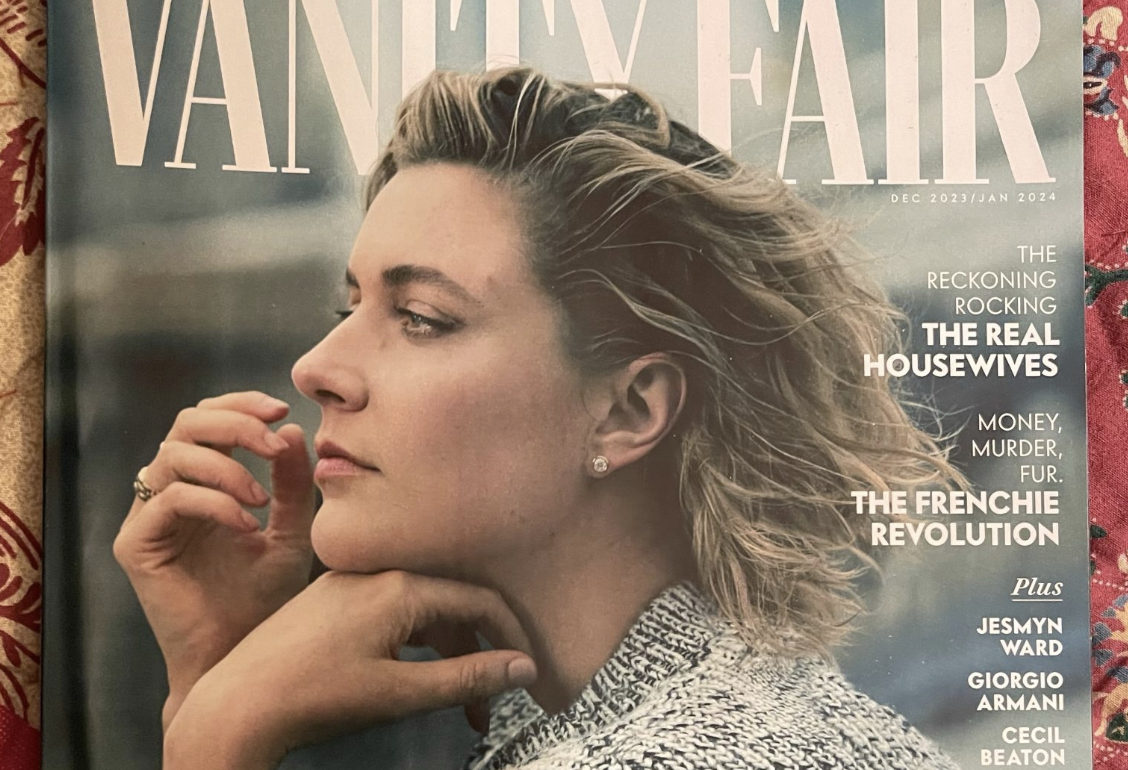
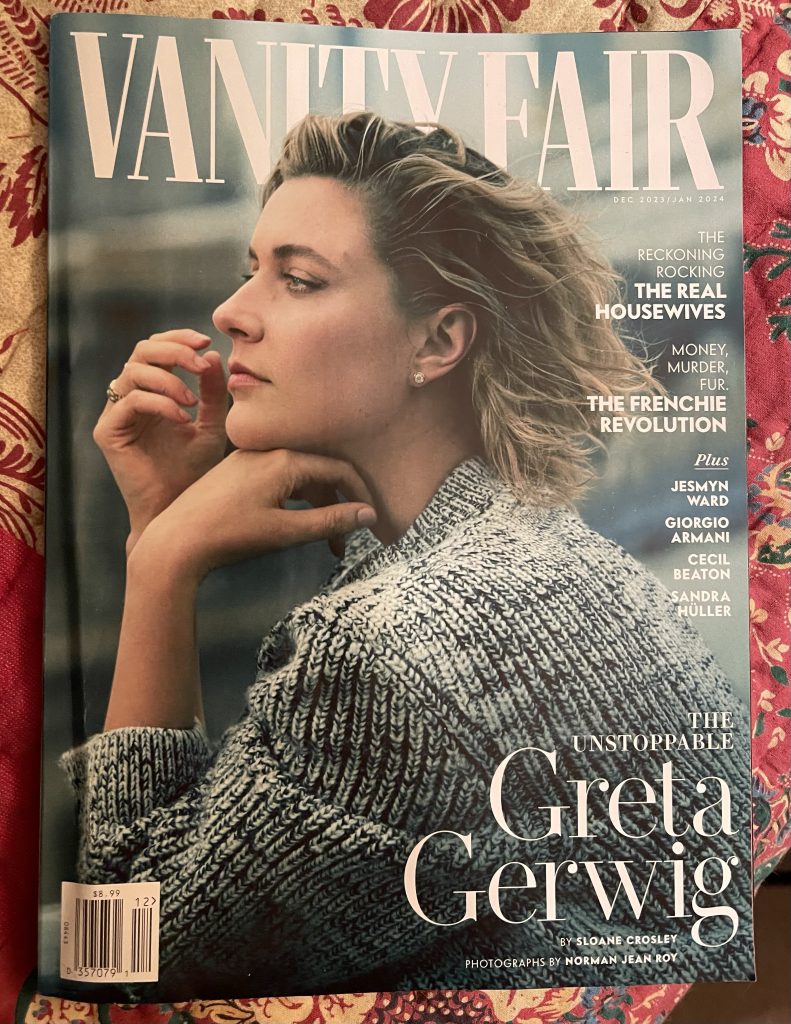
Barbie’s phenomenal summer success wasn’t/isn’t enough. GretaGerwig wants Oscar ratification on top of all that. Even while Yorgos Lanthimos and Emma Stone’s PoorThings (i.e., Barbie meets Radley Frankenstein Metzger Satyricon) nibbles away at the mystique. Perhaps last summer will have to do?
Friendo: “Greta appears to be sniffing her fingers.”
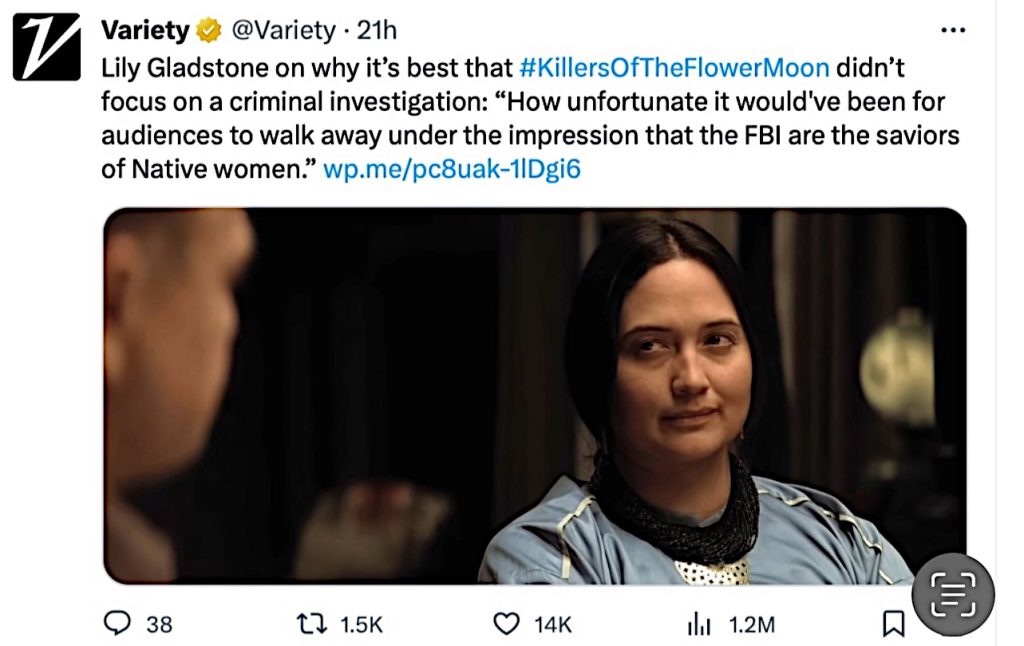
…but if KillersoftheFlowerMoon had resorted to the same dishonest-but-effective Hollywood tactics that Alan Parker’s Mississippi Burning deployed (depicting Tom White in roughly the same fashion as Gene Hackman’s charismatic FBI tough guy, well-crafted villain performances, sprinklings of historical bullshit, an emotionally satisfying resolution)…
If Team Killers had adopted an old-fashioned Alan Parker-like approach it wouldn’t have been as virtuous, but the popcorn crowd would have enjoyed it more.
I’ll never watch Killers again (twice was enough) but I could watch Mississippi Burning any day of the week.
White’s FBI team weren’t “saviors”, but they sure as hell busted William “King”Hale and Ernest Burkhart.
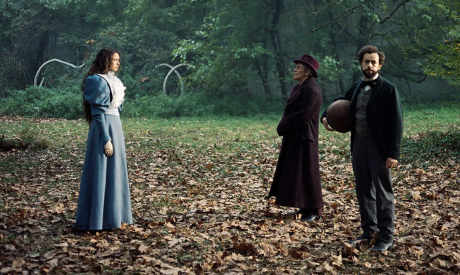
HE to Academy member who saw Poor Things at Fox Zanuck on 11.18: “Do you agree that Poor Things is basically Barbie meets Frankenstein? Or, if you will, Barbie meets Terry Gilliam + multiple orgasms + Fellini Satyricon?
“What did the proverbial room seem to think or feel about it? It was speculated back in Telluride (where it was rapturously received, to put it mildly) that the older Academy crowd might have problems with it.
“Jeff Sneider tweeted that he didn’t like it. Bill McCuddy told me the same thing, Perhaps it’s not as ‘Academy-friendly’ as some believe”?
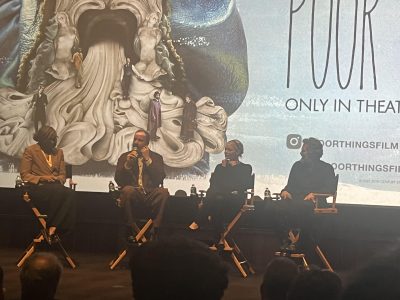
Academy member to HE: “The somewhat younger crowd (average age around 45 ) went wild for the film. After a slow start they seemed to resist the tone, but they were eventually mesmerized by the film’s audacity.
“Emma Stone was applauded repeatedly during the q & a. She expressed her complete trust for her director as a key part of her willingness to repeatedly bare all.
“There was no mention of the screenwriter or screenplay during the q & a.
“And YES, it’s Barbie on steroids. Ten nominations, seven wins. Academy-friendly.”
Posted on 10.2.23: Barbie and Poor Things are almost exactly the same movie — an attractive, spirited and completely naive (or childlike) young woman in her 20s encounters the big, bad, male-corrupted world for the very first time and somehow finds her way through the thicket, and emerges at the end of the tale with an emboldened, seen-it-all, “done with that bullshit” feminist attitude.
The only difference is that Poor Things is somewhere between throbbingly and obsessively sexual in an early ’70s sense of the term, and Barbie is plastic-ironic PG-rated by way of the Mattel corporation and a determination to be gay without actually being “gay”. Plus the only sexual act Barbie engages in, at the very end, is asking about birth control (“I’m here to see my gynecologist”).
Poor Things is obviously more perverse, not to mention more wildly imaginative in a Terry Gilliam kinda way, and Barbie is certainly slicker and more superficial in a consumer-friendly, vaguely toothless, wind-up-doll sort of way.
But when you get right down to it and boil out the snow, they’re pretty much the same movie, and this will factor heavily into the final voting for the Best Picture Oscar.
THR‘s Scott Feinberg, posted on 9.3.23: “While more than a few [Telluride] attendees found Poor Things — which I will only describe as Frankenstein meets Barbie, and which Searchlight will release on Dec. 8 — a bit too weird, and/or risqué and/or lengthy for their taste, the critical response to it has been off the charts.”
Critic friendo: “I agree completely [about the Barbie-Poor Things parallels]. I would add, however, that both movies are show-offy yet half-baked. In this context I’m almost enjoying the pile-up of woke piety — the Poor Things splooge fest.”
“Felicia Montealegre is the last character whom we see in Maestro, and the first actor’s name in the end credits is that of Carey Mulligan. This is her movie, and Bradley Cooper, to do him justice, knows it.
“How Mulligan can manifest such sweetness of nature without a trace of cloying, let alone mush, beats me. I spy a ghost of Julie Andrews in Mulligan’s smile, at once forgiving and brisk, and what she establishes, in Felicia, is the perfect ratio of rose to thorn. Hence the film’s best sequence, which is shot in one take, with no music and no camera movement at all. Mr. and Mrs. Bernstein talk, just the two of them, in a room overlooking Central Park West, during a Thanksgiving Day parade. The conversation stiffens into repartee, and then into rage. ‘If you’re not careful, you’re going to die a lonely old queen,’ Felicia cries.
“Behind them, through the window, we glimpse the huge head of a Snoopy floating by. Amid the Pax Americana, here is war.
“The movie does feature a death, though whose I will not reveal. Suffice to say that, in its wake, some viewers will have to be mopped up from the floor of the cinema. The looming pain is both sharpened and soothed not by Mozart or Mahler but by the sight of the Bernstein children larking around to Shirley Ellis’s ‘The Clapping Song.’ This is where Maestro scores.
“Spurning a fruitless bid at comprehensiveness, Cooper has conjured something as restless and as headlong as his subject. (‘I’m always just barely keeping up with myself,’ Bernstein once said.) To and fro we go, from the incisive bite of black-and-white, for the dawning of Bernstein’s fame, to the rich ironic glow of color in his later, grander, and less contented years; from the furious bliss of ambition to a kind of exhausted peace. And if Leonard Bernstein never got to star as Tchaikovsky in a Hollywood biopic, opposite Greta Garbo as the composer’s patron — a project that was seriously mooted in 1945 — then let us not lament too long. The guy had other things to do.”