All my life I’ve wanted to experience a total eclipse black-out…a serious Bing Crosby in AConnecticut YankeeinKingArthur’sCourt moment..,and if I want it badly enough I can have this tomorrow afternoon.
But I’ll have to drive hundreds of miles for hours and hours plus pay for several tanks of gas and at least one motel sleep-over to get to the sweet spot.
Why couldn’t the eclipse show a little more taste in deciding which areas of the country to temporarily darken? Austin and maybe one or two other towns aside, the eclipse will mostly affect nothingtowns and bucolic, bumblefuckbackwaters, regions that nobody ever seems to visit or even think about, and that’s really a shame. I’m serious.
Imagine if it hit Boston or the Berkshires or NYC…magnificent.
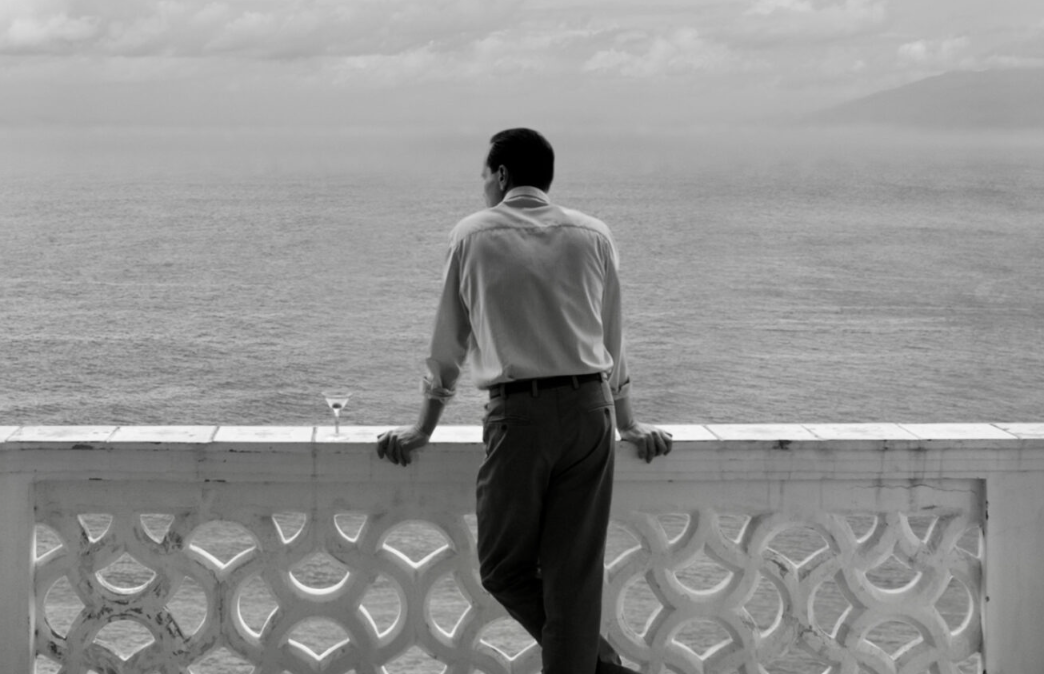
Last night I watched episodes #6 and #7 of Steven Zallian’s Ripley, and what a soothing, transporting dream trip this series is…a silky and serene monochromesoulbath…a reminder of how much better life was and still is over there in certain pockets, and (this is me talking and comparing, having visited Italy six or seven times) what an ugly and soul-less corporate shopping-mall so much of the U.S. has become this century…the contrasts are devastating.
Ripley is an eight-episode reminder that there really is (or was during the mid-20th Century) a satorikindoflife to be found in parts of Italy and Sicily, better by way of simplicity and contemplation and quiet street cafes, better via centuries of tradition, pastoral beauty and sublime Italian architecture…grand romantic capturings of Napoli, Atrani (the same historic Amalfi Coast city where significant portions of Antoine Fuqua’s TheEqualizer3 were shot), Palermo, Venezia and Roma.
Life doesn’t have to be dreary and banal and soul-stifling, Zallian is telling us in part…you can find happiness standing downstream, as thegreat Jimi Hendrix once wrote, especially if you’re an elusive sociopath living on a dead guy’s trust-fund income and therefore not obliged to toil away at some sweaty, shitty-ass job to survive.
Yesterday World of Reel‘s Jordan Ruimy told me he’s “hearing good things about The First Omen…from fairly reliable people, I mean.”
I won’t watch it…I won’t. Okay, I might if enough people chime in with the same positive views. Non-horror fans, I mean.
The basic problem is that I’ve always hated the Omen franchise. Three years ago I re-watched Richard Donner’s 1976 original, which I’d been respectful of for decades, and I realized it was actually prettybad.
Posted on 5.26.21: The Omen is “a good creepy film of its type,” I wrote years ago. “But I t’s actually not — it’s a very stupid film that was made in a lazy, half-assed manner with mostly awful dialogue, and is burdened by idiotic plotting.
The Omen‘s success was based upon a general audience belief in mythical religious bullshit, and it launched itself upon the lore of The Exorcist (’73), which was and is a much better film. So please accept my apology for saying what I said. I don’t know what I was thinking.
With the exception of three good scenes — the nanny hangs herself during Damian’s birthday party, the dogs in the graveyard scene with GregoryPeck and David Warner, and Warner gets his head sliced off by a flying pane of glass — The Omen is a painfully mediocre effort.
Almost every scene summons the same reaction: “Why isn’t this better…why didn’t they rewrite the dialogue?…God, this wasn’t finessed at all.”
I came to really hate the tiny, beady eyes of that young actor who played Damian — Harvey Spencer Stephens (who’s now 54 years old).
The middle-aged, warlock-eyed priest who gets impaled by a falling javelin of some sort — why did he just stand there like a screaming idiot as he watched the rod plunge toward him?
Why didn’t Peck and Lee Remick simply fire that awful demonic nanny (Billie Whitelaw)?
Why didn’t Peck just buy a pistol and shoot that demonic Rotweiler right between the eyes, and in fact shoot all the other Rotweilers in the graveyard?
The Omen depends upon Peck and Remick refusingtoconsidertheobvious during most of the running time. Refusing to reach for an umbrella, wear a raincoat or take shelter during a thunderstorm…that kind of idiocy.
During his career heyday (’45 to ’64) Peck mostly played smart, restrained, rational-minded characters, one after another. (His roles in Spellbound, Duel in the Sun and Moby Dick were the exceptions.) The Omen was the first time Peck was called upon to play a stuffed-shirt moron — a denialist of the first order. Okay, he starts to wake up during the final half-hour, but it’s truly painful to watch an actor known for dignity and rectitude and sensible behavior undermine the idea of intelligent assessment at every turn.
…better than John Wayne. And while we’re at it, let’s reconsider the lesson of Wayne’s increasing baldness and constant wig-wearing in the ’50s, ’60s and ’70s…losing most of your hair can be a terrible or certainly a diminishing thing.
“He’ll do.”
“Take your friend’s horse…we’ll bury him.” Later: “Get a shovel and my Bible. I’ll read over him.”
“Every time you turn around, expect to see me. ‘Cause one time you’ll turn around and I’ll be there.”
(1) If you are in the industry in any capacity, you know that you can’t really speak openly or honestly about your feelings if they aren’t absolutely progressive full tilt. This is tripled if you are a middle-of-the-road creative or technician white guy in the middle of a recession. It also applies if you aren’t a rich successful person with fuck-you money to a lesser extent.
(2) Why do you think every critic sounds exactly the same and has a lot of the same moralistic talking points? If I called Barbie misandrist on Facebook, 20 progressive friends would dunk on me and 50 others would share the take as if I wore a MAGA hat and had just shot a gay black trans woman on Park Avenue in Trump’s name. There is also no reason to have an Israel-Palestine take right now because people are equally worked up. Even if something isn’t political why go public with a hard or critical take on a film when you may be interviewed for or employed by someone who made it? You think in this economy I’d be willing to lose out on producing The Bachelor just because I think the new Bachelorette is lame?
(3) If you are a normal working person in any kind of a sales or public capacity, having the wrong take could literally cost you your job if it’s seen by the right people at the wrong time. People are politically and socially enraged and might literally avoid hiring a doctor or attorney if said doctor or attorney feels the wrong way about any hot-button issue.
(4) If you have middle-of-the-road safe progressive takes on entertainment you can speak your mind, but if you are slightly contrarian at the wrong time, it honestly might crush you at an inopportune moment. I work in reality and have worked in offices where people gossip, and let me tell you in the freelance world having non mainstream takes can literally mean not getting asked back on the next season. You can think I’m delusional or a neckbeard but I’m absolutely telling the truth. For what it’s worth I’m in decent to good shape, and am happily married with a kid.
(5) I’m not Brad Pitt but I’m better looking than Tobey Maguire so I’m hardly a basement dweller, but I know talking about why I dislike Barbie under my real name would get me blackballed with the half-dozen female EPs I’m friends with on social media. Barbie is just a random example but I wouldn’t even make my above comments in the current climate because some POC might decide that anyone thinking that the new Romeo and Juliet actress isn’t beautiful is racist. I went after Will Smith pretty hard when he assaulted Chris Rock and had two friends DM that I was borderlineracist and should respect that Smith was struggling and let it go cause it’s not my place to have an opinion on the actions of a black man.
(6) I guarantee there are folks here that would have lost their damn minds in 2004 if Seth Rogen were cast as Romeo opposite Natalie Portman. Those exact same people are pretending to be fine with this new Romeo and Juliet casting as if it’s not weird. Anyone But You works because they are both equally hot. It would not have worked with Josh Gad in the Glen Powell role. Sometimes I think people are just losing their minds in order to be morally righteous. Just wild nonsense.
(7) Like why can’t we all just have takes anymore without someone being insanely offended as if their world was destroyed? Racism = Bad. Questioning a romantic pairing based on looks in a love story is absolutely normal human behavior!
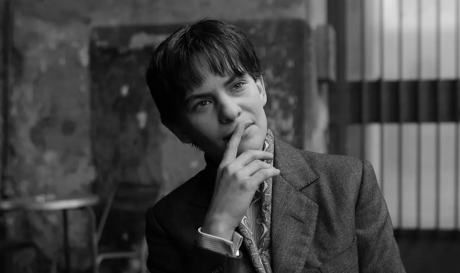
There’s definitely something different about the highly observant, suffer-no-fools Freddy character in Steven Zallian’s Ripley (Netflix, now streaming).
Played by Phillip Seymour Hoffman in Anthony Minghella’s quarter-century-old The Talented Mr. Ripley, Freddy is now a gender-fluid fellow played by musician Eliot Sumner, born a bio–female (the parents are Sting and TrudyStyler) and now a non-binary “they.”
The Cate Blanchett-resembling Sumner has everyone’s attention now with a Ripley supporting role as the blunt-spoken Freddy, thesuspicious-minded writer friend of Dickie Greenleaf (Johnny Flynn) and Marge Sherwood (Dakota Fanning)…a sharp-witted fellow who’s an arch-antagonist of Andrew Scott’s Ripley.
There were, of course, no uncertain perceptions about Philly’s gender or sexuality in Minghella’s film but there certainly are with Eliot.
Right away you’re thinking there’s something clearly womanish about Freddy…obviously…his voice is thin and reedy and tartlyfeminine is a Blanchett-sounding way, and his mid ‘60s Beatle-ish hair style is too long for a dude in a JFK-era realm. (The film announces itself as occurring in 1961.) Freddy has in effect been transformed into an exceptional X-factor dyke.
On one hand it’s fascinating that Freddy is portrayed not as a regular brainy dude but as a brainy lesbian strolling around in men’s clothing and wearing 1965 hair that’s half Blanchett-Dylan in I’m Not There and half Paul McCartney.
On the other hand Sumner’s casting violates our basic sense of what constitutes mid 20th Century guy vibes, traits and mannerisms. It therefore throws a monkey wrench into the Ripley engine, and our belief in Zallian’s carefully constructed reality, our faith in this elegant Italian milieu of 60-plus years ago that seems so right in so many hundreds of ways…our trust is slightly shaken.
The Sumner casting is therefore, I feel, intriguing but unfortunate at the same instant. The perversity of what has to be called an act of stunt casting is oddly interesting (jaded Europeans being ahead of the cultural curve), but it’s also anobviousnod and a capitulationtocurrentwokeattitudes and sensibilities in the area of gender and sexuality and whatnot.
Sumner’s Freddy absolutely doesn’t fit into 1961 Rome — that’s for sure.
I saw Woody Allen’s Coup de Chance (now playing) a few weeks ago. It’s basically about unstated but acted-out things, and I was pleased most of the way through because I couldn’t tell where it was going. I knew something unpleasant was in the pipeline, but there are no real tip-offs and I couldn’t guess what what the third act might actually bring. So in that sense I was fully engaged.
But I have to say (although I can’t explain the particulars, which is what most of my notes are focused on) that I didn’t care for the ending.
I would love to explain why the ending didn’t feel right or satisfying to me, and I’d really like to share my own solution (i.e., my own scenario) but I can’t. But overall this is a better-than-decent Woody — not Match Point good but reasonably diverting. And I totally concur, by the way, with Kyle Smith‘s 4.5 Wall Street Journal piece — “Woody Allen’s Cancellation Is a Crime Against Culture.”
Boilerplate: Lou de Laâge‘s Fanny, a young French wife, is feeling empty or even sterile within a marriage to Melvil Poupaud‘s Jean, an exacting and persistent rich guy in his early 40s…one of those “demanding in a quietly ruthless way” sort of guys. Fanny is more or less content because of the affluent comforts and whatnot, but at the same time she’s sensing that this overly comfortable, mostly bloodless relationship is slowly draining her of something vital.
And so despite all the perks and by a stroke of good (or bad) luck she finds herself hanging with Niels Schneider‘s Alain, an ex-boyfriend, and then naturally having sex with him and whatnot. And then all the stuff that inevitably happens when a wife or husband starts regularly lying and covering up…it all kicks in and then some.
I have to add that Woody’s Coup de Chance screenplay often feels a bit on-the-nose and first-drafty, like almost every film he’s written since the turn of the century. I’ve been complaining about this off and on for 20, 25 years. I’ve been saying all along that Woody needs a sharp writing partner…a 40something whippersnapper…a Marshall Brickman or a Douglas McGrath…someone to tell him that in 2023 there’s no such thing as an “only copy” of a novel in progress.
I was fine with Schneider’s boyfriend (a writer) although he’s something of a bland stock character…written rather conventionally, no edges or undercurrents, etc. And Lou’s cheating young wife struck me as brittle and wound too tightly, and she definitely didn’t radiate any of those magnificent-in-bed Grace Kelly vibes. I took one look at her and said “nope…not worth the trouble.”
Gay people are 100% cool but watch out for the trans-gender nutters, especially when it comes to their influence upon kids of various ages, including surgical stuff and school curriculums and whatnot.
This isn’t HE talking (I’m fairly easy with everyone in a facetime sense, hard only on HE commenters) but a cross section of Middle Americans….just listen.
Who is the American working class? Do they still have a shot at the American Dream? How do their beliefs differ from those of the elites who control the narrative? In reporting my book Second Class, I found that an extreme moderation characterizes the American working class: pic.twitter.com/ETwsT1HtzX
Earlier today I wrote that Kerry Condon‘s performance in Robert Lorenz‘s In The Land of Saints and Sinners (Samuel Goldwyn, 3.29) amounts to “one of the greatest female villains ever…a feisty, take-no-shit-from-anyone IRA firebrand.”
There’s no rolling your eyes or waving this woman away — she holds eye contact, means every feckin’ word and is full of absolute conviction and a fair amount of controlled rage. Condon’s character, Doireann McCann, won’t take “no” or “maybe” from anyone about anything, and her eyes are fierce and flaming. Talk about a fascinating lady from the word “go.”
In The Land of Saints and Sinners is “a Liam Neeson movie,” and we all know what that means — a steady and stalwart Neeson fellow who’s not looking for trouble and in fact would like to back off into a shelter or backwater of some kind, and then a slow burning, a gradually tightening situation, implications of tough terms, bad people up to bad stuff (including the threat of serious harm to a couple of innocent characters as well as to Neeson’s guy) until it all blows up in the end.
But the story, set in rural Ireland in the mid ’70s, pulls you in bit by bit, and the script has been carefully and compellingly written by Mark Michael McNally and Terry Loane, and the shaping of Condon’s character is exceptional. You can call Doireann a volcanic madwoman, but that would be selling her short or at least putting it too simply. She’s a villain, all right, but she doesn’t believe in playing it cool or fair or even-steven. You can’t help but believe every damn word she says, and at least respecting whatever it was that put so much acid into her blood. Not a woman to be trifled with.
I certainly didn’t see Doireann as some kind of broad charicature or cliche…some kind of Irish Cruella de Ville. She’s way too blistering for that.
All I know is that I sat up in my seat when Condon came along and start giving orders and barking questions and challenging and intimidating pretty much everyone, and I’m thinking of watching the film again just for her performance.
The only vaguely “off” thing about the exquisitely composed, visually ravishing Ripley (Netflix, now streaming) is that Andrew Scott seems a bit old to play the lead. He’s early 40ish looking, or 12 or 13 years older than the 28 year-old Matt Damon was in The Talented Mr. Ripley (’99) and 16 or 17 years older than Alain Delon was in Purple Noon (’60).
But it’s only a slight bother.
Dennis Hopper was almost exactly Scott’s age — around 40 or 41 — when he played Ripley in Wim Wenders‘ The American Friend. Ripley was shot in 2021, when Scott was 40 or 41.
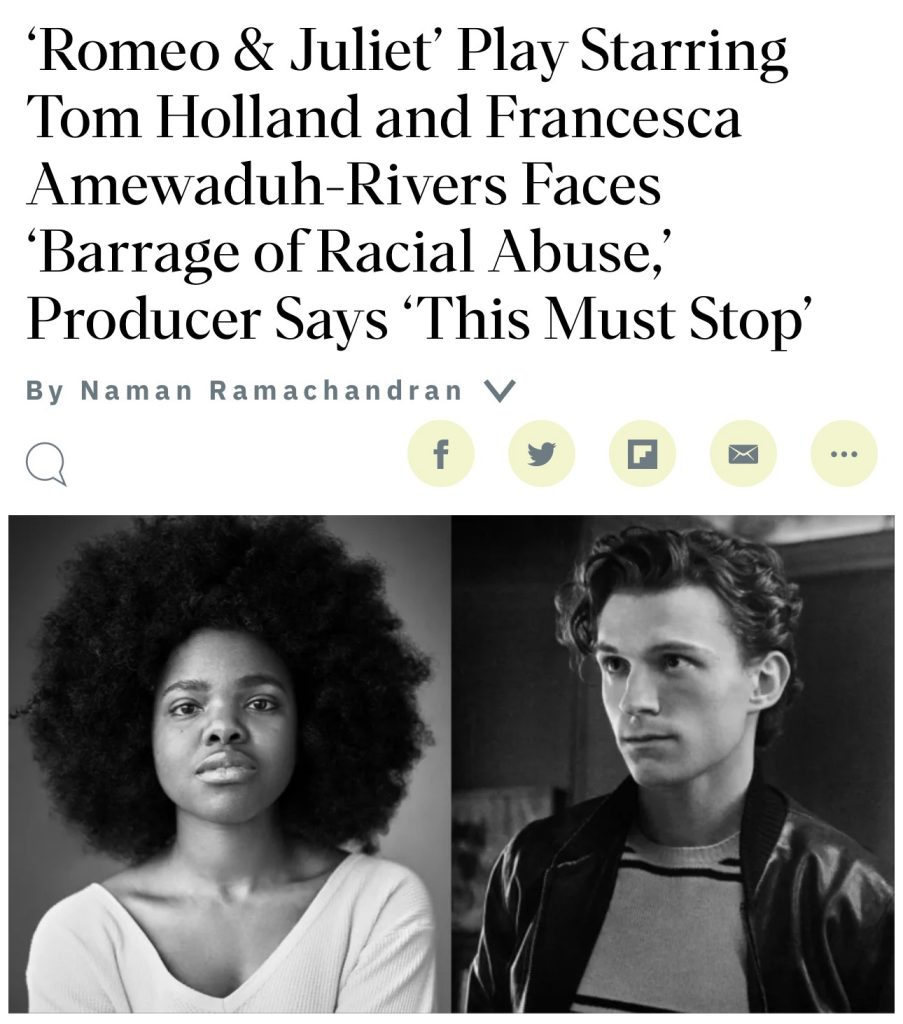
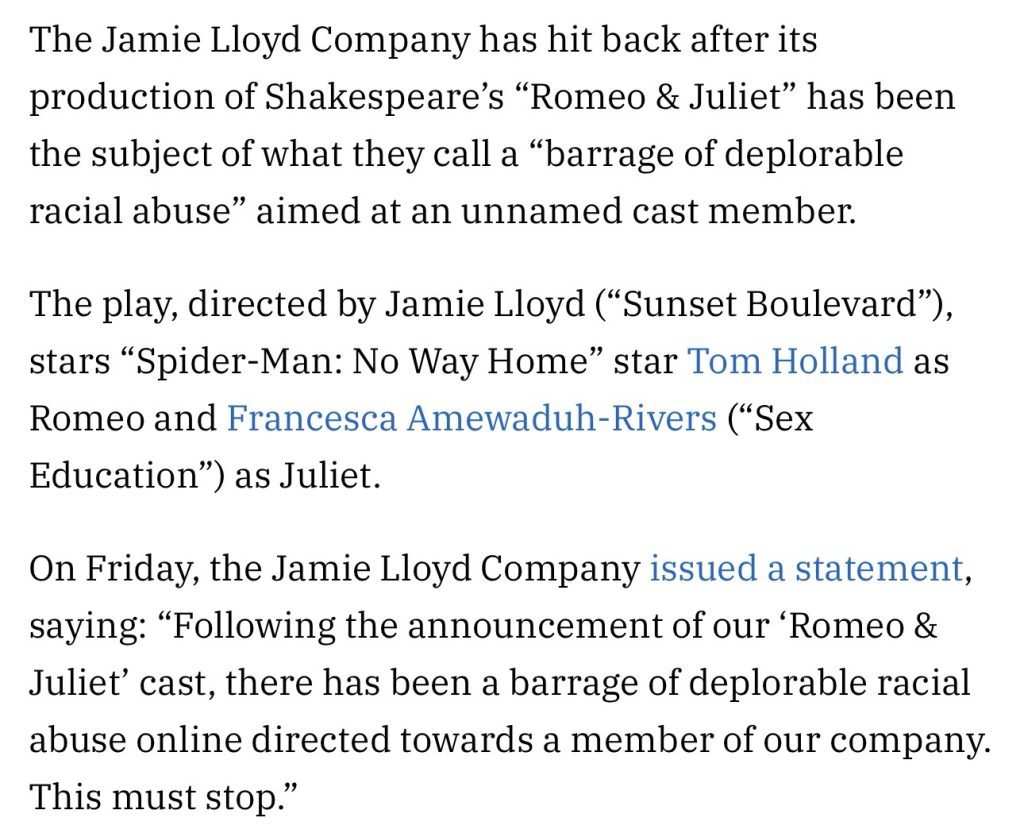
Last Tuesday (4.2) HE shrugged at the notion of the forthcoming interracial London stage production of RomeoandJuliet…Tom Holland and FrancesAmewudah–Rivers…another “woke casting stunt”, “wealthy London liberals will eat this shit up,” etc.
I happened to agree with a reader comment that a Zendaya-like actress would have been a better fit match-wise or looks-wise (i.e., Amewudah-Rivers isn’t quite on Holland’s level). Otherwise any blatantlyracistcriticisms (I haven’t read any but I’ll take the Jamie Lloyd Company’s wordforit) are deeply unfortunate and probably best ignored.
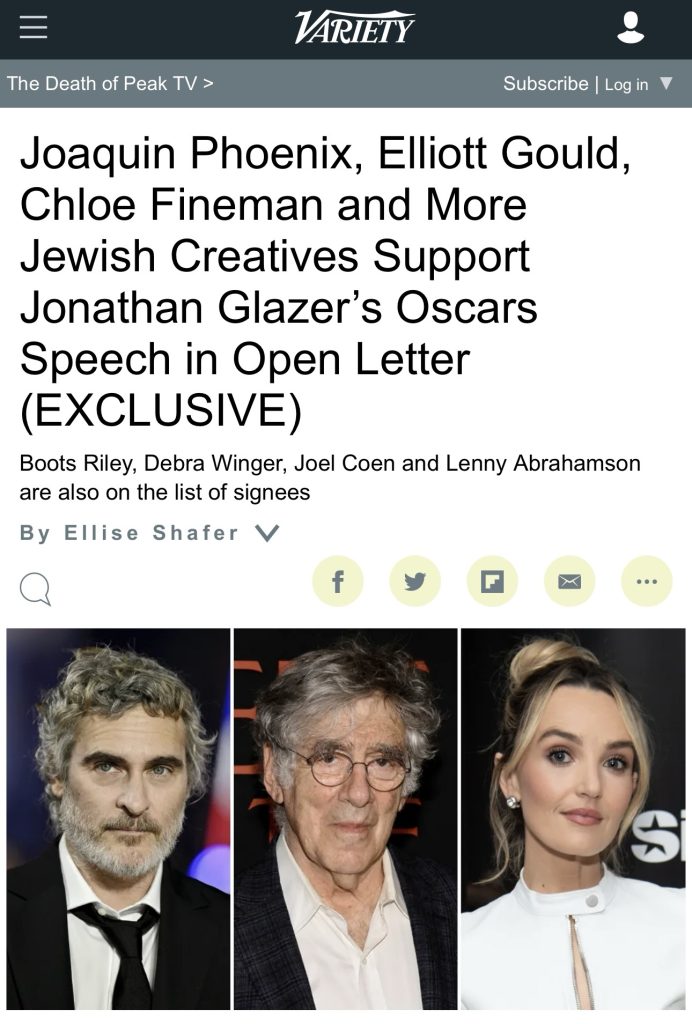
Due respect for the 151signatories of today’s “we agree with Jonathan Glazer’s anti-Zionist-overkill Oscar speech” letter, but may I ask what took them so long? The over-one-thousand-signatures letter that sharply disagreed with Glazer’scompassion–for–Gaza–victimsspeech…that timely letter was posted nearlythree weeks ago (3.18). Life is a moving train. Hubba-hubba.