A bearded Oscar Isaac as Colin Clive….we know that much. And the unseen Jacob Elordi as Victor Frankenstein’s monster.

A bearded Oscar Isaac as Colin Clive….we know that much. And the unseen Jacob Elordi as Victor Frankenstein’s monster.
…are, in this order, Peter Weir‘s Witness, John Huston‘s Prizzi’s Honor, Albert Brooks’ Lost in America, Woody Allen‘s The Purple Rose of Cairo and Robert Zemeckis‘s Back to the Future.
These five share 1985’s top honors…then, now and forever. Over the last 40 years they’ve not only held on but deepened or added.
I could possibly make room for a sixth — John Boorman‘s The Emerald Forest. (I’m actually thinking right now about re-watching it.) And a seventh, I suppose — Lawrence Kasdan‘s Silverado. And an eighth — Hector Babenco‘s Kiss of the Spider Woman. And a ninth, come to think — Stuart Gordon‘s Re-Animator. And actually a tenth — William Friedkin‘s To Live and Die in L.A..
So that’s five great ones and five very goods. Plus seven honorable mentions for a total of 17….not a bad tally.
Sydney Pollack‘s Out of Africa, which won ’85’s Best Picture Oscar, is handsomely shot, nicely paced and very well acted (by Meryl Streep in particular), but I haven’t rewatched it once this century. That means something.
I never much cared for Clint Eastwood‘s Pale Rider…haven’t rewatched it, will probably ignore it for the rest of my time on this planet.
I hate Steven Spielberg‘s The Color Purple, Terry Gilliam‘s Brazil, Richard Attenborough‘s A Chorus Line, James Bridges‘ Perfect, Wolfgang Petersen‘s Enemy Mine, Richard Marquand‘s Jagged Edge, Richard Donner‘s Ladyhawke, Carolco’s Rambo: First Blood, Part II, Michael Ritchie‘s Fletch, Joel Schumacher‘s St. Elmo’s Fire….if you want to be cynical about it, you could say ’85 delivered way too many shallow or otherwise disposable films.
Honorable Mention: Fred Schepisi‘s Plenty, Martin Scorsese‘s After Hours, Andrei Konchalovsky‘s Runaway Train, Roger Donaldson‘s Marie, Alan Rudolph‘s Trouble in Mind; Akira Kurosawa‘s Ran, Peter Masterson and Horton Foote‘s The Trip to Bountiful. (7)
The problem with Clint Eastwood‘s Juror No. 2, which I re-watched today after catching it last November, is that Nicholas Hoult‘s story can’t resolve itself in a way that feels fair or just.
It plays with you and keeps you guessing while boxing you in, but it’s deliberately meant to end “badly”, which is to say in a way that leaves you thinking “this isn’t right….I don’t like this…why did Hoult’s character, a decent guy, have to suffer so for an accident?”
If you ask me the Rotten Tomatoes critics overpraised it. They respected the story tension (as I did), but sidestepped the fact that the film is written in such a way that it can’t possibly resolve itself in a generally satisfying fashion.
Posted on 11.5.24: Clint Eastwood‘s Juror No. 2 is a smart, somber, adult-angled jury deliberation drama that holds you start to finish. Alas, it leaves you with an unsatisfied feeling at the very end.
It’s about a reasonable, sensible 30something dude (Nicholas Hoult‘s Justin Kemp, a married, ex-alcoholic magazine writer) trying to wriggle his way out of a tough moral-pressure-cooker situation.
There’s no good way out of what Kemp is facing, and yet we, the audience, would like to see this obviously decent protagonist find a solution regardless.
Serving as a juror on a murder trial, Kemp is devastated early on by a two-fold realization — i.e., the guy accused of killing his girlfriend (Gabriel Basso‘s James Michael Sythe) is not guilty, and that Kemp, of all the forehead-slapping coincidences, is accidentally guilty of having hit this woman with his car on a dark rainy night.
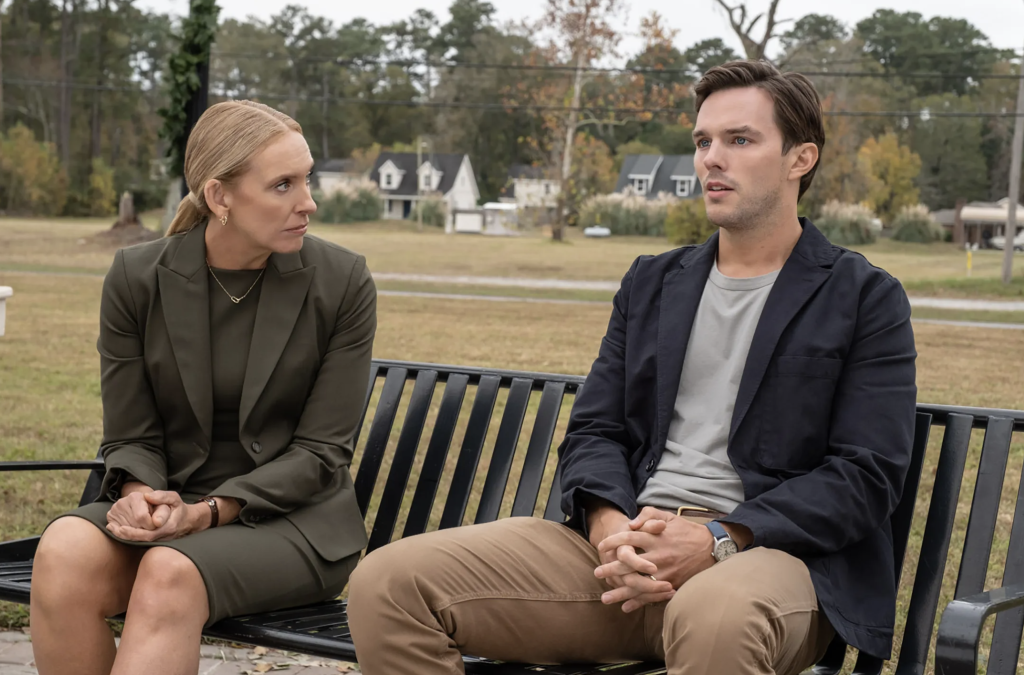
Kemp initially thinks he might have hit a deer, but he’s also not sure. He’s actually suppressing a terrible inkling. His car was damaged by the impact but he had the dent fixed and then he lied to his pregnant wife about where the collision happened.
So the film is basically held together by Kemp’s moral discomfort as well as our own.
How to solve this horrific situation? Kemp tries the Henry Fonda-in-12 Angry Men solution by trying to talk his fellow jurors out of finding a guilty verdict due to reasonable doubt. A hung jury won’t suffice as the case will just be retried.
Juror No. 2 lacks the tension and intrigue of 12 Angry Men, but it never bores and it certainly ends boldly. That’s all I’m going to say.
Our natural inclination is to want to see justice done, which in this case means Kemp has to come clean and face the music. But an attorney friend (Kiefer Sutherland) tells Kemp that because of his prior alcoholism no one will believe he was sober at the time of the accident, and that he’ll wind up doing serious time. Excerpt hie wife (Zoey Deutch) is about to give birth so there’s nothing but pain either way.
Without getting into specifics there’s a major plot hole that involves auto-body repair receipts. That’s all I’m going to say but this issue becomes more and more bothersome.
I haven’t seen Laura Piani‘s Jane Austen Wrecked My Life, but leaving aside this Sony Pictures Classics release, we’re obviously looking at a dreary weekend.
The only respectable diversion, for some, is Wes Anderson‘s The Phoenician Scheme, which I saw a couple of weekends ago in Cannes. And yet it only has a 77% RT rating, which by high-school grading standards is equivalent to a C-minus. Has anyone seen it?
I felt immediately mystified hy the casting of Mia Threapleton, the 25 year-old daughter of the once-married Kate Winslet and painter-filmmaker Jim Threapleton, in the lead female role. She delivers the same kind of standard deadpan performance that Wes always gets from his actors. The odd thing is Threapleton’s appearance. She’s not only short and chubbyish, but her face is wider than it is tall, and I’m sorry but she simply doesn’t stir the pot. I just couldn’t understand why she was cast.
Otherwise The Phoenician Scheme is another Wes comfort zone movie. Too much so.
Posted on 5.19.25: It’s not important or even noteworthy, trust me, to explain the plotline of Wes Anderson‘s exactingly composed The Pheonician Scheme. Because it’s just (stop me if you’ve heard this before) another serving of immaculate style mixed with ironic, bone-dry humor — another signature tableau exercise in WesWorld stuff — wit, whimsy, staccato dialogue, a darkly humorous attitude, faintly detectable emotional peek-outs. Plus the usual symmetrical framings, immaculate and super-specific production design and the Anderson troupe reciting their lines just so.
I’ve written repeatedly over the last couple of decades that Wes needs to recover or re-charge that old Bottle Rocket / Rushmore spirit and somehow climb out of that fastidiously maintained Andersonville aesthetic and, you know, open himself up to more of the good old rough and tumble. Maybe there’s no remedy. Maybe we’re all just stuck in our grooves and that’s that. What’s that Jean Anouilh line from Becket? “I’m afraid we can only do, absurdly, what it has been given to us to do. Right to the end.”
Otherwise you should live your life, manage your affairs and achieve your goals cold sober. There’s really no other way.
I kinda like floating around on Ketamine from time to time but I wouldn’t touch Adderall or any other speed-like substances with a ten-foot pole.
Elon Musk to himself: “I can do what I want as long as I stay lucid and keep it together and, you know, maintain a respectable front.”


I saw A Complete Unknown three times in theatres last December, and then once more on my phone (not recommended).
The truth is that between Timothee Chalamet’s frequently mumbled dialogue, today’s imperfect on-set dialogue recording tech and the decent but less-than-immaculate sound systems in mainstream theatres today, I never heard each and every line. I heard most of the screenplay, but missed maybe 25% or 30%.
Last night I watched it on Bluray with subtitles, and what a difference! Every previously slurred, half-articulated line was revealed and clarified, and it really bumped up the enjoyment factor. It’s almost like watching an entirely different film. Not to mention the fact that it looks better on Bluray than it did at those various AMCs (two in Manhattan, one in Westport).
I’d still like to know which scene is the fictitious one…the scene that Bob Dylan cooked up…the one that director James Mangold expressed concern about including because it never happened in actuality, in response to which Dylan said “what do you care?…if the scene works, it works.”
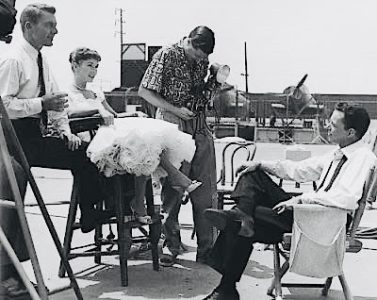
You may see a casual shot of Frank Sinatra, Debbie Reynolds and David Wayne on the set of The Tender Trap (‘55). I see that also, of course, but my eyes go right to Sinatra’s elevator heels, which may or may not have added two and 1/2 to three inches. Sinatra stood between 5’7” and 5’8” just out of the shower. Wayne was also 5’7”; Reynolds stood 5’2”.

Six days ago (Friday, 5.23) I watched a “new 4K digital restoration” of Barry Lyndon, projected upon the big, beautiful screen at the Salle Debussy. I had somehow persuaded myself that it would somehow look better (crisper, cleaner, whatever). Well, it looked fine but unremarkable…un-bumped…about as unexceptional as a 35mm screening I caught in Savannah several years ago…no better, no worse.
If Lyndon has been shot today the images would look considerably more specific and detailed…if it had been shot with an iPhone 15 even… but it was shot on 35mm film by John Alcott 51 years ago, and the lenses of that era were what they were.
But you know what? I have a suspicion that it will look better on the 65-inch Sony 4K when the Criterion 4K disc comes out on Tuesday, 7.8..
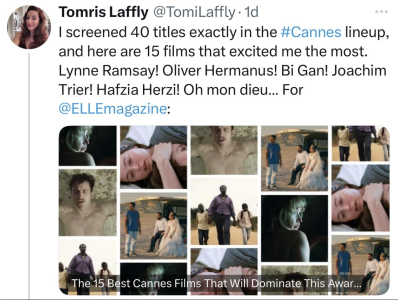
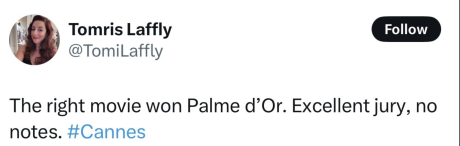
HE to Tomris Laffly: “Two or three days ago a colleague attempted to shame me for having only seen and reviewed a miserable 22 films in Cannes….a pathetic tally compared to your having bagged 40 screenings….40!. And you reviewed each and every one, right?
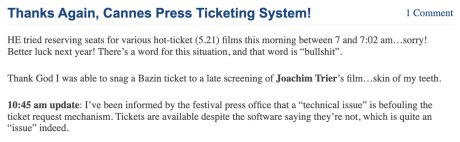
“40 films in 11 days = nearly four films per day. Very impressive!! I guess you didn’t suffer the same reservation + access issues I was forced to grapple with. I’m presuming you also caught a couple of extras on Saturday, 5.24.
“And each review was how long exactly? 5 to 7 paragraphs? Shorter? Longer?
“Rest assured, no one is more impressed with your amazing screening stamina…no one is more impressed than myself.
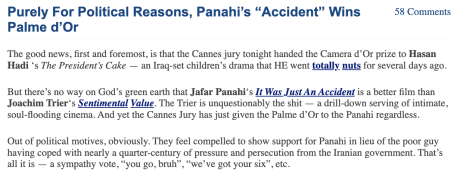
“You earned a demerit, of course, by approving of the Jafar Panahi film winning the Palme d’Or, but then you couldn’t help yourself, I guess, being a wokey and all.”
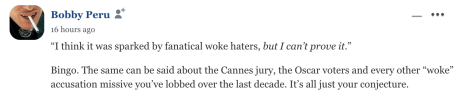
In fact….
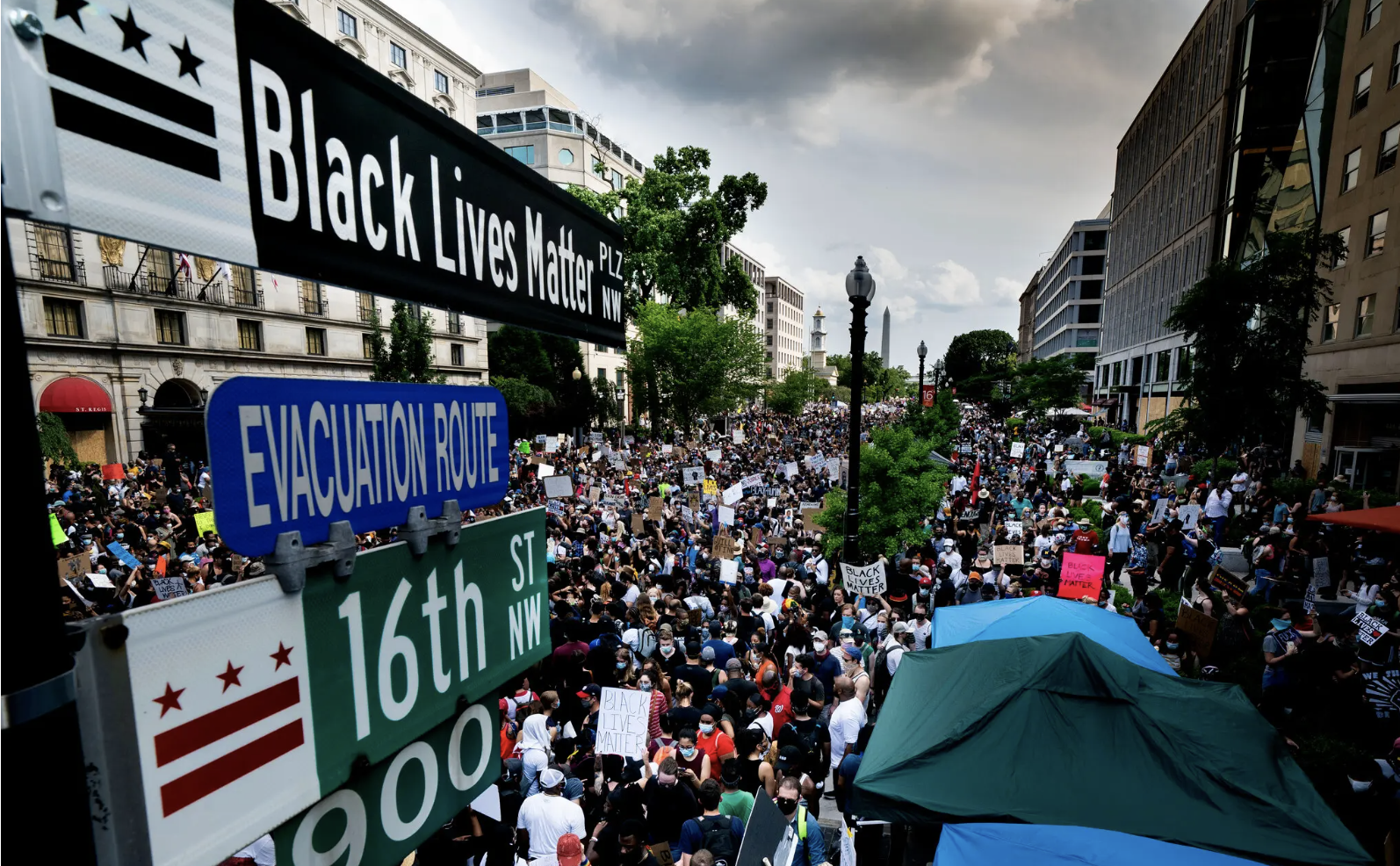
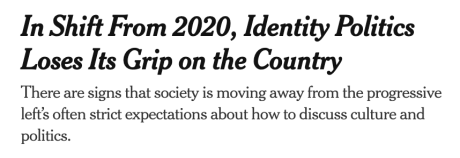
Woke terror — the U.S. version of China’s Great Cultural Revolution of the 1960s and early ‘70s — became a thing in ‘18, and it absolutely ruled the culture until it started to ebb in the middle of last year.
The first indication that the culture had said “enough!”…the blessed event that told me the tectonic plates had shifted…was when Lily Gladstone didn’t win the Best Actress Oscar during the 96th Academy Awards.
Woke terror hasn’t been fully eradicated as we speak but at least it’s been losing its grip, thank God. Six and a half years of twisted insanity! And you know why it’s taken as long as this for the string to run out? One reason is people like Bobby Peru saying “there IS no woke terror….its all in your head.”
Posted by N.Y. Times contributor Jeremy Peters on 11.2.24:
The first feature film to forsake opening credits was Walt Disney‘s Fantasia (’40), but this version has been jettisoned. Yes, the original 1940 theatrical cut was credit-less, but brief credits were added for an early ’90s home video version.
There were no opening credits for Mike Todd‘s Around the World in 80 Days (’56), although I have a memory of a 1.37:1 introduction about the eternal thirst for adventure and modes of 19th Century travel, narrated (I think) by Edward R. Murrow. But that was a pumped-up, high-tech travelogue movie + a reserved-seats roadshow thing…the first film to be presented in 30-frame-per-second Todd-AO, etc.
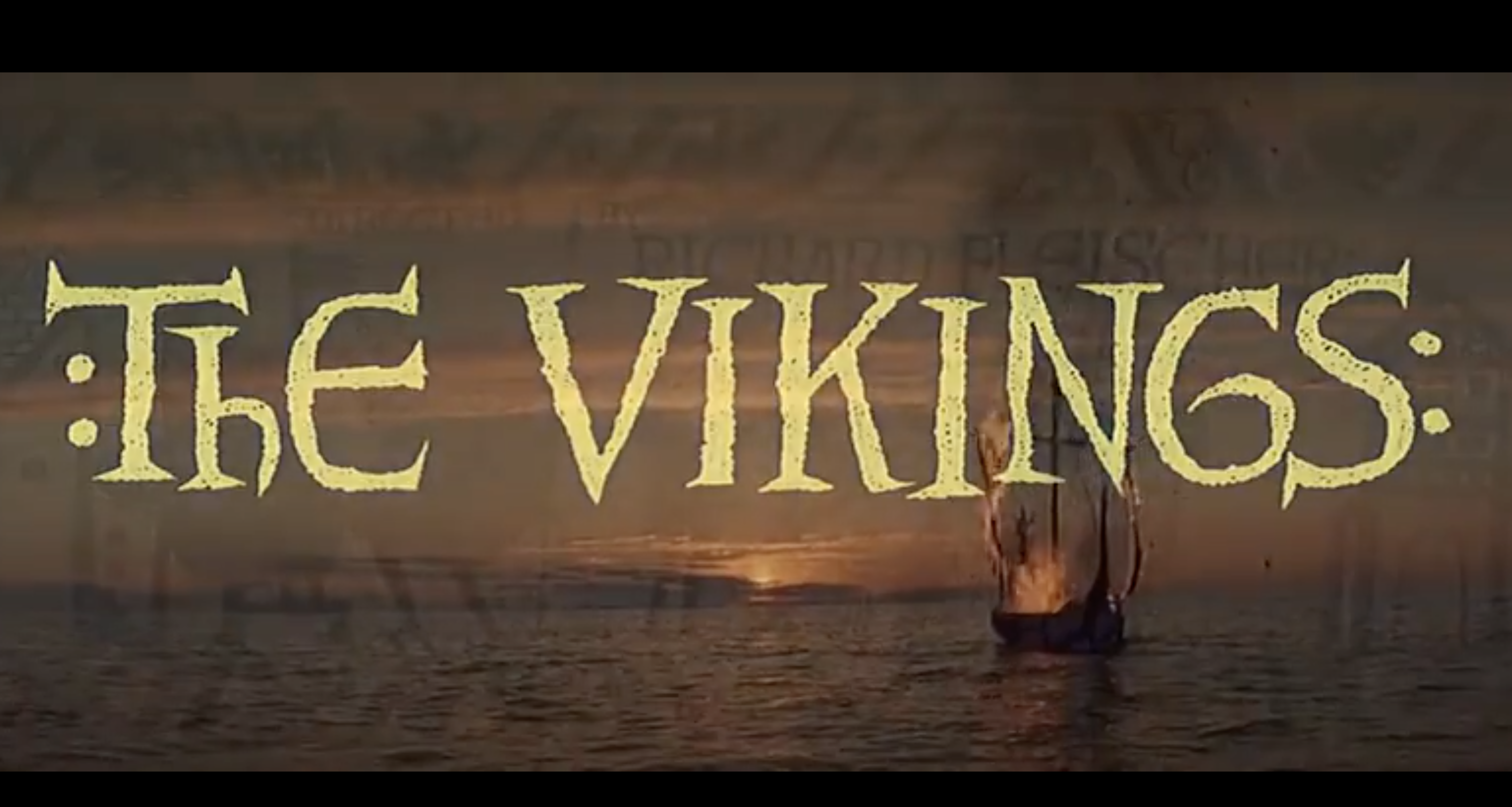
In fact the first general audience popcorn movie to forsake an opening credit sequence was Kirk Douglas and Richard Fleischer‘s The Vikings (’58). All the credits (above- and below-the-line) were confined to an animated sequence at the very end.
The next big-deal film to blow off opening credits was Robert Wise‘s West Side Story (’61).
And yet the last two announced their titles at the very beginning. The first film to completely ignore a title acknowledgment was Francis Coppola‘s Apocalypse Now (’79). The 70mm roadshow version didn’t even present a closing-credits sequence, although the 35mm general release version did.
[Lost, perverted, re-posted…and the piece isn’t all that great to begin with….sorry for the loss of the comments]
I’m trying to assemble a list of supporting actors who lucked into exactly the right role and then marshalled their gifts and delivered knockout, ace-level performances…but only once.
Not that they lacked (or lack) for talent or haven’t had successful careers since, but delivering just so with a performance that really lights up a film….that’s a much rarer thing.
It may sound brusque or cruel to say that for some this kind of performance comes only once in a lifetime, but unfortunately…
Nobody worked more regularly in features and TV than John McIntire (Wagon Train, The Virginian), but if you ask me his only truly memorable role was as Sheriff Al Chambers in Alfred Hitchcock’s Psycho. Partly because Mcintire played the part exactly right. Had it not been for an interior, three-minute dialogue scene in this 1960 thriller, McIntire would barely be on the radar today.
Take Dallas Roberts‘ low-key but authoritative performance as Sam Phillips in James Mangold‘s Walk_the_Line (’05)…a truly great moment in a first-rate musical biopic, but Roberts hasn’t been that lucky since.
26 years ago the late, great Nicky Katt gave a perfectly perverse performance as Stacy the hitman in Steven Soderbergh‘s The Limey….his three or four scenes rivalled Terence Stamp‘s in terms of sheer stuck-to-the-ribs longevity.
And never forget Gladys George‘s wordless emoting in that reading-the-citation-letter scene in The Best Years of Our Lives.
Who else? Which others? I’m not talking about supporting actors who nailed one perfect scene (that’s a separate thing), but whose one, single, diamond-bullet performance really hit home and will probably never be forgotten. But also can’t be repeated.