“That Aside, What Did You Think of the Play, Mrs. Lincoln?”

Yesterday morning I read a 5.7.24 Richard Brody appreciation of the late N.Y. Times film critic Andrew Sennwald, who served as the paper of record’s senior film authority between 9.18.34 and 1.12.36.

Hired by the Times as a reporter at age 23, Sennwald soon became a top-tier, unusually perceptive examiner of the art and hoopla of film, Brody writes. Sennwald was an ardent admirer of director Josef von Sternberg, for one thing.

I’ve since read a few of Sennwald’s reviews. He wrote confidently and well, and certainly knew the realm.

It’s a shame that this highly respected guy died at age 28 and suddenly at that, and possibly by his own hand despite reportedly being in excellent health, not to mention in the professional prime of his life.

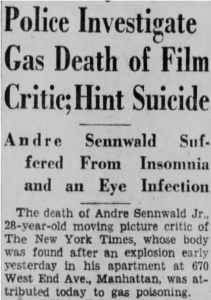
Weird as it sounds, Sennwald died of gas-stove poisoning, apparently or at least possibly a suicide.

On top of which the gas, which Sennwald, being dead, was unable turn off, exploded and wrecked his penthouse apartment at 670 West End Avenue, and not just the penthouse but the top three floors of the 17-story building. Investigators found Sennwald in his pajamas, on the floor of his kitchen.

Was this an accident? Why in heaven would a young man who’d quickly vaulted to a highly eminent position in his chosen field (it doesn’t get much better than being a top critic at the Times), a guy who lived in a fairly swanky abode and presumably had everything to live for…why would he off himself on a Saturday around midnight, and in his pajamas yet?

If I intended to do myself in, I would do so in my finest apparel — silk shirt, knotted tie, spit-shined shoes.

Sennwald’s last review focused on Rene Clair‘s The Ghost Goes West. Sennwald was succeeded at the Times by Frank Nugent.

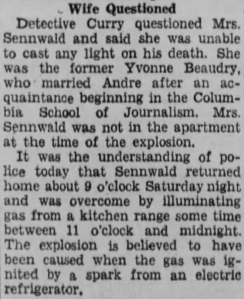
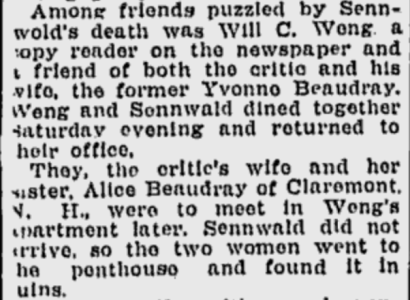
Sennwald’s marriage to journalist Yvonne Beaudry, whom he met while going for his journalism degree at Columbia University, had apparently gone south. Sennwald’s Wiki page describes her as an ex-wife, although they were reportedly on cordial terms. Beaudry was out on the town when he died.

Sennwald may have been suffering from a serious eye ailment called Uveitis, but there’s not much info on this. He was also an insomniac.

While reporting that Sennwald’s death was seemingly a “suicide”, Brody otherwise focuses entirely on his film criticism. I respect his decision to ignore the curious circumstances that attended Sennwald’s passing, but that’s still one hell of an ignore.

It’s not like Sennwald swallowed some pills and slipped away quietly while slumping on a bench in Central Park. His death triggered a violent spectacle and a major neighborhood trauma — collapsed walls, fellow residents evacuated, a busted water main…bluh-DOOM!!

Brody could have just as easily have written about the Skull Island life of King Kong (wrestling an occasional T-Rex, killing Teradactyls, roaring a lot) and then blown off what happened on his final day of life in midtown Manhattan.

Not to mention the fact (I’ve made this point but indulge me) that a top N.Y. Times critic would never kill himself inside his West End Ave. penthouse at a fairly young age…does this make any sense to anyone at all?

A film critic hypothetically pulls the plug when (a) he/she can’t find decent employment, (b) is past his/her prime (65 or older) and (c) is barely making ends meet in a grubby flat in the East Village.


Reported by The Brooklyn Eagle on 1.13.36:
Brody:

Choose or Lose: Cannes Day #1 (5.14)

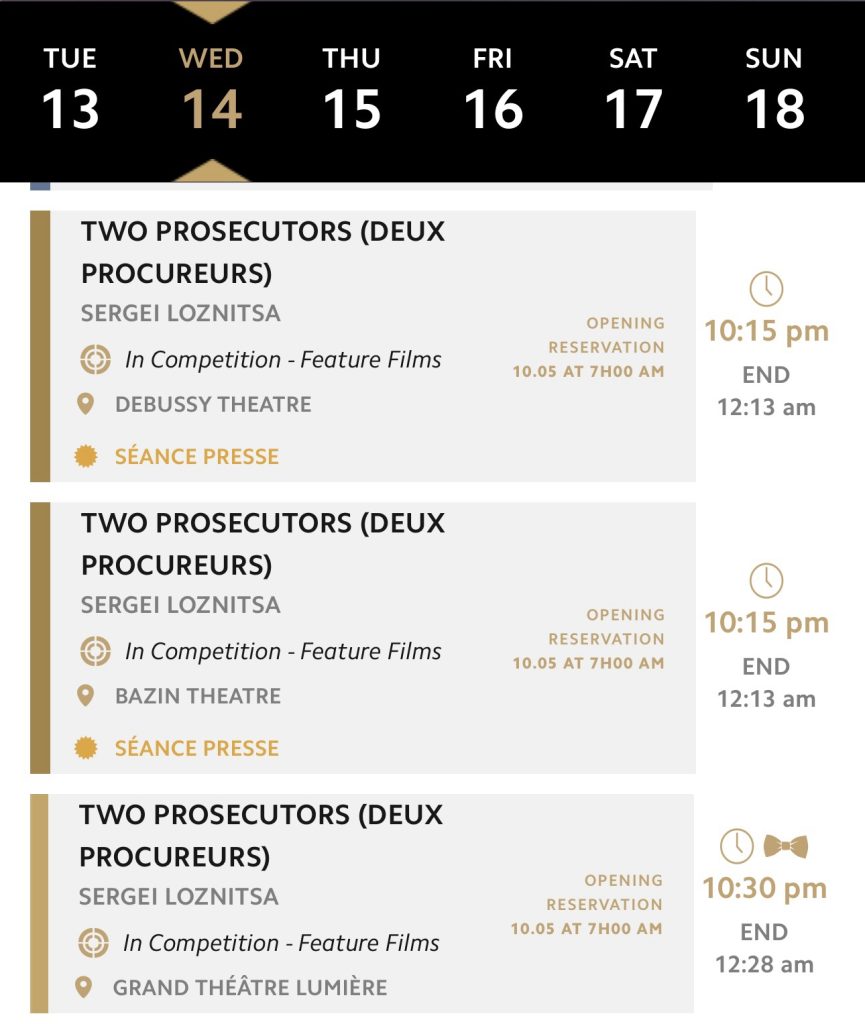
Amelie Bonnin ‘s Partir Un Jour (lowered expectations) at 9 am, the Chris McQuarrie thing at 12:30 pm, Mascha Schilinski’s Sound of Falling at 3:30 pm, ixnay on the Robert DeNiro thing, MI: Final Reckoning at 6:45 pm, Sergei Loznitsa’s Two Prosecutors at 10:15 pm. Four films. Come hell or high water, I must commit at 1 am eastern, tonight.

91 Years and Counting

In a comment thread following an 11.29.24 piece about an English-subtitled Russian Bluray of Roman Polanski‘s An Officer and a Spy (“#MeToo Suppressionists Are Powerless In This Regard“), the redoubtable Clemmy wrote, “If you financially support a child rapist, you do not care about your granddaughter’s future.”

HE response to Clemmy: “While most many intelligent people support the cinematic art of the obviously gifted and indisputably great Roman Polanski, HE does not and never has supported the notion that anyone proven guilty of sexual abuse or assault should skate. Crimes of the loins have penalties. Nobody’s disputing this.

“Then again are you telling me that Polanski hasn’t been made to suffer and submit to the proverbial lash for the last 47 [now 48] years?

“Are you telling me that Polanski’s kids, Morgane and Elvis, live in a state of perpetual fear about what their allegedly monstrous dad might do to them?

“We’re talking about two twains here, two separate boxes.

“History is flooded with accounts of great artists who didn’t behave well at certain points in their lives, or who behaved abusively or with cruelty toward this or that person. Isolated incidents, I mean.

“Enlightened art scholars have long argued and understood that at the end of the day you can’t throw the baby out with the bathwater.

“#MeToo ideologues will never understand or accept this.”

Read more

“You Make Me Feel Valuable”

“I feel this way because I’m a money whore, and you’ve got a lot of money so…perfection, right?” — Dakota Johnson‘s Lucy to Pedro Pascal‘s Harry Castillo in Celine Song‘s The Materialists (A24, 6.15). Okay, this isn’t an actual quote but it might as well be.

I hate this movie, sight unseen.

One of the most withering moments of my life happened in July ’13. I was texting with a lady I’d fallen in love with (i.e., an affair that ran from early May through late October) and in the middle of a discussion about something fairly basic she texted (and I mean right out of the fucking blue), “I’m expensive.”

Whoa.

It would have been one thing if I was a compulsive cheap-ass who was always looking to squeeze a nickel until the buffalo shits, but I was probably more of a give-give-giver with her than I’d been with any other girlfriend in my life. I was very generous and comme ci comme ca about everything. Everything was cool and steady. And yet she dropped that line on me. I’ll never forget that moment for the rest of my life.

The last time I’d heard that line was when Marilyn Maxwell said it to Kirk Douglas in Champion (’49). We all know what she meant, of course. Obviously not just “I’m high maintenance” but “I might be too high maintenance for you, given your apparent income and frugal tendencies. I’m not saying I’m a money whore but…well, you tell me.”

Posted on 10.28.13:

I obviously dip into non-film topics in this space from time to time, but I draw the line at relationship stuff. I’ll allude every so often to something going really well but leave it at that. Boundaries are respected, no telling tales, stays in the box. But I’m also figuring there’s nothing terribly gauche about acknowledging that it’s exhausting to go through a two-hour texting meltdown when things have taken a turn for the worse.

I wonder if anyone hashes this stuff out eyeball-to-eyeball any more. Thank God that iMessage allows you to text from a computer keyboard — I don’t think I could thumb my way through one of these ordeals. Texting your innermost disappointments and lamentations while keeping up your end of the “debate” (which can never be won or lost, of course) is quite debilitating. When you wake up the next morning you feel empty and a bit numb. Is “gutted” too strong a word?

Read more