
Month: August 2025
Existential Traffic Agony
That feeling of hopelessness and bottomless malaise that pours into the souls of trapped highway drivers on a daily basis in the major urban corridors…all I can say is that the gloomy authors and philosophers of yesteryear never knew this kind of anguish…they never knew they had it so good.
Industrial asphalt downerism became an American “thing” in the 1950s, when Dwight D. Eisenhower‘s vast interstate highway system began construction.
One of the first cinematic depictions of this stifling nationwide depression happens in the first minutes of Mr. Hobbs Takes a Vacation (‘62), a mostly middling family comedy with James Stewart and Maureen O’Hara in the leads. Stewart, playing a banker, is trapped in his sedan during a highway commute, and a truck just ahead belches out a cloud of brown exhaust.
But it wasn’t the exhaust and smog that so weighed on drivers. It was the sheer number, the tens of thousands of other commuters.
Born To Lose
I’m getting distinct Leaving Las Vegas vibes from this trailer for Edward Berger‘s Ballad of a Small Player (Netflix, 10.15). Honestly? I’m not looking forward to this.
Would I rather re-watch Josef von Sternberg and Nicholas Ray‘s Macao? Yes.
From Gerard Woodward‘s 4.26.14 Guardian review or Lawrence Osborne’s “Ballad of a Small Player“:
“The son of a vacuum cleaner salesman from Croydon, Lord Doyle has more reason than most to want to shed his wealth. It is loaded with the guilt of ill-gotten gains.
“As a lawyer back in England, he fleeced an elderly widow; now he has fled the country, hiding out in Macau, mainland China’s Las Vegas, across the bay from Hong Kong. The casinos he inhabits resemble fantasy versions of the European culture he has deserted, with names such as The Greek Mythology and The Mona Lisa: schmaltzy, sham palaces as tinselled as anything in Nevada.
“His game of choice is punto banco baccarat, ‘that slutty, dirty queen of casino card games’. It is the game Bond plays in Casino Royale (though in the film it was replaced with poker), the game of instant death, the guillotine. It is a game of no skill or strategy, the card-game equivalent of tossing a coin. The only hope the punter has is in the timing and pacing of his bets. But Doyle cares little for winning or losing. His life seems given over to the laws of chance, as though he were trying to gamble himself out of existence.
“The beauty of this novel is in the elegance and precision of its prose, which renders the glaring kitsch of Macau into a series of exquisite miniatures, and draws on Osborne’s reserves as a travel writer. The problem is that, apart from Doyle himself, there is no one else in the novel of much interest — the casino staff, the expat colleagues, the remembered family and friends back home: none of them comes to life with any conviction. The story itself begins to feel as though it is on a loop as the money comes and goes.
“Even when Doyle carries his winnings to his room in seven suitcases stuffed with cash, that isn’t the end of it, and one tends to lose interest in how many times Doyle goes from bankruptcy to riches and back again.”
If I Never Have To Sit Through “High and Low” Again…
…it’ll be too soon.
Late to “Highest 2 Lowest”
It would have been so much easier and simpler to have seen Spike Lee’s Highest 2 Lowest three months ago in Cannes, but easy-access press screenings were’t scheduled. Lee wanted the media bounce of a gala black-tie screening but cared not for persons like myself having a looksee, obviously calculating that reviews would be mixed.
I finally saw Highest 2 Lowest last night, and guess what? It’s mildly fine — a smoothly engaging, well-jiggered kidnapping drama for the whole family — a total popcorn movie that’s more or less about celebrating the color and vibrancy and musicality of New York City’s black and brown culture…a Spike joint that, for me at least, never bored or dragged (even during the first plot-light, character-driven hour).
Swanky Brooklyn pad, a high-profile son-snatching, a $17.5 million ransom in Swiss currency, a nifty second-act chase sequence, etc. Whatever, bruh…enjoy the ride.
This is basically a movie about wealth and happiness. Spike is flush, Denzel is bucks-up, NYC looks beautiful. It’s all good. (Did I feel left out because of my own lean portfolio? Yeah, kinda, but I got over that.)
Tightly assembled and visually punched-up (dare I say “balls-up”?), H2L is well-charged fun…panache, pizazz, an emphatically flush vibe (i.e., it’s kinda wealth-porny).
It boasts several fine, filled-out performances by several commanding, good-looking actors (Denzel Washington, ASAP Rocky, Jeffrey Wright, Ilfenesh Hadera), plus ample servings of luminous Matty Libatique images. And it begins with a Rodgers & Hammerstein cityscape montage that’s pure emotional pleasure.
It goes down easy, man — schmaltzy, emotionally heightened and made to charm and entertain the popcorn-munching serfs (including schmoes like yours truly).
Akira Kurosawa’s noirish High and Low (‘63) struck everyone as a grim, hard-nosed, visually unengaging downer — Spike’s remake is pretty much a tonal opposite.
Forget This Flawed IndieWire List
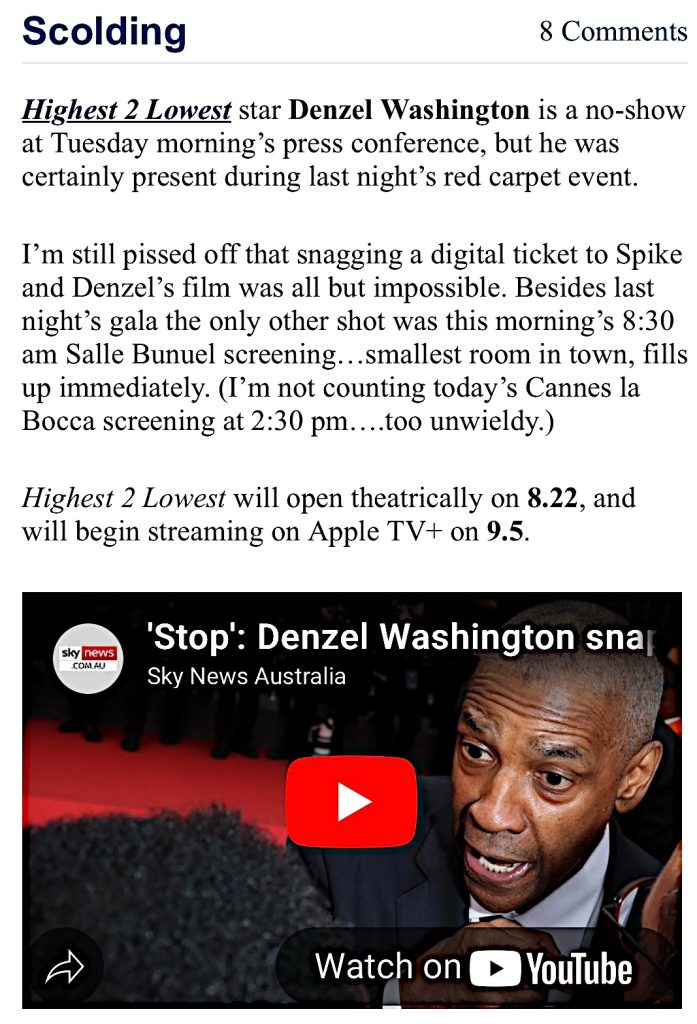
Any “100 best films of the ‘70s” list that doesn’t include Terrence Malick’s Badlands, John Flynn’s The Outfit, Mike Hodges’ Get Carter, Peter Bogdanovich’s The Last Picture Show, Michael Ritchie’s Downhill Racer and The Candidate, John Boorman’s Deliverance, Sam Peckinpah’s Straw Dogs, Mel Brooks’ Blazing Saddles and Young Frankenstein, Hal Ashby’s Being There and Robert Altman’s The Long Goodbye…any such list that ignores these 12 films invites my disrespect.
Plus there’s no way Chantal Akerman’s Jeanne Dielman ranks higher than the two Godfather films…get outta town! The IndieWire list was clearly assembled with a diversity mindset…too many diversity picks elbowing aside way too many first-rate’70s films.
(Thanks to Joe Dante for doing most of the heavy lifting.)
Give Anya Taylor Joy A Chance
HE is okay with Anya Taylor Joy playing the young Joni Mitchell in Cameron Crowe‘s forthcoming biopic (per Jeff Sneider’s scoop), but Amanda Seyfried would have been a much better choice. Obviously.
Converted
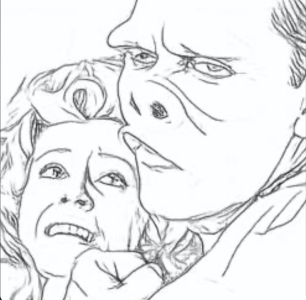
This morning I stumbled upon a free, relatively recent AI software that converts photos into line drawings. The idea is to hand prints of these drawings to Sutton for coloring. This weekend, I mean. Go ahead, lay it on me…tell me that free photo-to-line drawing conversion software has been around for years.
I’ve also just happened upon a YouTube file of Lou Reed‘s “What’s Good”, my favorite song from his 33-year-old “death album” (Magic and Loss).
“This…Is…Happening”
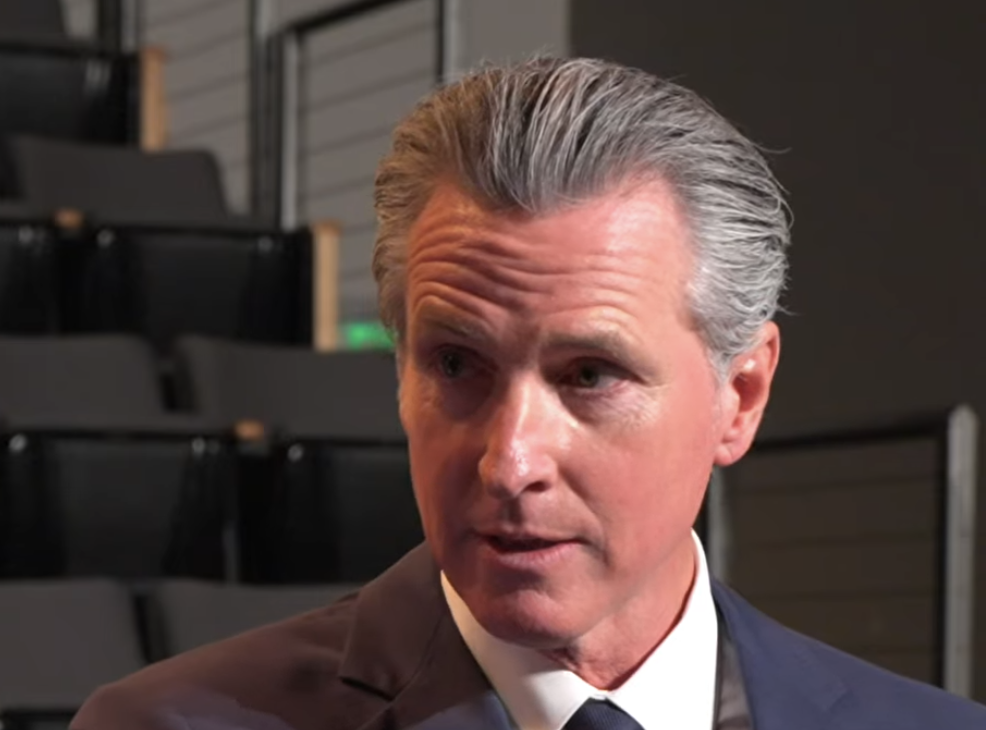
What is wrong with Gavin Newsom talking bluntly and defiantly about the authoritarian schemings of Donald Trump? What isn’t 100% right with such rhetoric? Who else is standing up like this? Who else is saying “wake up” and “this…is…happening”?
https://www.facebook.com/share/r/1L3DAf4ctf/?mibextid=wwXIfr
Easily Stamp’s Finest, Tenderest Scene
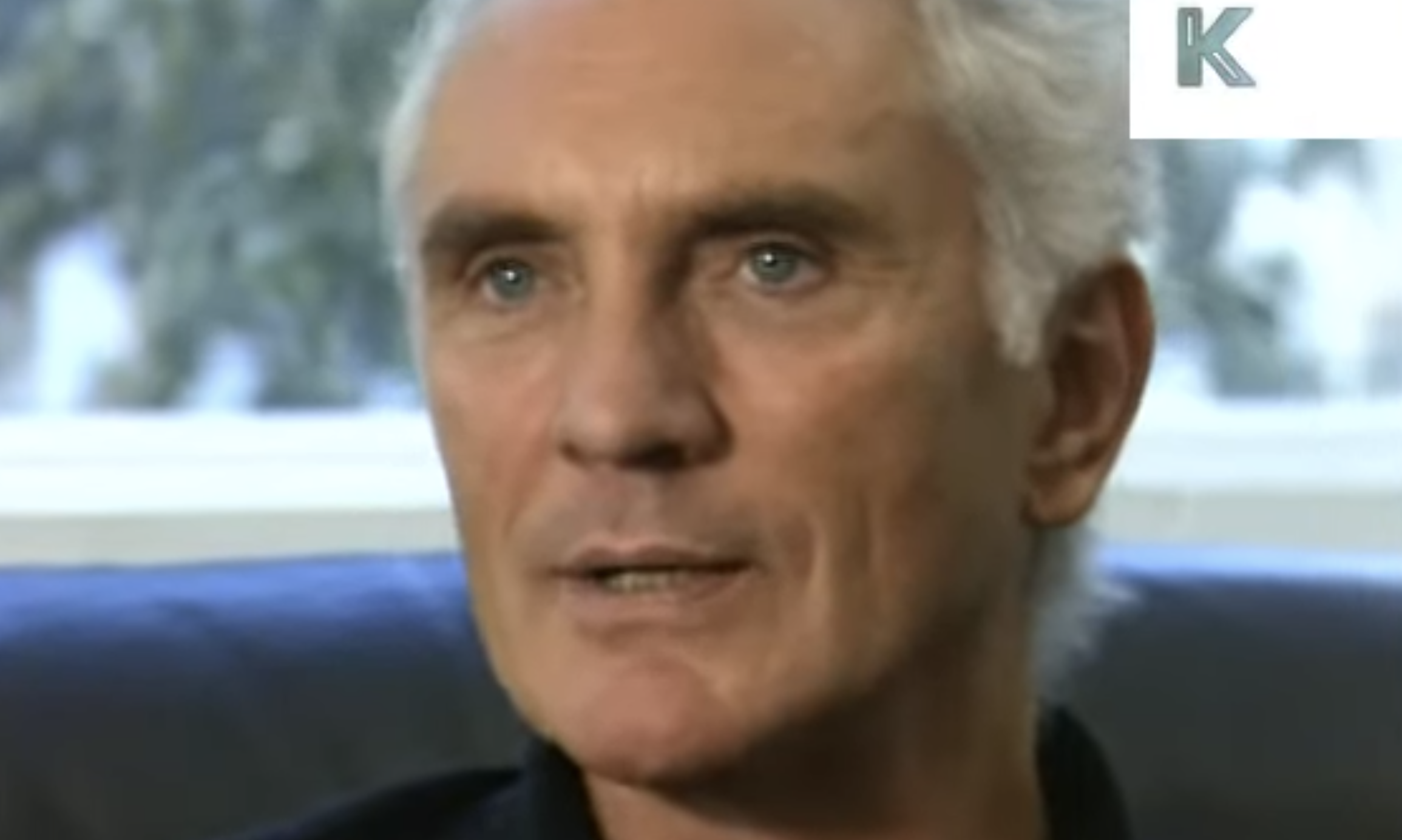
Terence Stamp‘s Willie Parker to John Hurt‘s Braddock in Stephen Frear‘s The Hit: “Why should I be scared? Death is just a stage in the journey. We’re here, and then we’re not here. And we’re somewhere else. Maybe. And it’s as natural as breathing.”
Why is the quality of this clip so shitty? Criterion has had a 1080p Bluray version out for several years now.



“I Want All Of It…”
“All of it…not just some of it, but all of it.”
The frozen-face, suppressed-anger look that Ann Coulter gives Konstantin Kisin is chilling.