I’ll tell you what happened to it. This is what happened to it, generally speaking.



I’ll tell you what happened to it. This is what happened to it, generally speaking.
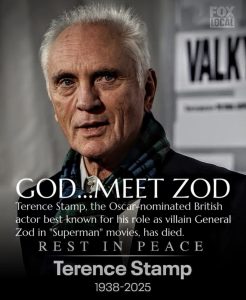
I’m rushed and running, but I’ll post my Terence Stamp obit later today or tonight. I’ll include my list of his greatest performances, topped by those in The Limey (‘99), The Hit (‘85) and Billy Budd (‘62), of course.
Actually Stamp’s greatest came down to only these three, truth be told.
Was Stamp’s “Willie Parker”, the doomed but spiritually teeming ex-gangster who commented about, coached and consoled John Hurt, Tim Roth and Laura del Sol during a road journey across Spain in what may have been Stephen Frears’ finest…was Willie his all-time best? I wouldn’t argue against this.
Yes, he’s fascinating and certainly a memorable object of spiritual desire in Pier Paolo Pasolini’s Teorema (‘68), but Stamp’s performance as a Christ-like seducer and redeemer (he fucks a wealthy Milanese family of four —- dad, mom, a teenage son and daughter) is mostly opaque.
I’ve never been much of a General Zod fan nor of Stamp’s cross-dressing turn in Priscilla, Queen of the Desert…sorry.
I have a curious soft spot for Stamp’s brief performance as a snooty ape professor (simiantologist?) in Richard Franklin’s Link (‘85).
As recently as 15 years ago, most of us shared a common understanding and acceptance of basic human truth. What we really believed deep down. Faith in fair-minded democratic ideals. The way life actually looks, smells, tastes and feels. Judging people by the content of their character.
Alas, most of this began to be discarded by the wokeys around eight years ago, largely in reaction to Trump and the MAGA whackos.
Now there are three kinds of truth, and the concept of their respective adherents accepting or respecting or even tolerating opposing views is mostly out the window.
The basic tenets of wokey truth are that (a) 85% of white guys are toxic dicks and need to be shunned on dating apps and certainly as potential marriage partners, (b) POCs are blessed angels who need shelter and protection as a make-up for four centuries of racist oppression, (c) children need the help of enlightened teachers and parents in order to change their gender in order to live their own authentic lives, (d) obesity is beautiful, (e) Netanyahu’s Israel is evil, (f) men are free to be women if they want this, and that includes the freedom to compete in women’s sports.
Wokeism peaked in mid-2024 and is certainly on the way down…the culture has shifted! But there are still millions of wokeys (mostly urban Millennials and Zoomers) who want Kamala Harris to run again in’28, and if not Kamala then AOC or Zohran Mamdani or Jasmine Crockett or somebody in that vein.
As long as wokeys are exerting major influence, the Democratic party will remain a minority party.
The basic tenets of moderate, sensible truth are basically those embraced by Bill Maher, Paul Schrader, Rahm Emmanuel, Barack Obama, Joe Rogan, Hollywood Elsewhere and all the other former liberals who were driven out by radical left insanity during the summer of George Floyd and beyond. (Gavin Newsom is almost part of this fraternity, but he has to abandon his support of minors having bottom surgeries.)
The one, basic, fundamental tenet of MAGA truth is that wokeys are insane and have to be stopped and suppressed at any cost.
If Howard Beale had his own podcast today, he would be praising the idea of unfiltered, raw, and honest human experience, much of which has been redefined and otherwise manipulated by the radical left’s domestic version of Mao’s Great Cultural Revolution.
For five years (2020 to 2024) Average Joes and Janes were persecuted by the racist, identity-driven, anti-white wokeys.
Beale would be saying that that too many people have become disconnected from their true selves, living under the once-terrible yoke of wokey criteria, demands and concepts. Beale would be saying “break free from these nutjobs and embrace genuine human emotion and experience.”
TikTok clip for thought:
https://www.tiktok.com/t/ZT6Q9StqD/
Strange as it may sound to some (Stalinist wokeys in particular), but in the old days actresses were not only given opportunity but valued and rewarded not just for their talent but also their looks. Audiences have always loved the company of dishy-looking performers. Or at least they used to.


The below sequence from John Huston s The Treasure of the Sierra Madre (‘48) arrives near the end of Act Three. The banditos have murdered Humphrey Bogart‘s Fred C. Dobbs, and are now trying to sell his burros. Entirely spoken in Spanish, obviously, but shot and performed in such a way that dialogue is all but superfluous. A five-year-old could easily discern what’s happening.
Question: Was this the first time that a critical scene in an American big-studio film was performed entirely in a foreign tongue without subtitles or any form of English translation or explanation?
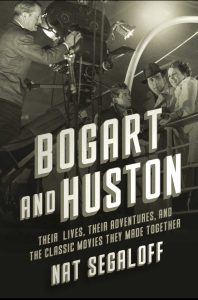
I bought and began reading Nat Segaloff’s “Bogart and Huston” book last night. Smart history, easy velvety prose, comprehensively researched, first-rate. The Beat The Devil chapter is a hoot.
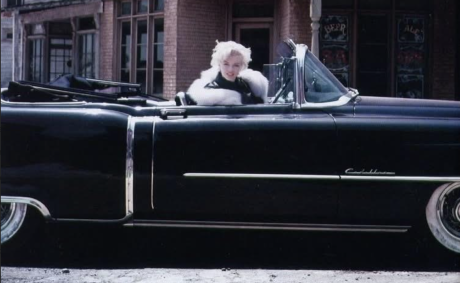
Marilyn Monroe‘s debut appearance on live TV happened on The Jack Benny Program on 9.13.53. This was roughly two months after Gentlemen Prefer Blondes opened theatrically and roughly two months before the opening of How To Marry a Millionaire. Monroe’s payment for the Benny gig was a 1954 black Cadillac convertible.
Early on in John McNaughton and Richard Price‘s Mad Dog and Glory (3.5.93), Robert De Niro‘s Wayne “Mad Dog” Dobie, a forensic examiner, defuses a potentially lethal robbery situation in a small Chicago convenience store. He comfort-talks the robber like a therapist and convinces him to split while the splitting is good. De Niro feels badly the next day, though, because he didn’t handle the situation in a commanding alpha-male, tough-cop style. He’s confesses this to his detective friend Mike (David Caruso), and Mike, looking to raise Mad Dog’s spirits, leans over and says, “That was balls-up what you did last night…don’t kid yourself.”
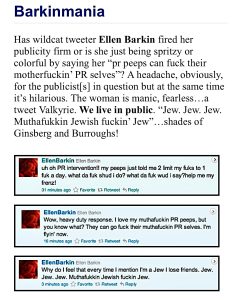
I was re-watching Ellen Barkin‘s testimony during the 2022 Johnny Depp vs. Amber Heard defamation trial, and really loving it.
Barkin is balls-up here. Her words and delivery are so real and plain and unaffected, but I was telling myself it was almost a kind of “performance” because she really knows how to sell. I believed all of it.
I was asking myself what the vibe might be if Angelina Jolie were to take another, similar-type stand and answer questions about her years-long relationship with Brad Pitt.
And you know what? Jolie couldn’t do what Barkin did three years ago. She doesn’t have the character to just tell it straight without posturing or performing. She’s so wrapped up in her turbulent emotional past that she can’t see the forest for the trees.
Jolie is beautiful and personable (I once chatted with her on a film set, and again during a brief junket interview) but off-balance, or so I came to believe.
The bottom line is that Jolie lacks conviction and steady hands while Barkin is made of sterner stuff.
Originally posted on 5.19.22:In her Thursday (5.19) testimony in the Depp–Heard defamation lawsuit trial, Ellen Barkin was persuasive in recollections about her “sexual” relationship with Depp (she said she preferred that term to “romantic”), which began sometime in ‘94 and lasted for maybe “five or six months”, give or take.
But they had a friendly relationship, both pre- and post-sexual, for roughly ten years, she said. Things were platonic at first, Barkin said, but then Depp “switched the buttons.”
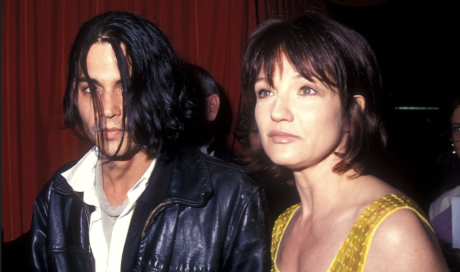
Things were largely defined by Depp almost always being drunk (i.e., “red wine”) or ripped or high in some way, Barkin said. In addition Depp was a “controlling, jealous man,” she testified.
Depp was nine years younger than Barkin (31 to her 40) when their relationship first became carnal during the second year of the Clinton administration. They later costarred in ‘98’s Fear and Loathing in Las Vegas.
Barkin’s snow-white hair, cut short as if she was playing an anti-Nazi freedom fighter in a Sidney Lumet or Michael Mann film, is striking. Ditto her “I have nothing to prove one way or the other” no-bullshit street vibe, and that wonderfully raspy New York accent.
Barkin was married to Gabriel Byrne between ‘88 and ‘99: she subsequently married billionaire Ron Pearlman, who divorced her in ‘06. Barkin reportedly emerged from that union with a $20 million settlement plus $20.3 million in a Christie-supervised jewelry auction.
I don’t have the time now to write anything about my talk earlier this afternoon with Another Happy Day star-producer Ellen Barkin and director-screenwriter Sam Levinson, or even to post an mp3…later. But the time just flew. The conversation was mostly on-point but digressions happened from time to time. Barkin and I reminisced about early ’80s Manhattan, sharing anecdotes in particular about the Hellfire Club and the old Edlich Pharmacy on 1st Avenue. Don’t ask.
 Another Happy Day star-producer Ellen Barkin, director-writer Sam Levinson — Thursday, 11.10, 2:55 pm, Sunset Tower hotel.
 …due to job demands, here’s a reaction from HE’s own “bentrane”:
“I know you’re not a fan of High and Low, which I think is easily one of Akira Kurosawa‘s best films. That said, Spike Lee’s version has some pluses, but overall, it’s just okay.
“Although I was never bored, it’s too long, and it takes too much time to get to the main story.
“It also lacks the moral clarity of the original. In this version Denzel seems to put up the kidnap money for his chauffeur’s son not because he thinks it’s the right thing to do, but more because he’s afraid of what social media will say about him if he doesn’t ante up.
“The film also doesn’t know when to end. Like the original, Highest2Lowest has a scene in which Denzel meets the kidnapper in jail, and their respective social standings and issues come to the fore. That was the end of High and Low, and it was a powerful one.
“But instead of ending it there, Spike had to add a totally unnecessary audition sequence in his apartment, which adds nothing to the film.
“Pluses: the cinematography; the soundtrack; the subway sequence; the very New York feel; the acting. But they’re not enough to overcome a bloated running time and a messy script.
“I’m giving it 2 1/2 stars out of four.
“And the wonderful State Farm joke, which had the audience roaring with laughter, won’t be understood by anyone outside the U.S.”
I firmly believe that John Clifford White‘s musical theme for Romper Stomper is one of the best of its kind, ever. Because you can immediately sense the downhead mood of racist skinheads, and because the instrumentation is incredibly spare and economical.
It’s just as effective in terms of vibe-summoning as Max Steiner‘s Skull Island music is for King Kong.
It proves that White is just as gifted of a film composer as any of the classic-era greats. He’s certainly just as talented as Bill Conti, whose Broadcast News theme summons the vibe of that whipsmart James L. Brooks film in a perfect, spot-on way.
&wprov=rarw1#/media/File%3ATerenceStampGeneralZod.jpg)