
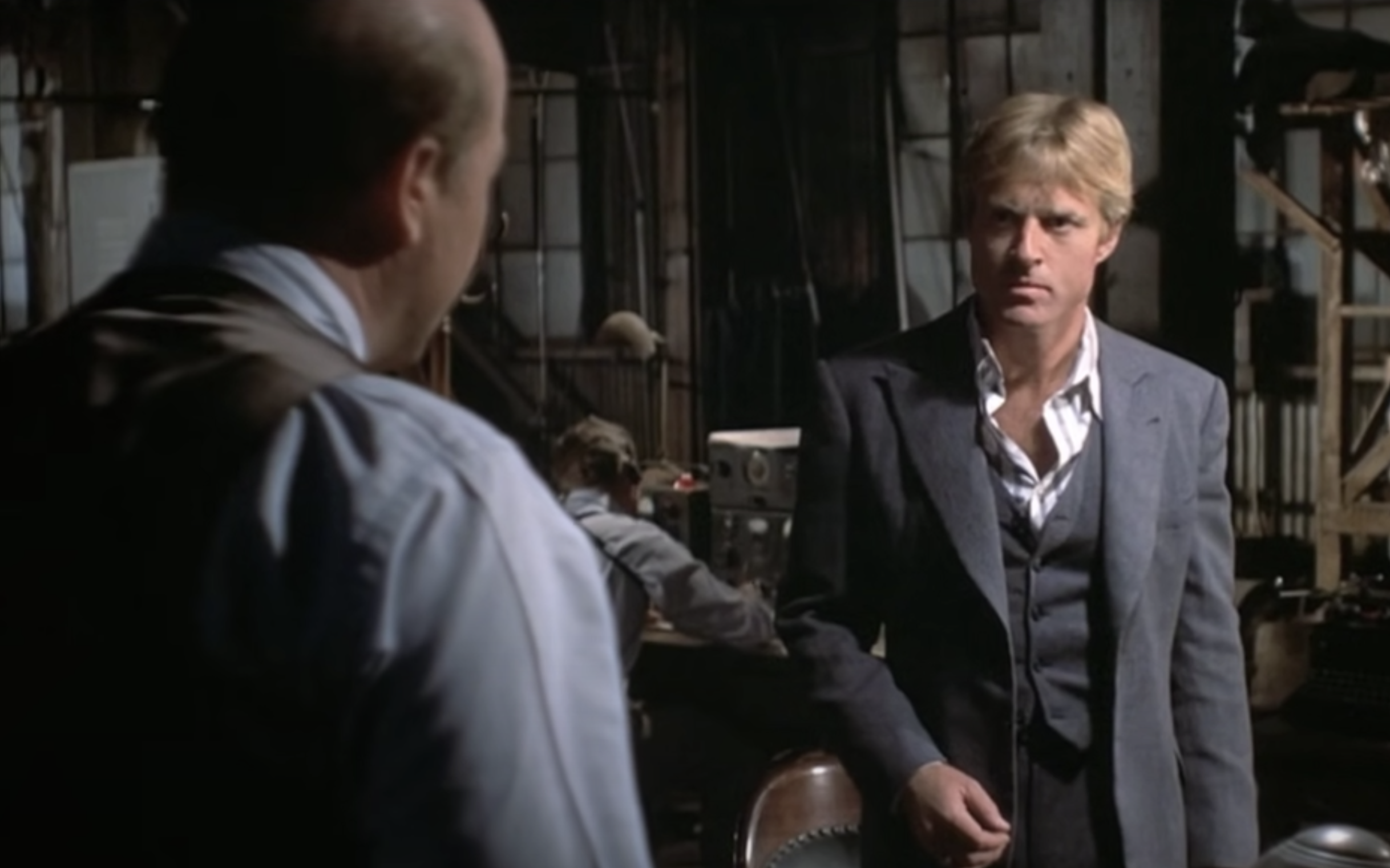
Posted on 3.1.20: Here’s a recollection from The Sting producer Tony Bill:
“In the late 60’s my agent (as an actor) was a wonderful guy — Bill Robinson. He didn’t represent producers (nobody did back then) or directors. I was successfully acting in movies, but I wasn’t interested in being a movie star. I, and many of my young friends, hoped we could make our way as filmmakers. Around 1970 Robinson hired Mike Medavoy to work for him. It was his first job as an agent, and I introduced Mike to many of my aspiring friends. (Not that it matters, but they included Spielberg, Malick, Coppola, Donald Sutherland and others.)
“One of my best friends [at the time] was Terry Malick — a young AFI student. Another was John Calley, a producer who then became head of Warner Brothers. I had an idea for a movie about big-rig truckdrivers, loosely based on a bunch of country & western songs about life on the road. Calley backed my idea of hiring Terry to write it, and the script, Deadhead Miles (his first), ended up being made in 1971/72 by Paramount. It was disastrous, because I made the two biggest mistakes a producer can make: (1) I hired the wrong director, and (2) I didn’t fire him.
“While licking my wounds from that project, I read a script by another young, unknown writer who was just out of UCLA — David Ward. It was called Steelyard Blues. I thought it was a fresh, original but difficult film to get made, and I asked David what he wanted to do next. He gave me a 2 or 3-minute pitch about a young con man whose best friend is killed by a guy who he decides to con out of every cent he’s got, with the help of an experienced con man. He told me the ending would be ‘his surprise’.
“That was it: I was hooked. I told him to tell it again on tape, then set out to find enough money to option Steelyard Blues and commission The Sting.
“After several months, I met Julia and Michael Phillips and we pooled our meager resources. We made Mike our agent, and got Steelyard Blues made at Warner Brothers in 1972/73. Richard Zanuck and David Brown were our executives there. When the script for The Sting was finished, we set about to get it financed. It took over a year to finish; we never saw a word of it…or knew the ending…until Ward handed it in.
“We gave it first to Redford. It was fairly easy to do as I knew him from developing a script that we’d had many discussions about, and Julia knew him from working at First Artists in NYC. We wanted to try to get Ward approved to direct it, but Redford resisted that concept. I also sent it early on to my pal John Calley, but he didn’t want David, and didn’t like the script very much. He thought it was ‘a shaggy dog story.’ He made fun of himself for years about that. Frankly, no one ‘packaged’ our project. Our package was us, Redford, and the script: take it or leave it.
“So, in gratitude to Zanuck/Brown for having treated us well on Steelyard Blues, Julia, Michael and I then gave them The Sting to present to Universal, where they had moved their company. (That’s why it’s a ‘Zanuck/Brown presentation.’ They were not producers or executive producers — a misperception they hastened to allow and refused to correct in perpetuity.) They slipped it to George Roy Hill, who told Newman about it. He read it and asked to do it.
“By the way, Robert Shaw wasn’t the first person offered the part of Lonnegan: Richard Boone was. He turned it down.
“Along the way Dan Melnick, newly installed at MGM, heard about the script and asked to read it. I think Mike may have been the one who sent it to him. But it was too late, and we continued our negotiations with Universal. Melnick was pissed: it was the first time I had heard the phrase, ‘Don’t get mad…get even.’ I guess he decided to take it out on Mike. He evidently forgave me, since he financed my next production, Hearts of The West, at MGM. I never met Jim Aubrey.
“Rob Cohen? The story I’ve always heard from him is that he went to work as a reader at ICM, where Mike Medavoy had moved after working for Bill Robinson. Rob had done coverage for the script, and Mike had then read it. I’ve read his coverage and it was enthusiastic, prescient and compelling.
“After this Julia, Michael and I optioned another script by a first-time writer, Paul Schrader‘s Taxi Driver. But that’s another story.
“A good example of the vagaries of casting: The original Sting script was written for a kid and a geezer. Perfect casting in those days would have been Jeff Bridges and Lee Marvin. That residual relationship is why Newman calls Redford ‘kid’ in the movie, despite their barely-discernable 10-year difference in age.”
Mike Medavoy’s version, also posted on 3.1.20: Many of us have read Rob Cohen’s story about how he discovered David Ward‘s script of The Sting while working for Mike Medavoy at International Famous Agency (IFA), which later merged with Creative Management Associates (CMA) in ’75 to become International Creative Management (ICM).
Cohen told the tale to journalist Germain Lussier in late November of 2008. I reposted the story in April 2012, or a couple of months before the release of a new Sting Bluray; I reposted it on 11.14.18.
I’ve known Medavoy since the early ’90s, and have always found him to be a decent hombre. I happened to run into him during the Neon/Parasite Oscar night party at Soho House on 2.9.20. I asked him about Cohen’s recollection and Medavoy said, “Yeah, I’ve heard that story.” He not only has a completely different recall but thinks it was “pretty silly” of Cohen “to have put himself at the center of it.”
I called Mike yesterday for the chapter-and-verse. Here’s how it goes, straight from the horse’s mouth:
“Tony Bill had been my friend and client. Sometime in ’72 he said to me, ‘I want to option a con-man project from a very talented writer named David Ward. Ward was the author of The Sting, except when Tony got it it hadn’t been written. It was just on tape. The option would be $5000, he told me, so how about you and I putting up $2500 each and you can leave the agency business and co-produce the film with me? I said ‘I don’t have enough money to leave the agency business but I’ll be your agent on it.’ On top of the fact that I had a lot of clients at the time and was in the midst of putting together Young Frankenstein and later on Jaws.
“Bill then found Michael and Julia Phillips to cofinance the option. Michael had been an investment banker in New York. Anyway the $5K went to David Ward. Then one day I was playing tennis in Malibu with Robert Redford, who had gotten the script. He decided he was interested in it. By this point I had listened to The Sting on tape, and I thought it was terrific. Then a script version came in, and I read it and liked it.
“Around the same time Cohen came to me for a job. I gave him the script and he liked it a lot. So based on our liking the same script I hired him as my assistant — that’s how he got the job.
“While in London Michael and Julia had given it to Dan Melnick while I was gone, and they were interested and got into a negotiation. At that time Ward wanted to direct the movie at MGM. Donald Sutherland and Peter Boyle, who were also my clients, had gotten the script first and wanted to play the leads. At the same time I gave it to Zanuck-Brown, who had just moved from Fox to Universal, and then they got it to George Roy Hill, whom they’d worked with on Butch Cassidy and the Sundance Kid.
“Then they gave it to Newman, who passed. Paul had an apartment in Manhattan, and George lived there also. So one night George and Redford sat in Newman’s apartment and tried to convince him, and at the end of the meeting Paul said he wasn’t gonna do it. But as he walked them to the elevator he said, ‘I’m just kidding, I’ll do it.’ And that was it. They came into the office and we made the deal. Right after that I was banned from the MGM lot.
“[MGM boss] Jim Aubrey had been hugely impressed that Columbia and BBS had made Easy Rider for a million dollars, and he felt that all movies ought to be done inexpensively and so he wanted The Sting to be made inexpensively too.
“But we decided that Universal would do a better job and who would not want to bring Butch and Sundance back together again? So we made the deal with Zanuck=Brown Who had just left Warner Bros to join Universal. Who knows what would’ve happened if they’d made the film with Aubrey and Ward?” With my other two clients, Sutherland and Boyle.
“Boyle went on to my other package, Young Frankenstein, and was brilliant in tat — that’s another story. That year we also represented a book by Peter Benchley entitled Jaws, which also sold to Zanuck I gave that to Zanuck and Brown, and that too has a story.”
HE interjection: I’m personally sorry that Cohen’s version has been called into question, as it has a certain ring and Cohen tells it very well.
Here’s Cohen (The Fast and The Furious) story, as passed along to Germain Lussier:
“I was a reader for 100 bucks a week for a big agent named Mike Medavoy, who went on to be a studio head and producer. Mike put me in this cubbyhole and they hadn’t had a reader in about a month and the backup was enormous in this agency because I was reading scripts for all the agents. So I was in this little cubbyhole piled floor to ceiling with unread scripts and I began to develop a little code unto myself. Like ‘I will never read two scripts in a row with yellow covers.’ Or ‘On Wednesday, I only read scripts with blue covers.’
“So there are all these piles, and Wednesday came and I pulled this script out of the bottom of heap. I had to read five scripts a day and write the coverage on them, basically reading 600 pages of material and writing 10 pages of material a day, which is a lot. So I started to read this script like you begin to read all scripts, like, dubious, because after you’ve been disappointed so many times reading, ‘When am I going to read a really good script?’
“And so I kept turning the pages on this one and it got better, then it got better and it got better and I realized that finally at the end I had been conned and the audience had been conned just like any other long con or short con in the movie. I flipped out and I wrote this glowing two-page synopsis and opinion, that I still have framed in my office, in which I fully went on record as this is the great American screenplay and this will make an award-winning, major-cast, major-director film.
“And the agent, Medavoy, came into my cubbyhole after he read the coverage and said, ‘How good is this script?’ and I said, ‘It’s as good as I just told you.’ And he said, ‘I’m going to try to sell it this afternoon and if I don’t you are fired, so tell me how good the script is.’ I said, ‘You can fire me if you don’t sell it.’
“And he went out, called a few people at Universal and the script was bought that day. And by the end of the week, it had Newman and Robert Redford and George Roy Hill reprising their relationships from Butch Cassidy.’”