Bald As Fuck

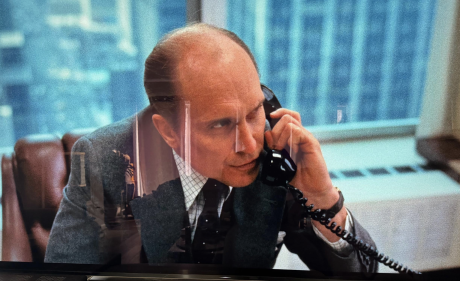
Luca Guadagnino‘s exceedingly thin thatch looks naturally pleasing and fine all around, but Bing
Crosby‘s mostly hairless crown always looked like a bad idea. Surely Crosby knew that and yet he rarely wore a rug. Why was that?

Please Don’t Inject This Gloom Into My Head

With all due respect, I really, really don’t want to watch a film about George Clooney withering away from the plague condition known in certain circles as “Al Z. Heimer.

Ditto Annette Bening, playing Clooney’s wife who arranges, at Clooney’s earnest request, to send him off to the next world.

First, a Clooney-type guy would never be married to a woman who’s more or less his age. (He and Bening are both in their mid 60s.) A Clooney-type guy would have tied the knot with…I don’t know, some kind of slender, 20-years-younger, dark-haired, uptown fox.

Second, I might accept or find some way to tolerate Clooney arranging for Bening to buy the farm, but not the other way around…please! Bening has played several morose, beaten-up characters over the last couple of decades, but Clooney is too slender and vital…too much the bon vivant smoothie. He’s Jay Kelly!

Third and finally, this Paul Weitz project is obviously (dare I say nakedly ambitious?) awards bait.

I don’t want Clooney or Bening to die. I want them to…I don’t know, fall into an adventure of some kind. Drive down to Central America and then Venezuela out of boredom and maybe get involved in the drug trade for extra cash. Okay, I’ll accept an accidental death (eaten by a shark?) but no Keverkorian action.

Coarse Hit Job

Even the matinee-handsome JFK, arguably the most attractive Oval Office resident in U.S. history…even JFK was impressionistically presented as some kind of hulking Quasimodo figure for a 1962 Time magazine cover. The painter was Pietro Annigoni.

Anyone can look diminished or even grotesque if captured by the wrong painter or snapped from the wrong angle.

I’m certainly no Trumpalo admirer or defender but he’s obviously been torpedoed by Time’s photo editors. They wanted him to look like a balding, Porky Piggy, saggy-faced animal and they certainly achieved that result.

With all his dough Trump could have easily taken care of his neck wattle problem. My Esthe Plastika Prague guy could have fixed him right up.

Accepting But Mystified

A few days ago I agreeably chatted with a nice, friendly, 50ish Connecticut woman about…well, not much but briefly about films.

She and her husband are hardly movie hounds, she confessed. They watch a lot of sports. “So no films at all?” I gently inquired. She said they’ve enjoyed streaming Tulsa King, the Sylvester Stallone / Paramount + series. (My interest in continuing our conversation dropped precipitously after she said this.)

I asked if she’s seen Anora, 2024’s Best Picture Oscar winner. She not only hasn’t seen Sean Baker’s edgy Russia-Brooklyn comedy, she told me, but before I pitched my question she’d never even heard of it. So much for the influence of the Academy Awards.

Repeating for posterity: Before her encounter with the living, breathing embodiment of Hollywood Elsewhere, this gracious, soft-spoken woman had never once HEARD of Anora.

She and her husband have, however, not only heard of but watched Edward Berger’s masterful Conclave, which is HE’s second most admired 2024 film (right after Anora). Alas, they zoned out and turned it off after an hour or so.

Whoa. I said “okay” to indicate that there’s nothing wrong or worrisome about not liking this or that film. But the silence that followed this admission — the silence between us, I mean — was deafening.

I was going to suggest that she and her husband might enjoy seeing Sentimental Value when it opens in November, but after considering their lack of rapport with Conclave I thought better of it.

Anyone Who Says This Or That Movie “Changed My Life”

…is buying into a fairly silly or pretentious idea.

What exciting movies do to young, impressionable types is often a combination of three things. One, they turn on a light bulb. Two, they light a fuse and, if the impressionable youth is lucky, ignite a spiritual chain reaction. And three, they inject you with one of those “aha!” or “eureka!” realizations (i.e., “wow, really good films can reach deep inside and amount to much, much more than just entertainment”).

Okay, I’ll share a “changed my life” reaction to a film. The explosive, cannonlike sound of the six-shooters in Shane, which I saw on a sub-run, years-later basis at some kiddie matinee when I was nine or ten. I had never heard that kind of primal roar from any machine or device or living thing before. It shook my soul in a way that never quite left my system or even faded.

Model Veronica Webb in Hofler’s book:

I Am Sorta Kinda Max Von Mayerling

In Billy Wilder Sunset Boulevard (‘50), the regal, curiously old-world, organ-playing, stiff-necked Max von Mayerling (Eric Von Stroheim) is not just Norma Desmond’s chauffeur. He is also her ex-husband and a once-powerful Hollywood director.

In the 1920s and early ‘30s Stroheim himself was a major, auteur-level Hollywood director (Greed The Merry Widow, Queen Kelly), which is why the snickering, smart-assed Wilder cast him as Max — a “wink wink” meta thing.

Like Von Mayerling, Von Stroheim’s imperious manner, exacting standards and creative arrogance had led to his being elbowed out of the elite circles of Hollywood power before he was 50.

I was never a filmmaker, of course, but I was undeniably an influential and consequential industry reporter and freelance commentator, print-wise, in the ‘90s, and then I became a major columnist, opinion-monger and “Oscar whisperer” when Hollywood Elsewhere took flight in ‘04 until…oh, roughly ‘21 or thereabouts, which is when I was Twitter-torpedoed by the Stalinist wokezoids, and by the femmebot-trans contingent in particular.

I hadn’t “done” a damn thing — it was all about my not-woke-enough or anti-woke views and opinions.

The 2025 version of HE is just as perceptively snap-dragon and on-target and lusciously well-written as it was in my Clinton-Bush-Obama-early Trump heyday.

But supplemental-income-wise I have become, in a sense, a Max Von Mayerling variation, chauffeuring Fairfield County swells to the four NYC-area airports while radiating a certain worldly, “oh, I’ve been around and done a few little things in my time” mentality or attitude, although always with a wink and a smile.

On top of which after his fall from grace Max Von Mayerling wasn’t a well-read, Bhagavad Gita-fortified columnist who annually attended the major film festivals (Cannes, Telluride, Venice) by way of crowd-funding and the kindness of certain friends.

In a certain light I’ve sorta come full circle. The first really cool job I ever had was driving for Checker Cab in Boston (’70s), and all the while I was a secret genius.

Von Stroheim never accepted the humiliation of becoming his ex-wife’s chauffeur, but he certainly suffered an industry-mindset comedown in the ‘30s, ‘40s and ‘50s. He was only 72 when he died in 1957.

Son of Sullivan Travels (i.e., Keaton Inspired)

Posted seven and a half years ago:

Most of yesterday afternoon was about hiking in Sullivan Canyon, a leafy, horse-trail community just west of Mandeville Canyon.

We defied the posted warnings and parked on Old Ranch Road, about 1/2 mile north of Sunset. We walked up a cloppy horse path to Sullivan Canyon trail, which goes on and on. By the time we were back to the junction of Sunset and Old Ranch we’d hiked five miles.

We also checked out Diane Keaton’s super-sized, industrial-chic home, which was written about last October in Architectural Digest. Keaton also published a book about it — “The House That Pinterest Built.”

We only scoped out the exterior, of course. It’s magnificent and exacting, so beautifully textured and all of a piece in so many ways, but at the same time (here it comes) so immaculate that it feels more like the workspace of an enlightened, forward-thinking company (it reminded me a bit of J.J. Abrams‘ Bad Robot headquarters) than what most of us would call a “home.”

Homes need to feel imperfect and lived in and just a little bit ramshackle — a tad sloppy and messy with the scent of white clam sauce and sliced lemons, and maybe a hint of cat poop. A good home always has magazines and books and vinyl LPs all over the place, not to mention flatscreens and blankets draped over couches and at least three or four cats and dogs hanging around.

Keaton’s place might feel homier inside, but the exterior seems a bit too precise.

Oh, and there’s hardly any tree-shade in the front yard of Keaton’s place. Warren Beatty once said that great-looking hair constitutes 60% of a woman’s attractiveness; by the same token a great-looking home needs great trees (sycamores, jacaranda, lemon eucalyptus, pin oak) to drop a few thousand leaves and shade the place up.

6:15 pm update: I just ran into Warren Beatty and Annette Bening at Le Pain Quotidien on Melrose…honest! I told him I loved the quote about hair constituting 60% of a woman’s beauty or appeal, and he said, “I don’t think I ever said it.” Huh. “You read this somewhere?,” he asked. Yeah, I said. In an article about Diane Keaton or about her home, and just this morning. I definitely didn’t invent it, I emphasized, but I love the observation regardless.

Diane Keaton’s spacious, self-designed home, just around the corner from Old Ranch Road and exactingly designed like nothing you’ve ever seen.

Read more

Keaton’s 15 Years of Peak Vitality and Zeitgeist Communion (‘72 to ‘87)

Diane Keaton first began to pop through on stage, initially in Hair (‘68) and then, the following year, as Woody Allen’s object of demure devotion in Play It Again, Sam.

Her big-screen dramatic breakthrough, of course, was her pained and conflicted Kay Adams in the first two Godfather films (‘72 and ‘74).

And then, concurrently at first, came the six-film Woody streak — 1972’s celluloid Play It Again, Sam (not as good as the play) plus Sleeper (‘73), Love and Death (‘75), Annie Hall (’77), Interiors (‘78) and Manhattan (‘79).

Looking for Mr. Goodbar (a dud) came out the same year as Hall but nobody much cared.

Then came the final six films of the Keaton peak — Reds (‘81), Shoot The Moon (‘82), The Little Drummer Girl (‘84a bust), Mrs. Soffel (‘84), Crimes of the Heart (‘86 — an over-acted headache movie), and Baby Boom (‘87).

From ‘88 on Keaton was fine or fun or earnestly mannered or perky or bothered or flaky-eccentric in some agreeable or interesting way, but the heavyweight era was over.

Another Exercise in Mute Nostril Agony

Mary Bronstein and Rose Byrne’s If I Had Legs I’d Kick You is about miserable, gloomed-out Linda (Byrne), a weary, facially-lined, stressed-out, emotionally and psychologically gutted therapist and struggling mother of a young ailing daughter (heard but unseen until the very end)…

Call her a 40ish woman under siege…anguished to a fare-thee-well and at her absolute wit’s end…a victim of a tortured, infuriating, harrowing, one-urban-indignity-after-another gauntlet that — surprise! — assaults and saps the life force out of the audience as much as Linda if not more so.

Within the first five minutes I was telling myself “you’re not going to last through this whole thing”. But I decided I would tough it out, dammit, for at least an hour. Which I did. It was agony and I was checking my watch every ten minutes, but I made it!

In Jeannette Catsoulis ‘s N.Y Times review (10.9), she calls If I Had Legswrenching and at times suffocating”, as well as “a horror movie…a howling maternal desperation spiked with jagged humor”.

There is no humor-spiking at any point in this film, trust me. Zero.

Catsoulis also writes that “some viewers could find the movie’s relentlessness exhausting“.

Famous Steve Martin line in Planes, Trains and Automobiles (‘88), spoken to John Candy: “Do ya think so?”