Closing Credits Are Separate

The common consensus is that whatever you may think of Noah Baumbach’s White Noise, a dryly farcical ‘80s period drama set in an Ohio college town, the final sequence — an ambitiously choreographed dance sequence featuring shoppers at an A & P supermarket — is the highlight.

The sequence affirms the film’s basic theme about nearly everyone turning to all kinds of distractions (including food) to avoid contemplating their own mortality.

Though brilliantly staged, the dance number is undercut by Baumbach’s decision to use it as a closing credits backdrop. Here’s how I put it to a friend:

“The LCD Soundsystem ‘New Body Rumba’ finale could have been great if Baumbach hadn’t decided to overlay it with closing credits. I almost shouted out loud ‘Oh no!! He’s blowing it!!’

“I’m saying this because once the credits begin we instantly disengage as we tell ourselves ‘okay, the movie’s over so the aisledancing is just a colorful bit, a spirit-picker-upper…whatever.’

“If Baumbach hadn’t given us permission to disengage, the dancing could have been wild and mind-blowing in a surreal Luis Bunuel-meets-Pedro Almodovar way. It could have been a mad slash across a wet-paint canvas…a Gene Kelly consumer-orgy crescendo.

And then it could have segued into a closing credit crawl. Alas…

True Optimum Story

This morning a Geek Squad tech guy was visiting the condo. Problems resulting from competing internet systems (Optimum vs. eero) were being addressed.

The first thing the GS guy did was call an Optimum agent about establishing a bridge connection. (Don’t ask.). The street address and account # had been verified, but the Optimum agent also needed to verify the name of the account holder (Joanne Jasser) and the corresponding phone #.

The latter was provided but I told the rep that the principal’s first name was a colloquial Jody rather than the more formal Joanne. Her response: “We don’t have an account holder by that name.”

It was soon after explained that Jody and Joanne were one and the same, but until that moment of clarity the Optimum rep was ready and willing to stop exchanging info. Everything but the first name had synched. The Optimum rep was being extra precise, of course. It could also be argued that she wasn’t the brightest bulb. I’ll let it go at that.

Hanks’ Truth Bomb

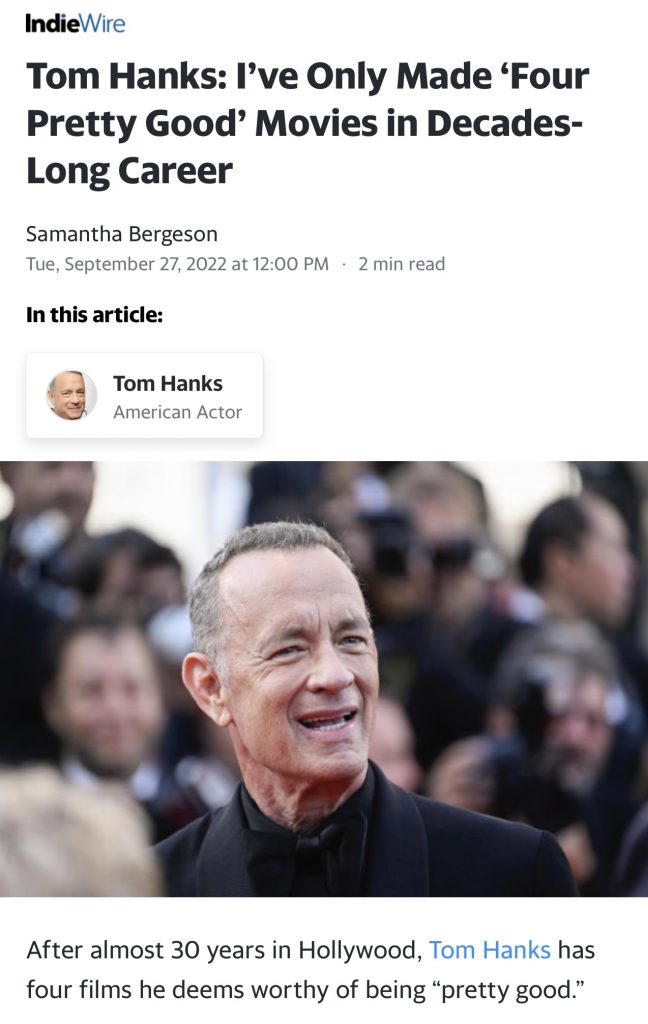
Out of 40something films he’s made since the mid ‘80s, Tom Hanks has said that only four cut the mustard. And that doesn’t even mean that the un-named four are great or A-level films — Hanks is only allowing that they’re “pretty good.”

Which films could he be referring to? I’m guessing Big, Philadelphia, Forrest Gump and Saving Private Ryan.

Road to Perdition Was Hanks’ Last Big Serious Score,” posted on 4.23.16: I would say that Hanks peaked from Splash (’84) to Road to Perdition (’02), or a run of 18 years. Okay, 14 years if you feel that Hanks’ career really took off with Big in ’88.

And yes, I would say that since Perdition luck was not really been with him except in the case of Charlie Wilson’s War (’07) and Captain Phillips (’13).

Once your cards have gone cold, it’s awfully hard to heat them up again. There’s nothing more humiliating than for a man who once held mountains in the palm of his hands having to push his own cart around the supermarket as he buys his own groceries and then, insult to injury, has to wait in line at the checkout counter. Then again he’s stinking rich.

Hanks’ finest early-career-building films: Splash (’84), Dragnet (’87), Big (’88), Punchline (’88).

Hanks’ amazing six-year, nothing-but-pure-gold period: A League of Their Own (’92), Sleepless in Seattle (’93), Philadelphia (’93), Forrest Gump (’94), Apollo 13 (’95), Toy Story (’95), Saving Private Ryan (’98), You’ve Got Mail (’98), Toy Story 2 (’99).

Hanks’ first big-time stinkera movie I’ll hate with every fibre of my being for the rest of my life: The Green Mile (’99).

Commendable:  Cast Away (’00)

Hanks’ last, best serious role after his ’90s kissed-by-God period: Road to Perdition (’02).

Read more

“Whassup, Elvis?”**

I was walking back to the car after visiting a shoe repair place on Van Sant Street in East Norwalk when all of a sudden this ruddy-faced, shaved-head guy wearing long baggy shorts is right next to me and saying the following in quick succession, like a Gatling gun: (1) “Whassup, Elvis? “, (2) “I like your shoes” and “put it there.”

A voice told me not to shake his hand, and I knew I’d made the right call when he said a second later, “Don’t wanna be friends, huh?”

I’ll shake hands with a stranger over a point of mutual agreement (i.e., “You don’t want a trans person with monster elephant boobs teaching your five-year-old? Put it there, pardner”) but I’ll never shake hands just to shake hands, especially with a skeezy guy.

This really actually happened around 3:15 pm today.

** He didn’t actually say what I said he said. He actually said “whass goin’ on there, Elvis?” I didn’t like how that looked as a headline so I shortened it. Then the lie began to burn through my soul.

“Watch The Skies”

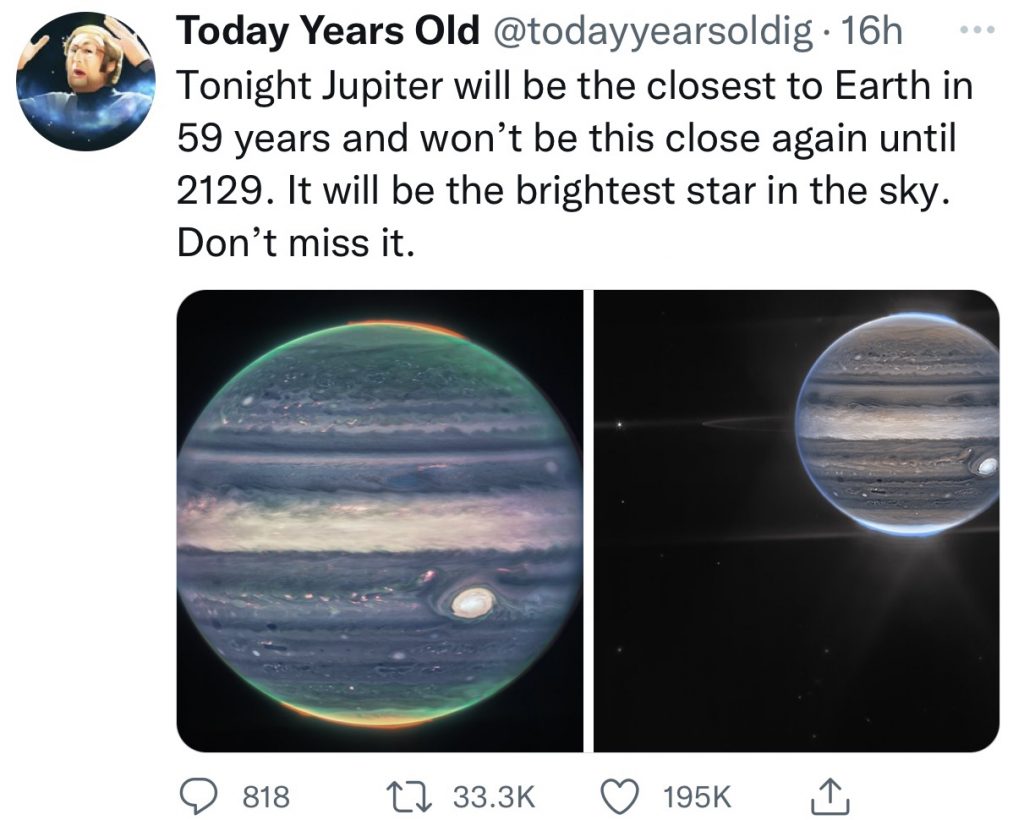
At least once a year I stare at the night sky and think of all the hundreds or thousands of intelligent civilizations living on hundreds or thousands of planets out there. Tonight is one of those nights.

Note: This doesn’t change HE’s negative opinion of Jupiter, a pretentious gas planet that you can’t even land on. I used to think of Jupiter as the home of the 2001 black monolith as well as the site of Dave Bowman’s 18th Century condo. No longer!

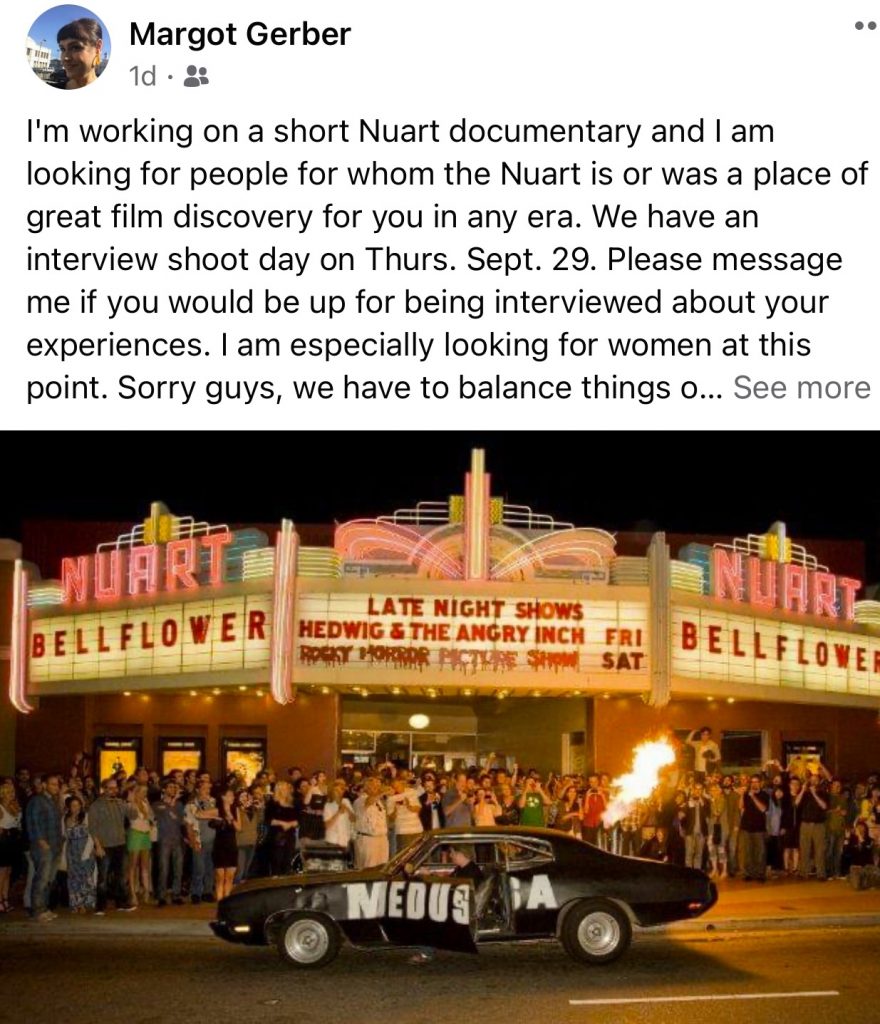
Haven’t Been to Nuart In Years

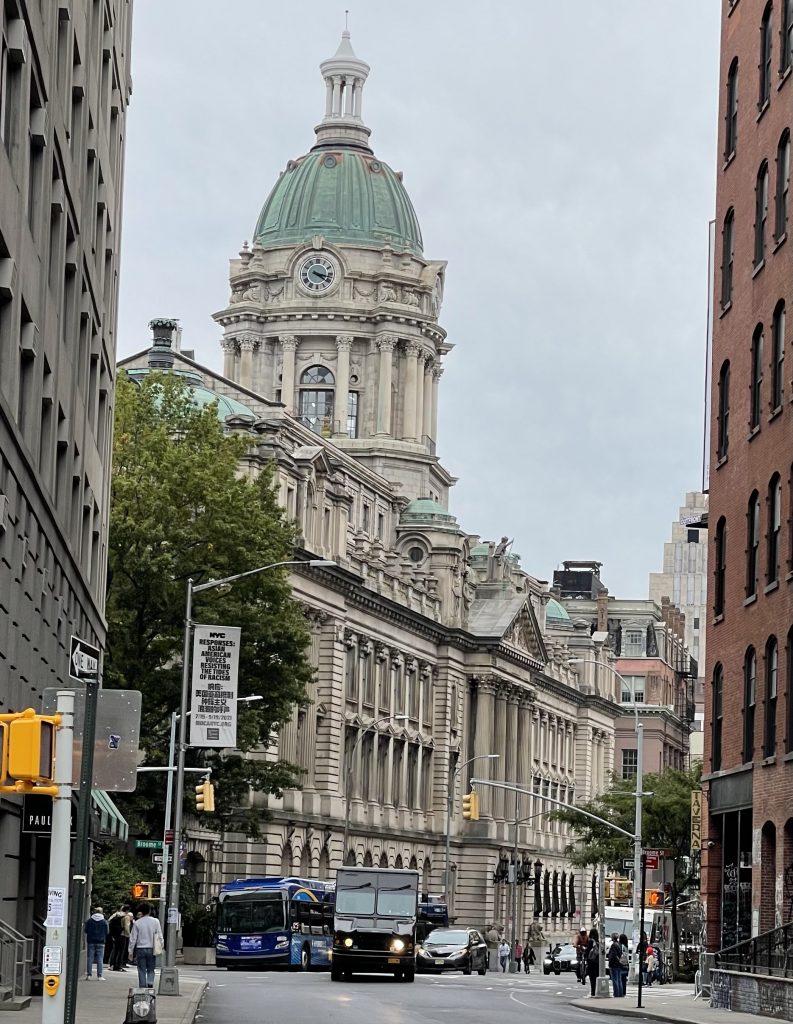
To me the Nuart has always been the West Los Angeles version of the Cinema Village — a certain storied, neon-marquee, down-at-the-heels atmosphere but never a theatre to get excited about attending, much less write home about.

If you ask me it peaked in the ‘70s and ‘80s, which many regard as the summit of L.A.’s arthouse era (Fox Venice, Beverly Canon, LACMA’s Bing, the varied Laemmle westside showplaces).

From a presentational or impressionistic viewpoint, the Nuart has always been a bowling alley-slash-quonset hut with a smallish screen.

My last viewing at the Nuart was the restored Becket (Glenville + O’Toole + Burton). The quality difference between that subdued, somewhat murky-sounding presentation and what this 1964 film undoubtedly looked and sounded like in big-city, first-run bookings, not to mention the first-rate Bluray….forget it, man.

The best aspect of the vaguely grubby Nuart is still the pinkish-red neon marquee, and even that isn’t what anyone would call spectacular. Okay, maybe I’m being too harsh.

Read more

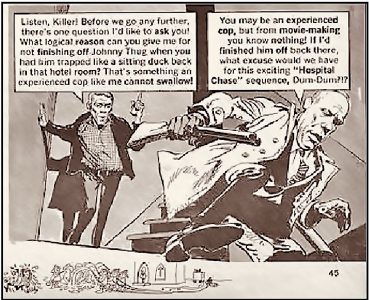
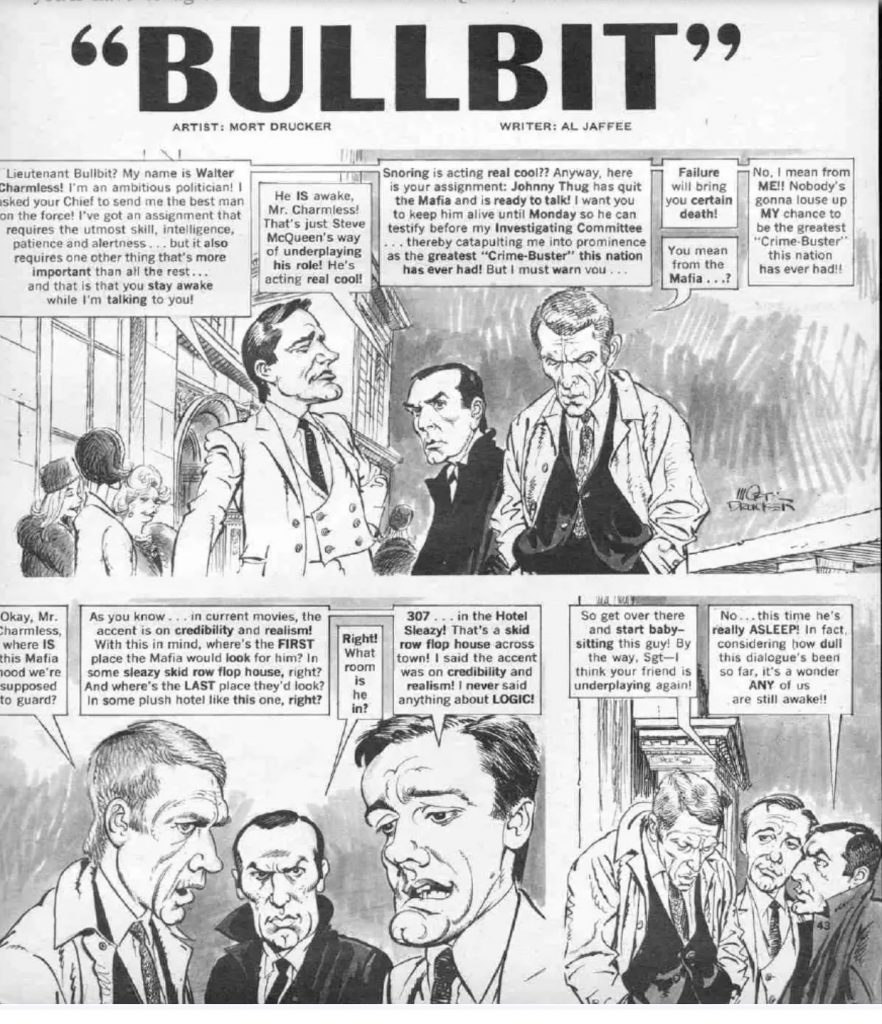
HE Movie Logic Question

…posted by Mad Magazine in a June 1969 issue. I’ve never written about the flophouse “hit” scene in Peter YatesBullitt (‘68). A professional assassin, armed with a pump shotgun, nonsensically fails to do the job. Written by Al Jaffee, drawn by Mort Drucker .

Holdupski on Mendes’ “Empire”

This morning “Rosso Veneziano” dismissed Sam MendesEmpire of Light as a “panned” film, at least in terms of its award-season potential.

HE response: “Empire of Light is my idea of a sublime and deeply moving yesteryear film, and is exceptionally well acted. There was no question in my mind that it was an authentic, emotionally fine-tuned masterwork after I saw it at the Herzog. It seemed “just right” in so many ways.

“As a study of a few characters living smallish lives in a somewhat isolated English coastal village in 1980 and ‘81, it recalls the complex textures of another tale of small-town characters, some of them grappling with sexual matters and with a certain movie theatre occupying an iconic space in their lives — Peter Bogdanovich’s The Last Picture Show (‘71).

“A few wokester fanatics panning Empire of Light in Telluride (vigilant defenders of Black identity and dignity, they didn’t care for the curious but affecting inter-racial romantic rapport between Olivia Colman and Michael Ward’s characters) doesn’t mean shit.

“Critics are truiy their own species these days, living on their own politically-attuned planet. Eternally fickle and excitably hair-trigger, they often seem divorced from and in some cases contemptuous of Average Joe perceptions about this or that film, and particularly those, it seems, that have explored racial situations or narratives. (2018’s Green Book being another example.)

More than any other time in cinema history, today’s elite critics are, to a large extent, living for and within their own realm.

“There are noteworthy exceptions and honorable outliers, thank God, and I’m not saying the elite critic cabal is entirely untrustworthy, but in the matter of films that either touch upon or seriously explore the holy woke covenant (race, gender, sexuality and whitey-very-bad), they’re never been more unreliable than today.”

Friendo: “I dunno. I’ve spoken to folks who don’t like it, and they didn’t seem to be coming from a woke perspective.”

HE to friendo: “They’re not ‘wrong’ but they’ve allowed themselves to be triggered by the romantic inter-racial dynamic. If Michael Ward’s character (who is only slightly older than Mendes’ age was in ‘80) had been white, the same know-it-alls you’ve spoken to would be much more accommodating. Then again the film wouldn’t stand out as much, of course, if Ward’s character had been a pale-faced Mendes stand-in.”

Bottom line: If you’re dealing with a Black lead character, a director-writer has to play his/her cards in exactly the right way or the elite critics will scold to no end.

Mendes casting Ward as a generational stand-in for himself seemed, at first, like a fashionably woke gambit before I saw it. But the writing and the acting and the overall quality factor won me over. I melted. And Ward is so charming and good-looking.