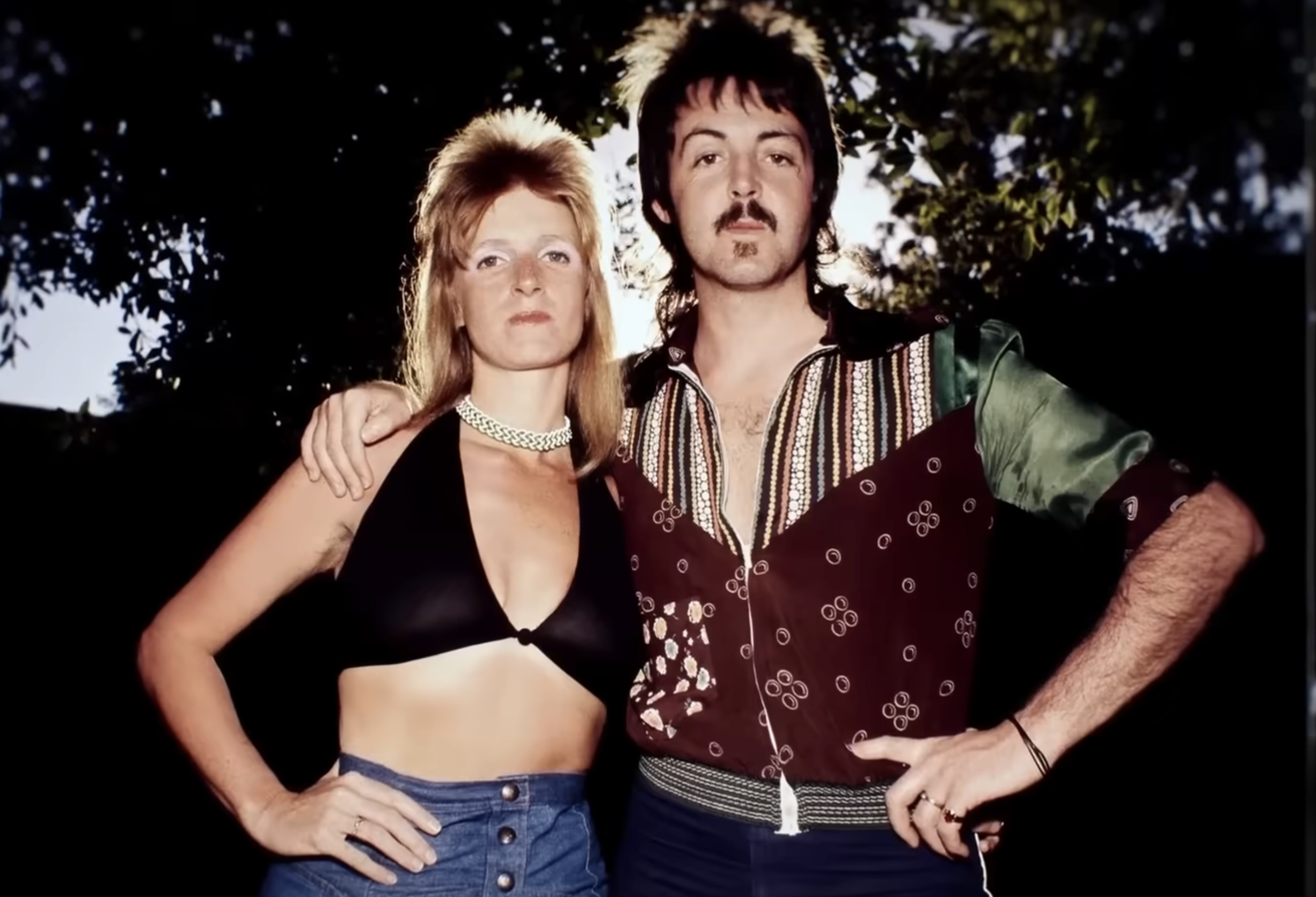
The mere sight of those awful rooster-and-mullet ’70s hair stylings sends me into a spiritual tailspin.
The only song from McCartney’s ’70s era that I really kinda like (don’t put me down) is “Bluebird.”

 Jeffrey Wells
I respect Otto Preminger and George Bernard Shaw‘s Saint Joan (’57), but I’ve only seen it once and that almost certainly means something. I feel the same way about the Preminger as I do about Victor Fleming and Ingrid Bergman’s 1948 version of Joan’s tragic saga, which is to say “yes but…” Two years ago I described Carl Dreyer‘s The Passion of Joan of Arc (’28) as a lapel-grabbing, no-way-out masterpiece.
The one aspect of the Preminger that I really love and swear by is Saul Bass‘s poster art. Within its own realm, it’s a better thing that the film itself.

Tatiana Siegel:
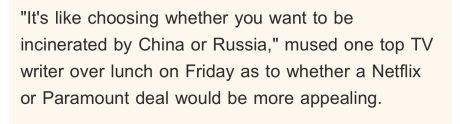
HE sez: But at least, given that Netflix has never had the slightest interest in supporting theatrical exhibition, the Ellison win signifies a slightly more earnest commitment to brick-and-mortar cinema. (Right?) Plus Ellison isn’t a rabid wokey and seems to believe in sensible centrism, which indicates (to me at least) that real, reality-embracing, non-woke movies might have a greater shot at emerging. If nothing else the Ellison win means that the final nail in the coffin of the woke terror era (2017-2024) has been slammed and driven into wood.
James Cameron about a week ago:

I could listen to “Nothing Man” over and over for the rest of my life. Nothing he wrote or recorded before or since feels so grounded, so shorn of artifice, so unconcerned with the usual concerns of a songwriter-performer.
I don’t remember how I felt, I never thought I’d live
To read about myself in my hometown paper
How my brave young life was forever changed
In a misty cloud of pink vapor
Anyone who pays to see Scream 7 has something really and truly wrong with them. They are lowering themselves into a vat of raw sewage.

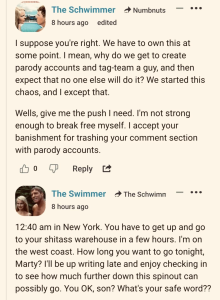
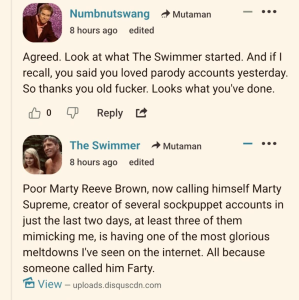
Over the last several months HE hasn’t necessarily agreed with the actual human commenter called “Marty Reeve Brown“. Certainly not chapter and verse. I am not a rightie, Lord knows, but I am a sensible centrist. MRB is clearly Trump-adjacent, or at least is a militant independent libertarian of some kind. On the other hand he seems…well, mentally disciplined. He mostly seems focused on argumentative particulars.
Plus MRB is blessedly not part of the psychotic, reality-denying, virtue-signalling, wacko progressive, Sinners-embracing, trans-celebrating, pearl-clutching wokey fuckface brigade, which is a reasonably fair characterization, I feel, of many HE commenters. (I’m not referring to the highly respected Kristi Coulter…she’s fine.)
It is widely acknowledged that the HE comment boards represent a rough-and-tumble environment, one that certainly reiterates the cliche about “if you can’t stand the heat, get out of the kitchen.”
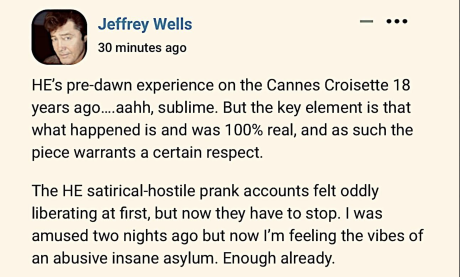
But the emergence of hostile satirical-imposter accounts over the last 48 hours changed the game, and then the atmosphere. At first I was lightly amused by the free-form imagination that went into the anti-Marty rants…I told myself “this is unruly but it also feels like an LSD trip…okay, one that’s turning weird but at least it’s trippy. It feels like 10-year-old kids goofing off in the classroom when the substitute teacher has gone out.
Then the air got thicker and thicker. The anti-Marty malevolence piled upon itself, layer after layer. Hostile pisshounds trashing MRB by pretending to be Frankenstein monster mutations while adopting hostile personalities, etc. And then MRB responded in kind by apparently creating his own counter-persona, one that trashed the persons who were trashing him…this site is devolving into chaos!
It’s all too much, man. Cease and desist. Go back to your respective rhetorical corners and try to adhere to common-man reality.
I guess I have no choice but to block the giddy fakers.
?


 ,/p>
,/p>
This is awesome 😎 pic.twitter.com/catUSFopzX
— Gandalv (@Microinteracti1) February 26, 2026
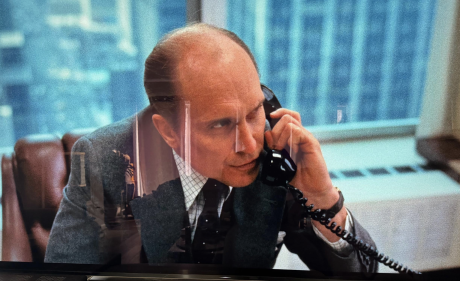
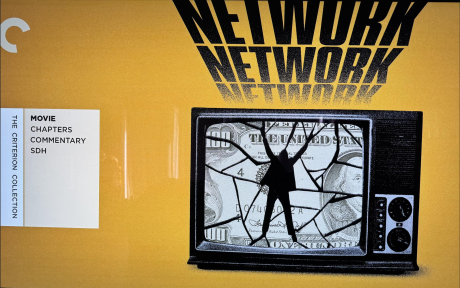
I’ve just watched Criterion’s 4K Network disc, and I wanted so badly to trash it on the basis of an alleged teal-poisoning. I wanted to do a full Eyes Wide Shut-style meltdown and scream bloody murder, but I can’t do that. Because it’s not that bad in this regard.
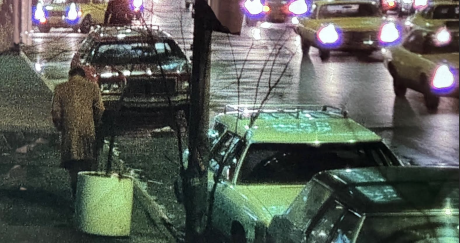
90% of the Network scenes are office interiors, and there just isn’t a teal problem indoors. Outdoors you can spot extra tealing but it’s not hugely bothersome.
Yes, the Criterion is a tiny bit more teal-toned than the 2011 Bluray version, but not overwhelmingly so.
The truth is that the 2011 Bluray (which I re-watched this morning along with the 4K) is itself slightly teal-toned in terms of the outdoor street footage, so it’s not a big deal. Yes, the 4K is more color-saturated than the 2011 disc. That’s the only real difference between the two, really. The color on the 2011 disc is less luscious, but the details seem a tiny bit sharper than the Criterion…just a wee bit. My face was right up against the 65″ screen.
Honestly? I don’t think Criterion’s 4K Network disc is all that special or revelatory. It’s pleasant to look at, sure, but it certainly didn’t blow me away. Let’s let it go at that. If you want to spend $35 or $40 on a new Network disc that doesn’t represent a huge visual bump, be my guest.
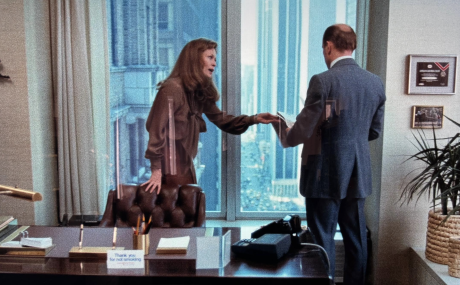

Hillary Clinton is testifying before the Congressional Epstein committee right now, but on a closed-door basis. What’s she gonna say? Nothing. Former president Bill Clinton will occupy the hot seat tomorrow. House Oversight Committee Chair James Comer, a Kentucky Republican: “We’re going to release the transcripts and release the video as soon as everyone approves it.”

The only good cookies are the 80% chewy, semi-soft kind. Or at least the ones that don’t explode like a hand grenade when you bite into them, crumbs and confectioner’s dust showering down upon your shirt or pants and littering the virgin floor.
Cookie manufacturers who make hand-grenade cookies should be fined if not cuffed. They know what they’re doing — they know what kind of ingredients and what kind of baking protocol produce semi-soft chewies. They know what people like and they churn out grenade cookies anyway. And you know what? They’re public enemies. Truly bad people.
James Cagney in One Two Three (‘61): “I wish I was in hell with my back broken. If I was a third-rate cookie maker, I mean.”
The good kind:

“Wanderer”, posted on 5.13.08:
I woke up at 4:30 again this morning and did my usual, which is to go to the Carlton lobby and use the free wifi there to do some work. On the way over — it was about 4:55 by this time — I walked by a small, dimly-lit club packed with the usual vampires. You could hear the cheap music blaring two, three blocks away.
And right next to the Carlton yet! Are they keeping Sean Penn up? If I were Penn and the music was keeping me up, I would walk down to the club and spit in the doorman’s face.
Hardcore criminals, pearl-clutching wokeys** and sociopaths excepted, is there any lower life–form than clubbers? Drinking and jabbering and hitting on people you want to go to bed with for six or seven hours straight. Indiscreet, loud, coarse.
If you haven’t gotten lucky by midnight or 1 am at the latest, go home and get a good night’s sleep.
A couple of assholes were walking down a dark street near my place — guys who’d obviously been at it all night — and they were talking so loudly you’d have to call it shouting. No respect for the time of night or people sleeping nearby or for God’s general rule, which is that only the aimless and the Godless prowl around in the wee hours.
Walking west on the Croisette a couple of minutes later I heard an American guy say to a couple of friends, “I can’t fucking believe you…300 for a lap-dance?” (That would be $450 US if he was talking euros.)
I ran into an unattractive prostitute with big feet a minute later. She offered the usual enticements. “What I really need is a bottle of water or a can of Coke,” I replied. “You know where I can get that?”
I was feeling thirsty, dehydrated. A door man at the vampire club wouldn’t let me in to buy a Coke or a glass of Perrier. “You won’t let me in for two minutes in so I can buy some water because I’m thirsty?” I said to him. What a dick.
I finally managed to talk the night clerk at the Noga Hilton into selling me a large bottle of Evian. It cost 10 euros or $15 U.S. This town is dangerous.

Return of “No Hugs, Sorrows, Laments — I Prefer Jerry the Flinty Prick“, posted on 8.2.16:
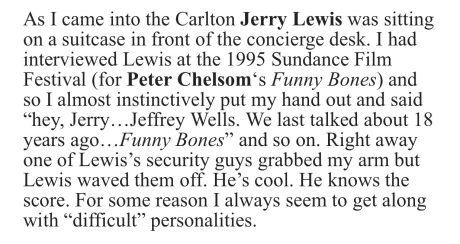
Lewis excerpt from 1995 Sundance Film Festival interview: “I sat down with Jerry Lewis to talk about Funny Bones. The interview happened at the Stein-Erickson. Right away you could feel the testy fear-factor vibe, but I enjoy that as it sharpens your game. Several people (publicists, etc.) were sitting and standing around us in a semi-circle. It was almost like we were performing.
“All through our relatively brief chat I was thinking ‘shit…Lewis is in a testy mood and it might get testier. But he won’t respect me if I ask kiss-ass questions so fuck it…I’m just going to look him in the eye and talk straight from the shoulder.’
“A year or two earlier I’d read and enjoyed Nick Tosches‘ Dino: Living High in the Dirty Business of Dreams, so I asked Lewis if he’d read it. He had, he said, and I knew right away I’d stepped into it. The book was hurtful to a friend, he said, and that was the end of it. ‘Ask me something else,’ he said, steam literally hissing out of his head like a radiator, ‘before I get pissed.’ Before?
“But I liked Lewis overall. He’s tough, shrewd, funny, been around, done it all, seen it all.”
“What I’d really like to see is a story of 90-year-old Jerry Langford, the late-night talk show star who was kidnapped by Rupert Pupkin back in the early ’80s. Jerry is semi-retired but still plugging away, involved in real estate and other ventures, still playing golf, still on the cryptic and blunt side, still disdainful when the occasion requires and is no one’s idea of a gentle or lovable fellow.
“And yet he’s largely unbent and, for an old guy, still full of beans. And he’s nice with kids and dogs.
“Does ‘mean’ Mr. Langford feel badly about still being flinty and not all that considerate with each and every person he deals with? Okay, maybe, but he’s ecstatic about the fact that he’s alive and crackling and living a pretty good life for a guy born in 1926. He’s on Twitter and Facebook and owns over 400 Blurays. And he has a 79 year-old girlfriend that he “puts it to” every so often (i.e., extra-strength Cialis), and he rides a bicycle and walks two or three miles every day and lifts weights.
“Who needs love, kindness and forgiveness when you’ve got your health? Langford pushes on!”
Posted from 2013 Cannes Film Festival: