Nobody Wants To Remember

…and the Charlie’s Angels hey-hey peaked 45 years ago so it doesn’t matter to under-40s or anyone else for that matter, but my God, that show was beyond reprehensible in its absolute disregard for even a semblance of realism of any kind, and its general embrace of sterility/puerility. It was Velveeta, and that didn’t stop anything. It ran between ‘76 and ‘81.

If only Aaron Spelling had instead produced Quentin Tarantino’s Fox Force Five. Ironically, I mean. With QT- level dialogue.

Marlowe In A Pot Haze, A Bit Lazy and Distracted But Going Through The Motions

I stopped getting high in 1974, and that decision came none too soon. It was time to get real and focused and stop farting around, and try to make movie journalism happen.

It took another five or six years to find my feet in that regard, but that’s writing for you — unless you’re a genius (which I’m not) it can take as much as a decade to become even half-proficient at it.

Robert Altman’s The Long Goodbye, which I’ve seen countless times, opened on 3.7.73. Film-wise the glorious ‘70s were still happening, but it all began to change in 1974, and if there’s one film from that fairly turbulent and convulsive year (Nixon resignation, close to the end of the great ‘70s film era with Jaws and Star Wars right around the bend, not to mention the beginnings of disco and punk) that has genuine staying power, it’s this one — a year ahead of schedule.

Altman was a serious pot-head, of course, and his hot-streak films (late ‘60s to late ‘70s) reflect that proclivity as well as the times — deconstructing, alternating, exploring, goofing off and playing it by ear.

The difference on my end was that in ‘73 I was starting to think about shirking all that and cleaning out all the closets. So I wasn’t really on Altman’s wavelength, and yet I love The Long Goodbye for all the ways that it captured in amber what the early to mid ‘70s felt and sounded and smelled like.

Altman’s primary motivation wasn’t to deride and dismiss Raymond Chandler’s hard-bitten shamus. He merely decided, quite sensibly, to make a private detective film within the realm of ‘74 (counter culture giving way to Me Generation narcissism, Nixon collapse, hash brownies, sinking into cynicism, anti-traditional you-name-it) and that meant, obviously, that the 1940s version of Phillip Marlowe (as interpreted by Humphrey Bogart and Dick Powell) no longer existed and had to be jettisoned.

What took its place was something vaguely stoned and misty — dry mockery and improvisation and a laid-back Zen cat attitude on the part of Elliott Gould. It all added up to “all those hard-boiled, tough-guy cliches no longer apply…maybe they never did…everything is shifting, devolving, being re-defined.”

Altman was always about poking the bear and trying to catch the wind, and he was never into genre stuff. He may have mainly wanted to dig down and deconstruct and have fun, but he also wanted to craft a Marlowe film that would reflect and comment upon what was happening back then — culturally, spiritually, morally.

Altman called The Long Goodbye “ a satire in melancholy.”

Except for the lampooning of gangster tropes by way of those goons who work for Mark Rydell’s Marty Augustine, the satire works. Plus Vilmos Zsigmond’s constantly slow-tracking, circular-arc camera, the 1948 Lincoln Continental, the Malibu security guard with the movie-star impressions, Khoury brand cat food, “Hooray for Hollywood,” etc.

Heavily accented Mexican official: “When did you last speak with the deceased?”

Gould: “The diseased? Yeah, right.”

When She Was Hot

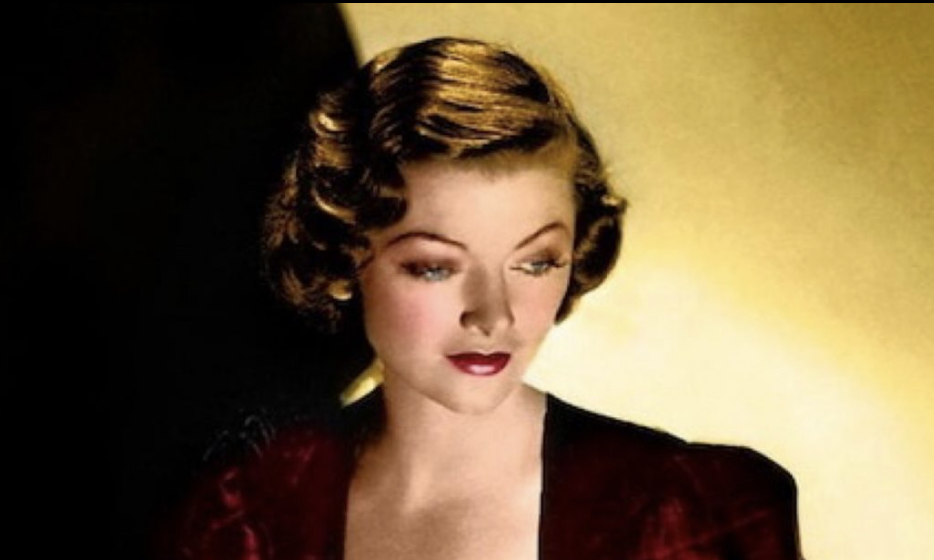
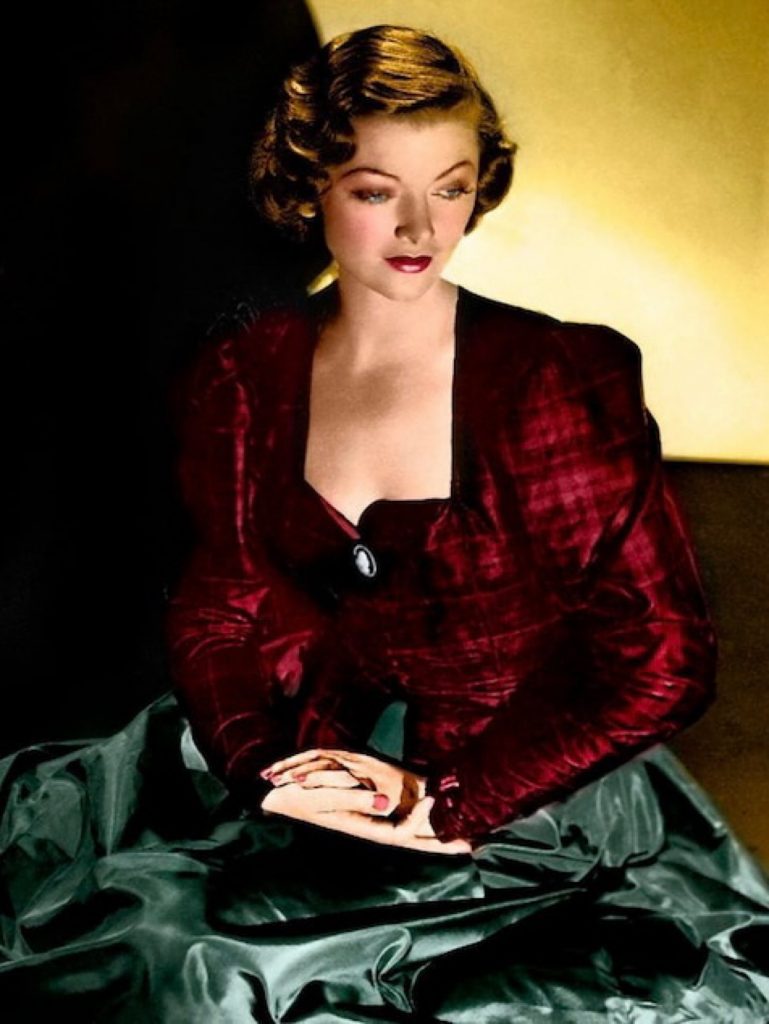
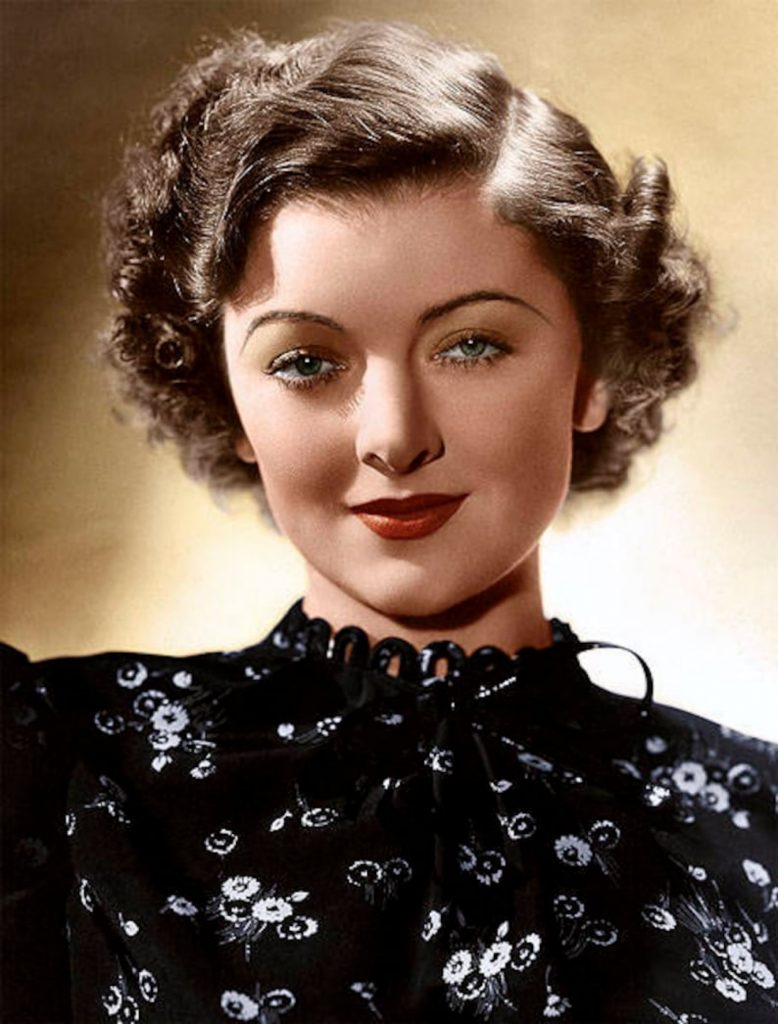
I’m not sure if Myrna Loy (1905-1993) ever gave a great performance. She shares a great “welcome home” scene with Fredric March in The Best Years of Our Lives (‘46), and is dryly amusing in a somewhat stiff-necked way in The Bachelor and the Bobby Soxer (‘47). But she was certainly in full command of a sexy exotic vibe in her late 20s and early 30s. She also gave great vibe in the Thin Man series.

Previously unreported fact: I stood five feet from the still curiously radiant Loy at a National Board of Review awards ceremony in late ‘81 or early ‘82. Ragtime costar James Cagney was also there; ditto Warren Beatty, who said something flattering about Loy — something about her beauty still making his pulse race a bit.

Read more

Slight Slap On Wrist

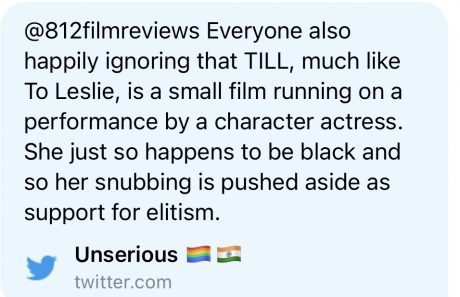
Team Riseborough (i.e., Andrea and homies) has been more or less given a pass by the Academy. Okay, Academy CEO Bill Kramer has mildly snorted but declared there will be no punitive measures.

HE friendo: “Thank God. Now she wins. Maybe.

“What Andrea really needs right now is Danielle Deadwyler going classy by telling Clayton Davis to siddown and shut up while proclaiming that Riseborough ‘shouldn’t suffer because of over-zealous friends…hell, she’s got my vote.’

“Sadly, the safest choice at this stage of the game is Michelle Yeoh. Sadly, the great Cate Blanchett has probably lost the Best Actress Oscar, and certainly her momentum.

“And that’s fine with me. I hated that film but this is is a year when older voters will turn off Everything Everywhere 20 minutes in and STILL vote for Yeoh. They can separate the two.

“Okay, ‘hated’ is a little too strong. I admired that it tried to do something unique. I applaud that in fact. I think it’s just The Emperor’s New Movie. Older voters who don’t want to be seen as dust think it’s hip.”

More Friendo: “I definitely wouldn’t have seen To Leslie without all of this happening. I’m positive I’m in the majority on that.

“What kind of stuns me is that Alison Janney and especially Marc Maron didn’t do more to push their own legitimately worthy little movie. Especially Maron whose WTF podcast has a huge following. Apologies to him if he did that but I missed it if so.

“Ironically speaking, I wouldn’t be surprised if Riseborough herself is drinking heavily these days. I would be.”

“Something Happening Here…”

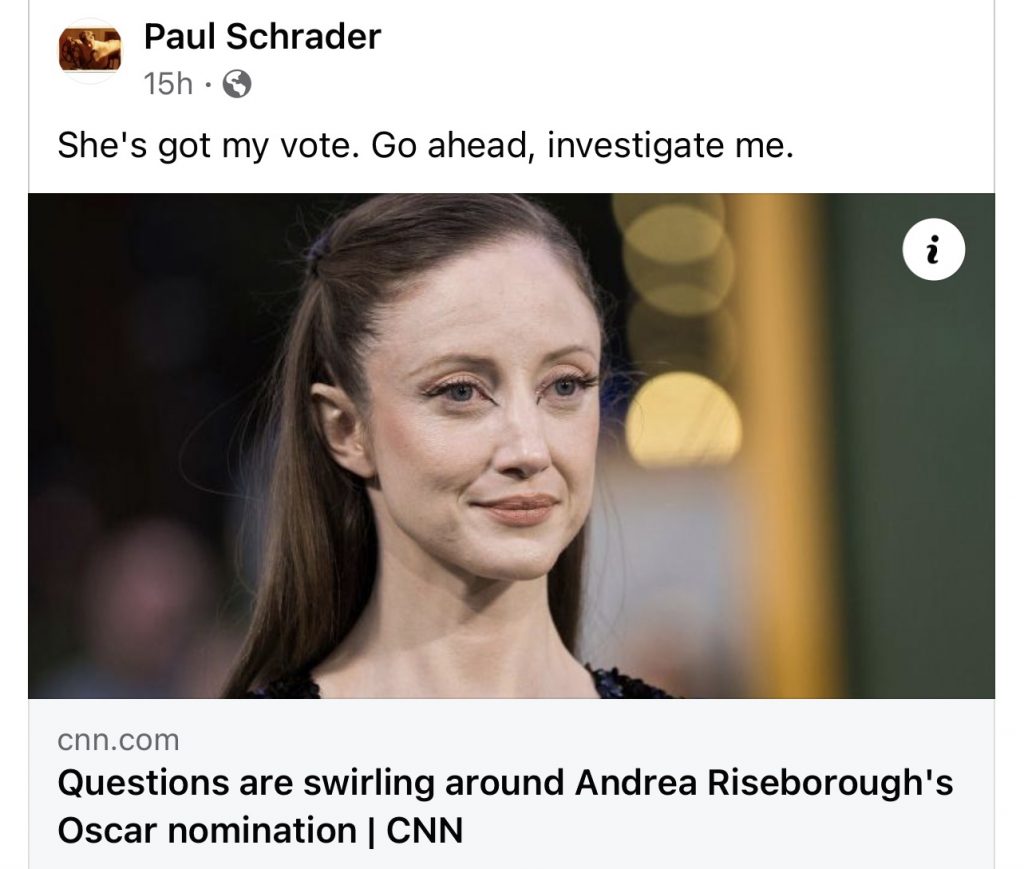
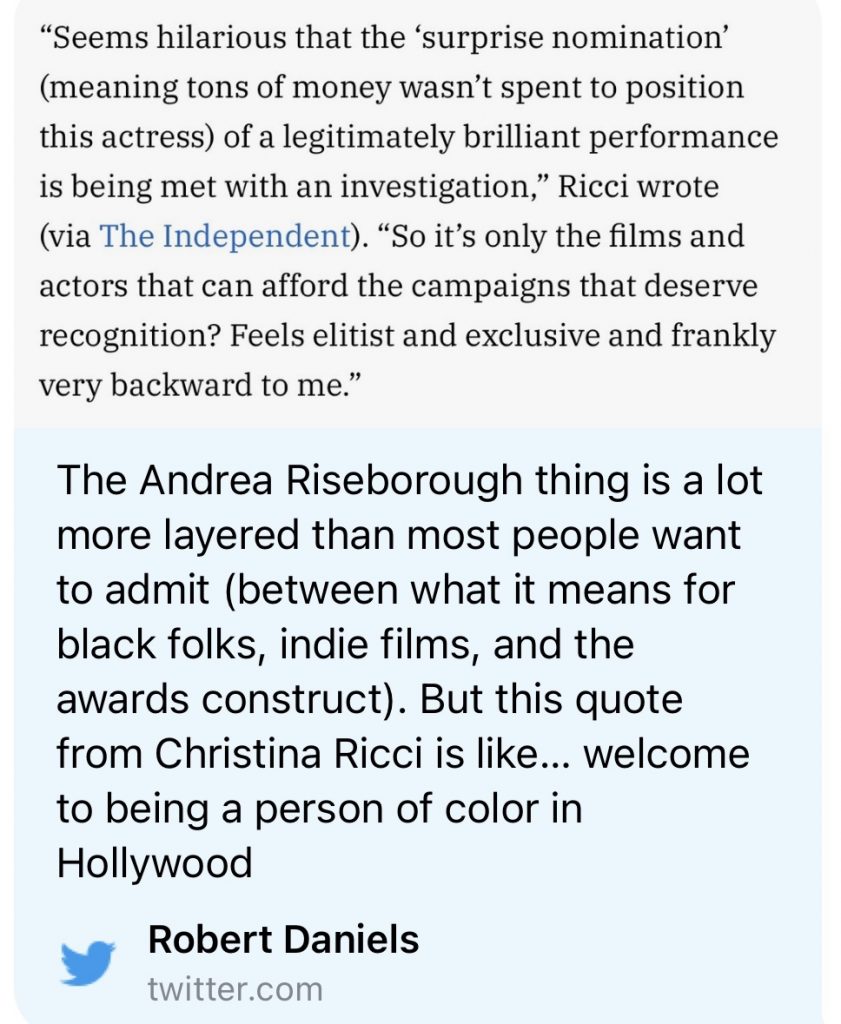
I was just as surprised by the Andrea Riseborough thing as anyone else, but to paraphrase Stephen Stills, “There’s something happening here.” Paul Schrader, Marc Maron, Rod Lurie…something has snapped.

The Academy of Motion Picture Arts & Sciences is just trying to placate the Riseborough conversation — we all understand that, no worries — but there’s an early groundswell thing happening regardless. Right here, right now.

What we’re all witnessing or at least sensing is the very early beginnings of the end of woke tyranny.

I am the groundhog — Hollywood Elsewhere is the groundhog.

Obviously the Riseborough thing (which is partially driven by the “hey, what happened to Danielle Deadwyler?” thing) and the climate of fear within film festivals are separate concerns. But they’re also linked in a certain oblique way.

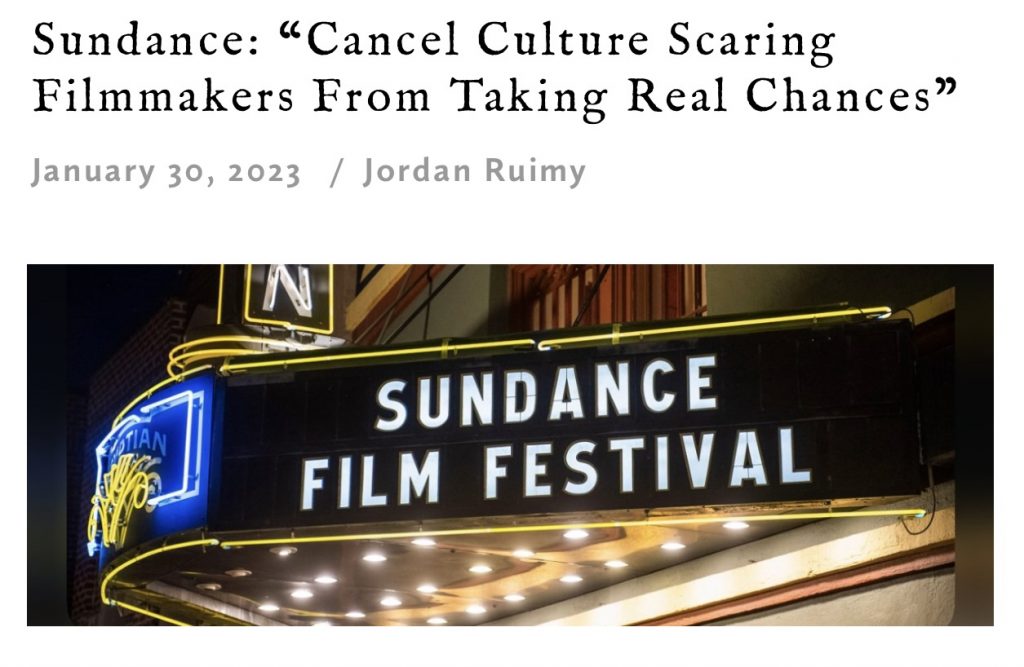
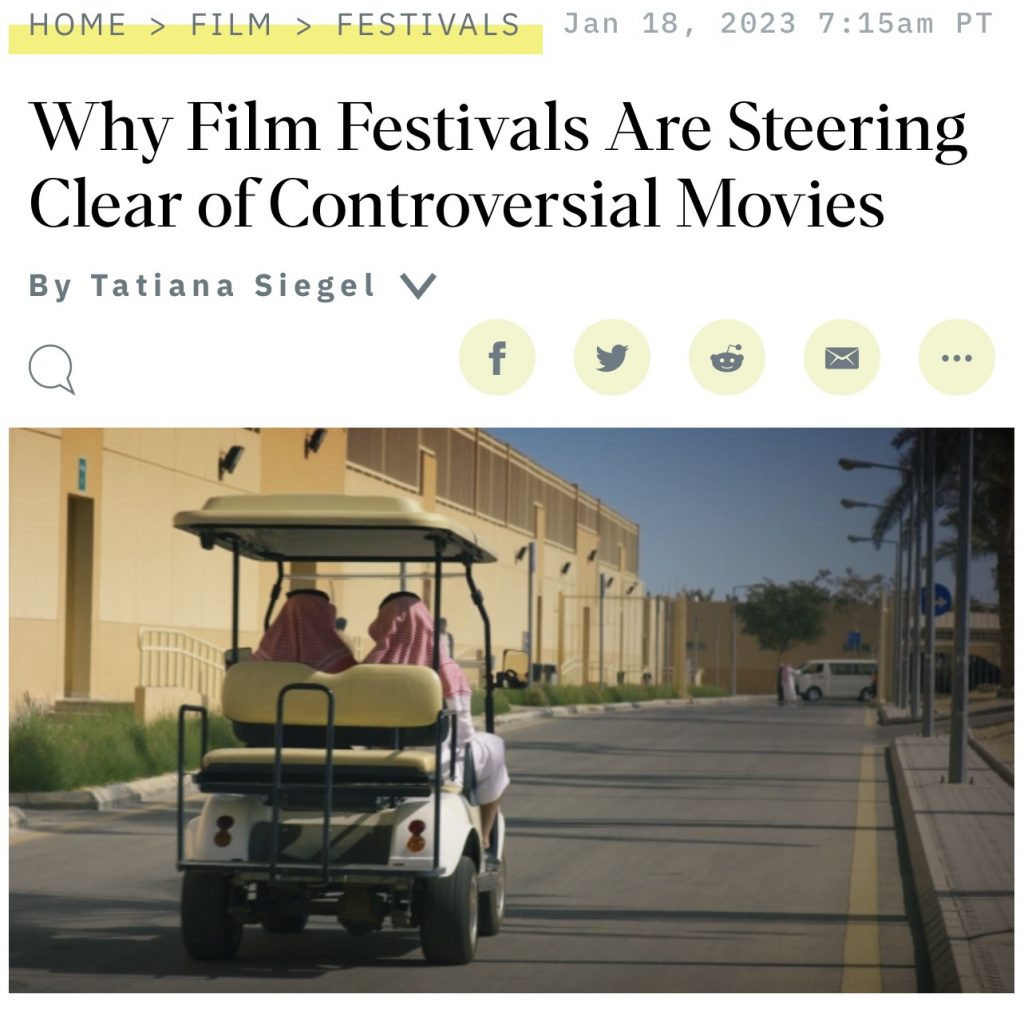
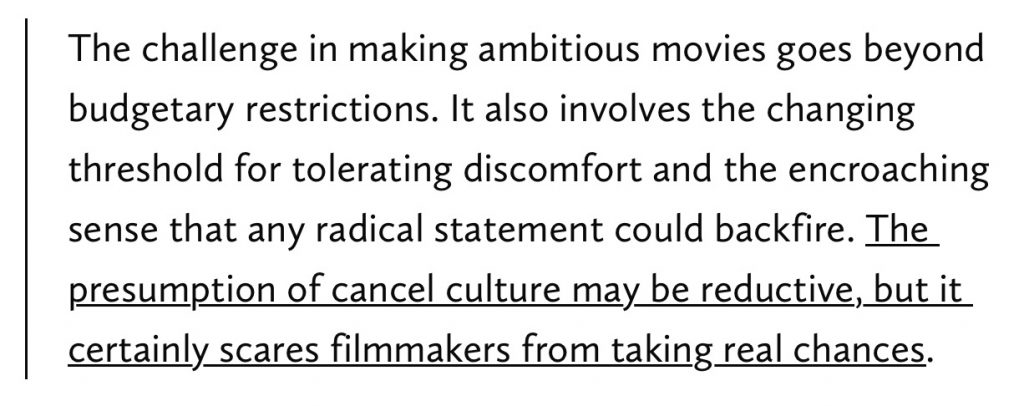
When Eric Kohn, of all people, is noting that goose-stepping woke groupthink is inhibiting artistic freedom, you know something’s up.

Go ahead and chortle if you want, but I think we’re witnessing the nascent beginnings of a Spartacus moment. It’s some kind of boiling-water, bursting-tea-kettle thing — a combination of a lot of triggers (and not all them contributing to an articulate whole) but it’s some kind of emotional socio-political catharsis that boils down to “we’re tired of this Big Brother-esque, guilt-tripping, Great Cultural Revolution, Twitter tyranny shit and we’re not gonna take it any more…fuck you!”

Remember Kirk Douglas, John Ireland, Harold J. Stone and the others yelling “aahhggh!!” as they attacked the Roman guards inside Peter Ustinov’s gladiator school in Capua?

IndieWire’s Eric Kohn, one of the original woke commissars who once challenged me about the validity of the word “woke” — he suggested it was arguably an imaginary construct used by righties — Kohn actually posted the following paragraph on 1.29.23, and this definitely means something…it means that all the cowards who raise their damp fingers to the wind before saying anything…the cowards are now asking themselves if woke fascism might need to be walked back a bit.

Journalist to Jounalist: “Can you imagine how a movie like Neil LaBute’s In the Company of Men, which premiered at Sundance in 1997, would be received today?” Such a film (a blistering critique of misogyny) wouldn’t be shown today, of course. And that’s what’s the matter.