One of Kuschnir’s inspirations, I believe or at least suspect, was Spike Jonze‘s legendary “Pardon Our Dust“, a 2005 Gap commercial.
Both use Edvard Grieg‘s “In The Hall of The Mountain King” on the soundtrack. Grieg supplies an arch, mock-bombastic air to the raucous destruction, etc.
Confession: I intend to see The Drama but I’m not sure I want to catch it theatrically. Okay, I may catch it this evening but while deliberating this I decided to ask Grok to write an HE parody review:
I saw A24’s The Drama last night at one of those smug little screenings where everyone’s pretending they’re not there to gawk at Zendaya and RTPatz pretending to be normal people having a meltdown. And this thing is a sleek, serpentine little viper of a movie, lemme tell ya. It’s cringe, all right, and it won’t let go until the credits roll and you’re left wondering why the hell you’re suddenly questioning every relationship you’ve ever had.
Kristoffer Borgli (the sick fuck who gave us Sick of Myself) has made what feels like an anti-romcom for people who’ve actually been in a real relationship.
Zendaya and Robert Pattinson play Emma and Charlie, this impossibly photogenic couple about to get married, and they’re happy…too happy. The kind of happy that makes you lean over to your plus-one and whisper, “Something awful is about to happen.”
And brother, does it ever! Without spoiling the precise nature of the “one damn confession” (though the trailer sorta kinda ruins it like a drunk uncle at Thanksgiving), the film detonates their perfect little world in ways that are by turns hilarious, excruciating, and weirdly erotic in that uncomfortable “am I supposed to be turned on by emotional carnage?” kind of way.
Pattinson is doing that patented Pattinson thing where he looks like a Victorian ghost who wandered into a SoulCycle class and decided to commit to the bit. He’s twitchy, haunted, funny as hell, and somehow still hot in the way only beautiful disasters can be. Zendaya, meanwhile, is operating on another plane. She weaponizes stillness like a sniper. One slow blink from her and you feel like you’ve been emotionally waterboarded.
The script is vicious in its precision. Borgli has an almost sadistic ear for the way people who love each other can still eviscerate one another with a perfectly timed sigh or a loaded “it’s fine.”
The supporting cast (including a couple of scene-stealing weirdos I won’t name because spoilers) are all operating at peak “A24 character actor who’s been waiting their whole life for this exact monologue”.
The Drama isn’t for the Marvel crowd. If you need your hand held and your catharsis spoon-fed with a nice little dessert served at the end, stay home and rewatch Anyone But You. The Drama leaves you raw. It’s messy. It’s mean. It’s funny in the way that real pain sometimes is when you’re watching it from a safe distance.
Zendaya and Pattinson have more chemistry arguing about whether a certain revelation counts as “technically cheating” than most couples have during actual sex scenes in other movies. I laughed. I squirmed. At one point I audibly groaned in the theater and the guy next to me (some hipster in a backwards baseball cap) shot me a dirty look like I’d violated sacred cinema space. Sorry, pal — this movie earns the groans.
Bottom line: The Drama is one of the most uncomfortably entertaining films I’ve seen in a while. It’s not perfect — there’s a third-act swerve that feels a little too pleased with itself — but it’s alive in a way most 2026 releases aren’t. Zendaya and Pattinson are giving career-high work, Borgli is a twisted little genius, and A24 continues its reign as the studio that understands that adults still exist and sometimes want to watch beautiful people destroy each other for two hours.Go see it. Then go home and stare at your partner a little too long. See what happens.
The Artemis IIapp is appreciated, but the poetic aura or undercurrent of past lunar voyages feels somehow less filling this time.
I can’t stop thinking about the reported spent–gunpowdersmell (or the scent in the air after a firecracker explosion) on the lunar surface; ditto the 96bagsofhumanwaste that were dumped by various astronauts between ‘69 and ‘72, and which are still effing lying there as we speak.**
** Would it have been so difficult to dig a hole with a plastic hand spade and bury the poop bags? I’m talking about showing respect and reverence for the purity of the lunar environment.
It was announced yesterday 4.2.26) that David Kelley is writing a miniseries version of Tom Wolfe‘s “The Bonfire of the Vanities” with Matt (LetMeIn,DawnofthePlanetoftheApes, Batman) Reeves inked to direct and executive produce.
This is a chance to properly resurrect Tom Wolfe’s great Balzac-ian novel of mid ‘80s Manhattan…sharp district attorneys, hungry journos, Harlem hustlers large and small, and the Wall Street culture of “Masters of the Universe.”
Brian DePalma’s 1990 film adaptation was a total catastrophe, of course, which is why it’s an inspired idea to remake the Wolfe book as a ten-parter. If you listen to the “Vanities” audio book it lasts for 20something hours. This is one of those rare instances in which a miniseries is the smarter way to go.
I’m confident that Reeves won’t screw this up. He’s too good of a director to follow in DePalma’s clumsy footsteps. This is a golden opportunity to translate Wolfe’s labrynthian book accurately. The Kelly-Reeves miniseries will presumably be shot in period (mid ’80s).
Reeves has always been a fan of Wolfe’s book and has long believed he could make a filmed version turn out right some day.
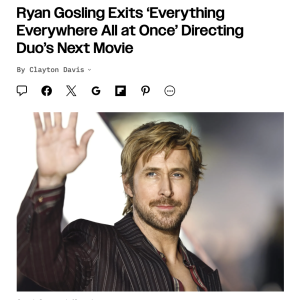
A week or so ago Ryan Gosling was anounced as the star of Daniel Kwan and Daniel Scheinert‘s next dazzling film. A week later Gosling bailed due to an alleged “scheduling conflict”…bullshit.
Variety‘s Clayton Davis: “Kwan and Scheinert, collectively known as Daniels, aimed to start filming in Los Angeles later this summer, but the production was unable to shift to accomodate Gosling’s schedule, which has been packed as of late following a lengthy global press tour for Amazon MGM’s sci-fi epic Project Hail Mary”…bullshit.
Gosling may have just saved himself from the Daniels’ “sophomore slump” effort. Okay, I don’t know if it’s a slumper or not, but I do know that an army of EEAAO haters is out there in force, and that they’re determined to get these guys one way or another, and that their luck can’t hold out forever.
Your wife will love you a tiny bit more if you go to Prague or Istanbul and (a) get that older guy, neck-wattle, saggy-faced condition taken care of (LIKE I DID 14 years ago), (b) get your hair fixed in Prague (like HE fan JOHN MILIUS did four or five years ago — he wrote me and I referred him to my hair follicle transplant surgery place in Prague), and (c) get your teeth capped or at least bleached.
Worn-down, grayish, old-looking teeth will age you terribly, and your wife will never let on because, being a kind and gentle person, she doesn’t want to hurt your feelings.
Compassionate women, bless ’em, will NEVER tell you the truth. Don’t ask your wife if you should fix yourself up. She will never, EVER be honest with you. She will gently caress your sagging neck and dropping cheeks, look you in the eye, smile lovingly and earnestly and lie right through her teeth.
You need to rejuvenate yourself for your own reasons, I mean. If you want to do this, do it and shave 10 to 15 years off your appearance.
That dreaded neck wattle can NOT be allowed to gain ground and/or proliferate. You need to defeat it the way Alexander the Great defeated Darius, that Persian king, and his ancient, spear-carrying horseback army.
You have to kind of melt into it, or wade into it like it’s the Gulf of Mexico from the Quintana Roo side. A salty lake with gently lapping mini-waves.
Either way you have to merge without the help (or really the hindrance) of all your acquired mental tools and skills and disciplines. You need to put aside the rational and in some cases judgmental constructs that you’ve been assembling for so many decades — all of those structural towers of intellectual, influential, scholastic, explorational and experience-based building blocks of your identity.
Attaining satori isn’t really about therapy or psychology (sorry, Cary) or this or that terra firma, furrowed-brow examination or rumination. It’s about stepping off a kind of misty, moss-covered cliff or, if you will, deciding that the rules, restrictions and governances that you’ve been living by are just obstructions, and that a blue-sky realm awaits.
You can’t really embrace satori without letting all that other stuff go…all of that material you’ve been accumulating and evaluating and sifting through since your early teens. None of that stuff really matters in the realm of the mystical.
What is the opposite of satori? Easy — just read the Hollywood Elsewhere comment threads any day of the week. 93% of what is posted in these oppressive threads represent an immersion into resplendent piss pools…they own these pools…a kind of snippy, dart-throwing, walnut-brained nowheresville, liquified and lemon-yellow. I realize that for some HE is a “hate read” and that’s fine, but I’m not a hater per se….I am (or am trying to be each day) an honest illuminator.
Many zoomers (1997 to 2012) are, I gather or have heard, freaked about how bruising and brutalizing the big, bad world is, and how rapacious everyone is.
Well, sorry but your helicopter parents did this to you. But there’s no percentage in blaming them or trashing them….you have to man up and brush yourself off and say “okay, that happened!” You have to somehow stand up on your own, make your own way.
“Fall down and get up…fall down and get up…fall down and get up.”
For me the most striking part of AlecGuinness‘s story about visiting Los Angeles in September 1955 to work with GraceKelly on TheSwan…the most arresting aspect is the fact that a female friend of Guinness’s tried to take him to dinner at two or three swanky industry restaurants but was denied entrance because she was wearing slacks. A Hollywood professional, a serious smartypants, a player…and they wouldn’t give her a table because she wasn’t wearing a dress. And she was accompanied by effing Alec Guinness!
When I first saw it in ’78 I thought The Fury was a fairly ridiculous film. It probably still is. I remember feeling genuinely sorry for Kirk Douglas, who was stuck with a character whose behavior made little sense. But the mad operatic finish makes up for most of the pain and frustration.
Amy Irving‘s ‘you go to hell!”…John Cassevetes‘ body blown into shards of meat, blood and bone…John Williams‘ riveting score. Only peak Brian DePalma (a period that started with Phantom of the Paradise and ended with The Untouchables) could have done this.