
Plastic Garbage Bag

Yesterday Thought Catalog‘s Brian Donovan posted an unusually perceptive, nicely phrased appreciation of Silver Linings Playbook, although it’s mainly a reiteration of what everyone (including Sasha Stone) has been saying from the get-go, which is that the film is almost entirely about Jennifer Lawrence‘s spunk.

Haters can say whatever they want but any hate-for-hate’s-sake Captain Ahab posts will be immediately killed…just saying. Here’s an excerpt:

“What makes it all work, what turns Silver Linings into the kind of movie you see once and immediately want to see again, is that despite being about sadness, the movie is never actually sad. Actually, it’s hilarious. It took me three viewings to figure out how they did it, and I think this is the secret: all the characters care. They’re passionate, mostly about achieving happiness, and so they try, despite every limitation and stroke of bad luck, to change. They usually fail, but they always try.

“So really, it’s not a film about mental illness, but a movie about people who want to get better. And who of us can not identify with that?

“You know that feeling when you’re standing at the bar, desperately wanting to talk to the guy or girl next to you, but are unable to force yourself to do it? Or staring at your gym clothes knowing that you’d ultimately be happier if you worked out, but your mind just won’t let it happen? That’s the world that this movie explores, in a simplistic sense. Obviously being bipolar is a lot more complicated and serious than being lazy, but for those who haven’t been around mental illness, that’s one way to understand it. No matter how badly you want your mind to cooperate, to do something that you know is for the best, sometimes it just won’t allow it.

“Every scene between Bradley Cooper and Jennifer Lawrence crackles with that conflict. They’re drawn to each other, it’s clear. They have too much in common, are too able to help each other not to fit, but Cooper just can’t let it be. You can see, over and over again, his mind standing in the way. Too obsessed with his pointless past to let a happy future in. The character’s motto is ‘Excelsior.’ Rise above. Improve. Excel. But he can’t ever pull it off. No matter how badly he wants to avoid a fight at a football game, he ends up with a fist in someone’s face. He clearly loves his Dad, but won’t let himself get close to him. And Lawrence, who’s so obviously his salvation, he dismisses as long as he possibly can.

“And when the movie takes off, the scene where it becomes irresistible, is when Lawrence says ‘Fuck this, I’m taking over, I’m fixing everything right now.’

“Without giving too much away, I’ll say this. There comes a moment two-thirds of the way through the film when all is lost. Cooper’s father, Robert DeNiro, is on the verge of a gambling catastrophe, Cooper seems to finally grasp that his marriage is over, and then Lawrence gives them all a way out. She has an argument with DeNiro’s character, and she owns it. An actor almost 50 years older than her, with two Oscars and a slew more nominations, who’s also, you know, Robert Fucking DeNiro, and I swear to God she acts him under the table.

“It’s amazing. She pulls the family (and the movie) together in two minutes, and sets us up for an outstanding third act. It’s like she’s speaking to all the craziness in the room, everyone’s collective insanity, and saying ‘No, we are all going to do better.’ And miraculously, somehow, they all do. It’s great writing, of course. But without out a dynamo like Lawrence you’d never buy it. I’m glad they got her, because it leads to a finale so good I can stop smiling just thinking about it.”

All Of It

What is it about Chis Nolan‘s Batman movies that have (a) prompted me and everyone else to sing praises for all three, jumping up and down, and yet (b) have all dropped off the screen or failed to register when it comes to awards tallies?

Nagisa Oshima Gasps In Heaven

Nagisa Oshima, the great Japanese purveyor-explorer of obsessive eroticism and dead serious ram-rutting, has died of pneumonia at age 80. His landmark film is/was In The Realm of the Senses (’76), which dove into the churning rapids of of fierce, desperate, no-holds-barred, lose-your-mind-and-irritate-the-neighbors sex and purer-than-pure, slit-my-throat love, was shot with unsimulated sex scenes, and was pretty much the erotic date movie of the ’70s, above Last Tango in Paris even.

And then there was Merry Christmas, Mr. Lawrence (’83), a WWII prison-camp movie about a Japanese officer (Ryuichi Sakamoto) falling madly in love with Major Jack Celliers (David Bowie), a British POW. And Empire of Passion (’78), a kind of Realm of the Senses sequel (from a marketing standpoint, I mean) which I saw once. I recall it being a kind of Postman Always Rings Twice but with the ghost of the murdered husband messing things up for the lovers.

Oshima made 20 films from 1959 to ’70 — quite an output. Between ’70 and ’83 he made five. After Merry Christmas, Mr Lawrence he made two — Max, Mon Amour and Taboo — and that was all she wrote. Respect the man. From the early ’70s to the early ’80s he held mountains in the palm of his hands.

Myth of the Cocaine Movie

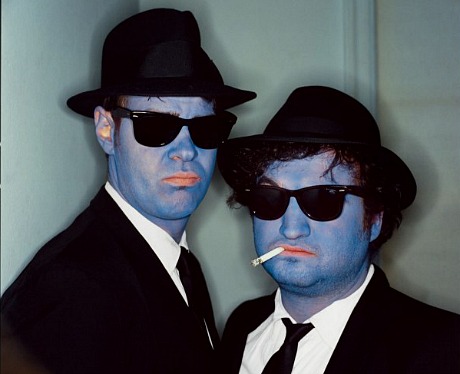
Ned Zeman‘s Vanity Fair piece about the making of The Blues Brothers (“Soul Men“) reminds that there actually used to be a thing called a “cocaine movie” — a film that exuded a certain hyperness, a tone of manic extremity. Or a belief, at least, in the legend of same. But how many cocaine movies were there outside of The Blues Brothers and Martin Scorsese‘s New York, New York? I’m asking.

The best depiction of a manic cocaine state is in that running-around-with-bloodshot-eyes sequence in the third act of Goodfellas, but that was made straight.

“What was it about The Blues Brothers that obliterated and suffocated?,” I wrote last May. “Oh, I don’t know. Maybe the fact that it was an unfunny, over-emphatic, overproduced super-whale that was made on cocaine (or so the legend went)?

“I asked Blues Brothers director John Landis about this wildly inflated, pushing-too-hard aspect when I interviewed him in ’82 for an American Werewolf in London piece. It was over breakfast at an Upper East Side hotel (Landis was hungrily wolfing down a plate of scrambled eggs and home fries). At one point I said that the ‘enormity’ of The Blues Brothers seemed ‘somewhat incongruous with the humble origins of the Chicago Blues.’

“That hit a nerve. ‘It wasn’t supposed to be a documentary about the humble origins of the Chicago Blues!’ Landis replied. But the essence of the Chicago blues wasn’t about flamboyant energy and huge lavish musical numbers and car chases and mad slapstick, I said. And your movie seemed to take that Paul Butterfield current and amplify it beyond all measure or reason.

“Okay, I didn’t literally say all this to Landis but that was the basic implication. (I wasn’t impolitic enough to call it ‘a cocaine movie’ but that’s what it damn sure felt like.) As Landis argued with me the Universal publicist sitting at the table started making ‘no, no’ faces, indicating I should tone it down.

“In any case I mostly hated The Blues Brothers from the get-go, and here it is 32 years later and I still hate it. And now Press Play‘s Aaron Aradillas has written an essay about it called “Cruel Summer.” — from “Chicago Blues + Nose Candy,” 5.14.12.

Another World

Consider this future-of-Hollywood discussion from New Yorker critic David Denby. It was posted in May 2008 — four and 2/3 years ago. It simply points out how far and how quickly things have come along since then. Almost all of his technological observations don’t seem as geeky or film-irreverent as they used to (at least to the analog generation), and in some cases they’ve become so-whatters. I myself have become more of a “format agnostic” than I was back then.

A Seven-Month Delay?

Kimberly Peirce‘s Carrie was supposed to open in March but now it’s not opening for another 10 months, or 7 months later than mid-March. Something’s wrong, right? One thing they have to get right for sure, and that’s improving on Brian DePalma‘s bloody-hand-rising-out-of-the-grave finale in his 1976 version. They have to come up with something better.

Best Buy Beckons

The most significant aspect of this Sharon Waxman-Steve Pond post-Golden Globes Oscar handicapping video is the tin-can sound of Pond’s voice. He sounds like Al Jolson in The Jazz Singer. His voice has the high fidelity of Paul McCartney singing “now she’s hit the big time!” in the Beatles’ Honey Pie. He sounds like Vitaphone.

The second most significant aspect is Pond’s disinclination to acknowledge the signs and admit that Best Picture-wise, Lincoln is all but finished. Instead he’s calls it a “shaky” frontrunner. No shit? Pond knows that everybody likes or respects Steven Spielberg‘s film, but nobody really loves it and that’s why it’s not winning anything. He knows it, I know it, Sharon knows it, own up to it. Yes, the 1.26 Producer’s Guild Awards will tell the tale.

“Mah-Mah!”

The last film I’ll see before flying to Park City tomorrow is Andres Muschietti‘s Mama (Universal, 1.18), in which Jessica Chastain stars as a gothy adoptive mom. The way to “get” this film is to repeat the title as if you’re producer Guillermo del Toro. Americans say “mahma” with a first-syllable emphasis, but GDT pronounces it “mah-mah” with a faint second syllable emphasis. He almost says “ma-MAH.” Just say it that way over and over, and it feels cooler and cooler each time.

Best This Is 40 Scene?

Is it me, or is this “Dining With Barry & Barb” scene from This Is 40 one of the best scenes from the material that Judd Apatow shot, even though it didn’t make the final cut? Apologies for being seven days late but as perverse, lifeless and emotionally shut-down as it sounds, the “expecting and offering nothing leads to serenity in a marriage” rap is at least a novel concept, and one that I’ve never heard voiced in a film before.