Dumbest Prequel Idea Of All Time

On 7.28 L.A. Times guy Steven Zeitchik reported that Hollywood writer-producer Laeta Kalogridis and partners Bradley Fischer and James Vanderbilt have been hired by Warner Bros. to try and whip together a prequel to Stanley Kubrick‘s The Shining.

The idea, says Zeitchik, would be to “focus on what happened before Jack Torrance (played by Jack Nicholson in the 1980 film), his wife Wendy (Shelley Duvall) and their psychic son Danny (Danny Lloyd) arrived at the Overlook Hotel where Torrance soon descends into violent madness,” blah blah.

That is really, really a dumb-ass idea. If I was running Warner Bros. I would can the person who dreamt it up. And then I would have him/her physically escorted off the lot. Because Jack Torrance was just a failed writer with an off-and-on drinking issue before he was hired as an Overlook caretaker, a guy who accidentally dislocated his son’s shoulder and then promised to stop drinking, etc. He’s a loser. He’s boring. He’s tedious. (Original Shining author Stephen King found Jack in the inner recesses of his own life and personality before he hit it big as a writer.)

If you want to milk The Shining, create a mini-series in which the main characters are cool-sexy-evil ghosts in the same sense that the vampires in True Blood are cool-sexy-evil. Each new episode would be about these long-dead phantoms — two hot girls and two hot guys, say, who come from different periods (the 1890s, the ’20s, the ’40s) and have been haunting the Overlook for decades and getting into all kinds of dark, foul stuff, but mainly into the heads of various guests who stay at the Overlook, as well as various maids and caretakers (including Delbert Grady) and administrators who work there, and making them act out their worst, darkest impulses. Or something like that. But forget Loser Jack.

Incidentally: Danny Lloyd is either a professor of biology at a community college in Elizabethtown, Kentucky, or a teacher of sciences in Missouri — or both. He will turn 40 years old on January 1, 2013.

All Them Lincoln Conundrums

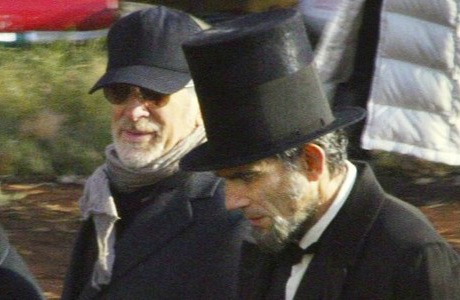
A little while back I floated a notion about Steven Spielberg‘s Lincoln (Touchstone, 11.9) being the closing-night attraction at the New York Film Festival on Sunday, 10.14. That would be only three and half weeks before the opening. The media-fed response would certainly get the word-of-mouth rolling if the film is any good. But since I wrote that certain…how to put this?…insect-antennae vibrations are suggesting that Disney might not be interested.

My first thought was that a no-go is pretty much expected. When was the last time a Steven Spielberg film screened at any festival, anywhere? He’s never been a festival-type guy. (Even Schindler’s List didn’t play any festivals.) Spielberg mostly makes popcorn films for the schmoes. His next movie is Robopocalypse. He’s the most successful hack of all time.

I spoke to a journalist pal about this yesterday, and he thinks Disney and Spielberg might be reluctant to have all kinds of Lincoln rebop (reviews, riffs, think pieces) flying around nearly a month before the Presidential election. He was referring to Spielberg having said last year that he doesn’t want Lincoln to be any kind of “political fodder.”

First of all, that’s a questionable position to take on Spielberg’s part. I can see Sony wanting to wait until after the election to open Kathryn Bigelow‘s Zero Dark Thirty as the film will probably be seen, at least obliquely, as pro-Obama. But it would be a stretch, it seems to me, for even the loony-tune right to claim that telling the story of Abraham Lincoln‘s last few months in office (Emancipation Proclamation through assassination) would somehow cast a favorable metaphorical light upon Barack Obama.

Yes, Obama is hated and defamed today as much as A. Lincoln was hated and defamed, and yes, they both came from lawyering and a legislative background in Illinois, and Lincoln’s Emancipation Proclamation was the first humanist piece of legislation to affect the status of African Americans, etc. A friend notes that “they were both raised, to a degree, by single parents. And they are both governing the country at its most divided. And they do seem to be similar types of people, both severely criticized and underestimated.” But I still don’t see it. That was then and this is now…y’know? Different magillas.

In any case, Spielberg’s determination to keep the film out of the Presidential election discussion seemed safe enough when Lincoln was presumed to be a December release. Even with the usual pre-release buzz, which usually starts a couple of weeks before opening and sometimes (depending on when it’s been advance-screened, and who for) three or four weeks before, the media wouldn’t have gotten into Lincoln until mid-November if it had been slated for a mid- or even an early-December release.

But then came Disney’s recent decision to open it on November 9th, or three days after the election on Tuesday, November 6th. They obviously want the movie (and especially Daniel Day Lewis‘s performance as the 16th President) to be part of the Oscar conversation sooner rather than later. And on top of satisfying Spielberg’s requirement, they’ve probably decided for whatever reason that the film will play better commercially in the immediate aftermath of the election as well before the Thanksgiving and Xmas holidays. (They also want to avoid the post-Thanksgiving and early December “dead zone,” when older viewers rarely go to movies in significant numbers.)

But the 11.9 release means that Lincoln will be in the air a good two or three weeks before the election, and that will bleed into Spielberg’s concern about keeping the film away from Obama-vs.-Romney.

Unless Disney intends to open Lincoln without any advance media screenings or audience previews of any kind (i.e., in the style of Alfred Hitchcock‘s Psycho), the film will start to be buzzed and tweeted about in mid to late October. Screenings will happen for the Josh Horowitz– and Dave Karger-level media, and somehow and some way the word will get out. It always does. Anyone paying attention will be aware of it. The alleged quality of it and particularly the alleged calibre of Lewis’s performance will be kicked around. Whatever Obama-esque echoes or allusions it might contain will be discussed, not just on Twitter but in regular print articles and preview pieces (i.e., the kind that are usually pulled out of writers’ and editors’ asses).

The only way this won’t happen, as I said, is if Disney and Spielberg decide to play it according to total Moscow rules and not show Lincoln to anyone at all under ANY circumstances prior to 11.9…but what are the odds of that happening?

My early thoughts about a theoretical NYFF closing-night screening went as follows: if they’re going to allow the conversation about Lincoln to begin two or three weeks before it opens, where or what is the possible downside in showing it to the NYFF crowd and the New York media on 10.14 — a mere three and a half weeks before 11.9? Pre-release conversation will be happening anyway to some extent. It always gets around. If Disney and Spielberg have the goods then they have the goods — it can’t possibly be a harmful thing to let people know that Lincoln is (let’s use our fertile imaginations) a very special, moving, possibly austere, high-calibre historical drama.

Unless, of course, Lincoln is Amistad by way of War Horse — unless it’s some kind of treacly, commercial, family-friendly, emotionally shameless “Spielberg film” in the worst sense of that term.

So if Disney is in fact averse to a NYFF closing-night venue (and I’ve only detected a hint of their position, which is to say no facts), then I would say they’ve got their reasons for playing it close to the chest. They’re probably figuring it’s best to (a) sell the broad strokes, (b) put out the poster, (c) put out the teaser in early to mid September, (d) issue the first trailer in early to mid October, (e) show it to only a very few media types in early to mid October and (f) to the general media in late October or early November and then (g) cross their fingers and hope for the best.

Girls Next Door

There’s something bothersome if not oppressive about listening to three or four women sitting in the apartment next door as they laugh uproariously about anything and everything….”hah-hah-hah-hah-hah!” We’re talking one shrieking, gut-busting laugh after another, almost as if their lives depend on meeting a strict requirement that everything they say or think or hear must be wildly hilarious.

Oh God, that’s so funny….aaaaah-hah-hah-hah-hah!….noooohh! Hah-hah-hah-hah-hah-hah! Hyper-cranked! That’s funnier than what we just laughed about five minutes ago! No, no, wait….THAT’s funnier still! Why does it sound like anxiety laughter on some level, or panic laughter? Hah-hah-hah-hah-hah-hah!

After a half-hour of this I could just scream. Or shoot heroin into my veins. Okay, not really but you get the drift.

I had the same reaction while sitting in a press lounge at the 2009 Sundance Film Festival. Here’s what I wrote:

“A little part of me — okay, one that I don’t admire and probably shouldn’t acknowledge — wants to go up to one of these groups, bend over and say in a very quiet voice, ‘I’m sorry, guys, it’s obviously none of my business…but did you know that the stuff you say in conversation doesn’t always have to be funny? And that you don’t have to laugh uproariously all the time? You can just sit there and chill down and be heavy-cat Zen types. You could even be silent for a bit and read about the jet that splashed into the Hudson yesterday. Oh, I’m sorry — not funny enough, right?”

Best Monument Valley Riff

Yesterday I wrote about my plans to visit Monument Valley late next week (i.e., Thursday & Friday with a fly-home on Saturday afternoon). A journalist friend who’s been there more than once wrote last night with this stirring recollection and recommendation.


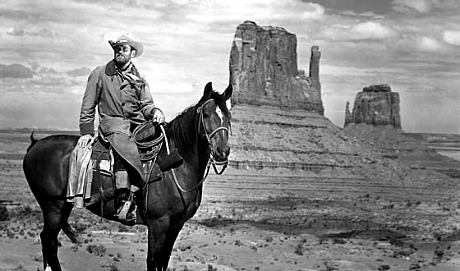
Henry Fonda in John Ford’s My Darling Clementine

“Well, it’s about time. Monument Valley is one of the wonders of the world. Drive around to different parts of it. Go out in the middle of the place toward dusk, look at the stars beginning to reveal themselves and just be quiet, listen to the wind or whatever there is to hear, knowing it’s the way it looked and sounded a million years ago. Nowhere I’ve been on all the continents of the world seems so timeless to me or makes you feel like such a transient thing compared to it. Big mountains can boast that, but this is a place you’re in, not staring up at.

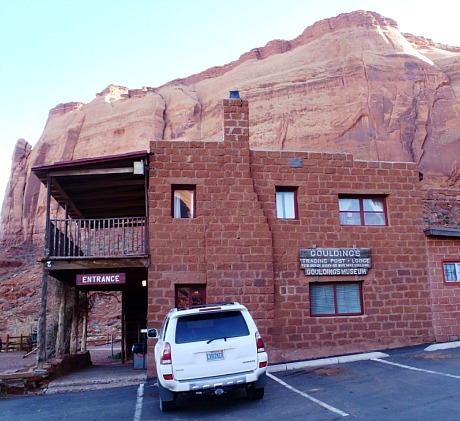
“I’ve been there seven or eight times, beginning in the ’70s when I did a cover story for American Film on the Gouldings, who were still around then, documenting how they went into the Valley in the ’20s, ran a trading post, how Harry went to Hollywood in the late ’30s when the Navajos and Hopis were in such dire shape that Harry hoped he could lure a production out there to bring in a few bucks. He sat in Walter Wanger‘s office for two or three days until he finally got a meeting, resulting in Stagecoach, which wasn’t the first film shot there but was the big one that was needed. John Ford and Co. had just started shooting Cheyenne Autumn there in November ’63 when they heard about JFK.

“I haven’t been in a few years and I hear some of the commercial stuff the local tribes have done is pretty tacky, but go get your picture taken at John Ford Point and, on the other side of the highway, you can drive around on your own. Behind Gouldings tucked in amongst some bluffs is a weird trailer park/medical center (run by a religious group, the Mennonites, I think), that’s so incongruous that it makes for some good photos. If things are still running to form, 80% of the visitors will be from foreign countries; Americans are utterly ignorant of it and where it is. Back in the ’70s the majority were Italians and French, then the Japanese in the ’80s, last time I was there it was at least 50% Russians. I’d be curious to know what it’s like now.

“It seems you’re booked to go through Las Vegas, but the best way to get there is to take the overnight train from LA to Flagstaff, getting in around 6 or 7 a.m., then renting a car and driving up.

“When you’re done, definitely drive north of the Valley and make a left toward the Goosenecks (it’s on maps); it’s an astonishing natural formation where the Colorado River twists around like goosenecks or a snake several times. You look down on it from several hundred feet above, very worth it. Not a bad idea to then go up a little further to Mexican Hat, the first town north of the valley, about 25 miles. Unless they’ve removed them, there are some great photos in the Gouldings gift shop of Harry and his wife and Ford & Co. at work. The food sucks. Navajo fried bread, forget it. It’s a good place to be dry, no booze on reservations.

“One of the freakiest experiences I ever had was driving up out of the valley with my father, who was a military pilot, and being buzzed (at no more than about 750 feet) by a B-52 shooting right over the buttes. Heart-stopping. Go and contemplate our tiny place in the universe and breath it in.”

This Vanity Fair story by Buzz Bissinger is also pretty good.

Save This Movie From Its Own People

Last year I became incensed that Strand Releasing was too cheap to book LA screenings for Paddy Considine‘s Tyrannosaur, and so I asked HE readers for donations and raised enough to pay for three or four screenings. Now I’m wondering if Side by Side, the upcoming and very worthwhile doc about the great transiation from celluloid to digital, also needs a little HE charity work. Because I’m feeling those anemic vibes again.

Side by Side‘s distributor, Tribeca Film, and IDPR, the p.r. firm hired to promote it, haven’t booked any L.A. or N.Y. screenings yet, and it opens in LA and NY in about three and four weeks, respectively. (The VOD debut is 8.22.) Instead Tribeca and IDPR are offering to send DVD screeners to those who want them. Which, no offense, is a bullshit, half-assed way of promoting a film. I’m a Side by Side fan, and so right away I began wondering if Tribeca really cares.

I realize that many critics and journalists keep up with new releases via DVD screeners. It’s a perfectly servicable way of putting a film “out there,” and for all I know some critic-journalists prefer home viewing. But if you want critics and journalists and word-of-mouth starters to really pay attention to a film, you have to get them to come to a screening room. Screenings are a way of saying you mean business. It’s a way of saying “we really want you to sit down in a dark room together and study our film because it genuinely deserves your utmost attention.”

I know what I’m talking about when I say that DVD screeners never get that. Most of the time you’re multi-tasking or on the phone while watching them. You’ll wind maybe half-watching or two-thirds watching, but never 100%. Sometimes the film gets a third of your attention. Sometimes you wind up watching it in segments. Sometimes you’ll watch it late at night and nod out on the couch.

This morning I wrote 35 or 40 name-brand critics and columnists to ask if they’ve seen Side by Side, and except for three who saw it at the Tribeca Film Festival, one who saw it last February in Berlin and one who’s expecting to receive a screener, everyone I’ve heard back from said no, they haven’t seen it, haven’t been contacted, haven’t heard about screenings or generally don’t have Side by Side on their radar.

The respondents included Roger Ebert, N.Y. Times critic A.O. Scott, Hollywood Reporter critic Todd McCarthy, Marshall Fine, Variety‘s Steven Gaydos, Badass Digest‘s Devin Faraci, AICN’s Moises Chiullan, Hollywood Reporter award-season columnist Scott Feinberg, Boston Herald‘s James Verniere, N.Y. Times columnist Dave Kehr, Miami Herald critic Rene Rodriguez, Arizona-based critic Phil Villarreal, Indiewire columnist Anne Thompson, Indiewire editor Dana Harris, The Oregonian‘s Shawn Levy, MSN’s Glenn Kenny, freelancer Katherine Brodsky, and MCN’s Michael Wilmington. It can be safely presumed, I think, that most of those who didn’t reply haven’t seen it, and/or haven’t been told about viewing options.

So it seems to me that Tribeca Film is dilly-dalllying. Which is a way of saying that the film’s producer, Keanu Reeves‘ Company Films, is also dicking around with a nickle-and-dime, wing-and-a-prayer attitude. Am I to understand that Keanu doesn’t want to cough up two or three grand to pay for screening-room showings in NY and LA? That’s not a lot of dough, bro. Didn’t you make anything on those Matrix films?

I was told this morning that Tribeca will start getting serious about getting people to see Side by Side starting on August 1st. Fine. But if I wanted to kill Side by Side, I would play it exactly and precisely as Tribeca and IDPR have so far — no early interviews, no buzz, no long-lead screenings, no energy, NO NOTHING. In their defense Keanu has been directing a Tai-Chi film in China, and Chris Kenneally, the director of Side by Side, has been wandering around Southeast Asia and more or less unreachable for a long stretch.

Keanu will be doing a press day on Tuesday, August 7th. (I’ve got the IDPR invite in my inbox.) Which is 11 days from now with almost no one having seen it or even aware that they should see it. Is this any way to run an airline?

I get the concept of operating within a budget but I really like Side by Side and I cannot stand idly by. I just can’t.

How Everything Changed

Film isn’t entirely gone from the movie-production landscape, but anyone who thinks it’s not on the verge of obsolescence has a needle in his/her arm. The realization that digital movies and digital projection are completely capable of and in fact destined to kick film out of the room for good has only settled in within the last three or four years. And as recently as 12 or 14 years ago digital was seen a joke that only the DOGMA guys and various no-account indie directors were working with.

So we’ve all been witness to a major technological revolution, and it really needs to be fully pondered and studied from this and that angle. It’s too seismic and seminal to ignore.

Which is where Chris Kenneally and Keanu ReevesSide by Side, a doc that will open on a city-by-city basis starting in mid August and also opening on VOD on 8.22, comes in. In a sense it’s the visual-tech story of our moviegoing lives since the late-Clinton era until now, or more precisely late last year, which is roughly when Kenneally and Reeves stopped shooting.

Side by Side is already a wee bit dated, or so a cinematographer friend told me when we watched it together a couple of weeks ago. Things move very quickly these days in a technical sense so you have to pounce quickly and cut it together and get it out there chop-chop.

Side by Side probably felt a tad more relevant when it was first shown at last February’s Berliniale and then Manhattan’s Tribeca Film Festival in April, but it’s still a highly intelligent sizing-up of the situation. It tells you what you know or have heard, but it’s a very soothing and stimulating thing to consider what’s happened over the last 14 or so years in one tight 99-minute presentation. It’s wonky, yes, but it’s cut and presented in such a way that even the dumbest, most ADD-afflicted Eloi dilletante will be able to get into it, and yet it’s well-ordered and sophisticated enough to intrigue those who know all about this transition, which, to put it mildly, has been traumatic for many thousands of people in the film industry and beyond.

I think it’s easily one the best made and most absorbing docs of the year.

So I’m of the opinion that Side by Side is not only smart and fascinating, but very necessary to see here and now because every so often we all have to take stock of where we are and where we’ve been, and this is one of those occasions. In short it’s important — it goes over everything and reminds us where things were not so long ago, and where we are today and are likely to be in 10 or 20 or 50 years.

Plus it assembles all of the leading and necessary hotshots in a single room, so to speak — interviewer Keanu Reeves plus Chris Nolan (a non-fan of digital), David Fincher, George Lucas, Steven Soderbergh, James Cameron, David Lynch, Martin Scorsese, Richard Linklater, Danny Boyle and dps Vilmos Zsigmond, Wally Pfister (who hates digital), Reed Morano, Michael Chapman and digital pioneer Anthony Dod Mantle, who shot The Celebration, the first significant digital feature, as well as the digitally-captured, oscar-winning Slumdog Milllionaire. Plus producer Lorenzo di Bonaventura and actress Greta Gerwig.

The film’s best line is from Soderbergh as he talks about his delight with the digital RED camera, and how working with it led him to realize that “for me, this is the year zero” and that “I feel I should call up film and say, ‘I’ve met somebody.'”

Not everyone is a fan. A friend who saw Side by Side in Berlin feels it’s “superficial crap for the most part, to say nothing of inordinately pro digital with very few dissenting voices save for Christopher Nolan and no mention at all of the problems with digital archiving, which is the real elephant in the room.”

I replied that Side by Side is a primer about the fundamentals for people who don’t know the fundamentals, but it’s also intelligent and sophisticated as far as it goes, and it talks to pretty much everyone who matters, and that it DOES get into the archive question at the end, noting that we’ve seen dozens of video formats surface and disappear over the decades and that they always change and degrade, and that celluloid is the only 100% reliable or trustable way to archive so that you know your film will be accessible 100 or 500 years from now.

“Do I Have To Spell It Out?”

Posted on 8.25.06: “When I was living in my cockroach-infested, struggling-young-journalist Soho pad in the late ’70s, there were all those Jean Michel Basquiat SAMO graffiti pieces painted all over Soho and the Bowery. SAMO (i.e., ‘same old shit’) was Basquiat’s graffiti alter-ego, and I remember being a bit disappointed when I met Basquiat himself on a street corner (or was it inside a store?) in ’78 or ’79 and he told me it was pronounced ‘same-oh’. I had always preferred ‘SAM-oh.’

“Some of the slogans were ‘SAMO 4 The Sedate,’ ‘SAMO as a neo art form,’ ‘Do I Have To Spell It Out? SAMO,’ ‘SAMO as an end to to mindwash religion, nowhere politics and bogus philosophy’ and ‘SAMO as an escape clause.’

“Anyway, I’ve never forgotten a certain SAMO graffiti that said the poiltical power of McDonalds had become equal to that of the CIA or the Vatican. I saw it somewhere near Broadway and Prince. That was something like a Major Moment for me, burned into my brain. McDonald’s = pernicious, anti-human, scourge of cvilization.

“McDonalds is a bit on the wane these days. In this country, anyway. The fearsome corporate franchise beast of 2006 is Starbucks, of course. Which is why I paid attention a week or so ago to that story about actor Rupert Everett joining forces with his Bloomsbury district neighbors to try and prevent a Starbucks outlet from moving into the neighborhood.”

What, if anything, has changed in the last six years? What, if anything, would Basquiat be saying in a SAMO vein about whatever he would be sensing in a cultural-spiritual-political vein about mid-2012?

Engineering

I got more enjoyment out of this three-cubs-in-a-dumpster video (which is roughly two days old) than anything in the opening ceremonies at the London Olympics. I’ve always been a cross between a “watch the highlights after it’s all over” type of guy and a “watch the story of this or that Olympic athlete in a touching movie five or ten years later” type of guy.

“Environmentally Perfect”

You’ve Been Trumped, Anthony Baxter‘s doc about Donald Trump‘s construction of a golf course in Scotland, has become “the highest-rated British film of all time on IMDB,” reports TheWrap‘s Steve Pond. The doc’s user rating of 8.5 makes it statistically “better than Lawrence of Arabia, better than The Bridge on the River Kwai, better than The King’s Speech, better than any other British production ever,” Pond notes.

Have I been invited to a press screening of You’ve Been Trumped? In New York, yeah. But in Los Angeles? Of course not.