Of all the high-craft, seriously aspirational, go-for-broke Timothee Chalamet films that he’s starred or costarred in since the mid teens, I’m not likely to re-watch The King and Beautiful Boy…sorry. And I’ll definitely never, ever re-watch Interstellar, a movie that I truly hated with all my heart and soul both times.
MARTY SUPREME
MARTY SUPREME + Introduction by actor and producer Timothée Chalamet
Sat. Feb 7, 2026 | 7:00pm
Aero Theatre
A COMPLETE UNKNOWN + Q&A with actor and producer Timothée Chalamet and actor Edward Norton
Sat. Feb 7, 2026 | 3:00pm
Egyptian Theatre
DUNE / DUNE: PART TWO in 70mm + Q&A with filmmaker Denis Villeneuve and actor Timothée Chalamet
Sun. Feb 8, 2026 | 7:30pm
Egyptian Theatre
INTERSTELLAR in IMAX 70mm + Q&A with filmmaker Christopher Nolan and actor Timothée Chalamet
Mon. Feb 9, 2026 | 7:00pm
Universal Cinema AMC at CityWalk Hollywood – Auditorium 19
THE KING + Pre-screening Q&A with actor Timothée Chalamet
Tue. Feb 10, 2026 | 7:30pm
Aero Theatre
BEAUTIFUL BOY + Q&A with actor and producer Timothée Chalamet. Moderated by Elle Fanning.
Thu. Feb 12, 2026 | 7:00pm
Los Feliz 3
MARTY SUPREME + Introduction by actor and producer Timothée Chalamet
Thu. Feb 12, 2026 | 10:00pm
Los Feliz 3
CALL ME BY YOUR NAME + Q&A with actor Timothée Chalamet. Moderated by Zane Lowe.
Fri. Feb 13, 2026 | 7:30pm
Cinespia at Los Angeles Theatre
Co-presented by American Cinematheque
…despite my having first having fallen for this song on Robert Palmer‘s “Some People Can Do What They like“, released in October 1976. The Belafonte is gentler, warmer, friendlier.
An old-time calypso number, “Man Smart (Woman Smarter)” was composed by Norman Span, who first recorded the song in 1936.
Homer’s Odyssey is about Odysseus’s ten-year journey home to Ithaca. Odysseus and his crew were blown far off course to exotic unknown lands. Odysseus resultantly had many adventures, including the famous encounter with the Cyclops Polyphemus, and an audience with the seer Teiresias in Hades. On the island of Thrinacia, Odysseus’s men ate the cattle sacred to the sun-god Helios. For this sacrilege Odysseus’s ships were destroyed, and all his men perished.
“Odysseus had not eaten the cattle, and was allowed to live; he washed ashore on the island of Ogygia, and lived there with the nymphCalypso. After seven years, the gods decided to send Odysseus home; on a small raft, he sailed to Scheria, the home of the Phaeacians, who gave him passage to Ithaca.
Frustrated, spiritually spent Odysseus (Matt Damon) to self: “First the decade-long siege of Troy, and then another ten years to get home! Good Lord!
“If only the young and impetuous Paris hadn’t fallen head-over-heels in love with Lupita Nyong’o‘s middle-aged Helen! On top of which she’s…what? Roughly 15 if not 20 years older than the 20something Paris? What could he have possibly seen in her? An obviously beautiful woman, yes, but hardly the most beautiful in the entire ancient Greek-Aegean world. At best Paris saw her as an exotic MILF, but was this mad passion worth the deaths of so many hundreds if not thousands of Greek and Trojan soldiers?”
Overview: Who needs ten years to return home? A year or two, maybe, but not a full decade.
Odysseus’s wife Penelope (Anne Hathaway in Chris Nolan’s film) had logical suppositions that would lead any reasonable woman to believe that her husband is dead. Who wouldn’t presume this after a couple of years?
What kind of wife shrugs her shoulders and says, “Ah, well…my husband has obviously been delayed on his way home, but I trust that he’ll eventually return so I will wait and keep myself chaste until the glorious day of arrival.” Commendable but not when you’ve been waiting ten fucking years. That’s ridiculous.
What if Odysseus couldn’t find his way back until 12 years had passed? Or 15 or 20? How many years of absence are tolerable or understandable? I say no more than two. Okay, three max.
If I were Penelope I would say after four or five years, “All right, screw it…Odysseus has obviously drowned or been killed or has settled down with another woman somewhere. I guess it’s time to start thinking about finding a replacement husband. What am I supposed to do? Wait until I’m 50 or 55 years old?
“And someone younger this time. My husband had begun to slow down or, you know, lose rigidity before he left. God knows what he’ll be like in the sack when he returns. If I’m going to remarry I want a man with a phallus like a piece of petrified wood.”
And so, naturally, the word gets out and several suitors start hanging around Penelope…all of them looking to “make it happen”. But then Odysseus finally returns, and in a big thundering climax he and his son Telemachus murder all the guys who were hoping for a little Penelope action.
Dying would-be suitor, arrow in his chest, bleeding on the floor: “What the fuck, dude? You’ve been gone for ten years and you expected your wife to…what, just wait and wait and wait? If you had been among us and some other king of Ithaca had been absent for ten years, you know you’d be looking to win Penelope’s favor and maybe discreetly do her on the side when no one’s looking…you’d be acting no differently. So why have you and Telemachus killed so many of us? What have we done that is so awful? Nothing.”
Sorry but The Devil Wears Prada 2 (20th Century, 5.1) is going to underwhelm. Such is the fate of nearly all sequels, excepting The Godfather Part II, T2: Judgment Day and…which others?
It’s obviously some kind of old-giving-way-to-the-new, passing-of-the-fashion-industry-torch saga. Meryl Streep‘s aging Miranda Priestly coping with the oppressive dynamics of a changing media landscape (digital overtaking print) as Anne Hathaway‘s Andy Sachs, now features editor at Runway, and Emily Blunt‘s Emily Charlton scheme to further their own ambitions blah blah blah.
The trailer offers one of two unappetizing scenarios — (1) Priestly is suffering from memory loss or perhaps even Alzheimer’s (who wants to watch a great ice-villain swirling downwards?) or (2) she’s playing cheap, petty mind games by pretending (initially at least) not to remember Andy and Emily blah blah blah. Only a frightened and insecure oldster would resort to such a tactic. Tedious either way.
I’m sorry but between :37 and :50Sam Neill‘s eyes look fake. Oh, and I hate, hate, HATE the jowly, neck-beard ginger guy with the purple Xfinity golf shirt. If only a T-Rex could come along and make Mr. Xfiniti howl and scream like a warthog as his bones are snapped and crunched between the T-Rex’s jaws.
Antoine Fuqua‘s Michael pops on 4.24.26 — a bit less than 12 weeks hence. 29 year-old Jaafar Jackson seems assured in the titular role, but I’m especially interested in Juliano Krue Valdi as young Michael.
14 months ago The Hollywood Reporter‘s Borys Kitreported that Lupita Nyong’o had joined the cast of Chris Nolan‘s The Odyssey (Universal, 7.16).
We’ve all since read the rumor that Nyong’o will play Helen of Troy and perhaps even a double role as Helen and her half-sister Clytemnestra, who was the wife of Agamemnon**, king of Mycenae.
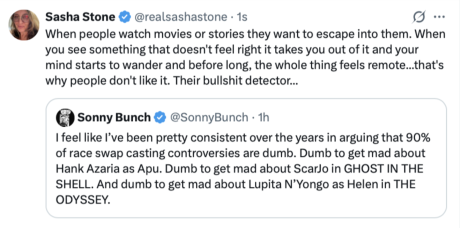
If Nyong’o has indeed been cast as Helen, we all know what this is — i.e., Nolan playing the diversity-for-appearance’s-sake game, or otherwise indulging in woke presentism.
Since the late teens Hollywood’s progressive comintern has been dictating that all historical films have to adopt the practice of presentism, meaning that all casts have to reflect social values as they should be in terms of inclusion and representation rather than how they actually may have been during the time of the story.
But let’s bend over backwards and consider the Nyong’o casting on its own historical merits.
First, the 42-year-old Nyong’o is too old to play Helen, who was a nubile 20something hottie when she ran off with Paris, the Trojan prince.
Secondly, historians seem to agree that ancient Greek culture wasn’t exactly racially enlightened, much less wokey-woke. Cruel or dismissive racial attitudes were apparently evident within ancient Greek culture, as they have been in many other cultures over the centuries. It’s been written that the Greeks had a term for POCs — Aethiopes (“Ethiopians”), which in Greek meant “burnt-faced ones.” Does that sound like a term of respect or elevation?
AI sez that “ancient Greek and Roman authors, including Aristotle, Diodorus Siculus, Ovid and Martial, perpetuated anti-black, xenophobic, and proto-racist attitudes that essentialized non-Greeks/Romans, particularly Africans, as inferior, exotic, or servile.”
Mythology says Helen’s actual father was Zeus, who apparently had sex with Leda while inhabiting the body of a swan. How was that physically possible?
If Nyong’o is, in Nolan’s mind, Helen and her half-sister Clytemnestra is also of African (or Kenyan) ancestry, it would naturally follow that Tyndareus and Leda were themselves African. Find me the respected historian or chronicler of ancient Greek mythology who will support that notion.
An overwhelming majority of classic-minded film buffs subscribe to the idea that Helen of Troy resembled Rossana Podesta, who starred in Robert Wise‘s Helen of Troy (Warner Bros., 1.26.56). Brigitte Bardot played Andraste, Helen’s servant or handmaiden.
** You want oddball casting? Nolan’s Agememnon is played by, of all the actors in the whole wide world, effing Benny Safdie.
… is intended to discourage internet bums like myself from hanging around for too long. That’s the basic idea. Drive customers slowly crazy with moderately awful MOR music…mediocre love ballads sung by Karen Carpenter, Robert Flack, Luther Vandross, the Fifth Dimension….not so awful that patrons can’t tolerate the songs for a half-hour or so, but impossible to listen to for much longer as they gradually poison and putrify.
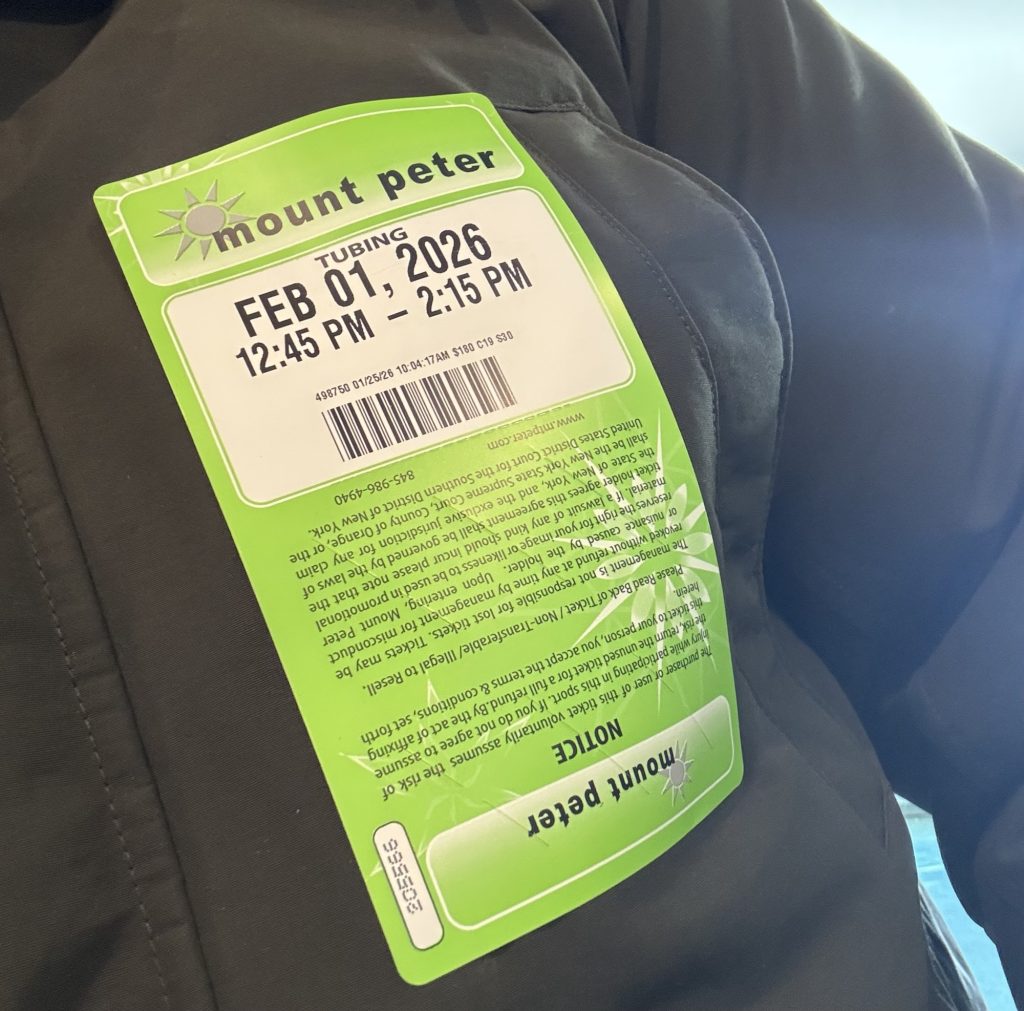
I’m sorry but it was simply too cold (17 degrees before wind chill) during Sunday’s visit to Mount Peter to experience any concept of enjoyment. Biting, jagged-steel cold exacerbated by gusty breezes…later.
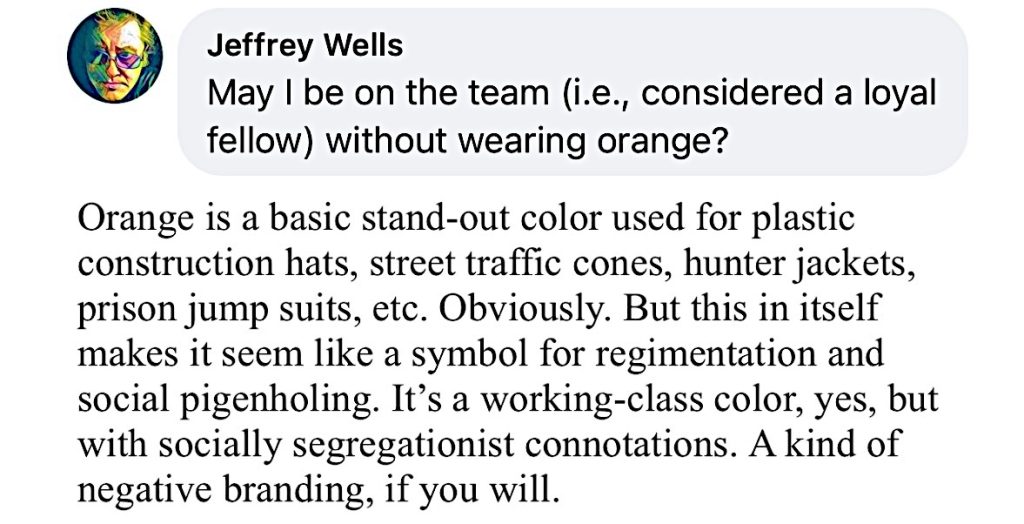
We went tubing down semi-steep slopes. My tube was a subdued orange color, and that in itself was a problem. Neurotic on my part, but generally true.
Just before pushing off a 17-year-old slope monitor told me to park my butt on the edge of my tube and not in the center of it — advice I didn’t like and therefore ignored.
Halfway down the slope the tube whirled around and I was suddenly speeding backwards at 25 mph or thereabouts, unable to see what was coming. Exhilaration + potential collision = EDGLRD!
I’m glad we went but next time the temps need to be in the 30s or at least the high 20s, and no wind.
The ADD fast-forward trend has been increasing over the last 12 to 15 years, and certainly over the last ten.
That said, I could probably come up with a fairly long list of acclaimed films that I’ve also had trouble sitting through, or have even dozed through portions of. Unlike the vast majority of snooty, know-it-all film crickets and essayists, I’m just being honest. This is mostly a failure on my part, of course, but in the case of, say, Mascha Schilinski‘s Sound of Falling or Mona Fastvold‘s The Testament of Ann Lee…