

 Jeffrey Wells
Clock Is Ticking
Take a look at Will Smith‘s IMDB page and you’ll notice that over the last 15 years he’s made four movies with four top-ranked directors — Fred Schepisi‘s Six Degrees of Separation (’94), Tony Scott‘s Enemy of the State (’98), Michael Mann‘s Ali (’00) and Robert Redford‘s The Legend of Bagger Vance (’01). And Redford’s film (a.k.a., Bag of Gas) was probably his worst and therefore barely counts.
The rest of Smith’s directors have all been journeymen — nice guy professsionals (Barry Sonnenfeld, Peter Berg) but mainly fellows who can shoot a film in focus, get it in on time, etc, but none of them visionaries or even marginally outside the box. 25 years hence which films will Smith be remembered for? Ali and what else? The man only has a few years to knuckle down and work with the AA-quality directors, or history will not remember him with any great respect or kindliness.
Fast Footwork
Most of the 20something assistants who work for top-tier producers, agents and studio bigwigs think that their job is somehow about them — what they deserve, being shown the proper respect and consideration by their bosses, getting their weekends off. And if they aren’t treated the right way, they all go “waahhh.” Maybe one in ten of these guys understand that it’s not about their piddly-ass needs or their boss’s personality, but about excellence and doing it right and giving 110% or 115% in the service of whatever movie or deal or campaign they’re working on.
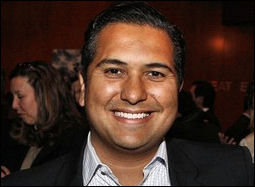
Mark Roybal, West Coast chief of Scott Rudin Prods.
It’s clear that Mark Roybal, longtime employee of producer Scott Rudin and self-standing producer of Doubt (as well as Kimberly Peirce ‘s Stoploss, and executive producer of No Country for Old Men), is one of the latter. Anyone who lasts 13 years with Rudin has to be sharp and shrewd and fast on his/her feet. Because Rudin is a tough taskmaster — ask anyone. Won’t tolerate slackers, whiners. Lives by the motto that goes something like (I’m improvising here) “we turn out top-quality stuff and so we damn well need to be better than the rest.”
The key to the 35 year-old Roybal’s survival and success, he says, is that working for Rudin is “finally about working for the movies he makes, and who makes better movies than Scott at this point? He’s the David O. Selznick of our generation.” That sounds like brown-nosing, but it’s pretty close to fact. What producer has a higher pedigree than Rudin’s? Who makes films that are more consistently Tiffany? No one.
Besides, says Roybal, “He’s as tough on himself as he is on anyone else. He’s incredibly productive. Complacency is not part of his vocabulary.”
The Harvard-educated Roybal has been with Rudin since ’95. He started out as an intern, then became an assistant and then an exec assistant. He earned IMDB credits during this period as Rudin’s assistant on Marvin’s Room, In & Out, The Truman Show, A Civil Action and Wonder Boys. In 2000 he began running Rudin’s literary department, which he calls “the greatest job in New York…you’re operating in the nexus of film, theatre and publishing” and basically being a first-rate golden retriever, which basically involves scoping out and optioning the latest hot galleys.

Doubt costar Amy Adams, Roybal, costars Viola Davis, Meryl Streep
Roybal moved to Los Angeles five or six years ago, and now operates out of Rudin’s offices in the Animation Building on the Burbank Disney lot. He basically oversees the west coast shop while Rudin holds down the fort in Manhattan.
Very few bosses offer advancement to employees, I told Roybal. Most of the time you have to stand up and look them in the eye and say I want a raise, a better job, more responsibility, more power. “It’s a little bit of both,” Roybal answered, meaning that he stood up but that Rudin was obliging. “I think Scott is looking for people who’ve got fight in them,” he says. “I learned that early on. Scott’s generous when you’ve proven yourself. He’s fair, he’s totally fair. It’s a meritocracy. He’s there to support you but you’ve gotta deliver. I figure if I can do it with Scott, I can do it anywhere.”
Roybal and Rudin both have “produced by” credits on Doubt but it was Roybal who rode herd on the New York shoot, which happened from late ’07 to February ’08. Rudin had produced the Doubt stage play, but he was occupied on the shooting of Revolutionary Road and The Reader as well as post-production matters and the Oscar campaign for No Country for Old Men.
Roybal feels especially proud of the work in Doubt, which he calls “a tight clean movie that only cost $20 million dollars. [Director John Patrick] Shanley‘s screenplay is sharp as a tack, and the autumnal colors in Roger Deakins‘ cinematography…as good as it gets, not one wasted shot.”
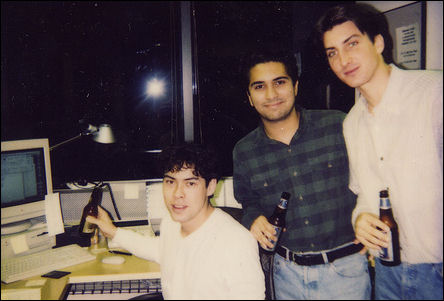
Old days (i.e., the mid or late ’90s) at Scott Rudin Prods. — (l. to r.) Ian McGloin, Roybal, Ed Goemans.
Roybal’s next producing gig may be on Snow and the Seven, a story based on Snow White and the Seven Dwarfs and set in Imperial Hong Kong of the 1870s. (The same basic bones with “a lot more action,” he says, “and of course with a wicked queen.”) There’s also the upcoming Nancy Meyers romantic triangle movie (Meryl Streep, Alec Baldwin, Steve Martin) and a Noah Baumbach film called Greenberg, which will star Ben Stiller .
Plus an adaptation of Jonathan Safran Foer‘s Extremely Loud and Incredibly Close, a hallucinatory 9/11 movie which Eric Roth has written the screenplay for.
Plus Liz Meriwether (Fuckbuddies) — “a truly comic voice, in the mold and vein of Tina Fey but with her own distinct tone” — is writing a movie for Rudin and Miramax called Maynard and Jennica.
Roybal has been married to Paramount marketing co-president Megan Colligan since ’02.
He seems a bit old-fashioned due to the fact that he reads print versions of newspapers — the N.Y. Times, New York Post and the Wall Street Journal every day plus the trades. Plus books, of course. Paper love! “I resist the Kindle,” he said. “There’s something very solid about reading a book and flipping those pages.” You’re a rank sentimentalist, I said. “A fundamentalist!” he answered..
Mr. Dick
In a 12.27 interview with CulturePulp’s Mike Russell, Valkyrie screenwriter Chris McQuarrie tries to pooh-pooh the matter of the film’s inconsistent, all-over-the-map accents. McQuarrie reports that he, director Bryan Singer and star-producer Tom Cruise “talked about it” and decided against having the characters speak German-accented English because it would sound distracting.
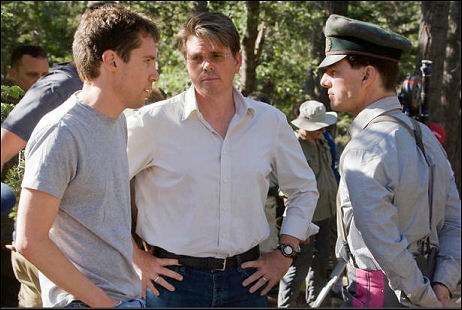
(l. to r.) Valkyrie director Bryan Singer, screenwriter Chris McQuarrie, star-producer Tom Cruise.
The solution, says McQuarrie, was everyone saying “why can’t we all just be human beings in this movie and not worry about that?” And have everyone speak English in different accents? Cruise using his American-hardball inflections, the British actors speaking like Oxford University Nazis, and the German actors applying their Teutonic strudel sauce? I don’t think so, Chris!
All the Valkyrie boys needed to do was decide on a uniform accent system and stick to it — simple. Even the much-ridiculed Marlon Brando/Young Lions/German-accent English route would have been okay if everyone had simply done this and stuck to it. As Russell points out, there’s no pure approach if you’re shooting an English-language version of a story about native Germans. You’re obviously cheating from the get-go. The important thing is to have everyone cheat in the same way.
I listed some examples in a Valykrie riff that I ran on 12.16. In Vicente Amorim‘s Good , set in Germany of the 1930s and early ’40s, everyone speaks in educated British accents — and it works fine. In Edward Dmytryk‘s The Young Lions (1958), the German characters all speak English in German accents — and it’s more or less okay. In Spartacus, all the elite Romans (except for John Gavin‘s Julius Ceasar) speak with British accents, and all the slave warriors speak Americanese. In Oliver Stone‘s Alexander, the Macedonian soldiers speak with Irish accents — and it pretty much works.
But the catch-as-catch-can accents in Valkyrie are hugely distracting. And I’m not the only one who’s said this. “Most of the crucial rebellious officers are played by British actors, while some of the Nazi diehards are played by Germans, which wouldn’t be worth mentioning if this cacophony of accents weren’t so distracting,” wrote N.Y. Times critic Manohla Dargis. “Distracting” again!
Earlier in the interview McQuarrie and Russell talk about all the journalist-columnist-internet chatter about Valkyrie that happened through some of ’07 and all through ’08. And McQuarrie says, “What’s interesting is that you’re one of maybe four people who ever asked me [about the release-date changes]…no one called to get a quote from us.”
Well, I tried to reach Singer (we know each other and he trusts me as far as it goes) about a Valkyrie matter, but the numbers and e-mail addresses I had didn’t work, and I knew I wouldn’t get this info from the turf-conscious marketing people at MGM so I let it go. I know a journalist who’s friendly with McQuarrie and has his info, but when I tried to reach McQuarrie back in the Alexander days I was more or less told that he couldn’t be bothered to reply.
This plus a couple of other experiences have persuaded me that McQuarrie is a guy who thinks he’s awfully hot shit and that he’s living on too elevated a plane to talk with journalists except when promoting a movie. Many filmmakers have a more open or trusting attitude, some are like McQuarrie and some are even less approachable.
Bobsled
In tribute to the late Heath Ledger and his ridiculous death — easily the saddest, dumbest and most infuriating act by a gifted artist in the year 2008 — here’s a clip I never saw until this morning. In taping this silly bit with Ellen DeGeneres, I love that Ledger went right to work at conveying the unreality of it — mock fear, reading a book, juggling balls, going to sleep, etc.
Given the miraculous nature of Ledger’s Joker performance in The Dark Knight, his winning the Best Supporting Actor Oscar two months from now is all but assured. But if it goes to someone else it will be over the revulsion some feel (myself included) over the circumstances of Ledger’s passing and the appalling waste incurred.
“You’re Likable Enough, Gay People”
“By the historical standards of presidential hubris, Barack Obama’s disingenuous defense of his tone-deaf invitation to Rick Warren is a relatively tiny infraction,” writes N.Y. Times columnist Frank RIch in his usual Sunday column. “It’s no Bay of Pigs. But it does add an asterisk to the joyous inaugural of our first black president. It’s bizarre that Obama, of all people, would allow himself to be on the wrong side of this history.
“Since he’s not about to rescind the invitation, what happens next? For perspective, I asked Timothy McCarthy, a historian who teaches at Harvard’s Kennedy School of Government and an unabashed Obama enthusiast who served on his campaign’s National Lesbian, Gay, Bisexual and Transgender Leadership Council. He responded via e-mail on Christmas Eve.
“After noting that Warren’s role at the inauguration is, in the end, symbolic, McCarthy concluded that ‘it’s now time to move from symbol to substance.’ This means Warren should ‘recant his previous statements about gays and lesbians, and start acting like a Christian.’
“McCarthy added that it’s also time ‘for President-elect Obama to start acting on the promises he made to the LGBT community during his campaign so that he doesn’t go down in history as another Bill Clinton, a sweet-talking swindler who would throw us under the bus for the sake of political expediency.’ And ‘for LGBT folks to choose their battles wisely, to judge Obama on the content of his policy-making, not on the character of his ministers.”
“Amen. Here’s to humility and equanimity everywhere in America, starting at the top, as we negotiate the fierce rapids of change awaiting us in the New Year.”
Downswirl
So if the cash-strapped N.Y. Times sells its stake in the Boston Red Sox for $150 to $200 million, this won’t be enough to get the paper through ’09, but “it should buy it some additional breathing room,” says the Silicon Valley Insider‘s Henry Blodgett . And they could pocket another $300 to $400 million if they sell the Boston Globe and About.com. A total between $450 to $600 million.
This additional cash “would allow the company to meet its cash needs until mid-2010,” the story says. “By then, however, if current business trends continue and the company hasn’t slashed costs, the news operations will be burning cash fast.” On 12.9 Blodgett estimated that the Times will need $214 million to make ends meet in ’09, $546 million in ’10, and $500 million in ’11. A grand total of $1,260,000,000.
Face it, guys — you’re going to have to Sam Zell yourselves and then some to keep body and soul together. I hate to say it, but a lot more staffers are going to have to work from home, and the print edition may have to fall by the wayside within two or three years, if not sooner. The main thing is to keep as much of the Times editorial team intact as possible, by hook or by crook, and not to weaken the operation by shelling out for ceremonial comforts.
“Fat Habits, Fat Minds”
Three days ago Jamie Lee Curtis published a HuffPost piece called “It Is A Wonderful Life.” It’s one of the most inspiring responses to the economic trouble we’re all facing that I’ve read since Election Day.
The gist is that too many of us have become drunk on lifestyle comforts over the last 20 or 25 years, wrapped up in them to the point of isolation and neurosis, living inside (and keeping life out of) our SUVs, McMansions, iPhones and whatnot. And that the severe economic downturn that we’re all going to suffer through for the next couple of years will be kind of a good thing in that it will force us to come out out of our cocoons and eat less and engage and share and generally pay less attention to the idiot wind.
Curtis is right, of course. The next two years (perhaps a bit less or more) are not going to be pleasant in a Great Gatsby/Louis Quatorze sense of the term, but material abundance has never done much for anyone’s soul. I think we’ll all come out of this period in a richer spiritual place than we’re all sharing and feeling right now. The big-feast way that comfortable middle-classers have been living in this country has been appalling me for years — too much food, too many toys and drugs, too many video screens, homes that are way too large and lavish, cars that guzzle way too much gas, etc.
“Many Americans are now feeling that pitiful and incomprehensible demoralization of financial loss and despair,” Curtis writes, “and many are facing financial ruin. Many men and women are feeling the shame and fear and anguish. I’m sure many have wondered if the world would be better off without them, that the judgments made about subprime loans and the lies that they were fed about them, were their fault and failures — theirs alone. They are not alone.
“I don’t know if we should bail out the broken auto industry. Now that gas is back down are we all going to go back to business as usual? Go out and buy a big guzzler just to keep the broken thing creaking along. Is that real help? I don’t know. Is loading up our plastic really going to help? Is debt the answer? I don’t think so.
“What I do know is that we are fat. Obese. See WALL*E. That is the future. We have fat lifestyles, fat habits, fat minds and arteries. Last week, Obama said that it was going to get worse but that we would emerge, leaner and meaner. I don’t think lean is mean — it just rhymes. Lean is healthy. Most of us eat too much, super-sized lives and meals. My four words to a better life, brand new, self-help/beauty/how-to book is being published right here on the Huffington Post, downloadable for free — right here, right now.
“Eat Less, Move More.
“What this crisis is going to do is bring us into financial alignment. Families may have to live together again! What a concept. Grandparents will live with their grown children and help raise their grandchildren — even at 1600 Pennsylvania Ave. Neighbors are going to meal-share and carpool and child care for each other and maybe even rent out parts of homes to other families. Less meat, more beans. Might be better for you anyway. Less indoor gym workouts and more walking, more park time, more family outdoor time.
“Obama promised change. Change comes from truth. Jung said, ‘Only that which changes, remains true.’ But as Jack Nicholson said in A Few Good Men, ‘You can’t handle the truth!’ Can you? Can you handle the change? You can if you understand that you are not alone, but that we can handle anything together.”.
Ripe For Picking
“I’ve been wondering what film WALL*E might pick off for a Best Picture nod. I’m guessing Frost/Nixon is the low-hanging fruit, huh? How long until we start seeing those articles? A Best Picture race of The Dark Knight, WALL*E, Benjamin Button, Milk and…shudder… Slumdog Millionaire would almost be respectable. Even if it consists of too much lesser work by a lot of good people.” — HE reader “KB,” posted a little while ago.
Best Dancing Dog
Posted eight months ago, never saw it until today, not ashamed to admit this. Kate and Gin’s Wikipedia page; a 9.27.08 Daily Mail story