Saturday Numbers

Four Christmases will be #1 again this weekend with $20,310,000 — off 35% from last weekend, which is a fairly decent hold. The second-place Twilight is projected to earn about $14.1 million for a cume of $139 million — look for finally tally of $160 million, give or take. Bolt will come in third with roughly $10.4 million.

Baz Luhrman‘s Australia is expected to earn around $7,034,000 — down 52% from last weekend’s middling debut and definitively dead, dead, dead in the water. The hammer-head Quantum of Solace will come in fifth with $6,846,000.

Cadillac Records will earn roughly $3,636,000 in 700 theatres, averaging $5700 per screen.

The slightly expanded Milk, playing in 99 situations, will earn about $1,791,000 or $17,000 a print. Slumdog Millionaire, in 70 theatres, will come in with $1,466,000. Frost/Nixon, playing in only 3 theatres, will make about $172,000.
Save the Tweeners

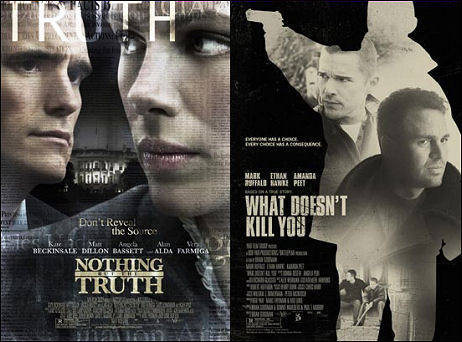
My liking for the Nothing But The Truth and What Doesn’t Kill You one-sheets follows in the footsteps of In Contention‘s Kris Tapley, who posted these side-by-siders this morning. But let’s also take a moment to acknowledge and respect the plight of these two — a pair of very realistic, strongly written, wholly believable “tweeners” that almost everyone is admiring but which don’t seem to be getting the love, attention or awards action they deserve.

Because, I’m guessing, they’re about straight-up realism in a sort of middle-range (notice I didn’t say middlebrow) way and less concerned with your high-concept, robo-marketed, big-budget stylistic kapow material. I’ve written plenty about Truth, and I’ll get into Kill You tomorrow.

Lean and Hungry

Beware of all Will Smith manifestations, now and forever. The man’s smile is too quick to appear and always looming, hovering. Smith is too engaging, too eager to charm, too emotional, too funny, too likable, too coddled and way too insulated. He seems incapable of simply “being” because he’s too hungry for affection. He can’t not perform. Such men may not be dangerous in the Shakespearean sense of the term, but you sure as hell can’t trust them.

As Charles Bukwoski once wrote, “Beware of those constantly seeking love and approval from a crowd — they are nothing alone.”

And double-beware any big-name actor who asks a film-series moderator for a hug (as Smith did a couple of days ago with Pete Hammond).

I’ve been in a room with Smith live and in private and he’s like this all the time with everyone, with or without an audience of any size. I’m not saying this indicates Seven Pounds might be a problem, but I’ve been told by a Los Angeles journalist friend who’s been known to occasionally give this and that film a compassionate pass that Seven Pounds is in fact an El Problemo. The word this person used, in fact, is “awful.” A word that another viewer used is “contrived.”

Ackerman in the Sky

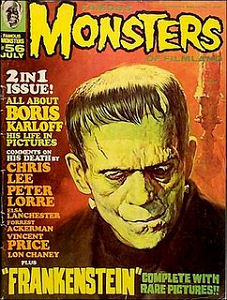
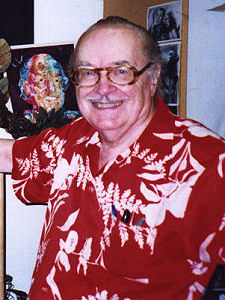
Yesterday I failed to pass along the news of the death of Forrest J Ackerman, who died Thursday at age 92. Not out of lack of respect for the legendary editor and horror-fantasy film fanatic who wrote and ran Famous Monsters of Filmland, the first big-time print fanzine, from 1958 to ’83. My hesitancy was due, rather, to an odd feeling that came over me when I examined several pics of the very weird-looking Ackerman after his death was announced.


The late Forrest J. Ackerman; an early ’60s cover of Famous Monsters of Filmland.

I don’t want to convey anything but admiration for Forry, as his friends called him. The man lived for the spirit of classic horror movies, creating a fanboy life before the term “fanboy’ has been invented, a guy who constantly hungered for the wonders and intrigues of cinefantastique. But not a smidgen of the baroque creepiness of horror films rubbed off on his appearance. The man looked like an old-urban-America streetcorner anachronism. A Moustache Pete character type out of a 1940s Dick Tracy short. He dressed like a Hollywood Park bet-taker from the late ’40s or early ’50s. He wore loud, loose-flowing sport shirts that would turn a funeral up an alley.

Ackerman was a giant in his realm, don’t get me wrong, but it’s difficult for me to feel emotional kinship with a guy who looked like a suburban-retirement-home version of Fearless Fosdick or Boston Blackie — no offense.

All Change Is Traumatic

N.Y. Daily News gossip columnists George Rush & Joanna Molloy have been — how else can I put it? — elbowed aside by Ben Widdecombe‘s Gatecrasher column, which will now run daily with R & M’s column to run once per week on Sundays. Sounds like a cost-cutting move. George and Joanna are way too young (and too expert at what they do) to be put out to pasture.

Knight Surge?

An older Academy friend has just spitballed what he believes the five Best Picture nominees will be at the end of the day. The top four will be Slumdog Millionaire, Milk, The Curious Case of Benjamin Button and Frost/Nixon — all routine picks. The surprise is that he believes the fifth slot will be filled by The Dark Knight. Really? Sure, he said — the Academy is getting younger and younger, and all along the word on that film has been strong and steady.

Monochrome Options

I’m so queer for monochrome that I’d be delighted if one-fifth of all feature releases, say, were shot in this mode. Because black-and-white pretty much trumpets the fact that you’re sitting at home (or in a theatre) and watching a “movie.” There are some films in particular, however, that I’d really love to see in those sharp, silvery, glistening tones. Revolutionary Road, I feel, would be heaven in monochrome. Ditto the World War II-era Valkyrie. I can’t be the only one who thinks this way. Which films would others like to see, or would have loved to see, in black and white? Risky Business would never work in monochrome; ditto Body Heat, Raiders of the Lost Ark, Weekend at Bernie’s, Jaws and ten thousand other films.

No Sale

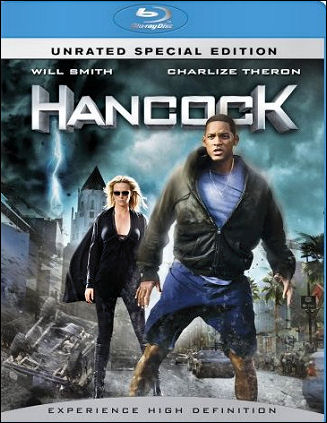
No — don’t buy Hancock on Blu-ray unless you have the movie-watching taste buds of a mountain gorilla. It has one of the dumbest, looniest third acts ever created in the history of drama. Relentless big-whomp special effects, but what’s that?

Gut Fear

A trailer for Ink, a creepy-scary movie from the Denver-based Jamin Winans that may or may not be released in 2009, which Damin says will happen.

Basic Morality

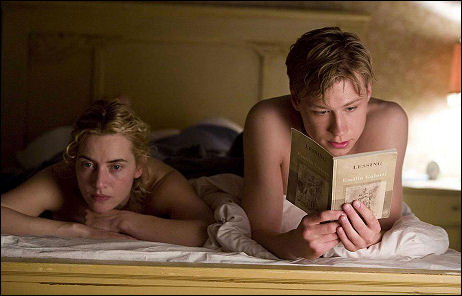
I’m finally ready to comment on a moderately controversial 12.2 Huffington Post piece by film critic Thelma Adams about how the older woman-teenage boy relationship in Stephen Daldry ‘s The Reader is basically a case of child abuse, and if the sexes were reversed (older guy, teenage girl) it would definitely constitute child abuse.


Kate Winslet, David Kross in The Reader

I’ve explained this a couple of times since the dawn of Hollywood Elsewhere in August ’04, and I’ll probably have to keep explaining it. If an older man takes a 15 year-old girl to bed, he’s an animal and a scumbag who deserves to go to jail. But if you’re a 15 year-old teenage boy (or 14 or 16 or whatever), you automatically get down on your knees and give thanks to God if an older woman wants to go to bed with you. No ifs, ands or buts — it’s a gleaming gift from heaven.

If a woman in her 20s or 30s or even her 40s had been interested in yours truly when I was 15 or so, I would have turned out a much happier person — certainly a more optimistic one. There’s no way in the world I would have ever been screwed up or even moderately traumatized by such a blessed, rhapsodic event.

Different standards but that’s how it is.

Contrarian

“I just saw Milk and as I’m watching it I’m thinking this is really, really dull. This is such a paint-by-numbers biopic that the only stand-out thing is the fact that it’s about gay men. But as an emotionally involving narrative, it’s just flat flat flat. And why is it that an incredible thriller like Transiberian can come out and no one pay attention to it. The state of film criticism is now so tied to the marketplace that it’s slowly choking American film as an art form. Maybe it’s just me.” — received this morning from a filmmaker friend.

Whackings

The beginning of the real bitter end of the Hollywood Reporter happened yesterday when, as Nikki Finke has reported, several essential, first-rate people were cut from the payroll — film reporters Gregg Goldstein, Carolyn Giardina, Leslie Simmons, managing editor Harley Lond, TV critic Barry Garron, TV reporter Kimberly Nordyke, Manhattan-based special issues editor Randee Dawn, international department editor Hy Hollinger, plus Dan Evans, Lesley Goldberg, Michelle Belaski and James Gonzalez.

Plus the roilling heads at Paramount, Universal/Focus and Newsday.

Plus I’m told that film critic Glenn Whipp has been cut from the ranks of the L.A. Daily News. Put vaguely, his duties and/or compensation have been reduced beyond a duties/compensation diminishment that had happened previously. (I could make it vaguer.) Whipp didn’t reply to an e-mail, his colleague Bob Strauss didn’t reply to email and a call, Whipp’s arts editor didn’t pick up, etc. People never seem to want to call back when someone’s been cut. Nobody wants to touch it.