
“Exclusive! Indiewire’s Eric Kohn texts from the premiere of Raiders of the Lost Ark!” — written by eFilmCritic’s Rob Gonsalves. Funny stuff.
 Jeffrey Wells
Evolving Che Buzz
Variety‘s Anne Thompson is reporting that the “buzz is good” on Benicio del Toro‘s performance as Che Guevara in Steven Soderbergh‘s The Argentine and Guerrilla, which will show in tandem in Cannes tomorrow night. A guy who’s seen both films told me last night that Del Toro’s performance is so intense he’s “almost scary.”
I’ve heard two other things — one from a journalist with a contact who’s seen it, and a director who gets around and tends to hear pretty good stuff. The journalist claims that Guerilla gave his friend “the feeling of ‘why am I watching this?” — the guy having enjoyed The Argentine much more. The director says he’s been told that Guerilla is the far superior of the two.
Kenny’s Take
“I gotta give it up — as earnest and awkward as Two Lovers — a loose rethink of Dostoevsky’s White Nights — can get, it frequently moved me,” writes Some Came Running‘s Glenn Kenny. “Perhaps it’s something to do with my own past as a fall-hard guy for troubled, difficult women. Then again, a lot of my male colleagues not giving this movie any love have similar skeletons in their closet.”
Straight Paycheck
Having made perhaps too many thoughtful political-minded films that haven’t made money, John Cusack is taking his agent’s advice and plunging into Roland Emmerich‘s 2012, an apocalyptic thriller for Columbia Pictures. Redbelt star Chiwetel (“Chewy”) Ejiofor is also planning to join the big-budget epic, whose title refers to the end days of human civilization as foretold by the ancient Mayan calendar, blah blah. Variety‘s Tatiana Siegel reports that the screenplay was cowritten by Emmerich and Harald Kloser. Harald?
Real Reason
So the Daily Mail‘s Baz Bamigboye went to the Vanity Fair party at the Hotel du Cap last Saturday night, and learned from an “executive” that Vicky Cristina Barcelona costar Scarlett Johansson didn’t make it to Cannes because of “scheduling issues,” as Woody Allen put it the other day in a press confernce, but because she was being an ego-monster in terms of perks. She demanded an out-of-town villa (“way out in the sticks, some 25 to 30 miles away”) and insisted on a 5,000 euro-per-day makeup consultant, Bamigboye reports.
Two Lovers
James Gray‘s Two Lovers, which screened last night, is an attractively composed, persuasively acted but slightly too earnest and on-the-nose drama about romantic indecision. But it’s not half bad — a little Marty-ish at times, maybe a bit too emphatic here and there, but nonetheless concise, reasonably well-ordered and, for the most part, emotionally restrained and therefore believable.
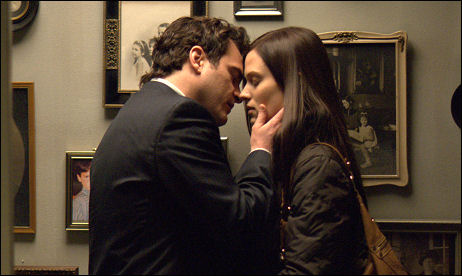
Joaquin Phoenix, Vinessa Shaw in James Gray’s Two Lovers.
Financed by the Wild Bunch, Two Lovers is, I gather, up for grabs at Cannes.
Unlike Gray’s The Yards and We Own The Night, there’s no criminal behavior in Two Lovers, and the absence of this — no resorting to gunplay, car chases or fist fights — has naturally led Gray in a gentler, quieter direction. It’s mainly a mild-mannered borough family film, and fairly decent in that regard. I’m not a lockstep Gray fan — I was mostly okay with The Yards but disliked We Own The Night. But for what it’s worth, I think Lovers is his best yet.
Leonard (Joaquin Phoenix) is a lonely, less-than-worldly, recently suicide-prone guy, reeling from a busted relationship and living with his parents (Moni Moshonov, Isabella Rossellini) and working for his dad’s dry-cleaning store. The movie kicks in when he finds himself torn between Sandra (Vinessa Shaw), a sweet, wrinkle-free Brooklyn girl who wants to get married and do the usual-usual, and Michelle (Gwynneth Paltrow), a scattered, impulsive blonde who lives in Phoenix’s parents’ apartment building and is obviously “trouble” from the get-go.
Guess which one Leonard has the major hots for? Naturally.
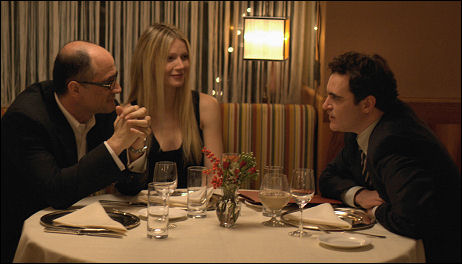
Elias Koteas, Gwynneth Paltrow and Pheonix.
Leonard’s passion for Michelle is partly due to her being hot shiksa material, but also because she’s very much the big-city girl. His sincere but less passionate feelings for Sandra are precisely about her being a home-and-hearth type — stable, loyal and not exciting enough. As Leonard is also a fairly decent photographer, he understandably sees Michelle as spiritually linked to the big “out there” where his talent may some day be recognized — a place where people may see more value in his work than his family and neighborhood friends, who look at his stuff and say “yeah, pretty good” and then ask him to photograph weddings.
I was disappointed that Gray didn’t touch on a general rule-of-thumb when it comes to nice girls vs. crazy girls. As Woody Allen and other men of the world will tell you, the crazy ones are better in bed. This isn’t an absolute fact, thank fortune, but my experience on the planet has taught me it’s more true than not. I regard this as one of the great unfair conditions about life. It is certainly something Gray should have gotten into, and the fact that he doesn’t even flirt with this is, for me, strike #1.
Strike #2 is the casting of Shaw as Sandra. She’s too Fairfield County pretty, poised and delicate to be a borough girl. There are exceptions galore in real life, of course, but men and women from Brooklyn and Queens (i.e., those born and raised) tend to exude a slight coarseness. A coarseness that’s often vibrant and agreeable (I know New Yorkers and it’s not a cliche), but is also saddled, I feel, with a lack of interest in other realms. A wanting for worldly finesse. An Adrianna-from- The Sopranos quality. Not to mention that happily hunkered- down attitude about being “borough” — a life of eating pizza, not quite dressing the right way and failing to learn to speak French or play piano. Not to mention the distinctive ethnic features and honky accents. (I’ve known exactly one woman in my life who was raised in Brooklyn but doesn’t look it or talk it.)
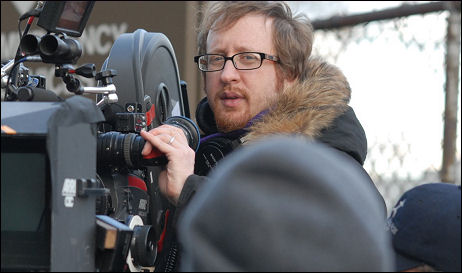
James Gray
Shaw, simply, looks and talks like a girl from Greenwich or Westport or the Hamptons or Pacific Palisades. I’m a huge fan of this actress (as HE readers well know), but she’s too finishing-school to be believed here. Plus Gray and co-writer Ric Menello haven’t given Sandra enough in the way of distinctive ticks or weirdnesses. (Which everyone has.) They’ve settled for making her warm, generous, full of support and understanding. In short, a fantasy.
That said, I admired Pheonix’s performance — his best since Walk The Line, I feel. He convinced me that Leonard is just hermetic and naive enough to fall for a girl like Paltrow’s Michelle and not realize what he’s getting into. He’s starting to look vaguely 40ish — jowly, slightly chunky, filled-in. This is fine from an acting perspective, but a little curious given that he’s only 33.
Sidenote: anyone who chimes in about Shaw in a certain context — you know what I mean — will be banned for life from this website. Fair warning.
McCarthy’s Rave
“A thematic companion piece to Mystic River but more complex and far-reaching, Changeling impressively continues Clint Eastwood‘s great run of ambitious late-career pictures,” writes Variety‘s Todd McCarthy, who was given an early look at the Burbank Studios on May 5th. “Emotionally powerful and stylistically sure-handed, this true story-inspired drama begins small with the disappearance of a young boy, only to gradually fan out to become a comprehensive critique of the entire power structure of Los Angeles, circa 1928. Graced by a top-notch performance from Angelina Jolie, the Universal release looks poised to do some serious business upon tentatively scheduled opening late in the year.”
McCarthy’s liking for Jolie’s performance is well put: “As she did in A Mighty Heart, Jolie plays a woman abruptly and agonizingly deprived of the person closest to her. But impressive as she may have been as the wife of Danny Pearl, her performance here hits home more directly due to the lack of affectation — no accent, frizzed hair or darkened complexion, and no attempt to consciously rein in emotion. There are inevitable one-note aspects to her Christine Collins, as she must exasperatedly repeat her positions to the authorities again and again. But Jolie makes it clear Christine maintains a grip on her sanity in the face of many assaults on its stability.”
Stenography
CHUD’s Devin Faraci has taken great exception to Indiewire‘s Eric Kohn having live-blogged during Sunday’s debut screening of Indiana Jones and the Kingdom of the Crystal Skull. ” It’s hard for me to explain to you how angry this makes me. It’s bad enough when a regular jackass whips out their phone and bathes everyone behind them in a blue glow during a movie while they text away like a moron, but for a film critic like Eric Kohn to do this… well, he should probably have his texting fingers broken.”
Indiewire’s Eric Kohn
I agree totally — it’s doggerel. Lame. Kohn and Indiewire were simply looking to be first to provide the very first commentary on the film anywhere in the world — except it wasn’t commentary but rudimentary (i.e., quite crude) descriptions of scenes as they happened. There’s an internet audience for this kind of stenography, of course, but to what end? A movie deserves a little thought before before commented on. I tapped out an instant hand-held judgment after Indy 4 ended, but at least I’d thought it through for an hour or two.
Exchange Praise
Just spoke to a British journalist who’s just come out of Clint Eastwood‘s The Exchange. “Absolutely first-rate,” he said. “It’s long” — 141 minutes — “but it’s very strong, very moving. There’s not a weak point in the entire film.” Like Mystic River before, which also dealt with a missing child and the violations that result, The Exchange is a genre piece — a kidnapping whodunit, set in 1928 — but, the journo said, Eastwood mines the material for a good deal of “complexity and emotional depth.”
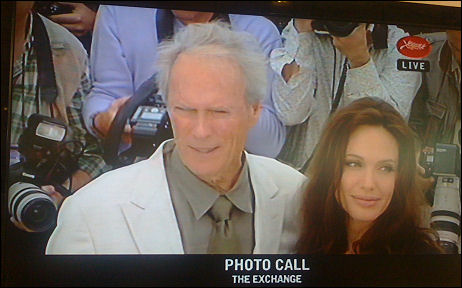
Angelina Jolie, he emphasized, “is very, very good,” he said. Ditto John Malkovich as an activist minister who helps Jolie’s character, Christine Collins, uncover the truth of what’s really happened to her kidnapped son. J. Michael Straczynski‘s script hammers the old-time LAPD for the corruption that was rife in that period, but “its much more of woman’s film,” the Brit emphasized. “And much more than what the plot suggests.”
Eastwood “is amazing,” he said. “He just keeps getting and better the older he gets. What is he…close to 80 now? I think he might pull of a Best Director win next weekend.”
The Exchange Now?
I knew if I went to the Two Lovers party last night, which didn’t begin for me until 12:30 am, that I might not awake in time for this morning’s screening of Clint Eastwood‘s The Exchange (L’echange). Sure enough, I didn’t flop until 2:30 am and slept right through my double alarm system (6:40 and 7 am.) Maybe I can snag a ticket to the gala screening at 7:30 this evening. If not, there’s a makeup screening tomorrow morning in the new Salle du Soixantieme at 11:30 am.

Waiting outside Salle Debussy for last night’s press screening of James Gray‘s Two Lovers, which began 40 minutes late. A couple of hundred press people got into a 10 pm screening in the smaller Salle Bazin.
I don’t see the point of going to the Exchange press conference at 11:30, which is an hour from now. All that bubble, toil and trouble just to take pictures of Clint and Angelina Jolie, and to ponder questions and answers that won’t mean much? Today’s plan is to (a) drop by the Two Lovers press conference at 1 pm, then (b) see Jean-Stephane Sauvaire‘s Johnny Mad Dog (great title!) at 2 pm, and then (c) Amat Escalante‘s Los Bastardos at 7 pm. (Unless a ticket comes through for the 7:30 Eastwood.)
That wasn’t an error before — Eastwood’s film, I’ve been told, will henceforth be called The Exchange rather than Changeling, which is what it’s been called all along. While waiting last night for the Two Lovers show to begin, I asked Cinematical’s James Rocchi if The Exchange is a new title, and he said “naaah, that’s just an English translation of the French one.” But then a British journo standing nearby said he’d read/heard that The Exchange is in fact the new title — that Eastwood recently decided he liked it better.