Feast of Love

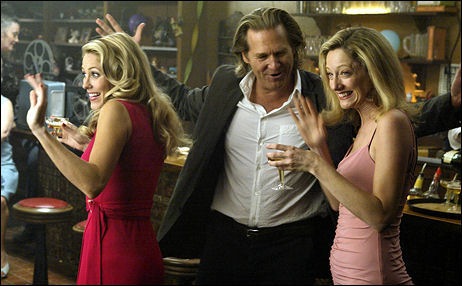
I paid money to see Robert Benton‘s Feast of Love last night. It’s a completely decent second-tier relationship drama. That doesn’t mean “second-rate” — it’s just not refined enough to be called top of the line. A little too schematic, not enough of an underflow. Maybe it is second rate, but I half-liked it. I was half into it and sometimes fully engrossed, and also a bit bored from time to time, but it didn’t hurt altogether.

I respected Gregg Kinnear‘s willingness to go into vulnerable places, and the growing intimation that you get from Allison Burke‘s screenplay (based on Charles Baxter‘s book) that the sad/bad stuff might happen at any time. Radha Mitchell delivers as a conflicted real-estate agent who brings fresh misery into Kinnear’s already cloudy life, and hats off to Benton for not shying away from matter-of-fact nudity during the numerous bedroom scenes.

And I really liked Billy Burke‘s acting as Mitchell’s married boyfriend. Burke is mainly a TV actor but he deserves more. He knows how to deliver lines like they’re coming from someone (and some place) genuine, and he has a kind of primal Steve McQueen-ish thing going on.

But I absolutely despised a moment early on when Morgan Freeman‘s charac- ter, a 60ish teacher struggling with the death of his 20-something son from a heroin overdose a year earlier, wakes up in the middle of the night and goes for a stroll. He walks by a vacant baseball field and suddenly sees and hears a softball game in progress — one he’s remembering, presumably. (We all understand scenes like this. Most of us, I mean.) Then all of a sudden it’s daylight and people are everywhere and Kinnear comes up to Freeman and starts chatting.

It’s a beautiful transition at first — Freeman might be remembering a conversation he had with Kinnear, or it might be an imaginary chat that he’s having in his head. It doesn’t matter either way because we’re “there” with Freeman — he inspires trust and comfort no matter who or what he’s playing — and cool with whatever goes down.

But two seconds after Kinnear greets Freeman Benton throws in a title card that says “six months earlier” and the moment is shattered all to hell. Who gives a shit if it’s six months earlier or the next morning or the day before or six months hence? We’ll figure it out as we go along, no? Nope. Some idiot producer (or perhaps some idiots who were asked about this scene following a research screening) confessed to confusion about the dark-to-daylight element (whoa!) and Benton lost his nerve and put in the title card.

Kowtowing to the dumbest people in the audience will always be a mark of mediocrity, and I lost a lot of respect or Benton at this very moment. A stronger director wouldn’t have done this.

Imagine a producer coming up to David Lean during post-production on Lawrence of Arabia and going, “Uhhh, David? I’m not really getting the thing with Peter O’Toole blowing out the match and a split second later we’re watching a sunrise in the desert. He’s standing in Claude Rains‘ office when he blows it out, right? I’m not getting how he’s suddenly hundreds of miles away in a different country… it’s a little disorienting. You need to put in a title card that says, ‘Arabian desert — Three Weeks Later.’ People will be less confused this way.”

Something-faces

Here‘s a well-phrased appreciation from N.Y. Times DVD columnist Dave Kehr of Paramount Home Video’s 50th anniversary DVD of Stanley Donen‘s Funny Face (’57). I’m not sure I would have watched this without Kehr’s recommendation, but now…maybe. “In a version that returns to the original VistaVision negative for an uncommonly crisp and vibrant transfer,” he writes, “Funny Face is a movie that bridges two generations — that of the traditional, studio-bound musical and that of the new, on-location epic.”

Wasn’t On The Town (’49) was the first on-location musical? Shot mostly on sound stages, used a lot of Manhattan location footage.

Whenever I think of something-face in a movie, I think primarily of Cary Grant calling Joan Fontaine “monkey-face” in Suspicion. Then, I suppose, I think of Fred Astaire, Audrey Hepburn and Funny Face. Then Robert DeNiro using the term “fuck-face” in Mean Streets. Then Sex in the City‘s Sara Jessica Parker and that unkind term sometimes applied — “horse-face.” Finally I think of Michael Madsen calling Parole Office Seymour Scagnetti as “ass-head” in Reservoir Dogs. Always the downward spiral…

Knowing less about Dylan

“I actually think that it’s easier for people who know less about Dylan to go with it, if they’re up for something different. Clearly, that’s the first thing. Whether you know Dylan or not, you have to surrender to the movie to have a good time at all and get anything out of it. If you have a lot of Dylanisms in your head, it’s kind of distracting, because you’re sitting there with a whole second movie going on. You’re annotating it as you go.

“[But] it’s kind of nice to sit back and let it take you. I think people get it: Even if you don’t know which are the true facts and which are the fictional things, and when we’re playing with fact and fiction, from the tone of it, you know that it’s playing around with real life.” — I’m Not There director Todd Haynes speaking to Reeler interview Eric Kohn.

Forcible viewings

Another industry-watcher — Wall Street Journal contributor Anthony Kaufman — is reporting that the Iraq-Afghanistan movies are either dying (In The Valley of Elah) or underperforming (The Kingdom). If I had the power, I would make every person who voted to continue the Iraq War by voting for Bush’s reelection in ’04 watch every last Iraq War movie there is. I would have them gently brought into theatres and strapped down like Alex in A Clockwork Orange with their eyes kept open with those clamp devices and shown every last one.

Okay, I might let them off the hook with Brian DePalma‘s Redacted, which is a rough sit even for people like myself. But they’d see all the rest. I’d make sure they’re comfortable and serve them good food between screenings and offer free shiatsu neck massages to anyone who wants one, but they would see each and every Iraq War movie, Afghanistan movie and 9/11 movie…anything to do with that general tragedy.

This may sound like a anti-Bush totalitarian fantasy to some, but I think it’s a fair thing to insist upon. If you voted for the war, you should deal with the films about it. (Unless they’re poorly made, in which case you’re excused.) What’s so bad about that?

Final Blair film in the works

Eight or nine months ago Michael Sheen told me that a third chapter in the Tony Blair saga — a film about Blair’s relationships with Bill Cinton and George Bush, and particularly about Blair’s misguided alliance with Bush over the mounting of the Iraq War — would one day be written by Peter Morgan (who wrote the first two chapters, The Deal and The Queen), and then be directed by Stephen Frears and star himself as Blair.

Morgan sounded somewhere between iffy and disinterested about it when I asked about the project at last October’s Queen press junket, but he sounded slightly more engaged when I asked it again at a screenwriter’s panel at last February’s Santa Barbara Film Festival. Anyway, Variety’s Adam Dawtrey says Morgan has finally begin to write it. Oddly, Dawtrey doesn’t mention the downfall-of-Blair-over- the-Iraq-War angle. Does that mean he wasn’t told about it, or that Morgan has changed the focus of the script? Or at least, the focus as Sheen described it to me last fall?

Same “Lamb” photos

This “what do you stand for?” Google/You Tube promotion for Robert Redford‘s Lions for Lambs (MGM, 11.9), which offers a $25,000 cash prize for the best short political video piece submitted, might raise awareness and get the word going. Maybe. What would really help, I suspect, would be for MGM to release stills that show costars Meryl Streep and Tom Cruise doing something besides sitting in that damn Washington, D.C., office with Cruise instructing/lecturing Streep about the hard choices facing America in the fight against terrorism.

For weeks and weeks I’ve been looking at the two of them in trailers and stills, wearing those same outfits and talking, talking, talking to each other — Cruise clenched and focused, Streep doubting and sardonic. Do they do anything else in the film? At all? I’m starting to wonder.

“The lion and the lamb shall lie down together, but the lamb won’t get much sleep.” — a quote attributed to Woody Allen.

Guttenberg Diary

Steve Guttenberg is alive and well and 49 and doing (I presume) pretty well, but the fact that he’s cut a deal with Thomas Dunne Books to write a memoir about his early years in Hollywood (the late ’70s to mid ’80s) indicates he’s either got time on his hands or is looking to jump-start things.

It’s generally agreed that Guttenberg’s peak artistic period was between Barry Levinson‘s Diner (’82) and Curtis Hanson‘s The Bedroom Window (’87). His last bona fide hit was Three Men and a Little Lady (’90). I used to hate him before Diner. I remember being elated when his character got killed in Franklin J. Schaffner‘s The Boys From Brazil (’78). I also remember a New York critic writing about his performance in Nancy Walker‘s Can’t Stop The Music (’80) and observing that Guttenberg had “all the charm of a barking dog.”

Rordiguez, the genre-wallower

A 9.30 report by Elle‘s Tracey Lomrantz that Robert Rodriguez will be directing real-life squeeze and Planet Terror star Rose McGowan in a remake of Barbarella is at least…what, four months old? But it reminds us that Rodriguez is an old hand at dressing his leading ladies in skimpy outfits and turning them into objects of lascivious attention (as he did with Salma Hayek in Desperado and From Dusk to Dawn). And it seems to once again confirm R.R.’s absolute opposition to making a film of any attempted soul or substance or delicacy for the rest of his life. He’s a thick-fingered genre-wallower.

Ballard walks off dog movie

For years the once-great Carroll Ballard (The Black Stallion, Duma, Never Cry Wolf) has been tagged as the go-to guy when you’re making a spiritual-poetic animal movie, so it was no surprise when he was hired to direct Hachiko: A Dog’s Story, a feature that will star and be produced by Richard Gere. Also produced by Vicki Shigekuni Wong, it’s based on a true-life Japanese legend about of a college professor’s bond with the abandoned dog he takes into his home.

The problem is that Ballard wound up butting heads with Gere and, according to a trusted source, walked off the shoot last week just 21 days before the start of principal photography. The informer says it was “apparently due to creative differences with Gere over the film’s ending.” People on the production have told him that Ballard “was acting strange and cantankerous,” and that the producers are scrambling right now to find someone to come in and take over “while the production team sits up in Rhode Island twiddling their thumbs.”

The source has read Stephen Lindsey‘s script and calls it “good, but it needs a strong sensitivity that won’t come easily with a director just dropping in at the last minute. “

Yemen volcano

I can’t remember the last time I saw a fiery volcano explode in a film, but we know we won’t be seeing one from Roman Polanski any time soon with the plug recently pulled on his Pompeii movie. But look at this — a real-life volcano blowing fire and fury just hours ago about 130 kilometers off the coast of Yemen. I can only hope for a YouTube video down the road. It looks like the fire-breathing monster effect in the trailer for J.J. Abrams’ Cloverfield.


A better-than-ILM display of fire, lava and massive ash clouds following an actual volcano eruption on a Red Sea island off the coast of Yemen, in this photo taken from the deck of the Canadian frigate HMCS Toronto.

The story was filed this morning by the Toronto Star.

Smoking under fire

Every time I read a story about certain political forces wanting smoking in Hollywood movies to be restricted or stopped, which is the topic of this Michael Cieply story in the 9.30 N.Y. Times, I have the same reaction. Europeans, people under heavy stress, 20-something clubgoers and low-rent rubes often smoke cigarettes, and as offensive as this habit can seem to ex-smokers like myself it’s absurd to say that filmmakers shouldn’t show people sucking smoke into their lungs when it’s appropriate for the story or theme they’re trying to convey.

And yet it wouldn’t be bad to see less movie-smoking as a general rule. Actors would be forced to do lean on some other tic or mannerism — it would push them to be more creative.