
New Line’s “For Your Consideration” site is trumpeting three ’07 releases — The Golden Compass, Hairspray and The Last Mimzy. In a normal year the obvious third-ranked contender would be Gavin Hood‘s Rendition, which hasn’t much of a shot at anything but has some decent performances to its credit. Peter Sarsgaard and Meryl Streep are stand-outs, and Esquire recently hailed Jake Gyllenhall‘s lead perf as a conflicted CIA guy. But it’s all been tossed aside so that a vanity project can enjoy a nominal day in the sun.
 Jeffrey Wells
Blacnhett’s “bird in hand” being fucked with
Cate Blanchett‘s I’m Not There performance seems an extremely safe bet to win a Best Supporting Actress trophy or two from critics groups later this year (perhaps even a bagful), and is a near-certain lock to be Golden Globe- and Oscar-nominated in this category. And the category itself is correct because she’s part of a six-actor Dylan ensemble. But now, according to David Poland, certain parties want to mess with this groove and reset the table.
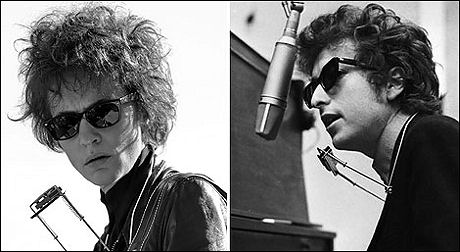
Even the clueless Academy types who aren’t fans of the film (exemplified by that woman who told Pete Hammond “the only people who’ll like this film are those who like this guy’s music“) will most likely vote for Blanchett’s “Jude” — not only the greatest cross-gender inhabiting in motion-picture history, but a curiously moving portrait of a soul in torment.
But I’m Not There director Todd Haynes, bless him, won’t leave well enough alone. He’s told me twice that Blanchett’s performance should be pushed in the Best Actress category, and now Poland is reporting that “after much discussions — weeks of discussion — and the flop of Elizabeth: The Golden Age, the decision has been made to put Cate Blanchett into Best Actress for I’m Not There and not in Supporting.”
You’re killing the olden goose, guys. Electric and arousing as it is, Blanchett’s I’m Not There performance is not a lead role. A bird in hand is worth two in the bush. If various supporting actress awards from critics are almost in the bag and a nomination from the HFPA and AMPAS fuddy-duds close to assured, why mess with a good thing? As Richard Burton‘s Thomas Becket said to Peter O’Toole‘s Henry II, “My lord, I beg you….do not do this.”
The Envelope‘s Tom O’Neil has called Poland’s rumor into question, saying studio sources have told him that “there’s [a] possibility that the switcheroo may be made after all principals discuss the issue further, but as of now Blanchett remains in supporting.”
Death of “Redacted”
I blame the “leave us aloners” for blowing off the Iraq-themed films willy-nilly, especially the really good ones like In The Valley of Elah. But I can’t blame anyone for passing up Brian DePalma‘s Redacted, a very difficult sit that died a pauper’s death this weekend.
Latest “Speechess” spots
Laura Linney‘s WGA “Speechless” short (#1) is certainly the best-acted and perhaps the best of the bunch — earnest and solid, but at the same time dryly funny. “Hi, my name is Laura and I’m an actress without a script. I realize that my life has become unmanagable in this situation, so I’ve decided to take a step forward and ask my higher power for guidance and help.” Creative team: George Hickenlooper, Alan Sereboff, Kamala Lopez and Jill Kushner. Tech team: Joel Marshall, Justin Shumaker, Anthony Marinelli and Clint Bennett.
Plus “Speechless” #7 with Andre Benjamin, Speechless #8 with Bill Macy and Felicity Huffman, “Speechless #9 with Harvey Keitel and “Speechless” #10 with Nicolette Sheridan and Eva Longoria.
I still say the two best are Hickenlooper’s #11 with Laura Linney and Rod Lurie‘s #6 with Kate Beckinsale and David Schwimmer.
Woody Harrelson’s broken heart
An odd recollection can be found in David Carr‘s 11.25 N.Y. Times interview with No Country for Old Men costar Woody Harrelson. The feminist attacks upon The People vs. Larry Flynt “sort of broke my heart,†Harrelson says, “because what people were saying really had nothing to do with the work and what it was about. It was just politics.†And so he took five years off to lick his wounds? I’ve lost count how many times I’ve had my heart broken and wanted to hide out in some faraway place and do nothing. But it wasn’t an option.
New IFC “4 Months” release plan
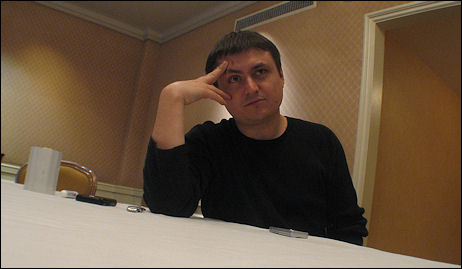
Christian Mungiu‘s 4 Months, 3 Weeks & 2 Days is getting a one-week Oscar qualifying run in Los Angeles starting on 12.21. This will make it slightly easier for various critics groups to give it their Best Foreign Film prize, if they’re so inclined. Before the December date was anounced, the plan was to open it through IFC First Take on 1.25.08.
HE reader Mary Chan wrote yesterday with observations about the shift, to wit:
“As you know, IFC had planned to release 4 Months, 3 Weeks and 2 Days through IFC First Take. But the official site of IFC doesn’t mention 4 Months, 3 Weeks and 2 Days as an IFC First Take release. Nor is this mentioned on the poster credit block.

“Presumably this means that IFC will release 4 Months, 3 Weeks and 2 Days through IFC Films rather than IFC First Take (which means it won’t be released simultaneously in theaters and via video-on-demand). This seems like good news for 4 Months, 3 Weeks and 2 Days. According to IFC’s policy, if they think that a movie isn’t likely to gross more than $1 million in US, they’ll send it to IFC First Take; if they foresee more than $1 million in US, it goes out under IFC Films.”
More money, Les Moonves
A straight-reporting piece by Time’s Rebecca Winters Keegan about the WGA’s “Speechless” spots as well as other online diversions on You Tube, etc. Latest fave: www.lateshowwritersonstrike.com. A slogan from a Justin Stangel piece: “More money, Les Moonves.”
“Enchanted” figures flat…or over $50 million?
Enchanted was steady but flat yesterday. The new five-day projection tally has dropped to $49,086,000, just a nose hair below yesterday’s figure of $49,198,000. Fantasy Moguls’ Steve Mason, who sometimes tends toward generosity, is projecting a five-day tally of $53 million and change. It be It would be entirely natural for Disney distribution execs to claim $50 million-plus in today’s trade box-office stories, and — who knows? — the real Monday figures may bear this out.
Tough Times for Phil Donahue’s “War”
Phil Donahue has told Politico‘s Jeffrey Ressner that he’s “feeling his way along the wall of a dark hallway” in terms of finding theatrical distribution for Body of War, the documentary about a wounded Iraq War veteran he co-directed with Ellen Spiro. The movie can’t get arrested because the leave-us-aloners won’t pay to see Iraq War dramas with movie stars in the cast, which makes distributor interest in a doc along these lines next to nil. It will obviously help if Body of War becomes one of the five Best Feature Doc nominees (it’s on the short list), but…be optimistic!
Sragow on thoughtful heartfelt machismo
An 11.23 L.A. Times essay by critic Michael Sragow about the links between No Country for Old Men, Sam Peckinpah, Norman Mailer, Tommy Lee Jones and Roger Deakins.
Norman Lloyd doc
Touched by his performance as a blind former college professor in Curtis Hanson‘s In Her Shoes, I interviewed the 90 year-old Norman Lloyd at his Brentwood home a couple of years ago. The producer-actor is still going strong today (healthy, plays tennis, gets around town in a Jaguar) and currently the subject of career retrospective doc, Who Is Norman Lloyd?, which opened yesterday at Manhattan’s Film Forum.
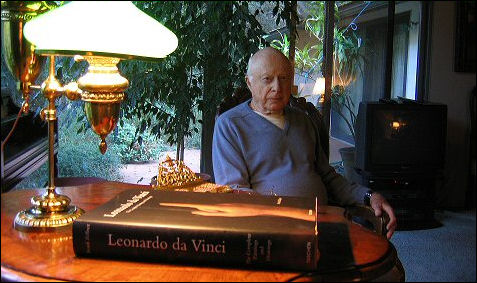
Norman Lloyd in his Brentwood home — Tuesday, 9.27.05, 5:45 pm.
I haven’t seen Matthew Sussman‘s doc yet, but presumably a Los Angeles screening or booking is in the cards.
Here’s Matt Zoller Seitz‘s N.Y. Times review. Here’s a a Leonard Lopate interview on NYPR, John Anderson‘s 11.20 Village Voice profile, and Stu van Airsdale‘s recent Reeler piece. Here’s my own interview piece from two years ago.
Lloyd will drop by the Film Forum on Monday, 11.26 at 8:15 pm for a q & a session with Bruce Goldstein and John Martello, exec director of The Players. Surprise guests may show.
Saturday numbers
Enchanted‘s five-day projection keeps falling, falling…it’s now dropped to under $50 million for five days. $49,198,000, to be precise, with $34,398,000 for the three-day weekend. This Christmas is looking at $27,296,000 for 5 days and $18,800,000 for the weekend. Beowulf will end up with a 5-day tally of $23,399,000. This will bring Robert Zemeckis‘ 3-D fantasy up to a $56,445,000 cume — it’ll be a push to hit $100 million. Hitman keeps on dropping..$20,800,000 for the weekend.
Other 5-day totals: Bee Movie — $15,700,000. Fred Claus — $14,600,000. August Rush — $13,800,000. American Gangster — $13 million even.
The Mist is looking at $12,300,000 for 5 days and $8 million for weekend…dead. No Country or Old Men will earn about $10,700,000 for the five-day holiday for a cume of $16.3 million. It’ll probably pull down $35 to $40 million by the end of the run, although a Best Picture nomination will push it along further. Todd Haynes‘ I’m Not There is will make $955,000 over five days, $720,000 for the weekend — a little over $5000 a print.