“Wild” finale similar to “Time”

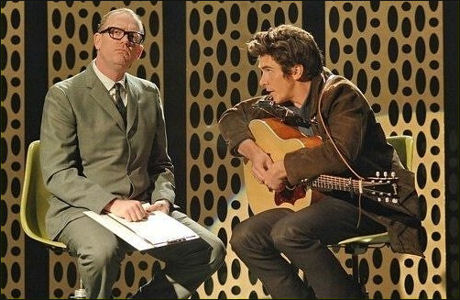
[Note: a spoiler for people who don’t read book reviews or articles about anything, and who live in dark caves on remote Pacific islands follows] Sean Penn concudes Into The Wild with a long, ambitious, unbroken death scene — a crane shot that’s CG-blended with a helicopter shot that conveys the freeing of Emile Hirsch‘s (i.e, Chris McCandless’s) spirit. It’s a closer — it sells the entire film. Without it, Wild wouldn’t be as good, or at least wouldn’t play as well, without it.

It didn’t exactly remind me of the ending of Jeannot Szwarc‘s Somewhere in Time, but there are similarities.

I spoke to that film’s dp, Isidore Mankofsky, two or three years ago and asked him about the long crane and tracking shot that this 1980 film ends with — the camera looking down at Chris Reeve as he gives up the ghost, and then rising and tracking along, looking down at the doctors as they try to save his life, and then it moving straight ahead down a hallway and toward Reeve’s love interest, played by Jane Seymour.

One thing that the Wild and Time finales share is a double-current feeling. The death of the main character is tragic, but on some kind of ethereal, hard-to-define level it doesn’t seem like a totally bad thing because there’s something joyous being conveyed.

No right to be here

“You are a fluke of the universe. You have no right to be here, and whether you can hear it or not, the universe is laughing behind your back.” — from Tony Hendra‘s “Deteriorata,” written 35 years ago for the National Lampoon’s Radio Hour. This very thought occured as I was sitting on my bike at a stoplight this morning on Olympic Blvd. I considered the merits and decided otherwise, but I used to swear by flip cynicism when I was younger.

Scott in “Into The Wild”

Though the structure of Sean Penn‘s Into The Wild may be tragic, “its spirit is anything but,” writes N.Y. Times critic A.O. Scott. “It is infused with an expansive, almost giddy sense of possibility, and it communicates a pure, unaffected delight in open spaces, fresh air and bright sunshine. [It is] alive to the mysteries and difficulties of experience in a way that very few recent American movies have been. The film’s imperfection, like its grandeur, arises from a passionate, generous impulse that is as hard to resist as the call of the open road.”

Shit from shinola

“Intelligencer” reporter Bennett Marcus writes that when a “perky” MTV producer asked Jesse James producer-star Brad Pitt what he’d learned from doing the film. “I didn’t learn shit, really,” Pitt replied. If only others would answer inane red-carpet questions in a similar fashion.

I’m thinking of a scene in Michael Ritchie‘s The Candidate between Robert Redford‘s “Bill McKay” and Kenneth Tobey‘s labor union leader. Tobey: “Well, no point in our getting into our differences. When you get right down to it we may actually find we have a lot in common.” Redford: “Yeah? I don’t think we have shit in common.”

“Resident” review

Hollywood/Chicago’s Shane Hazen, a colleague of HE columnist Adam Fendelman, has seen Resident Evil: Extinction in Austin, and is calling it “yet another cineplex excursion that’s beneath contempt.

“Directed by Russell Mulhaney, who’s best known for the serviceably charming pulp translation of The Shadow, the franchise is injected with a promising Mad Max riff by writer and producer Paul W.S. Anderson — yet does nothing with it.

“At best, I’ve always thought of Anderson (who directed the first film and wrote the second) as a poor man’s Stephen Sommers. To have the second consecutive sequel where Anderson couldn’t be bothered to direct (only write and produce) really says you’re in for B-movie hack hell.

“So Extinction is another video game-based sequel by test-marketed numbers where everything about it was cooler in the trailer.”

“Chuck” reviewed by Lowry

“For an aspiring romp awash in sex and nudity, Mark Helfrich‘s Good Luck, Chuck proves painfully flaccid — a movie that simultaneously squanders its leads and its DVD extras. Dane Cook sells out arenas with his stand-up act, and Jessica Alba is, well, Jessica Alba, but once Chuck exhausts their devoted bases, this doesn’t promise to bring much good luck to Lionsgate.” — from Brian Lowry‘s Variety review.

A voice is telling me reviews of this sort won’t matter when it comes to ticket sales this weekend. (Chuck will probably run a close second to Resident Evil: Extinction.) If a problem of any kind develops, it may be because of what a friend told me this morning: “This is a movie in which Dane Cook is naked in some scenes and Jessica Alba is naked in none. Now, what’s wrong with that concept?”

Faris, Linda Lovelace, “Inferno”

Anyone who’s seen Randy Barbato and Fenton Bailey‘s Inside Deep Throat knows it’s an awfully sad story as far as the life of the late Linda Lovelace was concerned. An emotionally vulnerable, none-too-bright woman who allowed herself to be sexually exploited, and later wound up an extremely pissed-off feminist (no surprise there) and later died from a car accident — a story that’s mainly about low-rent people and some very grim doings.


Ana Faris, Linda Lovelace

The only intrigue is that it’s not a cut-and-dried saga. Lovelace wasn’t forced to star in Deep Throat with a knife at her back, and the doc suggests she was basically the sort of person who responded to strong direction — first from the guy who got her into porn, and later from the feminists who urged her to express anger at what she’s been goaded into doing on-camera.

All to say that Ana Faris has told MTV.com’s Larry Carrollthat she wants to play Lovelace in a “really deep and dark” feature biopic called Inferno, and that she believes it’ll “be cool for me to do.” I doubt it. The urban blues will process it as a portrait of sexual exploitation and probably go “hmmm, tragic story…later” and the rural reds are just going to go, “Whooo-whoo!” Either way it won’t do much for her.

“Kite Runner” concerns

In this audio NPR report by Kim Masters, there are fears about the safety of the children who star in Marc Forster‘s The Kite Runner due to its exposure of “deep ethnic divisions” as well as a scene depicting a sexual assault. The film will not be released in Afghanistan “but it won’t be long before the DVDs show up” in Kabul, says Masters, which may provoke “reprisals from members of the Taliban.”

Schwarzbaum on “Jesse James”

One final reminder to bulldoze your reluctant N.Y. and L.A. friends into seeing The Assassination of Jesse James by the Coward Robert Ford tomorrow, Saturday or Sunday, and get those guldarned, dad-blasted per-screen averages up where they damn well oughta be for a film this plum mesmerizing. If any varmints and polecats need a further nudge, here‘s Liza Schwarzbaum‘s A-plus review in Entertainment Weekly:

The Assassination of Jesse James by the Coward Robert Ford — a haunting retelling of one of the enduring outlaw sagas in American culture — is shot by the brilliant cinematographer Roger Deakins in a wide-open geography of moody skies and fields plaintive with bent light and shadow,” she writes. “Yet the psychological heart of the matter is dark, secretive, and daringly interior.

“This masterful Western by New Zealand filmmaker Andrew Dominik (Chopper), based on the 1983 book by Ron Hansen, dips into the genre-bending influences of wild-card Westerns from the late ’60s and ’70s like Bonnie and Clyde and Days of Heaven for its elegiacally fatalistic tone.

“Yet the picture emerges with something very much plaguing the 21st century on its mind — a cool acceptance of lethal paranoia as the natural state brought on by the weight of too much legend-building and the warp of too much unrequited fandom.

“The charismatic, bank-robbing, gunslinging James, after all, was shot in the back by a puny would-be tagalong who claimed to be the gang leader’s biggest fan, and this is one rueful recounting of how it all went down. Stories about the loneliness of celebrity and the dangers of firearms rarely get starker or more mesmerizing than that.”

“Zodiac” Director’s Cut running time

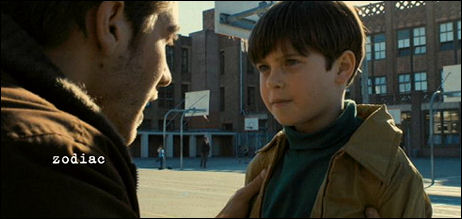
Ever since David Fincher‘s Zodiac opened early last March the hardcores have been eagerly awaiting the “Directors’ Cut” DVD, in part over expectations that something close to a three-hour version of this classic crime-obsession movie would be offered, especially as I’d heard from various sources that something close to a 180-minute cut has been screened, with one publicist telling me in particular that he preferred the longer version to the the final release-print version, which either ran 156 minutes (according to Variety‘s Todd McCarthy), 157 minutes (per Amazon) or 158 minutes (says the IMDB).


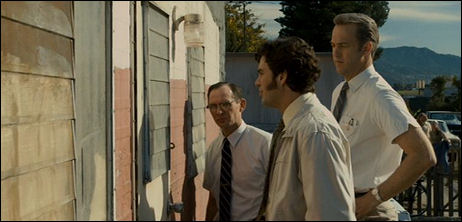
The “Lake Berryessa” scene in Zodiac.

Now for some mildly shocking news: the Zodiac “Director’s Cut” DVD that will be released on 1.8.08 (official stories have run over the last couple of days) will run 162 minutes, according to a story by DVD Lounge‘s Travis Leammons. That will make it a mere five minutes longer than the theatrical version (if you go by the Amazon running time) or six minutes longer if you go with McCarthy’s count.

The whole point of Zodiac is obsession. The fun is in the obsessive wading through detail after detail, clue after clue, hint after hint. It follows, therefore, that the Director’s Cut DVD should give free rein to the film’s investigative intrigues (Jake Gyllenhaal‘s, Mark Ruffalo‘s, Robert Downey‘s…everyone’s). This naturally means more details, hints and clues and more running time to explore each one. In this light, five or six extra minutes isn’t nearly enough. I was looking for at least an extra 20 or 25 minutes. This is very disappointing.

I called Phoenix Picture to see if the 162-minute running time was correct. One guy expressed surprise at this length (“I would have thought it would be closer to three hours”) but said “we have nothing to do with the director’s cut.” I called Paramount Home Video publicity to double-confirm the running time, but the person I was looking for wasn’t in. I tried to reach David Fincher‘s Benjamin Button crew but gave up after a three or four calls. This sounds obsessive in itself.