“I think the Vietnam War drove a stake right through the heart of America. [And] we’ve never really moved [beyond] that…we never recovered.”
I’ve been to Vietnam three times, and would love to return. I’ve even flirted with the idea or moving there permanently. There’s never been the slightest doubt in my mind that Johnson and Nixon administration policy makers brought immense horror and unimaginable slaughter to that beautiful, once-divided country.
But during my three visits I’ve never felt anything but the most tranquil vibes. Nobody has ever given me so much as a hint of a dirty look because of my heritage. The natives who fought against the Americans are, of course, in their 70s and 80s or passed on. The 45-and-unders weren’t even born during the hostilities. Nobody wants to carry that war around — we all want to live in the present.
Which is why I didn’t want to watch Ken Burns and Lynn Novick‘s The Vietnam War, a ten-part, $30 million, 17-hour doc about that tragic conflict, when it premiered on PBS almost exactly six years ago (9.17.17).
But last night…I don’t know why exactly, but I felt suddenly drawn to this miniseries. So I watched three episodes — “The River Styx” (January 1964 – December 1965), “This Is What We Do” (July 1967 – December 1967) and “Things Fall Apart” (January 1968 – July 1968). Five hours without a break. This morning I watched episodes #7, #9 and #10.
I was fascinated, fascinated, horrified, saddened, at times close to tears. What a deluge of death, delusion and horror. Immeasurable and irredeemable. The second most divisive war in U.S. history. And I couldn’t turn it off. Had to see it through. Glad I did.
Excerpt from a 10.10.14 assessment of David Ayer’s Fury: “The climactic situation comes when the weary Brad ‘Wardaddy’ Pitt and his four bone-tired men (Logan Lerman, Shia LaBeouf, Michael Pena and a revolting redneck animal played by Jon Bernthal) are stuck next to a country farmhouse with their tank temporarily disabled by a land mine. They soon after discover that 300 well-armed German troops are marching in their direction.
“Pitt has been ordered by his superior, Jason Isaacs, to protect a supply train, but five guys in a broken-down tank vs. 300 German solders is just suicide, plain and simple. They’ve no chance so why does Pitt decide to fight it out? To what end? They aren’t trapped. They could run for the trees and meet up with U.S. forces later and live to fight again. But no. You can call it bravery but I call it nihilism.
“I understand crazy courage and uncommon valor and all that. I choke up every time I think of Sam Jaffe climbing to the top of the temple so he can blow the bugle and warn the British troops of an ambush at the end of Gunga Din. And I understood the situation during the finale of Pork Chop Hill when 30 or 40 trapped U.S. troops have nothing to do but fight back against hordes of Chinese troops. And the ending of Platoon when U.S. troops were being overrun by North Vietnamese but they fight on regardless and even call in an air strike against their own position. And I certainly understand the Wild Bunch finale when William Holden and Ernest Borgnine and the other two decide that they’re getting old and their lives are over so why not go out in a blaze of gunfire?
“But the Fury finale is nothing like any of these scenarios.
Friendo: “That’s not how it went down.’
HE: “What do you mean that’s not how it went down’? That’s exactly how it went down. Pitt said ‘Nope, I’m gonna fight it out….you guys run for the trees if you want.’ Think about that decision for four or five seconds. It was utter suicide and for what?”
Friendo: “If they made a movie about guys who ran for the hills I don’t think it would be quite the same, would it?”
HE: “Not run for the hills but hide in the trees until the company passes by, and then regroup with the nearby American troops and fight on. What’s wrong with that?
“They weren’t fighting the enemy in order to give other Allied troops time to achieve some other objective — this wasn’t the Alamo. They weren’t ordered to protect a bridge at all costs, like the guys in Saving Private Ryan. This was April 1945 — the end of the war. Hitler would be dead in a couple of weeks. It didn’t matter. If Pitt and his homies had abandoned the tank and run like thieves I would have jumped out of my seat and said ‘Yes! Run for it! All right!'”
Friendo: “The Fury finale was analogous to those two cops in the mean streets of Los Angeles in Ayer’s End of Watch.”
HE: “Not the same thing at all. Sorry but you’re throwing out bad analogies. And that finale in End of Watch was ridiculous also. L.A. cop Jake Gyllenhaal is shot by gangbangers, what, 12 or 15 times and he’s attending the funeral of his partner in the next scene?
Friendo: “I will stand to the end of this thread defending my analogies just like Pitt did against the Nazis!”
HE: “During the big court-martial scene in Paths of Glory a French infantryman, Private Maurice Ferol (Timothy Carey), is asked by the prosecution why he retreated after his comrades had all been killed in an attack on the Ant Hill (i.e., a German fortification). The question is satirically re-phrased by Colonel Dax (Kirk Douglas), the defense counsel. ‘Why didn’t you attack the Ant Hill single-handed?’ Dax asks. ‘Single-handed? Are you kidding, sir?,’ Ferol replies. ‘Yes, I’m kidding,’ Dax says.
“Pitt and his crew going up against 300 German troops isn’t much different from Ferol vs. the Ant Hill, trust me.
“A soldier can’t go into battle saying ‘I don’t want to die…where can I hide?’ He has to go into battle saying ‘we have to man up and accomplish our objective.’ The chances of survival are never good but suicide is suicide. And as a moviegoer I can’t support a battle in which there’s no chance of the protagonists prevailing. There has to be at least a shot at victory.
“If it’s a choice between self-destruction and running for cover in order to live and fight another day, just call me Jeff ‘run for the treeline’ Wells.”
[Posted in mid-November 2013] Yesterday was a long one. A road and train trip from Hoi An to Nha Trang from 7:30 am until just after 10 pm last night. I wanted to visit the My Lai massacre museum near Quang Ngai so we drove down early yesterday morning — a two-hour trek with all the rain and the traffic and road construction. I was told it would take another 11 or 12 hours to drive to Nha Trang so I bought a train ticket from Quang Ngai to Nha Trang, which would take about eight hours, I was told. It took ten.
The down-at-the-heels, less-than-fully-hygienic train left at 1 pm and chugged along at a moderate pace for 400 kilometers, stopping for 10 or 12 minutes at each station. It was hellish, in a sense, but I didn’t want to be encased in a luxurious tourist cocoon. I wanted to feel and smell and taste the real Vietnam like an average local. Well, I got that.
Did the My Lai massacre museum and the surrounding grounds make me feel revolted and a bit nauseous? Of course. Is the after-vibe as bad as Dachau? Pretty much, yes. Cold-blooded mass murder is cold-blooded mass murder. I don’t think the scale of it (504 Vietnamese civilians vs. six million Jews) matters that much in a moral sense.
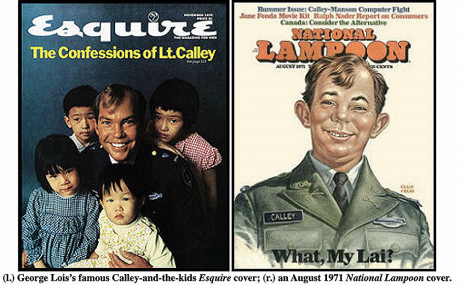
Did visiting the site make me feel a bit ashamed to be an American? Within this context, yes. But then I never felt the slightest kinship or compassion for the principal perpetrators (Col. Oran K. Henderson, Cpt. Ernest Medina, Lt. William Calley). I wasn’t there, of course, and I don’t know what it was like to be in a combat environment. But there’s no way to give this kind of barbarism anything but the harshest condemnation.
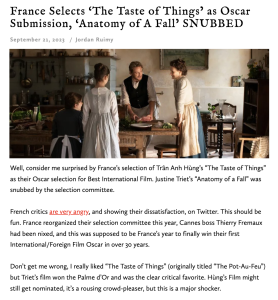
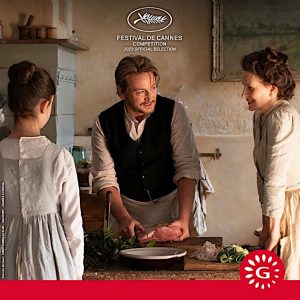
HE has two messages for Eddie Ginley and all the Anatomy of a Fall snooties who had dismissed the idea of France selecting The Pot-au-Feu (aka The Taste of Things) as its official submission for the Best Int’l Feature Oscar.
Nothing makes me feel better than to remind know-it-alls that they don’t know it all.
France did right by selecting an instant classic that is not only spoken entirely in French (Anatomy contains roughly 60% French vs. 40% English) but exudes the soul of France by way of fine French cuisine.
Thanks to World of Reel‘s Jordan Ruimy for the heads up.
This is an old story, but it can’t hurt to tell it again.
It’s been 21 years since the late Roger Ebert pushed back at Asian-American political correctness following a Park City Library screening of Justin Lin‘s Better Luck Tomorrow.
The original version of Lin’s film, which I saw at the very same screening that Ebert attended, was a very sharp and striking film about opportunism and amorality among Asian American youths. During the q & a some guy got up and said this kind of depiction denigrated Asian-American culture and called it “empty and amoral.” Ebert stood up and called that way of thinking repressive horseshit.
Can you imagine how anti-woke Ebert would be today if he was still with us?
Rewatching this video reminds me how Lin copped out on Tomorrow‘s ending after his film got picked up by Paramount. In so doing Lin conveyed to the suits that he was basically looking to roll over and play ball and make commercial films. And that’s what he wound up doing.
After the Paramount acquisition Lin got pressured about the original ending (in which the lead guy, played by Parry Shen, gets away with murder and isn’t all that bothered about it) being overly dark and despairing. So Lin changed it so that the film implied at the very end that Shen would probably get caught for his crime.
GenX dads with attitudes vs. Millennials, Zoomers and sensitive Stalinists. Pretty much a Bill Burr show — starring, directed by, co-written (with Bill Tishler), co-produced by. Plus Bobby Cannavale and Bokeem Woodbine. Netflix debut on 10.20.
Pic was described as a “semi-autobiographical” and “Bill’s stand-up in a narrative form” by The Hollywood Reporter‘s James Hibberd.
…and others can’t. Or shouldn’t, at least. Nic Cage is among the latter group. I am too — I could never, ever go there. Which is why finding a certain clinic in Prague was one of the best things that ever happened in my life.
Posted on 5.11.17: With God’s grace, even moderately talented, less-than-genius-level actors can briefly rise to the heights. Simply by being lucky enough to find the right role in the right film at the right time.
HE’s Top Ten in this regard: Madonna in Evita. Vin Diesel in Find Me Guilty. Kate Hudson in Almost Famous. Justin Timberlake in The Social Network. Jennifer Lopez in Out of Sight. Adam Sandler in Punch Drunk Love. Sly Stallone in Rocky. Ann Margret in Carnal Knowledge. Ryan O’Neal in Barry Lyndon. Gary Lockwood in 2001: A Space Odyssey.
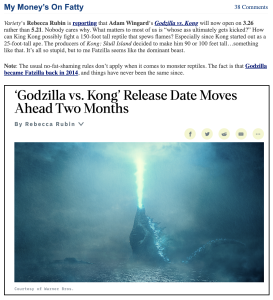
Kurt Russell: “Nine years ago Godzilla turned fat. Actually morbidly obese. He was totally out of control, and what’s worse, 90% of the fan base blamed Hollywood Elsewhere…a massively overweight Godzilla wasn’t the problem, they said, but fatphobia itself. Everything went downhill from there.”
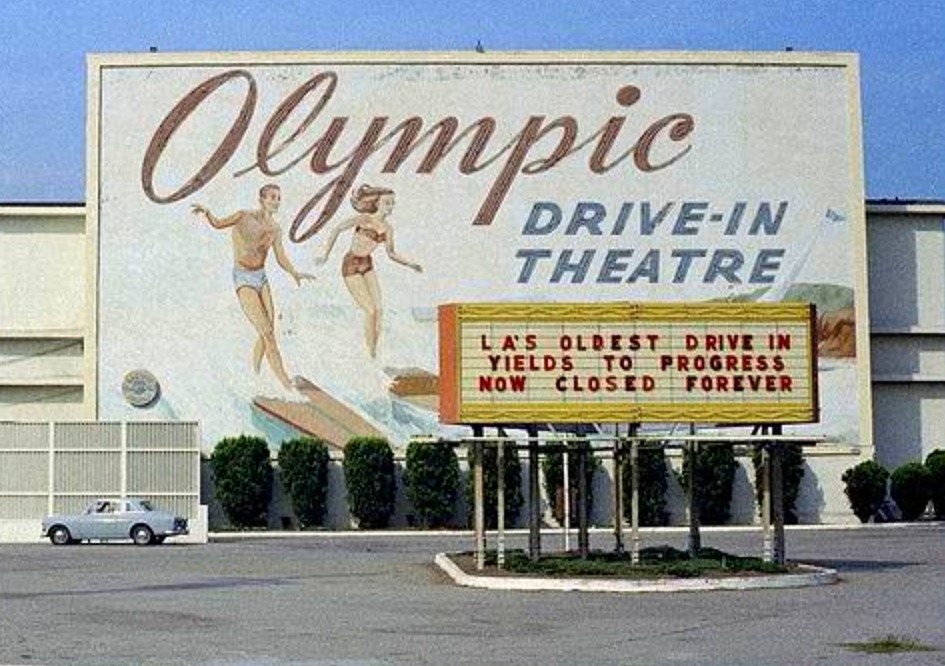
Posted on 8.22.19: I respect the nostalgia that some have shared about the drive-in experience, and I love the Americana aspect of drive-ins…those iconic images of ‘50s and ‘60s films playing to an army of classic Chevy roadsters, Impalas, Buicks, Dodge station wagons, Cadillacs, Ford Fairlanes and T-Birds.
But if you cared even a little bit about Movie Catholic viewing standards (decent sound, tolerable light levels, no headlights hitting the screen every five minutes) you avoided drive-ins like the plague. If you went to drive-in it was mostly for the heavy breathing, and you brought your own beer.
I never actually “did it” at a drive-in. Too uncomfortable. Lots of second-base and third-base action, but what is that in the greater scheme?
Wise guy to HE: “I guess this explains the affection for Elton John ballads. You really are from Connecticut, aren’t you?”
HE to Wise Guy: “What are you saying, that people actually got laid at the drive-in? Some did, I guess. But they sure kept it a secret.”
The last time I saw a film at a drive-in was sometime in the early to mid ’80s. I think it was a Bob Zemeckis film (Used Cars or Romancing The Stone). Somewhere in the northern Burbank area, or in North Hollywood. My first drive-in experience was with my parents, somewhere in the vicinity of Long Beach Island on the Jersey Shore.
“Listen, you fuckers, you screwheads…here is a man who would not take it anymore. A man who stood up against the scum, the cunts, the dogs, the filth, the shit. Here is a man who stood up. Here is…”
The Sun‘s Simon Boyle is reporting that Robert De Niro will reprise TravisBickle in a currently lensing Uber ad campaign. De Niro will be riffing on the Bickle thing (“You talkin’ to me?”) in a series of spots being filmed in London this week. “He’s going to be Travis Bickle, saying some phrases and playing up to it,” etc.
First of all, Bickle died in that 1975 East Village shoot-out. As his soul hovered over the carnage Bickle dreamt that blowing away three guys (Harvey Keitel‘s “Sport,” that gray-haired asshole in the brown suit, that creepy-looking detective with the white shoes) had not only restored his life and made him into a hero (bullshit) but also persuaded Cybill Shepherd to find him attractive, but he’s dead so fucking forget it.
Secondly, even if Bickle had lived it would be meaningless to show him driving an Uber at 80 years of age. Complete bullshit.
However, if the Uber ads use the young Bickle of the mid ’70s…then we’d have something. Then all would be cool.
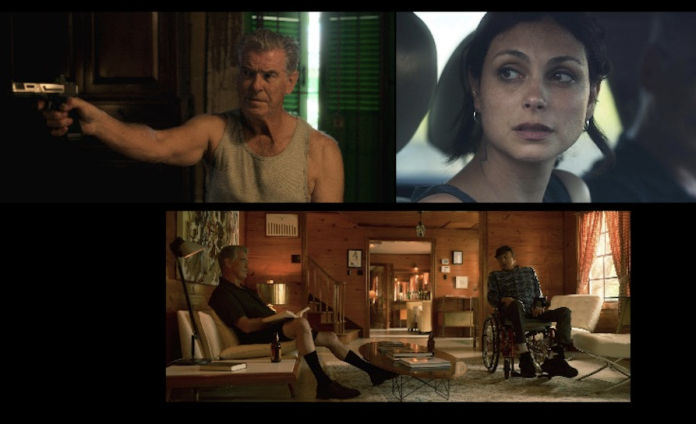
Phillip Noyce‘s Fast Charlie will have its big debut at the Mill Valley Film Festival debut on Saturday, 10.7. Screening invites and links have been received.
I became a fan after catching it at a buyer’s screening during last May’s Cannes Film Festival.
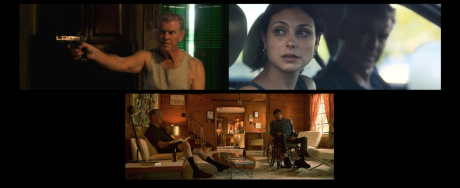
It’s half of a laid-back, settled-down relationship drama between Pierce Brosnan‘s Charlie, a civilized, soft-drawl hitman who loves fine cooking, and Morena Baccarin‘s Marcie, a taxidermist with a world-weary, Thelma Ritter-ish attitude about things. And half of a blam-blam action thriller.
There’s a suspense scene involving a hotel laundry chute that I’m especially taken with.
A trailer will hit in a month, or just after the MVFF debut.
Fleetly performed by Brosnan, Baccarin, Gbenga Akinnagbe and the late James Caan in his final performance, Fast Charlie is….ready?…a mature, unpretentious, character-driven, action-punctuated story of cunning and desire (not just romantic but epicurean) on the Mississippi bayou. Four adjectives plus gourmet servings.
The Brosnan-Baccarin thing reminds me of Robert Forster and Pam Grier in Jackie Brown. Sprinkled with a little Elmore Leonard dressing. One of those smooth older guy + middle-aged woman ease-and-compatibility deals.
Richard Wenk‘s screenplay, adapted from Victor Gischler‘s “Gun Monkeys,” is complemented by cinematography by Australian lenser Warwick Thornton (director of The New Boy).