Gloriously Immune To Woke Mobthink

Posted this morning around 8 am: “To a modest degree Mission: Impossible — Dead Reckoning Part One has a varied cast (the half-Korean Pom Klementieff and the cappuccino Greg Tarzan Davis are the ethnic standouts) but it’s not annoyingly diverse in a Barbie-ish, check-all-the-right-boxes way.

“It was seemingly produced within an alternate reality membrane, welcomely and even gloriously immune to the woke convulsions of the last six years…no conspicuous LGBTQ or trans characters, no Jabbas. Strange as it may sound and as confounding as it jay seem to some, MI:7 isn’t particularly focused on matters of race, gender and sexuality…good heavens!

Contentious Friendo: “One reason that superhero movies dig in harder on diversity and whatever other shit bothers you is because they’re (ostensibly) aspirational, as teenagers have all kinds of identity issues and sensitivities and whatnot.

“Honestly [Hollywood’s woke fetish is] not THAT different from what comics, especially Marvel Comics, did in the ‘60s, introducing Black Panther and the native American character Wyatt Wingfoot.And they were pretty ahead of the curve in gay ‘representation”’ in the ‘80s. It didn’t hurt that X-Men writer Chris Claremont was a bondage enthusiast whose off-hours lifestyle closely resembled what you see in Friedkin’s Cruising.” [HE insertion: “Oooohh, a bondage enthiusiast!”] And then DC got in on the fun with very earnest Social Issue plots, like Green Lantern/Green Arrow fighting the scourge of drug addiction.

“With the basics of the franchise now almost thirty years established, the Mission: Impossible franchise isn’t teen-oriented. Ethan Hunt’s a sexually abstemious James Bond and that’s enough to earn him a pass through woke world, or maybe Chris McQuarrie and Tom Cruise are hell-bent on making sure what they do isn’t ‘relevant’ to the larger world, and jusy serveing up a lot of suspenseful escapism.

“I know you’re consumed by the topic but there is honestly nothing more boring to me than thinking about it. Hollywood ‘ideology’ has always been provisional and ultimately insincere in any event.”

What A Bummer for “The Pot Au Feu”

As a huge fan of Tran Anh Hung’s The Pot au Feu, which I praised a few weeks ago during the 2023 Cannes Film Festival, I was heartbroken to learn that it’s been acquired by IFC Films and Sapan Studios.

The Pot au Feu (aka The Passion of Doudin Bouffant) could become a major adult-market hit (it’s the greatest foodie flick of the 21st Century) and perhaps a major contender for Best International Feature Oscar, depending on whether or not France officially submits it.

Forgive my prejudiced viewpoint, but I’ve long believed that an IFC Films distribution deal is almost tantamount to a kiss of death. It’s certainly a guarantee that a first-rate, ecstatically reviewed European film will not be vigorously publicized and hooplah-ed. What IFC Films seems to do, in fact, is acquire exciting, critically hailed titles only to bury them.

History tells us that whenever a terrific Cannes movie is acquired by IFC Films, it is (a) never promoted for Oscar consideration (too costly for a cash-strapped distributor) and is (b) always released to low or non-existent buzz several months after the initial Cannes or Venice Film Festival breakout.

They certainly buried Kent JonesDiane (’18) or at least the Best Actress prospects for Mary Kay Place, who won Best Actress trophies from the Los Angeles Film Critics Association the National Society of Film Critics Award for Best Actress. They buried the hell out of Olivier AssayasPersonal Shopper, which exploded in Cannes in 2016 only to limp its way to an anemic box-office opening in March 2017. God’s Country, an IFC Films acquisition, whiffed when it opened on 9.12.22. IFC had a nice little charmer in Stephen FrearsThe Lost King (HE-reviewed on 3.24.23), and it barely made a ripple.

People see what they want to see, of course, but it always seems as if excellent movies under-perform when IFC Films is at the helm.

Will IFC Films (which currently has a 100% Rotten Tomatoes rating) at least offer to screen The Pot au Feu in Telluride and Toronto? This movie is a hit waiting to happen, at least among over-40 types.

Read more

Haven’t Much Interest…Sorry

Steven Soderbergh and Ed Solomon‘s Full Circle (Max, 7.13) is a six-part botched-kidnapping drama, set in New York City and Guyana.

The complex tale was inspired by Akira Kurosawa‘s High and Low (’63), a similar kidnapping drama which isn’t as good as its reputation. We’ve all been instructed to drop to our knees in admiration because of the Kurosawa brand, but I saw it for the first time about a year ago and wasn’t impressed. I’m sorry but I hated the grainy, bleachy cinematography by Asakazu Nakai and Takao Saito.

I am therefore less than fully interested in Full Circle, which is about an affluent Manhattan couple (Claire Danes, Timothy Olyphant) grappling with whether to pay a ransom for a kid they don’t know; some kind of insurance scheme provides a further wrinkle. No thanks.

An Interesting Man

Maximillian Schell (1930 – 2014) was such a brilliant, inquisitive, well-cultured smoothie, not just during his prime years (late ’50s to mid ’80s) but throughout his life. I love how he constantly turns things around and throws questions back during this Dick Cavett interview segment. Very few interview subjects do this. They want to seem interesting and alluring and so they play along; they almost always never say “wait, what do you mean?”

Read more

I Didn’t Mind “Bridge of Spies”

Posted on 10.4.15: Steven Spielberg‘s Bridge Of Spies (Dreamworks, 10.16) isn’t half bad — a sombre, dialogue-driven, fact-based spy tale. It’s a little Spielbergy in the second half (i.e., visual punctuations or signatures that feel a bit pushed or manipulative) but not in ways that I would call excessive or tedious. It’s aimed at the over-40 crowd as younger auds will most likely steer clear.

The only obvious stand-out, Oscar-worthy attribute is Mark Rylance‘s droll supporting performance as real-life Russian spy Rudolf Abel, but it’s a keeper. Rylance owns this movie the way Jane Fonda owns Youth; he may very well snag a BSA nomination.

Regular HE readers know how I feel about Spielberg, and I’m telling you I didn’t feel as if I was suffering through this at all. Half of Spies is actually pretty good and the other half is…well, in and out but basically tolerable. From me that’s almost a rave. And I don’t think that’s proportional. This is not a “great” film but a smart and mostly satisfying one, especially if you’re getting older and fatter and have a few faded memories of the days when Russian commmies were the big baddies.

Tom Hanks, once again portraying a walking emblem for American front-porch decency and Atticus Finch-style values, is James B. Donovan, the late American attorney who defended Abel after his arrest in ’57, and then, following the 1960 Russian capture of U2 spy-plane pilot Francis Gary Powers, was asked to fly to Berlin to negotiate for Powers’ release by swapping him for Abel. Donovan also managed to free wrongly accused academic Frederic Pryor, whom the East Germans were holding on suspicion of espionage.

Spies is basically two espionage flicks, the first and best taking place in New York City in the late ’50s and the second occuring in Berlin in ’61 and early ’62. The Spielbergy stuff starts to kick in during the second half, and when it happens you’ll say to yourself “okay, here we go…time for Spielberg to remind us every so often what a great and exacting cinematic composer he can be.” What’s so great about part one (i.e., the New York chapter) is that Spielberg doesn’t insert any conspicuously brilliant flourishes at all, or at least none that demanded my attention.

Read more

“We’re Takin’ On Too Much Wah-Wah”

Nobody talks anymore about Sir “Low” Grade‘s Raise The Titanic, which opened and bombed in August 1980. Which means they’re also not talking about an incident that happens around the halfway point, when salvage experts begin to prepare for the dangerous job of actually raising the Titanic from the ocean floor.

At a depth near 10,000 feet, one of the project’s submersibles, Starfish, experiences a cabin flood and implodes.

“This is Turtle…we got Starfish in visual contact.”

Two Angry Men (Jew vs. Kraut)

The early car conflict scene between two old guys (Lou Gilbert‘s “Rosenbaum” and Ben Dova‘s “Klaus Szell”) is one of the most gripping sequences in John Schlesinger‘s Marathon Man (10.8.76).

Set on a one-way street in the 70s or 80s in Manhattan’s Upper East Side, it must have been a bitch to shoot with all the traffic control issues and whatnot.

One problem: I’ve never believed that both men would recklessly and obliviously drive full-speed into a fuel truck. Perhaps one of them but not both. A potentially great scene ends on a note of disappointment.

Sidenote: 24 or 25 years before Marathon Man Gilbert played “Pablo,” a trusted friend and ally of Marlon Brando‘s Emiliano Zapata, in Elia Kazan‘s Viva Zapata (’52)

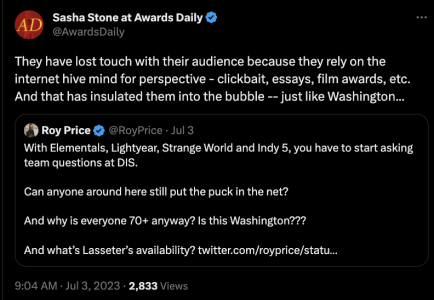
Jeff & Sasha: Hollywood’s Ongoing Woke Implosion

No matter what the topic, Jeff and Sasha are reminded that there isn’t a single aspect of Hollywood diversion these days that hasn’t been woke-modified, influenced, or compromised by the urge to educate and enlighten by way of progressive guilt-tripping. Hollywood, in short, has totally torpedoed the classic idea of entertainment and Average Joes are sick of the preaching.

Oscar Poker Substack topics include the imminent financial disappointment of India Jones and the Dial of Destiny, Ethan Coen and Trish Foster‘s Drive-Away Dolls and the rare journalistic cojones of Deadline‘s Michael Cieply.

Again, the link.

Read more