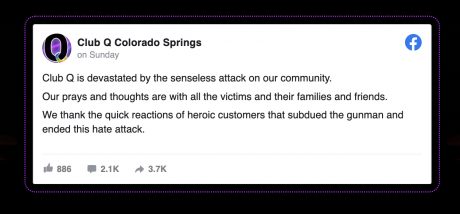
Last night the Daily Mail‘s Paul Farrell and Stephen M. LePore posted a story about the Club Q shooter, a massively overweight, non-binary wackazoid named Anderson Lee Aldrich.
The 22 year old murderer of five patrons at Club Q last Saturday night is the son of Aaron Brink, a former MMA fighter and porn star who has sexually performed under the name of “Dick Delaware”, and Laura Voepel.
And you’re reading about this nightmare and going “good God!!” It’s a story about epic-scale derangement and dysfunction and unbridled rage on the part of ALA, and it just makes you feel sick to read it. There’s some sort of lunatic virus streaming through a white-trash subset of the American middle class right now, and the overwhelming impression is that these people are degraded and diseased and unable to focus their energies in any kind of healthy (or at least non-destructive) direction.
Aldrich, whose birth name was Nicholas Franklin Brink until he changed it in 2016, got into some kind of guns-at-the-ready trouble with the local fuzz in ’21, and you’d think with his history that someone in authority would take his weapons away as a cautionary move while examining his situation.
Posted on 10.1.22: “The common consensus is that whatever you may think of Noah Baumbach’s WhiteNoise, a dryly farcical ‘80s period drama set in an Ohio college town, the final sequence — an ambitiously choreographed dance sequence featuring shoppers at an A & P supermarket — is the highlight.
“The sequence affirms the film’s basic theme about nearly everyone turning to all kinds of distractions (including food) to avoid contemplating their own mortality.
“Though brilliantly staged, the dance number is undercut by Baumbach’s decision to use it as a closing credits backdrop. Here’s how I put it to a friend:
“The LCD Soundsystem ‘New Body Rumba’ finale could have been great if Baumbach hadn’t decided to overlay it with closing credits. I almost shouted out loud ‘Oh no!! He’s blowing it!!’
“I’msayingthisbecause once the credits begin we instantly disengage aswetellourselves‘okay, themovie’soversotheaisle–dancingis just a colorful bit, a spirit-picker-upper…whatever.’
“If Baumbach hadn’t given us permission to disengage, the dancing could have been wild and mind-blowing in a surreal Luis Bunuel-meets-Pedro Almodovar way. It could have been a mad slash across a wet-paint canvas…a Gene Kelly consumer-orgy crescendo.
“And then it could have segued into a closing credit crawl. Alas…”
…from wearing Mexican huarache mandals to afternoon parties?
The answer is that you can’t. If guys want to wear these godawful things you have three options — (a) man up and roll with it, (b) avoid looking or (c) thank your host profusely, tell him/her how much you enjoyed the gathering and leave. No offense to the wearer. I just can’t stand mandals in any form.
Sitting second from right on the right side of the sofa is Cold War star Joanna Kulig.
William H. Clothier‘s framings of John Ford‘s The Horse Soldiers (’59) are so visually pleasing…so wonderfully balanced and lighted, not to mention staged and edited to a fare-thee-well. First-rate filmmaking from an old-time era when 1.66 was still a celebrated aspect ratio.
The attack of the children’s army sequence is pure pleasure. There’s a moment when Sgt. Major Kirby (Judson Pratt) is about to take a shot at the approaching Jefferson Military Academy Reverend (Basil Ruysdael, who was 81 at the time), and Colonel John Marlowe (JohnWayne) stops him at the last second. I love the “are you kidding?” look that Wayne gives Pratt — no anger, just mild irritation.
The Horse Soldiers viewer is never unaware that he/she is watching a John Ford/John Wayne film, but the feeling of comfort and assurance is sublime.
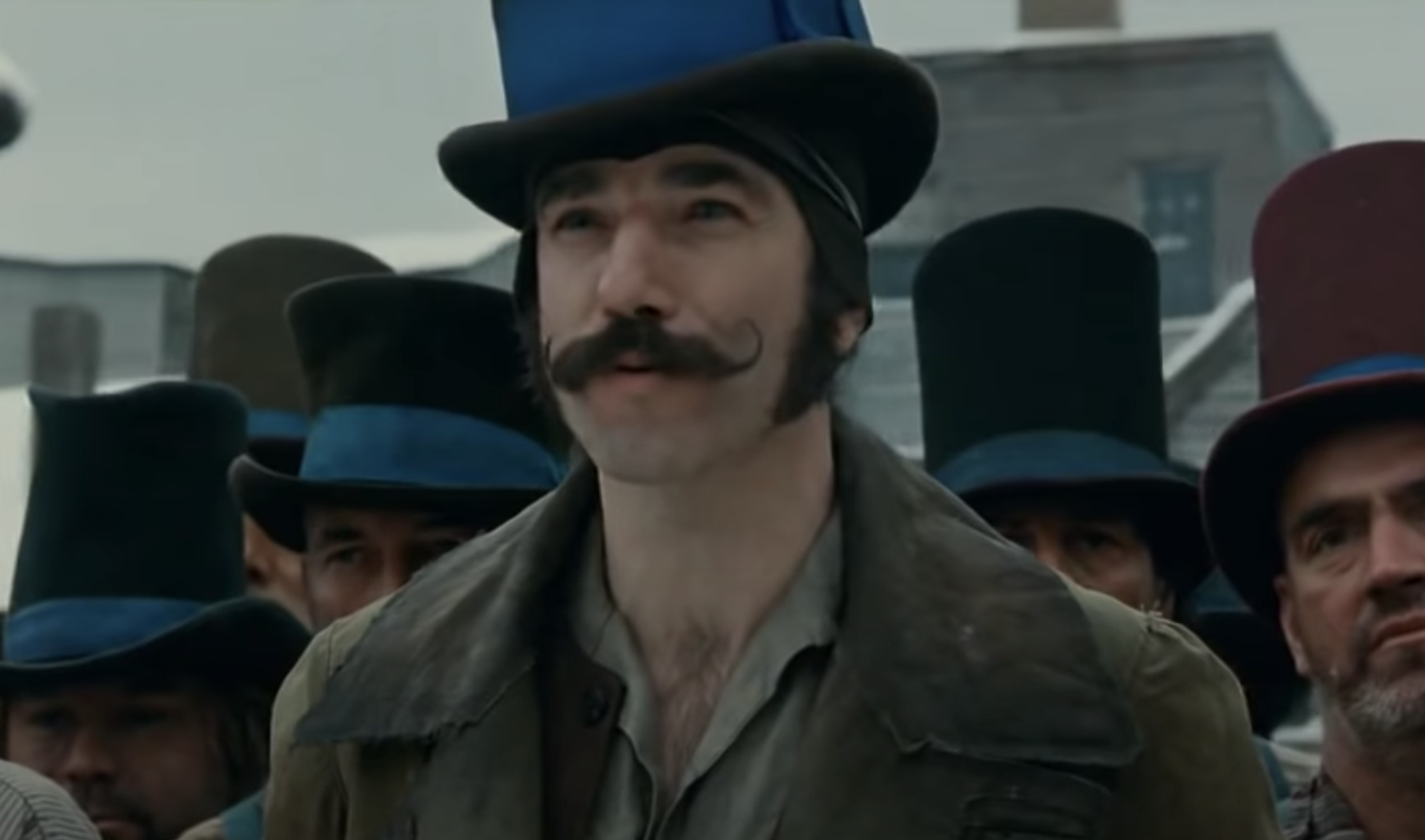
I was told earlier today that the Gangs of New York Wikipedia page mentions a noteworthy piece by yours truly, posted in December 2001, that described the differences between a 1.37:1 work print version of Gangs that I saw on VHS vs. the final 2.39:1 release version. Here’s a link to the original article, and here’s a repost of it:
If Miramax Films and Martin Scorsese had decided to release a polished, cleaned-up version of the Gangs of New York work print they had in the can (or, if you want to get technical, that was stored on Marty and editor Thelma Schoonmaker‘s Avid) sometime in October ’01, we’d all be enjoying a better, more rewarding film than the Gangs that will open nationwide four days from now (12.20.02).
I’ve seen both versions and most of you haven’t, so I know something you don’t. The best Gangs of New York will not be hitting screens this weekend, and may never even be seen on DVD, given Scorsese’s apparent disinterest in releasing “director’s cut” versions of his films, or in supplying deleted scenes or outtakes or any of that jazz.
The work-print version is longer by roughly 20 minutes, and more filled out and expressive as a result, but that’s not the thing. The main distinction for me is that it’splainerand therefore morecinematic, as it doesn’t use the narration track that, in my view, pollutes the official version. It also lacks a musical score, with only some drums and temp music.
This leaves you free, in short, to simply pick and choose from the feast of visual information that Gangs of New York is, and make of it what you will. And if that isn’t the essence of great movie-watching, I don’t know what is.
It also points out what’s wrong with the theatrical release version, which I feel has been fussed over too intensively, compressed, simplified, lathered in big-movie music and, to some extent, thematically obscured.
Miramax and Scorsese had the superior work-print version in their hands 14 months ago. It’s a little rough around the edges, but it’s not tremendously different from the version being released on Friday. It is only missing Leonardo DiCaprio‘s narration, a musical score and some CG effects, which tells me it could have easily been prepared for a December ’01 release. But Miramax decided otherwise and pushed it back it until now. If you ask me their reasons for doing so were short-sighted and wrong.
HE’s “B. Dog” (posted earlier today): “What’s missing? A sense of surprise. And the new trailer’s visuals, themes, dialogue, characters…none have changed. There’s a feeling of ‘haven’t we kinda seen this already?’ That said, they have to market this thing some way, right? So might as well go with ‘familiarity’ and a ‘Welcome back to the awe of Pandora’ strategy.
“I’m going to assume James Cameron and his writers have assembled some clever and compelling narrative suspense and structure under all this animated CGI stuff to drive more Avatar movies. I mean, one would hope. But it’s not evident in the trailers. At all.”
James Cameron to GQ‘s Zach Baron, as excerpted in a World of Reel post: [“Avatar: The Way Of Water is] very fucking [expensive]…the worst business case in movie history. It’ll have to be the third or fourth highest-grossing film in history [to become profitable]. That’s your threshold. That’s your break even.”
Ruimy: “Cameron has already mentioned that, if The Way of Water doesn’t break even (or earn roughly $800 million), he might stop making Avatar movies after the third, already completed one gets released.”
World of Reel commenter Richie Rich: “The story I’ve gathered from the trailer is that Jake and his family had to leave the forest and move in with the water people. So now they have to learn ‘the way of water’. And I’m sure some bad guys (who may or may not have been the ones who forced them out to the forest) will come to disrupt their new lives leading to Jake and family fighting with the water people against said bad guys.”
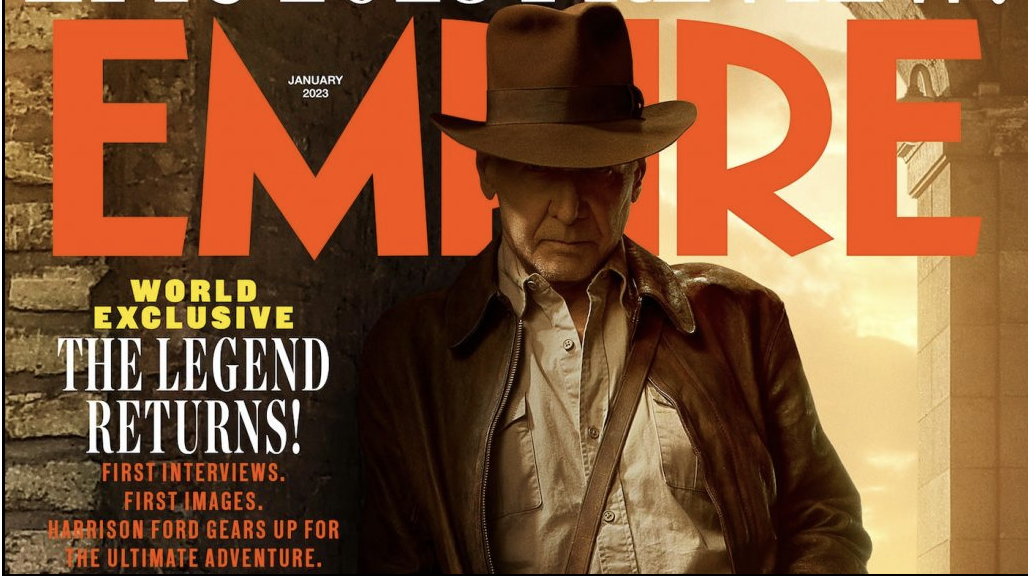
I’ve always understood that Jones was born sometime around 1900, and so Ford (roughly 38 or 39 during the shooting of Raiders of the Lost Ark) will be inhabiting the 44 year-old archeologist in the forthcoming James Mangold film (Disney, 6.30.23).
Are we clear so far? In Indy 5 Jones will start out as a 44 year-old, or roughly six years older than he was in Last Crusade, which took place in 1938 and was released in 1989, when Ford was 47. Even I’m a bit confused.
The Indy 5 prelude is set in an old castle and involves Nazi antagonists. A blend of old footage plus anti-aging tech was used to make Ford look 44, or roughly how he appeared in Witness (’85) and The Mosquito Coast (’86). Ford was born in 1942.
Ford to Empire: “This is the first time I’ve seen [de-aging technology] where I believe it. It’s a little spooky. I don’t think I even want to know how it works, but it works.”
After the opener, Indy 5‘s story will advance 25 years to 1969, when Jones is supposed to be roughly 69. So Ford will be playing ten years younger than his actual age, which shouldn’t be a problem.
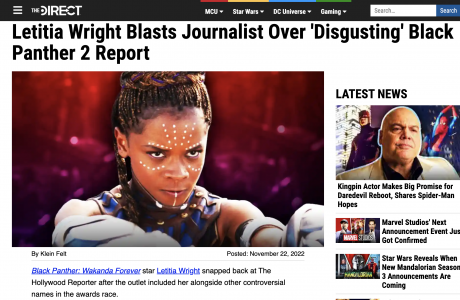
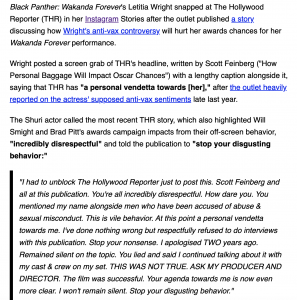
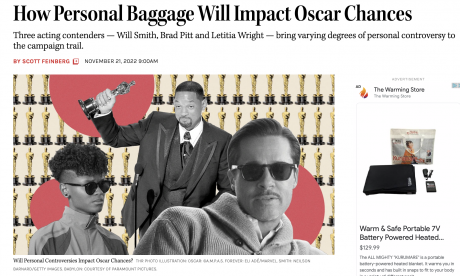
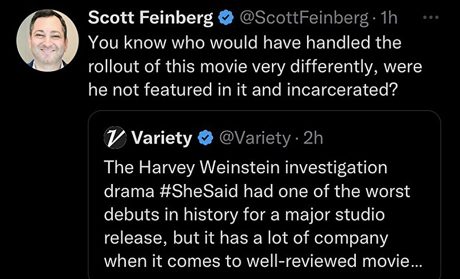
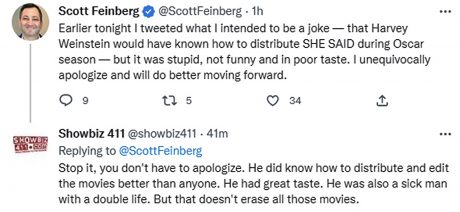
Two days after The Hollywood Reporter‘s Scott Feinbergmanaged to apologize his way out of a #MeToo Harvey Weinstein kerfuffle, another incident has blown up with Wakanda Forever star Letitia Wright, due to Feinberg having written about Wright having award-season baggage due to allegedly promoting anti-vax messaging.
“You’re all incredibly disrespectful“, Wright has stated on Instagram. “This is vile behavior. Stop your disgusting behavior.”
It has to be acknowledged that Wakanda Forever is a very difficult sit (or at least it was for me), and that in a sane world no one would even be flirting with the idea of nominating Wright for anything….please.
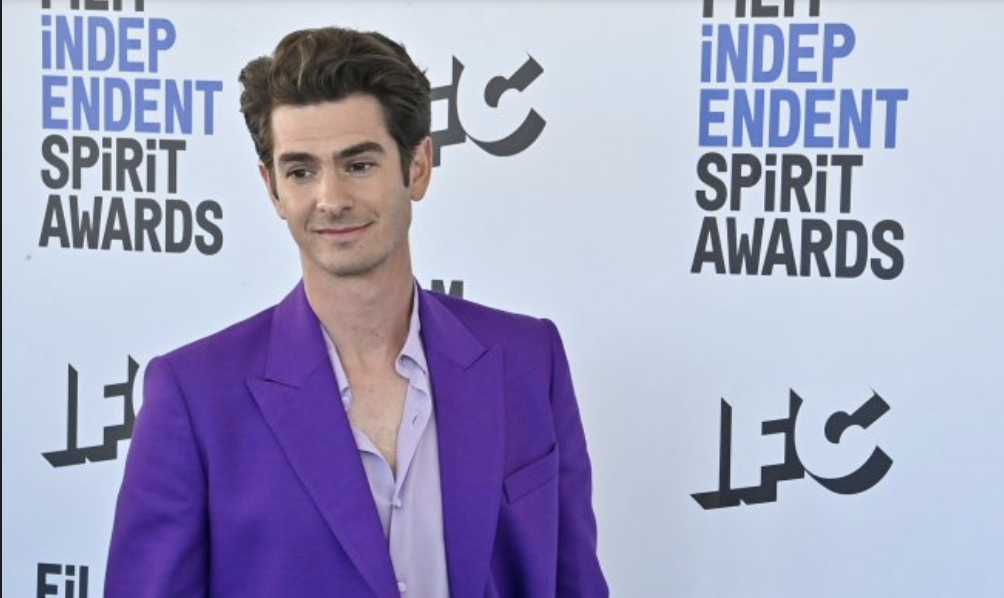
Back in the old days (i.e., seven or eight years ago and earlier) the Spirit Awards were known as the hip Oscars. Now they’re a secular award forum for the Woke Branch Davidians.
The Spirit Award nominations popped today, and what an inexplicable setback for The Whale‘s Brendan Fraser, who was expected to pick up an easy Best Lead Performance nom on his path to the Oscars.
If the Spirits were still adhering to gender categories, Fraser would have certainly been nominated for Best Actor.
But even under current gender-free system he still should have been nominated. Fraser plays a massively overweight gay guy (two woke points in one character) plus he has his emotional comeback narrative. What was the problem exactly?
On top of which the Spirit Davidians backhanded Danielle Deadwyler’s powerful performance as Mamie Till in Chinonye Chukwu’s Till. They brushed aside a major BIPOC performance in a film about the most searing incident in the 1950s and ’60s Civil Rights movement?
They also told James Gray‘s Armageddon Time to take a hike; ditto costar Jeremy Strong in the supporting category.
As things currently stand, the Spirit Davidians have announced ten nominations for Best Lead Performance, and only two honor male performances — Aftersun‘s Paul Mescal (a performance that I hated with a passion) and The Inspection‘s Jeremy Pope (which I still haven’t seen).
Here are the nominees along with HE’s boldfaced preferences in each category:
Best Feature:
“Bones and All” (MGM/United Artists Releasing)
“Everything Everywhere All at Once” (A24)
“Our Father, the Devil” (Resolve Media) “Tár” (Focus Features)
“Women Talking” (MGM/United Artists Releasing)
Best Director
Todd Field – “Tár”
Kogonada – “After Yang”
Daniel Kwan, Daniel Scheinert — “Everything Everywhere All at Once”
Sarah Polley – “Women Talking”
Halina Reijn – “Bodies Bodies Bodies”
Best Lead Performance
Cate Blanchett – “Tár”
Dale Dickey – “A Love Song”
Mia Goth – “Pearl”
Regina Hall – “Honk for Jesus. Save Your Soul.”
Paul Mescal – “Aftersun”
Aubrey Plaza – “Emily the Criminal”
Jeremy Pope – “The Inspection”
Taylor Russell – “Bones and All”
Andrea Riseborough – “To Leslie”
Michelle Yeoh – “Everything Everywhere All at Once”
In my limited white-guy mind rap and hip-hop didn’t really ignite until the late ’80s, mainly when NWA became popular in ’87. Musical scholars will also tell you that rap & hip-hop are generally understood to have originated in New York City in the 1970s.
And yet the very first time I associated the word “rap” with musical punch and propulsion was when I heard “The Rapper,” a lame flash-in-the-pan single from The Jaggerz. “The Rapper” was released in January 1970, or nearly 53 years ago.
“The Rapper” was also the first male-composed pop song that could be interpreted as sympathetic to women in a political sense, and even supportive of the nascent women’s liberation movement. It’s basically a “women beware” song that warns of insincere assholes who will turn on the charm spigot in order to get laid any way they can.
It’s my suspicion that the song’s author, Donnie Iris, wrote “The Rapper” out of resentment and jealousy. Iris probably saw himself as the soulful, sensitive type, and he probably became infuriated when he noticed that full-of-shit types were having better luck with women than he was — that hot women were falling for the puerile.
Iris to women of the late ’60s: “Don’t you girls understand that you’re making a mistake by blowing off sensitive soul men like myself in favor of Shallow Hals who have nothing on their minds except dipping their wicks? My song is telling the truth — these seducers are empty vessels, and they have nothing to offer. Please think it over and consider what you’re missing. I’m the kind of Frye-boots-wearing guy you want to go home with, and not those insincere jackals in their polyester shirts.”
HE to Feinberg and especially the wokesters who beat him with the same stick that the Turks beat Peter O’Toole with in Lawrence to Arabia: It’s perfectly allowable to simultaneously walk and chew gum while discussing Harvey Weinstein. Pre-#MeToo and in private suites Harvey was a brutal, beastly rapist (proven, no question) but he was also a canny distributor with brilliant, go-getter instincts. If he wasn’t a deranged criminal and not behind bars and running Miramax and the Weinstein Co. like he did between the mid ’90s and mid teens, Harvey might have managed a very respectable sell of She Said.
Attorney Friend to HE: “Do you spend time with your family?” HE to attorney friend: “Sure, I do.” Attorney Friend to HE: “Good. Because a man who doesn’t spend time with his family can never be a real man.”