I went last Friday to an ear doctor and discovered that my left ear canal and especially the left ear drum were totally jammed. I was told to go home and squeeze several drops of Debrox into this afflicted ear two or three times on Saturday and Sunday. Which I did.
I returned to the doctor’s office this morning and an assistant whirred and vacuumed me out with warm water, and guess what? Both ears are now totally clean and semi-purified, and now my hearing is better…really.
What I mean is that I can now hear as well as I did 20 or 25 years ago, or maybe even 30. My hearing isn’t as good as my granddaughter’s, but I feel renewed regardless.
And if I can’t quite hear what you just said in the midst of a loud clattery party, it’s your fault because you’re slurring your words and/or failing to speak with the diction of a RADA-trained Shakespearean actor. Learn to project and enunciate like Ian McKellen (whom I’ve hung with on a couple of social occasions so don’t tell me) and we’ll both be better off.
The general consensus has sunk in all over, and it’s this: Trump’s military parade in Washington, D.C. felt rote, pallid and under-attended while the NO KINGS demonstrations across the nation were broadly supported and far more vigorous. I think that’s fair to say.
“I have never experienced such a joyless, lifeless, and sterile mass event in my entire life. Grim-faced soldiers, marching past half-empty grandstands, many of them obviously wanting to be somewhere else. No bands. Little bunting. Just piped-in rock music and MAGA hats. If this truly was meant to honor the 250 years of the United States Army, all we got was an endless procession of uniformed troops looking like they’d prefer to have been at Valley Forge. The president, sitting on the reviewing stand in that weird, forward-leaning attitude that he has, rarely smiling, a skunk at his own garden party.
“I think there probably was more good feeling and genuine emotion when they took Jack Kennedy out to Arlington for the last time.” — Esquire‘s Charles P. Pierce, 6.15.25.
I’m going to say this plain and straight and no bullshit. I hate (i.e., am totally bored by) Ennio Morricone‘s score for John Carpenter‘s The Thing (’82), and all my life I’ve completely worshipped and adored Dimitri Tiomkin‘s score for Howard Hawks and Christian Nyby‘s The Thing From Another World (’51).
This video of Brad Pitt and g.f. Ines de Ramon was shot yesterday in Manhattan. It immediately sent me into a tailspin of depression.
One, the poor guy looks awful — at least 15 or 20 pounds heavier that I’ve ever seen him before, and his hair all but completely shaved off. I’m presuming this is because Pitt has been playing a former Navy SEAL in David Ayer‘s Heart of the Beast, but nobody wants to see a handsome movie star looking all bloated and grunted up.
Even worse is Pitt’s ghastly baby-blue velour suit — oversized, extra-baggy pants. Plus he’s wearing a beige-yellow striped shirt that looks like he snagged it at a Goodwill store…what the hell are you doing, man?
I was going to call this post “Fat Pitt”, but that would’ve made me feel worse.
Five days hence (6.20.25) marks the 50th anniversary of the release of StevenSpielberg‘s Jaws.
Given its reputation as the film that pioneered the ubiquitous wide-release saturation strategy, HE is again reminding that the real saturation trailblazer was Chartoff-Winkler’s Breakout, a quasi-exploitation prison-break flick costarring Charles Bronson, Jill Ireland and Robert Duvall.
HE update: Commenter Sonny Hooper argues that 1974’s The Trial of Billy Jack (11.13.74) began with a thousand-theatre break on a four-wall basis, and therefore launched the practice of saturation bookings six months before Breakout and Jaws. I’ve always thought that the indie nature of that film plus the four-walling thing…I’ve always thought these factors constituted an asterisk.
Put it this way: Breakout and Jaws were the first studio-distributed films (Columbia and Universal being the studios) to launch with saturation bookings.
Postedon4.17.16: A veteran filmmaker reminded me yesterday that Breakout, a 1975 B-grade action flick that’s basically about a helicopter pilot (Charles Bronson) air-lifting a framed American prisoner (Robert Duvall) out of a Mexican jail, was the first film to open via wide saturation booking, and not Jaws, which usually gets the credit.
After Breakout opened internationally on 3.6.75, Columbia opted for a radical, roll-the-dice decision to open this mezzo-mezzo actioner in 1350 situations on 5.21.75. After two weeks it had grossed a then-head-turning $12.7 million.
Impressed, Universal chairman Lew Wasserman and studio president Sid Sheinberg decided to ape this strategy by opening Jaws, which they knew would be a big hit, on 6.20.75 in a similar fashion.
The initial Jaws plan was to open it in 900 theatres, but Wasserman cut that figure down to 464. Wikipedia claims that Breakout opened on 1300 screens, or nearly three times the opening-day screen count of Jaws. The veteran who reminded me about Breakout recalled a screen tally more in the 600 range.
I just think it should be recognized or remembered that the Breakout guys were the saturation pioneers and not the Jaws copycats.
Full disclosure: I don’t think I’ve ever seen Breakout. (Or have I?) It was regarded as a harmless, enjoyable diversion at the time, although no one thought it was anything more than a throwaway for drive-ins and sub-runs. Now that it’s been re-activated in my mind I intend to stream it soon.
As I noted a few days ago, Celine Song‘s Materialists (A24, now playing) is a better-than-decent romantic drama about a Manhattan matchmaker (Dakota Johnson‘s 35-year-old Lucy). And yet I said in the headline that it might not charm average ticket-buyers.
The fact that Materialists currently has a Cinemascore rating of B-minus doesn’t mean it’s dead in the water, but it certainly indicates that Joe and Jane Popcorn aren’t altogether happy.
People don’t liked being lied to, as I mentioned yesterday, plus (this is admittedly a peripheral issue) they probably don’t like being instructed about the advisability of interracial dating and marriage.
I mentioned this in my original 6.11 review but here we go again: In a second-act scene Song is clearly casting negative aspersions upon one of Lucy’s female clients, a paleface, because she’s said she’s mostly interested in finding a white boyfriend or husband. Lucy doesn’t scold the client when she hears this, but she’s obviously a bit put off.
Question: What’s so awful about a bird of a particular feather wanting to mate with someone from her own flock? Song is presumably aware that some POCs prefer the romantic company of men or women from their own tribe. She’s also presumably aware that some years ago Denzel Washington stated that he’s uncomfortable kissing white women in his films, and that he prefers hooking up with women of color. And yet in Song’s world, whites aren’t allowed to voice similar feelings.
Toward the end of the film Lucy and Chris Evans‘ John, an under-employed actor, happen to observe an inter-racial GenZ marriage ceremony in upstate New York. (Rebecca of Sunnybrook Farm exchanging vows with a 20something Jimi Hendrix in a gray tux.) We all understand that black-white marriages are increasing among Zoomers, although the percentage of such unions is relatively small (between 5% and 10%). What we know for sure is that Song is conveying her approval by way of virtue signalling. I hate this shit but that’s me.
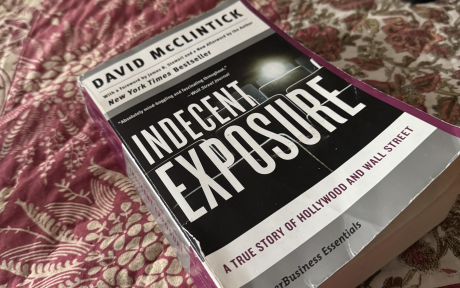
Having taken three or four weeks to re-read David McClintick‘s “Indecent Exposure“, a fascinating, well-detailed saga of the David Begelman/Columbia Pictures check-forging scandal of ’77 and ’78, I’ve come to a conclusion that two mistakes were made.
Inner-sanctum Hollywood was always a tawdry, slippery, self-protecting community, and McClintick’s portraiture makes that extra-double clear. But even in this environment Begelman’s pattern of felonious thievery — not only forging a $10K check made out to Cliff Robertson but also checks for $85K and $25K that had been made out respectively to director Martin Ritt and resturateur Pierre Groleau (mistake #1 in the aggregate) — went beyond the pale.
And yet it all blew up because Robertson, fearful of possible tax consequences and under advice from his attorney, reported Begelman’s check-forging to the authorities. And that was arguably the biggest error, certainly in a political sense. At the end of the day Begelman was mostly forgiven while Robertson wound up being blacklisted by Columbia for a long stretch.
Cliff, his wife Dina Merrill and his attorney should have kept it all within the family. They should have gone to Columbia CEO Alan Hisrchfield and said, “This is obviously illegal and sticky if the feds get wind, but if you can offer absolute assurance that Begelman’s criminality stops here and now and if you make this right as far as my standing and interests are concerned, I’m willing to sit on his whole business in order to save Columbia from embarassment and possible scandal. But don’t fuck with me.”
All hail “theycallmebigtuna“!….this is almost exactly what Materialists looks, sounds and feels like! This TikTok performer is right next door to phenomenal…seriously.
I’m not saying Rush is wrong or deluded, but it certainly takes all sorts to make a movie-loving world.
Rush is certainly permitted to hold this opinion, of course, but there is exactly one “funny” scene in New York, New York — the one in which Robert DeNiro‘s Jimmy Doyle is thrown out of a nightclub by a couple of bouncers, and while literally being carried through a lengthy, well-lighted entranceway DeNiro manages to kick out a dozen or so lightbulbs…pure malice and spite.
The scene isn’t humorous by Average Joe standards. It’s perverse guy humor — the same kind of only-in-the-midtown-Manhattan thing that Joe Pesci got into with the late Frank Vincent in that Raging Bull Copacabana fist fight.
Otherwise New York, New York mostly gives you a headache. Honestly? During my first and only viewing I was hoping that DeNiro would get clipped or hit by a taxicab.
Rush: “I have memories of being in the Leicester Square cinema when I first went to London in the 70s and seeing New York, New York. I’ve never heard laughter like it. When you watch that film on your own, you don’t realize it’s such a big comedy.”