Nightmare From Half-Century Ago

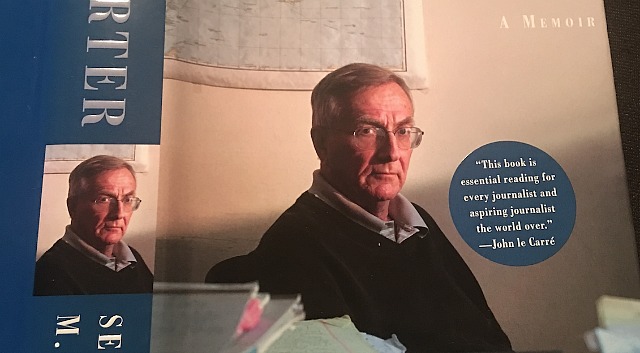
It’s hard to set aside time to read a book when you’re already putting in several hours a day on a column plus the usual chores, reveries and occasional screenings. Last night I nonetheless read five or six chapters of Seymour Hersh‘s “Reporter“, which hit stores less than two weeks ago. I read the ones about Hersh serving as an Associated Press Pentagon reporter and as press secretary for the presidential campaign of Eugene McCarthy in late ’67 and ’68, and two chapters about his breaking the My Lai massacre story — “Finding Calley” and “A National Disgrace.”

Of course and indisputably, “Reporter” is a page-turner. First-rate writing and reporting — pruned to the bone, no wasted words. I was completely hooked and immersed, and then appalled all over again when I got to the Calley chapter. After I finished I found “Finding Calley” in a recent Harper’s post.
Remember that scene in Full Metal Jacket in which a blustery helicopter gunner regales Private Joker (Matthew Modine) and Rafterman (Kevyn Major Howard) with stories about how he “sometimes” mows down women and children, etc.? That was, of course, the My Lai sensibility, albeit diluted for mass consumption.

Hersh: “One GI who shot himself in the foot to get the hell out of My Lai told me of the special savagery some of his colleagues — or was it himself? — had shown toward young children. One GI used his bayonet repeatedly on a little boy, at one point tossing the child, perhaps still alive, in the air and spearing him as if he were a paper-mache pinata. I had a two-year-old son at home, and there were times, after talking to my wife and then my child on the telephone, when I would suddenly burst into tears, sobbing uncontrollably. For them? For the victims of American slaughter? For me, because of what I was learning?”

Hersh’s initial My Lai report broke on 11.12.69. He wrote about the atrocity in “My Lai 4: A Report on the Massacre and Its Aftermath” (’70), but a long excerpt in Harper’s appeared a few weeks before that. Hersh had interviewed nearly 50 Charlie Company perpetrators. The initial indictment said that 109 My Lai (or Son My) villagers had been murdered — the figure was actually 504. Two years later a second Hersh book, “Cover-up: The Army’s Secret Investigation of the Massacre at My Lai 4“, was published.
Read more

Different Film, Same Drumbeat

Ocean’s 8 costar Mindy Kaling has repeated a lament about crotchety male critics that Brie Larson, Sandra Bullock and others have voiced, which is basically that Rotten Tomato dudes don’t get women’s films and that their dominance is a problem in and of itself.

Kaling is quoted in a two-day-old Guardian piece. She told a junket journo that the white male critic heirarchy is “unfair”, and explained that “if I had to base my career on what white men wanted I would be very unsuccessful, so there is obviously an audience out there who want to watch things like [Ocean’s 8], what I work on, what Sarah [Paulson] works on.

“And the thing about so much of what this movie is, I think white men, critics would enjoy it, would enjoy my work, but often I think there is a critic who will damn it in a way because they don’t understand it, because they come at it at a different point of view, and they’re so powerful, Rotten Tomatoes.”

Ocean’s 8 costar Cate Blanchett: “The conversation has to change, and the media has a huge responsibility.”

Hollywood Elsewhere exception #1: If more women elbow their way into the film-critic conversation, great. But any critic worth his or her salt will tell you the same thing, which is that it’s not about gender as much as quality. A caper flick has to have the right attitude and the right kind of chops, which is to say the kind that appeal to both genders. A heist movie that chooses to deal frivolous wank-off cards can be fine, but it has to do so with charm and finesse and a certain air of confidence.

I still say that the high-water mark for this kind of thing is Peter YatesThe Hot Rock (’71). It was totally throwaway, but it was reasonably well-plotted in an absurdist way, and it had a clear-cut comedic tone.

Hollywood Elsewhere exception #2: For what it’s worth I didn’t find Ocean’s 8 all that problematic. In my 6.7 review, I said “it doesn’t deliver much but it’s not that bad. To my profound surprise it doesn’t get into emotional stuff at all. It’s like ’emotion who?’ It deals almost nothing but dry, droll, mid-tempo cards. And I kind of liked that. Was I knocked out? No, but I felt oddly placated.”

Read more

Connected, Good Taste, Knew Guys

Producer Martin Bregman, the elegant New York smoothie who basically built a career out of producing five Al Pacino movies and five starring Alan Alda, has passed at age 92. The Pacinos were Serpico (’73), Dog Day Afternoon (’75), Scarface (’83), Sea of Love (’86) and Carlito’s Way (’93). The Aldas were The Seduction of Joe Tynan (’79), The Four Seasons (’81), Sweet Liberty (’86), A New Life (’88) and Betsy’s Wedding (’90).

To me Bregman was always the consummate, well-connected gentleman producer with a deep voice who gave great on-camera interviews, especially about the making of Scarface. Brooklyn-born and Bronx-reared, he was a classic New York “industry” personality — as much of a staple of a New York filmmaking attitude (make things happen, finesse the unions, grease the right palms) as Sidney Lumet. He seemed cut from the same (or at least a similar) cloth as producer and talent agent Jerry Weintraub, who also hailed from Brooklyn and the Bronx.

Bregman started in insurance and real estate, and then sashayed into the entertainment biz as a nightclub agent and a personal manager, eventually representing Pacino, Alda, Woody Allen, Barbra Streisand, Bette Midler, et. al. He also produced Phillip Noyce‘s The Bone Collector (’99) and The Adventures of Pluto Nash (’02), an Eddie Murphy vehicle. In ’05 Bregman also produced a Carlito’s Way prequel that his son Michael wrote and directed.

A sharp producer who hails from the east and has been around: “Bregman played it pretty close to the vest. He was a tough guy who could deal with the goombahs who for many years controlled the city streets that were needed for outdoor locations in New York. He had the connections. Nobody fucked with him. And he was widely respected by left coasters for being the insider who got the job done.”

Triumph of the Will

Trump Is Making Us All Live in His Delusional Reality Show,” by New York‘s Andrew Sullivan, posted on 6.15: “The president believes what he wants to believe, creates a reality that fits his delusions, and then insists, with extraordinary energy and stamina, that his delusions are the truth.

“His psychological illness, moreover, is capable of outlasting anyone else’s mental health. Objective reality that contradicts his delusions is discounted as ‘fake news’ propagated by ‘our country’s greatest enemy,’ i.e., reporters. If someone behaved like this in my actual life, if someone kept insisting that the sea was red and the sky green, I’d assume they were a few sandwiches short of a picnic. Almost no one else in public life is so openly living in his own disturbed world.

“This past week was a kind of masterpiece in delusion. It was a long version of that surreal video his National Security Council created for Kim Jong-un. It was crude, crass, and absurd. I can’t begin to unpack the madness, but it’s worth counting the bizarre things Trump said and did in such a short space of time.

“Trump clearly believes that Canada’s milk exports are a verifiable national security threat to the United States. He thinks Justin Trudeau’s banal press conference, reiterating Canada’s position on trade, was a ‘stab in the back.’ And he insists that the nuclear threat from North Korea is now over — ‘Sleep well!’ — because he gave Kim the kind of legitimacy the North Korean national gulag has always craved, and received in turn around 400 words from Pyongyang, indistinguishable from previous statements made to several presidents before him.

“For good measure, he took what was, according to The Wall Street Journal, Vladimir Putin’s advice –I kid you not — to cancel the forthcoming joint military exercises with the South Koreans. More than that, he has offered to withdraw all U.S. troops from the peninsula at some point, before Pyongyang has agreed to anything. He regards all of this as worthy of a Nobel Peace Prize, his Reagan moment. And he is constructing a reality-television show in which he is a World Historical Figure.

Read more

How Much Did You Love “Incredibles 2”?

Go on, tell me how much fun you had with Incredibles 2. How you just loved sitting with kids and their families. How you found it just as good if not better than the 2004 original. How impressed you were by the nonstop wit and action. How the post-Iron Man superhero onslaught had no influence upon the machine-gun, ADD-styled pacing. Go on, lay it on me.

Every Successful Magazine Has A Peak Period

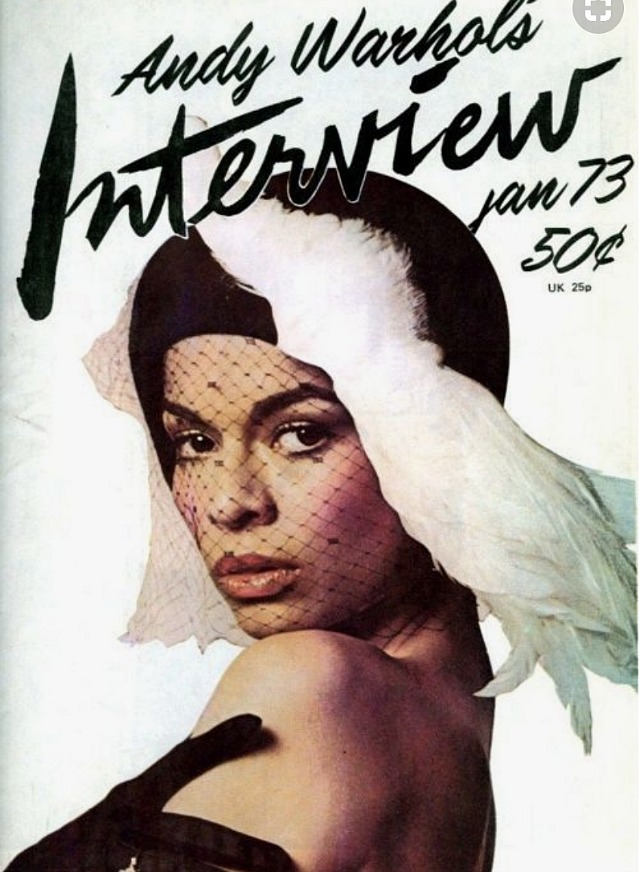
Jacob Bernstein‘s “The Great Interview Magazine Caper“, a N.Y. Times “Style” piece (6.16.18), is a thoroughly reported, concisely written history of a high-fashion, celebrity-focused monthly that really seemed to matter from the early ’70s to early ’80s. To me anyway and others in my Manhattan journalist circle. Particularly, I would say, during the mid to late ’70s, and especially the Studio 54 heyday (’77 to ’80).

Launched by Andy Warhol in ’69, Interview folded last month after nearly 50 years in business.

I forget exactly when I realized that Interview had lost that special aura of downtown coolness, but it was probably sometime in the mid to late ’80s. It was clear to one and all that the edge factor was gone by the early ’90s. I’m amazed that a past-its-prime version of Interview limped along for a quarter-century, but it did.

My one and only visit to Interview‘s editorial offices was in early ’78. I had written up an interview with Sterling Hayden for Fairfield County magazine, and was trying to sell it to a Manhattan publication. (Zero overlap.) It was just a so-so profile, and yet executive editor Robert Hayes didn’t blow me off. As I sat by his desk he unfolded a copy of my article and read it line by line. He didn’t skim — he actually read each sentence. He said it was “good” but let it go at that. I didn’t expect that much would happen, but Hayes made me feel welcome and conveyed a certain peer respect.

We chatted about various critics who were around at the time. He described one as an “easy lay” — the first time that a big-league New York editor had confided that kind of opinion to me. I was flattered. A few years later Hayes died of complications from AIDS. I never forgot his graciousness and good manners.

Read more

Crystal’s Hot Streak

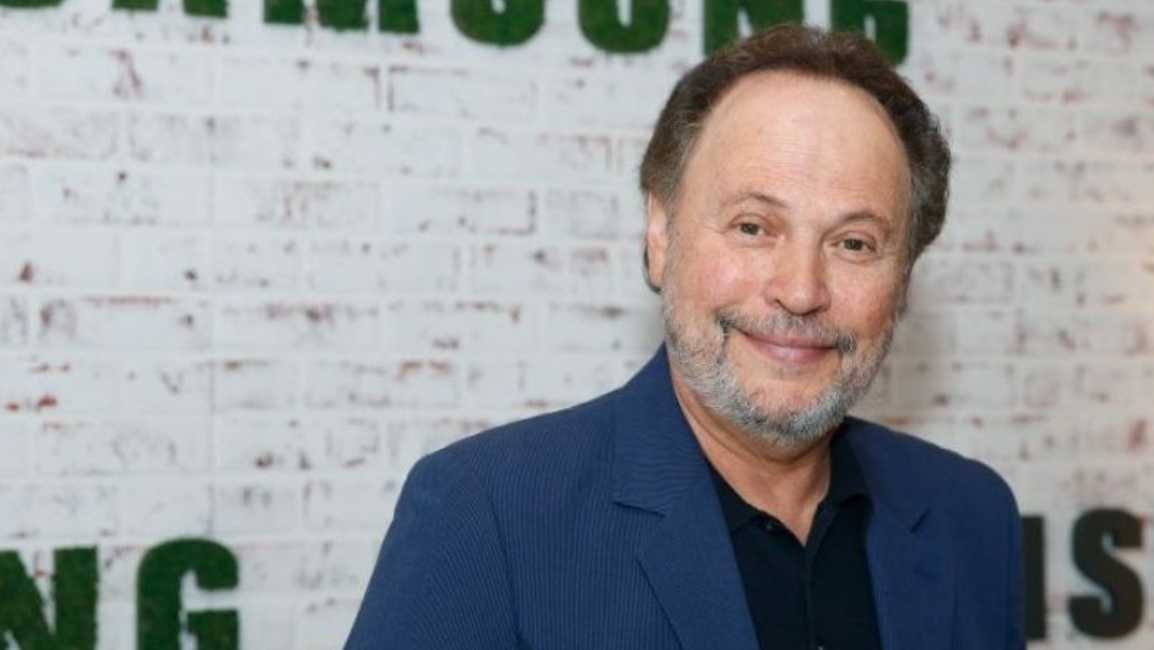
Billy Crystal is alive and crackling as we speak, obviously, but there’s no denying he had a great run in the early ’90s. A five-year period from ’89 to ’93, specifically. When Harry Met Sally (’89) kicked things off. The came the near-great. enormously well-liked City Slickers (’91), which opened right smack dab in the middle of Crystal’s four-year-run as the Oscar host (’90 to ’93), which cemented his top-of-the-worldness. (Crystal also Oscar-hosted in ’97, ’98, ’00, ’04 and ’12.)

Things slightly downshifted for Crystal over the next five or six years — City Slickers 2, Mr. Saturday Night, Forget Paris, Hamlet, Deconstructing Harry, Fathers’ Day, My Giant. But he rebounded big-time with Harold Ramis‘s Analyze This (’99). Then he directed ’61, which I re-watched recently and has aged very well. And then he delivered a beautiful eulogy for Muhammud Ali two years ago. And he’s got the book. But the early ’90s!

I’d honestly forgotten that 10-year-old Jake Gyllenhaal played Crystal’s son, Danny, in City Slickers.

Read more

While Completely Agreeing…

I still say that anyone who acts in a belligerent, aggressive manner when the cops come is an idiot. Because pushing back against the bulls can only end badly. Beatings, handcuffs, jail cells, sometimes emergency rooms. And sometimes even death. Are the wrong cops on the job? Obviously. Are there a lot more bad ones than authorities realize? Almost certainly. But this isn’t likely to be fixed next week. When the cops arrive, the drama stops. The only way. Head down, calm tone of voice, mild submission…duhhh.

Read more

Dead Gotti Twisting In Hell

The last two paragraphs of Glenn Kenny‘s N.Y. Times review of Kevin Connolly‘s Gotti are hilarious.

“For many scenes, it seems that Mr. Connolly asked himself, ‘What would Martin Scorsese do?’ All his answers are wrong. His staging of shots is not even rudimentary. And when he tries for a slightly sophisticated effect, he whiffs. There’s a shallow-focus view of Gotti and his crew walking down the street near their social club. The background is impressionistically out of focus as intended, while the characters walking toward the camera are…well, they’re out of focus, too. Just less out of focus than the background.

“The use of period pop music on the soundtrack here is probably influenced by Mr. Scorsese’s Goodfellas. Except the choices are on-the-nose dull or out-and-out hilarious. The killing of ‘Big Paul’ Castellano, which occurred in December ’85, is accompanied by Elvis Presley’s ‘Silent Night.’ Mr. Connolly even throws in Isaac Hayes’s ‘Theme From Shaft.’ You don’t put the ‘Theme From Shaft’ in a movie that is not Shaft. Come on.”

Side comment: I really don’t like that comma in the sixth sentence of the first paragraph, the one between “focus” and “too.” It may be technically correct but it looks wrong, and that’s the bottom line. HE version: “The background is impressionistically out of focus as intended, while the characters walking toward the camera are…well, they’re out of focus too.”

Sophisticated Innuendo

From Philip Lopate’s N.Y. Review of Books essay on Joseph McBride‘s “How Did Lubitsch Do It?” (Columbia University Press, 561 pp., $40.00): “McBride has set out to write not a biography (no need for that, since Scott Eyman’s ‘Laughter in Paradise’ is so satisfying) but an in-depth ‘essayistic investigation’ of the entire oeuvre. What has been lacking until this critical study has been a sustained, systematic, fully integrated overview of both Lubitsch’s German and American work. Without seeing his career as a single, unified whole, it cannot be fully understood or appreciated.”

Excerpt from “The Masters’ Master: Ernst Lubitsch and The Marriage Circle,” a McBride essay posted on brightlights.com, itself excerpted from “How Did Lubitsch Do It?”: “The name Ernst Lubitsch stood for the epitome of sophisticated humor and romance in what we now regard as the Golden Age of Hollywood. As fellow producer/director Mervyn LeRoy said when presenting him with an honorary Oscar on March 13, 1947, seven months before Lubitsch’s death, ‘He had an adult mind and a hatred of saying things the obvious way. Because of these qualities and a God-given genius, he advanced the technique of screen comedy as no one else has ever done.”

“[The German-born helmer’s] approach to style and theme was widely celebrated as ‘the Lubitsch Touch,’ a virtually indefinable yet almost tangible concept embodying an ever-fresh, delightful, tantalizing, slyly witty blend of style and substance. It combines a characteristic joie de vivre in the actors with an elegant visual design that conveys its meanings largely through sophisticated innuendo.

“But the phrase was something of a marketing cliché, like calling Hitchcock ‘the Master of Suspense,’ and Lubitsch himself was apt to joke about it. When people would ask him what it meant, he would say with a grin, ‘I would like to know myself…you find out and tell me, maybe?’ And he said, ‘I cannot give you a definitive answer because, fortunately, I’m not conscious of it. If I ever become conscious of it — Heaven prevent — I might lose it.’”

Read more

Chicago Story

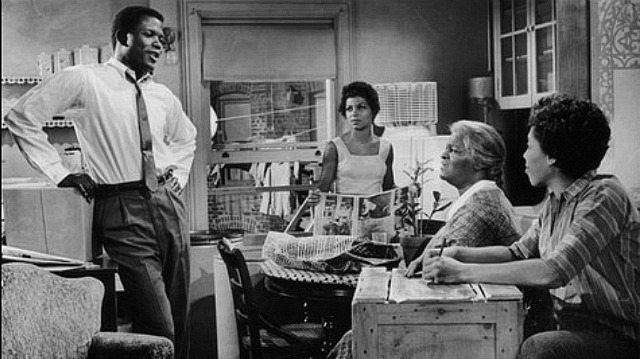
A Criterion Bluray of the ’61 version of A Raisin in the Sun will pop on 9.25.18. Based on Lorraine Hansberry‘s 1959 play, directed by Daniel Petrie, produced by David Susskind. Sidney Poitier, Ruby Dee, Claudia McNeil, Diana Sands, Stephen Perry, John Fiedler and — in his film debut at age 25 — Louis Gossett Jr. Early ’60s social realism — straightforward, modestly framed, well-honed, cards on the table. I’m very sorry, as usual, that Criterion had decided to present this much-honored film in a cleavered 1.85 aspect ratio when they easily could have gone with 1.78 or 1.66. (The cinematography is by Charles Lawton, Jr.) A Columbia Classics DVD presented Raisin in both full-screen and 1.85.


Full-frame.

Cleavered.

Read more